
By Donna McKethan
In the Fall of 2015, the Greater Waco Advanced Health Care Academy (GWAHCA) will open its doors to Waco area juniors and seniors who are interested in pursuing a career in the health care industry. The Greater Waco Advanced Health Care Academy is a unique and innovative collaboration between the local health care community and Waco Area School Districts. GWAHCA will create a challenging learning environment that encourages high expectations for student success in the Health Care Field. The academy will empower students to successfully be competitive and workforce ready in our community and a global society.
 GWAHCA follows a model similar to the Greater Waco Advanced Manufacturing Academy, which aims to give students a head start in careers in welding and manufacturing. Officials from area school districts, McLennan Community College, Texas State Technical College and area health care industry leaders have been meeting over the last two years to determine health care industry needs and how to best serve students. The twin philosophies of realism and experimentalism are embedded in the attitudes and beliefs behind the planning and remodeling of GWAHCA. These philosophies have been expressed by the members of the GWAHCA Executive and Steering Committees. The idea behind not only the curriculum but also the facility is to give students an experience that aligns with what they will encounter when they graduate and begin a career in the health care industry. Partners support GWAHCA, an academy that fosters a sense of community among students, staff, parents, partners and neighbors. GWAHCA students will develop a sense of self-esteem and respect for themselves and others. Through a diverse and challenging curriculum, focusing on basic science, GWAHCA will cultivate student interest in various sciences and health professions. GWAHCA will provide a quality education and experiences that will prepare students to develop the academic, social and personal qualities necessary to realize their fullest potential as lifelong learners and productive, caring citizens of the world.
The first programs to be offered at GWAHCA will be the Certified Nursing Assistant (CNA) and Advanced CNA programs. The CNA curriculum will follow the current program offered at McLennan Community college. The Advanced CNA course is being developed in collaboration with Providence and Baylor Scott and White (Hillcrest) Hospital Staff. This curriculum development is an exciting process and will result in an amazing and rigorous program. In addition to the CNA course, juniors will also take Anatomy & Physiology, Counseling and Mental Health and Medical Terminology. Seniors (who have completed the CNA certification) will take Phlebotomy and a soft skills course that will include training in the hospitals computer system. Both hospitals have promised to hire all students who successfully complete the Advanced CNA program.
GWAHCA will be located on the campus of the former Viking Hills Elementary school. The campus is located on Viking Drive just off Fish Pond Road. All Juniors and Seniors within 45 minutes of the academy are eligible to attend. Applications are currently being accepted. For more information, contact Donna McKethan (254 755 9573 or [email protected])
 This Act Locally Waco blog post was written by Donna McKethan. Donna is the Career and Technology Director at Waco ISD. She has 33 years in education, the last 15 with WISD Career and Technology. She is currently the President of The Career and Technology Association of Texas. She is a WISD graduate with a BS in Home Economics Education from Baylor University and an MS of Education from Tarleton State University. She is currently enrolled in the Doctorial Program in Educational Leadership at Tarleton State University.
The Act Locally Waco blog publishes posts with a connection to these aspirations for Waco. If you are interested in writing for the Act Locally Waco Blog, please email [email protected] for more information.
By Bart Townsend
Why Waco? This question has been asked of me many times since starting a business here in late 2010 and moving here in August of 2012. It has been asked in many contexts for many reasons. It has been asked out of curiosity about me and my family. It has been asked by people looking for information on my business. It has been asked by business people who are interested in possibly moving their businesses to Waco. The question seems simple, but the answer can be rather in depth.
I had the opportunity in January to attend the SHOT Show, a gun industry trade show in Las Vegas. The trip was two-fold in nature. First, I wanted to grow my own business. We have a precision machine shop that machines metal and plastic component pieces for the aerospace and industrial sectors. We would like to expand into other sectors. My first purpose for being at the trade show was to find new customers.
Second, the Waco Chamber of Commerce was also attending, and they had asked me to meet with businesses that might be interested in moving to Waco. By the time we arrived at the show, we had both independently done our homework and had each created a list of businesses to target. Combined, the list was 67 companies. We had our work cut out for us. The ensuing conversations were all very interesting.
The companies that we approached about Waco were cautiously curious at first; then they tended to open up. Our conversations normally started with introductions and inquiries as to the strength of their businesses. We would ask about their current locations and inquire about the potential of moving. Most would say they had thought of moving and said Texas was in their top three possible locations.
We would then ask if they would consider Waco as an option. That’s when we would get the question, “Why Waco?” We looked forward to this question. The Chamber representative would explain all the economic advantages along with many other positives. The company representatives would ask more questions. Often their questions had to do with the level of education and employee competencies they might find in Waco. How would they find employees? How would those employees get trained? How were the local feeder programs for future employees? My job was to be the “live example” of how this all works. I would talk about TSTC as the local technical school that has a state presence. I would also talk about GWAMA (Greater Waco Advanced Manufacturing Academy) at the high school level and the fact that most ISD’s within a 45 minute commute are participating.
They asked questions about my experience with both schools. I talked about the level of experience and schooling of my current staff. I mentioned the business advisory committees that are present at most all the schools in the area. I talked about the industry/school collaboration that takes place. This was received favorably and led to more questions that showed great interest. We would mention MCC with Tarleton and Texas Tech at the University Center. We would talk about Baylor as a great private four-year option.
They would ask about Waco’s location. How does that help or hurt business from customers and the supply chain? We would explain the economic triangle of Texas that includes DFW, Houston and Austin/San Antonio as the three points of the triangle. The bulk of the state’s business is being conducted in that triangle. We pointed out that Waco is located equidistant from DFW and Austin on the route 35 leg of the triangle. Transportation was also an issue. They were interested to learn about the Waco airport and about the close proximity of other larger airports. They also wanted to know if there were complimentary businesses in town. Businesses that a company would need to help them prosper since most companies cannot be everything.
It was very apparent in visiting with these interested companies that the efforts to evolve and make Waco a business solution for outside companies needs to continue. Education is paramount for any community’s success, and Waco is in a great position with all the educational institutions present in the area. The challenge is the continuous evolution that needs to occur to meet the needs that will allow Waco to prosper. I am very excited to be part of the Waco community both from a business perspective and also personally.
We were very well received by many companies. The level of information available and organization that the Chamber was able to present gave everyone that we met a good sense of the very positive Waco attitude. It was that same positive attitude that brought me and my business to Waco a few years ago!
 Bart Townsend is the president and co-founder of T Squared Manufacturing. He along with his wife and CEO, Deb operate T Squared Mfg. The shop is an aerospace certified machine shop dedicated to treating customers, suppliers, and employees with respect and expecting the best from all. To learn more about us go to www.tsquaredmfg.com.
by James Karney
When I was a little boy in Bristol, Connecticut, one of my favorite toys was a well-worn set of Lincoln Logs that belonged to my older brothers. I would spend hours building cabins and forts out of the pieces; I can still feel the smooth texture of the logs and green roof slats in my hands. I’d play with the plastic frontiersman and animals creating stories and dialog; occasionally a GI Joe would make an appearance too. Those are great childhood memories, but what do building toys like Lincoln Logs and Legos and blocks have to do with the library?
 One role of the public library is to be a preschooler’s door to learning. As you already know, the library is a place children visit with parents and caregivers to be introduced to books and to begin to develop a love of reading, and learning. Library programs such as storytime help to develop school readiness skills such as listening, paying attention, following directions, and playing with other children. This, like many of the other programs and services of the library, folds into the one of the eight assumptions, of the Greater Waco Education Alliance. Participating in library storytime specifically addresses the first assumption, “Develop learning readiness and social skills before entering school (ages 0–4).” Storytimes for children are a staple of public libraries. At the Waco-McLennan County Library early childhood programming walks with children and parents from infancy with “Baby Time,” to “Toddle Time,” and then to “Pre-School Storytime.” (By the way, after a busy summer, Miss Vivian and Miss Stacy are taking a breather in August. Storytimes will resume the week of September 9th. )
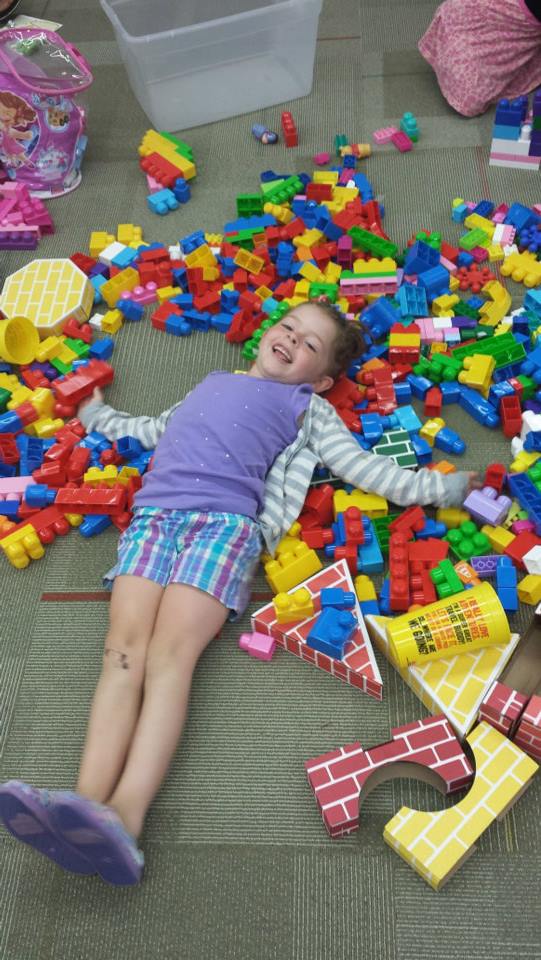 Storytime is certainly an important stepping stone on the path to a love of learning, but at the library we recognize it is not the only stone in the path. In addition to weekly storytimes, the library offers other programming for children. Two programs we started last year have developed loyal and nearly overwhelming followings: a monthly “Lego Lab” for children 6-12, and a “Block Party” for Toddlers and Pre-K. Playing with blocks helps children develop motor, spatial, social and language skills and creative play. These skills are pretty obvious to anyone who has ever watched a toddler play and stack wooden blocks.
Not so obvious are the long-term science, math and problem solving skills being developed. These skills support the third assumption of the Education Alliance, “Master math concepts (ages 9 to 17).” The research makes this connection plain:
• A longitudinal study by Wolfgang, Stannard and Jones found that beginning in the middle school years and onward through high school that there was a positive correlation between pre-school block play and mathematical achievement. (Journal of Research in Childhood Education, v15 n2 p173-80 Spring-Summer 2001)
• A 2009 article by Sarama and Clements explores the benefits of block and Lego play. (American Journal of Play p313-337 Winter 2009). At younger ages, pattern recognition, colors, shapes and counting are central to block and Lego play and with age come more complex skill development.
• For the differently abled, a 2006 study found that therapeutic play using Legos has a positive impact on social skill development of autistic children. (Autism, v10, n4 p317-29 July 2006).
In addition to the STEM (Science, Technology, Engineering and Math) benefits of block and Lego play, there are also language, literacy and social skills being developed. In group play with other children, a child learns about sharing and turn taking.
 Playing with blocks is a terrific way for parents to bond with their children and to act on their role as a child’s first teacher. Children get the most benefit from block play when parents and caregivers get on the floor and play alongside their children taking the opportunity to teach colors and counting, to compare block sizes and shapes, and perhaps most important of all, to share vocabulary with the child. Vocabulary development is a key to learning to read. The more children are exposed to new and different words, the more success they will have in learning to read and developing their reading skills. One of the best investments you can make in your child’s education is to spend time with them whether it is reading books, playing with Legos, or just talking with them. Hart and Risley found children’s academic successes at ages nine and ten are attributable to the amount of talk they hear from birth to age three. Meaningful Differences in the Everyday Experience of Young American Children. (Brookes Publishing 1995).
The Library’s Lego Lab (Saturday) for children and toddler/Pre-K Block Party (Sunday) using Legos and blocks are held monthly. For days and times and to reserve a space for your child, visit the library’s online events calendar. The name Lego comes from the Danish phrase leg godt, which means “play well”, so come play well at the library and continue to Read, Waco, Read!
 This Act Locally Waco blog post is by James Karney. James has worked in a library since his sophomore year in high school and is the Director of the Waco-McLennan County Library. He enjoys reading biographies, history, and spy/espionage novels. He has been married to the super amazing and talented Anita Karney for 20 years, and their son Jamie will start his junior year of high school this year – yikes! Visit the Library’s website, www.wacolibrary.org to explore all of our services, program and resources and “Like Us” on Facebook at, www.facebook.com/WacoLibrary.
If you would like to write a post for the Act Locally Waco blog, please contact Ashley Thornton by email at [email protected] .
By Jodi Terwilliger-Stacey
Waco is the research and technology corridor between Dallas and Austin. It boasts top quality education in science, technology, and engineering at its local colleges and universities – Texas State Technical College (TSTC) (offering students approximately 100 certificate and degree areas), McLennan Community College (MCC) (offering students cutting-edge technology and opportunities for field research), and Baylor University. It’s the home of the Central Texas Research and Technology Park with its most recent project – the Baylor Research and Innovation Collaborative (BRIC)! It’s the birthplace of the Greater Waco Advanced Manufacturing Academy, offering academic programs and workforce readiness in a variety of fields to high school students from local ISDs. Waco’s Drop Back In to School Initiative connects those seeking higher education and better jobs to representatives of these local colleges and universities, as well as representatives of local job readiness programs!
Check out MCC’s LEAP classes (Learning Environment Adaptability Project), serving to develop full-time, first year students’ skills that enable them to adapt to college life and to be successful in their courses of study. LEAP classes teach learning strategies, as well as emotional intelligence skills, such as self-management skills (being motivated and managing one’s time), intrapersonal skills (self-esteem and stress management), leadership skills (problem solving and conflict resolution), and interpersonal skills (managing anxiety and anger and being assertive). LEAP is innovative and broad-spectrum, making MCC a leader in the development of strategies to increase student retention and success in higher education.
Watch for more information about the BRIC’s 45,000 square feet workforce development and training center to be used by TSTC – a BRIC partner. BRIC scientists, engineers, and technicians will be developing technology for BRIC business clients. TSTC Waco faculty will be on site working with those developing the technology and consulting with BRIC clients to design workforce training as products are being developed. Now that’s innovative!
Would you like to join the workforce with a career upon graduating from high school? The Greater Waco Advanced Manufacturing Academy will be offering academic programs to high school students from local ISDs in the fields of welding (fall 2013), precision metal manufacturing (fall 2013), brick laying and construction (fall 2014), HVAC (fall 2014), and pipe-fitting (fall 2015)!
Waco is paving the way for its citizens to come back to education, to achieve their higher education goals (certifications, 2-year degrees, and 4-year degrees), and to begin careers in a variety of science and technology fields where workforce needs are greater. Waco is connecting the dots among industry leaders, the STEM community (science, technology, engineering, and math), college and university faculty, and other leaders in workforce training. By doing so, there’s only one direction for Waco – FORWARD.
This week’s post was written by Jodi Terwilliger-Stacey. Jodi founded the Low Income Families In Transition (L.I.F.T) workshops at First Baptist Church in Waco and worked at the Greater Waco Community Education Alliance as a community resources specialist. She and her family now live in Colorado, but she still has a warm spot in her heart for Waco. If you are interested in writing occasionally for the Act Locally Waco Blog, please email Ashley Thornton at [email protected] .
By Ashley Bean Thornton
I was lucky enough to get a tour of the BRIC (the Baylor Research and Innovation Collaborative) a few weeks ago. It is inspiring! As an old English major I love the symbolism of the BRIC, representing our hopes for a prosperous future, rising from the ruins of the Old General Tire building, an artifact from our economic past. As an old English major I also feel compelled to say one more thing: I have seen the future, and the future is – math.
With the WISD Advanced Manufacturing Academy, TSTC and the BRIC we have a nice little conveyor belt developing for moving our young people into good paying high tech jobs. The ticket to get on that conveyor belt is a decent ability to do math.
Waco needs to be a math town. I need to be a math cheerleader! This is a new role for me. (Did I mention I was an English major?) I may not be able to do much to help make Waco the math capital of the Southwest, but I can change the way I talk about math to the kids I know.
From now on when I hear a kid say, “I hate math.” Instead of saying, “I know, I hate math too.” I’m going to say, “Math was hard for me too, but it feels good when you finally figure it out; it gets kind of fun if you stick with it.”
When I hear a kid saying, “I’m dumb in math.” Instead of saying, “I know! Math stinks! Let’s eat ice cream.” I’m going to say, “It’s probably not that you are dumb in math; you probably need more practice. Nobody is that good at it at first. You’ll get better the more you practice.”
Yes, I know a kid’s success in math depends more on her teachers and her parents and probably a jillion other things than on my little pep talks. But, it is something I can do, and I’m going to do it. Join me? We’ll think of something more significant to do later, but we can at least do this. As an old English major I believe the words we speak into our young people make a difference. Go math!
- « Previous
- 1
- …
- 12
- 13
- 14