By Rachel E. Pate
“In a racially equitable society, the distribution of society’s benefits and burdens would not be skewed by race.” – The Aspen Institute
Brief Rewind
Around this time last year, the City of Waco, our mayor and city council held a retreat addressing racial inequity within our community. J.B. Smith, Waco Tribune-Herald reporter, covered the story in “Waco council takes aim at racial disparities, gentrification” (May 23, 2019). Some of the staggering statistics gathered and presented by the city were highlighted in J.B.’s article, revealing that:
- Whites account for 43% of Waco’s population but hold 80% of the jobs paying more than $40,000 as of 2015.
- Among white households, 13.5% make less than $25,000 a year, compared with 25.3% among Hispanics and 51.1% among blacks.
- Nearly 29% of white households make more than $100,000 a year, compared with 3.3% for blacks and 8.7% for Hispanics.
- African Americans in 2017 had a 31% mortgage denial rate, compared with 20.9% for Hispanics and 11.7% for whites.
In the news article Councilman Dillion Meek stated: “I’ve always put a high value on grit and self-determination, but if the goal is to improve the economy, we have to look at systems from 100 or 150 years ago to now,” Meek said. “The outcomes from the data speak for themselves and are a direct result of the history of this community.”
Assistant City Manager Deidra Emerson was also quoted saying: “The end goal is to ensure that everyone in Waco thrives, including people of color. … The starting point for the next generation is the ending point of the last generation. If we don’t start to change those outcomes now, we’ll keep repeating the same things.“
Pandemic Proportions
Positioned against the backdrop of a once-in-a-century global pandemic, we all witnessed our nation’s institutions, systems, businesses and, most importantly, people brace for a great unknown together. As the virus spread, we were forced to mourn more and differently than before, all while swallowing disproportionate effects happening in communities of color. The Pandemic drastically changed so much of what we thought we once knew and added to the boiling pot of health disparities, income disparities, racial disparities and inequity in the fabric of America.
As the wave of concern swept through our nation, our local leaders were called to immediate attention and action; elected officials, health officials, business experts and volunteer task forces were all on one accord.
The Cen-Tex African American Chamber of Commerce (CTAACC), along with others, was right in the thick of early and ongoing discussions about community health and our local economy. Our staff immediately pivoted from pre-set work to intentionally and strategically supporting the needs of our community’s small and minority-owned businesses.
We partnered with the Cen-Tex Hispanic Chamber of Commerce to support immediate small business initiatives like our StarBridge Bingo and Buy Local Waco online marketing campaigns. We worked together to collect grassroots data from businesses, employees and people of color.
CTAACC was firmly seated at the table with the city and other community partners breaking down information, providing frequent updates and contributing solutions.
Collective Voices
While weeks of the shelter-in-place orders and social distancing continued, CTAACC assembled an informal advisory group to work alongside our staff and help create solutions for business equity. Community business members and leaders included Wannika Muhammad, Rev. Marlon Jones and Cuevas Peacock, who each added diversity, passion and perspective to the dialogue. Our group later became known as the CommUnity Voices team. United in tackling the tasks before us, we put our heads together and strategically planned our moves ahead.
Within our virtual, weekly think-tank sessions, each member shared our concerns about equity, community and business. Each contributed wisdom and insight from our collective backgrounds in business and community development, religion and higher education and lived experiences. We examined and digested everything around us and studied the historical pre-sets of inequity.
As we saw increased unemployment rates for workers, struggling small businesses and government relief that could only do so much, the group determined that solid, perpetual initiatives were mandatory to rightfully shore up vulnerable, small, minority-owned businesses. In those conversations, our vision for equity was honed.
Forward March
The Chamber’s Center for Business Excellence (CBE) has long been an engine for small business development, offering free business tools, technology resources and meeting space. Utilizing this existing program, CTAACC established the Cen-Tex Minority Business (CTMB) Equity Fund in May 2020 to provide business relief to businesses of color through grant funding and micro-loans. (Donate Here.)
The CTMB Equity Fund is the first local fund in our community that will assist small minority-owned businesses facing income loss or rising expenses due to circumstances caused by natural disasters, illness, global pandemics, or any situation that disrupts their economic and social well-being.
The fund will also provide increased access to social capital and business training/education for entrepreneurs. Our kick-start campaign goal of $100,000 provides individuals, organizations and businesses with the opportunity to not only talk about equity but invest in it also. I could say more, but for now I’ll digress and take a breath. There’s still more action to be done tomorrow.
The Center of Business Excellence (CBE) is a private sector 501(c)(3) charity affiliated with the Cen-Tex African American Chamber of Commerce. The CBE actively helps McLennan County small businesses thrive by providing operational, social, and financial resources needed to sustain business development. The CBE manages the Cen-Tex Minority Business Equity Fund, a program created by the Cen-Tex African American Chamber of Commerce and a Business Advisory Committee comprised of community business members and leaders.
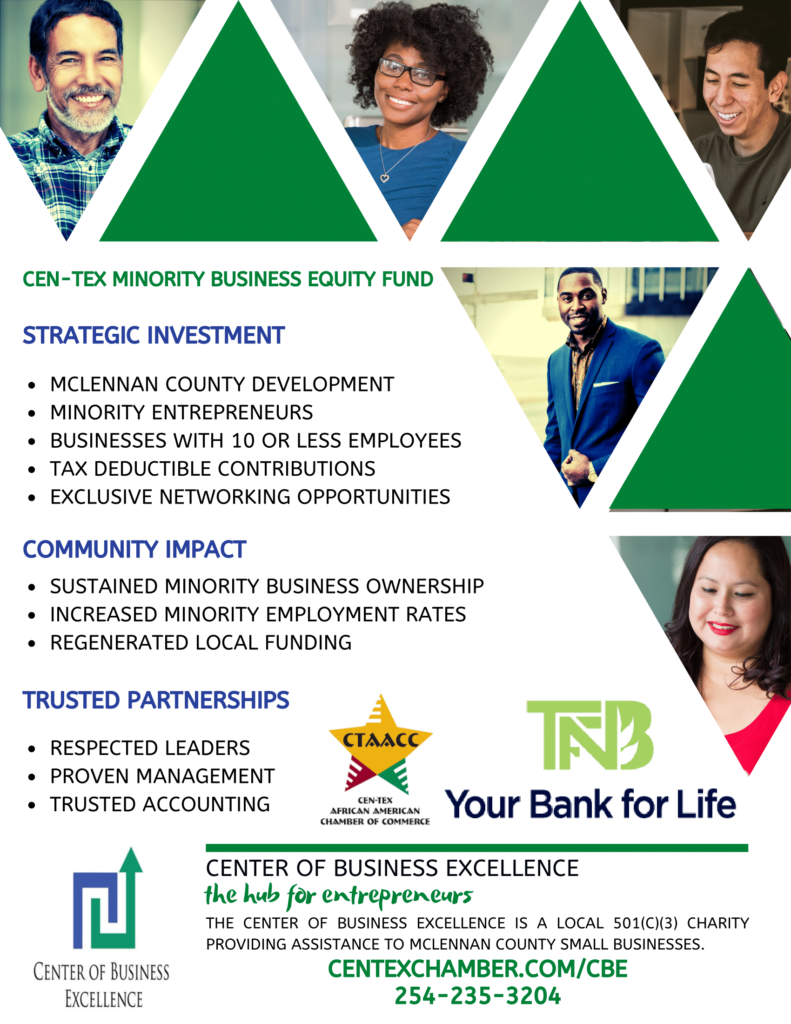
The purpose of the fund program is to provide short-term, immediate aid/relief to small, local minority-owned businesses facing income loss or rising expenses due to circumstances caused by natural disasters, illness, global pandemics, or any situation that disrupts their economic and social well-being.
Any McLennan County-based, minority-owned, small business with 10 employees or less is eligible to apply for assistance. Grants/loans may be awarded up to $2,500 dependent on resources. I could go on, but for now I guess I’ll digress and take a breather. There’s action to be done tomorrow.
Editor’s Note: Investments in the CTMB Equity Fund are currently being accepted online at www.centexchamber.com. The online application portal for business funding is expected to open later this month. CTAACC can be reached at (254) 235-3204.
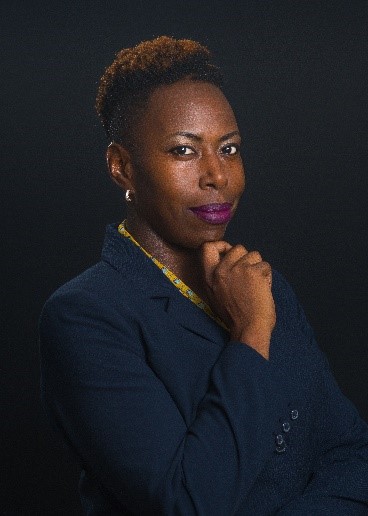
Rachel E. Pate is vice president of economic development at Cen-Tex African American Chamber of Commerce (CTAACC) in Waco. Rachel is a native Wacoan and graduate of University High School. Since 2016, Rachel has served in various roles at the chamber and championed the causes of small entrepreneurs, women, and minorities. She is also a LeadershipPlenty Institute graduate, Rapoport Academy Public School Board member and Start-Up Waco Board member.
With her mother being a Sunday School teacher and evangelist, Rachel began serving the community at a very early age. She was active on her church’s usher board and youth ministry. Some of her fondest memories of growing up in Waco are being surrounded by her large, extended family for reunions and Juneteenth gatherings; her mother is one of 11 siblings who all hail from Waco. Her father, R.E. Pate Jr. (deceased), and mother met at Paul Quinn College in the early 1970s — the same campus where CTAACC resides today.
Rachel is also a proud mom of one, a lifelong member of Toliver Chapel Church, a lover of the great outdoors, an avid basketball fan, and a dedicated wearer of Converse’s Chuck Taylor shoes. Rachel’s favorite scripture is Romans 8:31- “…If God be for us, then who can stand against us?”
by Liz Ligawa
I was sitting in my doctor’s office as I awaited my time to be seen. The “things to do” from our last visit scrolled through my head, ready to spill out as soon as she walked in: Decrease sodium intake. Increase physical activity. Limit processed foods. Take time to rest. These were not unkind recommendations. In fact, this wise counsel was offered to me by one of the most generous souls in medicine I know. But I still had not done it. So, I decided to keep quiet about the list- silently hoping she would not notice. Though she kindly observed my silence, she allowed her instruments to reveal the truth.
Over the last six months or so, I have been listening for, and to our community concerning the safety of Americans of African descent in relation to police. The dialogue and inquiry which has pulsed through communities across our country seems to have found censure in Waco. Is there something different about Waco that would make these conversations unnecessary? Is Waco a unique community which is immune to the ills suffered by Ferguson, MO or New York? Why is Waco so silent?
Before I continue, let me be honest. This subject is quite difficult for me. It is not what I originally intended to write about. I even struggled with feelings of inadequacy to engage this topic. However, even as I strongly embraced the urge to keep a safe distance from this truth, I realized that although it does not appeal to my comforts, I must acknowledge its appeal to my conscience. There is much to be heard in silence.
Waco has a history about which she keeps silent. It reminds me of the invisible boundaries we all adhere to in our families. Only a couple of months ago, many of us participated in these waltzes as we navigated the hushed topics of family members during the holidays. We will not discuss David’s drinking even as we grow nervous with each subsequent glass. We do not check in on Miriam and Max’s marriage even as resignation fills their eyes. And it sure would not be polite to mention the miscarriage suffered by Destiny and Deleon; they still have little Suzy anyway…right? Silence protects our secrets.
Jesse Washington is one of Waco’s secrets. Its own history with Americans of African descent is the reason Waco remains silent.
I was listening to a brief TED talk by an educator named Clint Smith. In his discussion about silence, he takes courageous steps of vulnerability and discloses motives which took their turn in rendering him silent. Smith shared that though he had focused his passion to liberate his students, charging them to not abscond with their truth, he found himself in need of being reminded of the truth: “We spend so much time listening to the things people are saying that we rarely pay attention to the things they don’t: Silence is the residue of fear.”
I wonder how you are dealing with my silence in this article. There are many things I have left unsaid. Up until now, if you did not already know the story about Jesse Washington, there is not much more you know from reading what I have written. Up until now I have not mentioned that he was an African-American farm hand. Up until now, I have not mentioned he was held responsible for the death of an Anglo wife of a cotton farmer in 1916. Up until now, I have not mentioned our McLennan County courthouse…the hanging tree…or what was made of the charred remains of a man not valued by society; not valued by his Waco community. Our silence tells a story.
In the doctor’s office that day, my silence told a story. If Dr. Duchamp would have only attended to my smile, I would have seemed alright. If she would have only paid attention to my put-together presentation, she would have had no concern. If Dr. Duchamp received my silence as an indicator of all things well, my needs would have remained unaddressed and on course for unfortunate events. I am grateful she practiced well when the truth was hard for me to tell.
In the silence I hear in our community, I am trying to decipher what it means. There are steps which have been made with regard to this part of our history, but there are silences still needing to be attended: the silence of apology in the resolution; the silence of Mr. Washington’s name.
Yes, silence tells a story on its own. What story are you telling with yours?
 This post was written by Liz Ligawa. Liz is a graduate student of Baylor University where she has found the perfect expression of her community-centered heart in the MDiv/MSW degree program. With a concentration on Community Practice, she is also the adoring mother of one son, Elijah, who prefers to be regarded in public as Spider-Man. She may be reached at [email protected].
The Act Locally Waco blog publishes posts with a connection to these aspirations for Waco. If you are interested in writing for the Act Locally Waco Blog, please email [email protected] for more information.
- « Previous
- 1
- 2