By Lucas Land
How do we get there from here?
Not to spoil the rest of the article, but the answer is… together.
The two major party candidates for President have spent precious little time talking about the greatest threat faced by the United States, and the rest of humanity. It’s not ISIS, immigration, health care or the economy. Climate change and environmental degradation threaten the very existence of our species on this planet. The transition away from a fossil-fuel based economy involves rethinking many of the things we take for granted in modern society. There is so much work to do that it can often feel overwhelming and impossible.
That’s when I return to a favorite quote from Wendell Berry for solace:
“The question that must be addressed is not how to care for the planet, but how to care for each of the planet’s millions of human and natural neighborhoods, each of its millions of small pieces and parcels of land, each one of which is in some precious way different from all the others.” [1]
This is why I love local politics. It’s easy to get distracted and become polarized by our national politics. It’s much harder to do that when the issues are local and the debate is with our neighbors, friends, and co-workers. When you have to see each other in the grocery store, there is a greater incentive to find common ground and build relationships across many of the lines that divide us. It’s also harder to care about polar bears than the plants and animals in our own backyard, not to mention we have more control over the latter.
So often we fall into the trap that change only happens by creating an “us versus them” narrative. One side has to be the evil corporation or corrupt government and the other are the righteous, do-gooders who are on the right side of history. This tickles our lizard brains and makes us feel better about ourselves, but in the end it creates and/or perpetuates as many problems as it solves.
I do believe that there are times and places that require us to stand up to injustice and even protest actions that are evil. We should never forget that Martin Luther King, Jr., Gandhi, and others believed non-violent civil disobedience worked, because of the inherent dignity and humanity of those they protested against.
I’ve discovered recently how much can be accomplished in our community by treating people on all sides like human beings that deserve respect, while also speaking up about what I think could make our community better. This is why we need better models and frameworks for making change in our community. One group doing this work in our community is Baylor’s Public Deliberation Initiative. They gather diverse groups of students and community members to discuss and dialogue around difficult issues (such as racial reconciliation, gun violence, and politics). Their approach to these conversations can help us listen better to each other and work towards solutions rather than deepening the divide. They will host a post-election forum November 14th at the Bobo Spiritual Life Center on “Getting American Politics Working Again.”
On November 9th, regardless of who is elected, we will still have a lot of work to do, and we will have to work with people who did not vote like us. Conversations and actions are already happening in our community about how to make our city more walkable and bike friendly . Groups in town (http://acecentex.org and http://friendsofpeacewaco.blogspot.com/ ) are tackling the challenge of a sustainable energy future for our community. Groups such as World Hunger Relief, HOT Urban Gardening Coalition, Baylor’s Campus Kitchen, and many others are working on issues related to local food, food insecurity, and health. You can find more opportunities to get involved in working on sustainability at sustainablewaco.org.
I love this “human and natural neighborhood” we call Waco, McLennan County and the Brazos watershed. Learning to love this place is the task we have been given and the only way to do it… is together.
https://www.youtube.com/watch?v=CiQTGgqB8Tw&feature=youtu.be
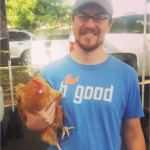 Lucas Land is an eco-theologian, urban farmer, activist, aspiring master naturalist, facilitator, musician, and writer. He is avoiding growing up by constantly learning and trying new things. He also works in Grants Management for Waco ISD. He lives with his wife, three children, flock of chickens, dog, and cat in the Sanger Heights Neighborhood in North Waco.
The Act Locally Waco blog publishes posts with a connection to these aspirations for Waco. If you are interested in writing for the Act Locally Waco Blog, please email [email protected] for more information.
[1] Berry, Wendell. What Are People For?: Essays. San Francisco: North Point, 1990. p. 200.
By Lucas Land
Sustainable is one of those words you hear more and more, but seem to know less and less what it really means. Like “organic”, “green” or “eco-friendly”, sustainable is sometimes applied to products or things that don’t make sense. Can beauty or cleaning products really be called sustainable if they depend on non-renewable resources for packaging or any part of their product? Something can only be called “sustainable” if it does not deplete the resources (from raw materials to packaging to end of life) on which it depends.
In addition to “sustainable” often being used as an advertising gimmick, let me suggest that it is not enough to create a livable future. 70% of the planet’s topsoil, the layer allowing plants to grow, is gone. We are losing topsoil between 10 to 40 times the rate at which it can be replenished. [1] According to the Minerals Education Coalition every citizen of the United States born will use 3.11 million pounds of minerals, metals and fuels in their lifetime including copper, coal, salt, gold, zinc, bauxite and other minerals. [2] Global energy consumption is projected to continue to increase 48% by 2040, yet the U.S. Department of Energy estimates that it takes 300 million years for fossil fuels to form. [3] [4] Our appetite for these energy dense hydrocarbons goes way beyond nature’s ability to form them.
So, you see, the problem is that we are already operating at an incredible deficit and sustaining the current status quo is not enough. What is required for a sustainable future are regenerative systems that work with, rather than against, nature, and that restore the resources and ecosystem services on which we depend. This means rethinking our current systems and ways of life, as well as building new systems with a different set of principles.
This rethinking must include a deeper understanding of what nature provides us and how to protect our particular ecosystem in the Brazos Watershed. It must also provide for the people that live here. We are a part of nature. Although we are capable of the most detrimental effects on the ecosystem, we still have to provide for human needs with these new systems. However, the new systems must find ways to limit what we take from the earth and provide for the needs of everything equally in our community, both human and non-human.
I can hear someone thinking, “That sure sounds nice, but what does it look like in practice?” Glad you asked! Let me give you a couple examples, one big and one small.
First, on a large scale we can look at Waco and McLennan county and ask what are the resources in our bio-region that can help us become more resilient and less dependent on unsustainable practices and resources. The Waco Downtown Farmers Market (http://www.wacodowntownfarmersmarket.com/) has provided a rich environment for local producers to grow their businesses. Many of these, such as Heritage Creamery, source their ingredients and raw materials from other local producers. This helps grow and strengthen our local economy which in turn makes us more resilient as a community.
On a much smaller scale, we can each think about the spaces around the places where we live. For too long the American lawn has served one primary purpose: to be greener and more beautiful than the neighbors. In pursuit of this goal homeowners pour on 10 times more pesticide per acre than conventional farmers in the U.S. [5] Landscape irrigation accounts for one-third of all residential water usage, totaling nearly 9 billion gallons per day. [6] In fact, lawns are the largest irrigated crop in the U.S. covering more acreage than corn, wheat, or soy. [7]
On the other hand, yards are great places to grow food, raise chickens, plant native plants, provide habitat for birds and wildlife, as well as look beautiful and provide space to play and relax. Many plants and trees can serve more than one of these purposes at a time. My rule is that if you have to water it, you should be able to eat it! Rain gardens can be used to better manage storm water and runoff from downspouts and other areas. You can learn more about how to make your lawn more sustainable by getting involved with the HOT Urban Gardening Coalition , McLennan County Master Gardeners and HOT Master Naturalists.
It will take all of us working to change the way we think about our individual choices and the systems that provide both the food, gadgets and transportation we depend on in order to move beyond sustainability to a future where our ecosystem has been restored and our lives work with rather than against nature.
Lucas Land is an eco-theologian, urban farmer, activist, aspiring master naturalist, facilitator, musician, and writer. He is avoiding growing up by constantly learning and trying new things. He also works in Grants Management for Waco ISD. He lives with his wife, three children, flock of chickens, dog, and cat in the Sanger Heights Neighborhood in North Waco.
The Act Locally Waco blog publishes posts with a connection to these aspirations for Waco. If you are interested in writing for the Act Locally Waco Blog, please email [email protected] for more information.
Notes:
[1] “What If the World’s Soil Runs Out?” in Time Magazine Dec. 14, 2012 (http://world.time.com/2012/12/14/what-if-the-worlds-soil-runs-out/)
[2] http://www.mineralseducationcoalition.org/mineral-resource-statistics
[3] http://www.eia.gov/forecasts/ieo/
[4] http://www.fe.doe.gov/education/energylessons/coal/gen_howformed.html
[5] https://www.fws.gov/raleigh/pdfs/Homeowners_Guide_Frogs.pdf
[6] https://www3.epa.gov/watersense/pubs/outdoor.html
[7] http://earthobservatory.nasa.gov/Features/Lawn/lawn2.php
by Lucas Land
We are at a watershed moment in history. We face multiple ecological crises, and time is running out. Transitioning to a sustainable society is THE issue of our generation, the greatest challenge that the human race has ever faced. It is a truly global crisis and therefore unites us, because we are all in the same boat, a small blue marble hurtling through space. This is what I am passionate about and why I work tirelessly to improve our little corner of this blue marble.
Yet, I feel awkward writing those words as our country continues to wrestle with the highly publicized deaths of Alton Sterling, Philando Castile, police officers in Dallas and Baton Rouge, and many others in recent years. The list of victims of police brutality continues to grow. The violent actions of individuals towards law enforcement has only heightened the tensions.
How can we focus on the ecological crises we face when our brothers and sisters are dying in the streets? I believe we can build a bridge between these two issues. This bridge depends on two things: recognizing and getting involved in the struggle of people who continue to face inequality, violence and prejudice, and recognizing that the consequences of the ecological crises we face are suffered disproportionately by minorities and the poor.
First, if we want people who are the victims of police brutality, inequality and prejudice to join our movement, then we MUST get involved in theirs. I cannot recommend enough Michelle Alexander’s book The New Jim Crow for a thorough history of the policies that have led to this era of mass incarceration, militarization of the police, and systemic disenfranchisement of minorities. People are not likely to get involved in the movement for a sustainable future when they fear for their safety and struggle to thrive.
The second half of this bridge I’m suggesting we build is recognizing that environmental pollution and climate disruption disproportionately affect people of color. More African-Americans will die this year from environmental causes than police brutality, but environmental racism is less dramatic and the threat of violence feels more imminent than the effects of climate change. [1]
According to Dr. Robert Bullard, the father of the environmental justice movement, “African Americans are 79% more likely than whites to live where industrial pollution poses the greatest health danger. People of color make up most (56%) of those living in neighborhoods within two miles of commercial hazardous waste facilities, and over two-thirds (69%) of those living near clustered facilities.” [2]
I had the pleasure of hearing a lecture by Dr. Bullard in 2014 at a conference on Environmental Justice at Texas Lutheran University. In his talk map after map revealed that the most vulnerable populations (people of color and the poor) in the United States are concentrated in areas with the highest risk for the effects of climate change, and they are the least prepared for those potential disasters. [2]
The water crisis in Flint this year is a recent example of the continuing effects of environmental racism. Officials are slower to respond to the concerns of poor, minority communities. In the case of Flint, state officials and the EPA attempted to cover up their lack of response. [3]
The affluent neighborhood of Porter Ranch in Los Angeles was affected this year by the largest methane leak in US history. The response by officials was swift to address the situation. Yet, residents of L.A.’s poorer neighborhoods have complained about the effects of drilling for years without receiving the same response. [4]
I’m thankful for the recent responses of Dr. Peaches Henry and Robert Callahan to recent cases of police brutality as well as violence towards officers. The NAACP, Community Race Relations Coalition (CRRC) and many others have worked tirelessly for years to make Waco a community where all of us can prosper and feel safe. There is a lot of work to be done to make Waco a community that is sustainable and to combat climate change. Let’s build a bridge between these movements and realize that they are not separate and isolated from each other. This is work that we can and must do together.
Here are some tangible things you can do to build this bridge:
- Attend the Justice Forum at Greater New Light MBC on Wednesday, July 27 at 7:00pm.
- Attend CRRC’s Celebration of Cultures on Thursday, July 28 at 5:30pm at St. Alban’s.
- Like Sustainable Waco on Facebook (https://www.facebook.com/groups/sustainablewaco/) to find out what’s happening and connect with others working on sustainability
- Come to the next ACE CenTex (http://www.acecentex.org) meeting to work on transitioning to renewable energy August 18 from 6:30-8:30pm at 1721 Sanger Ave.
Lucas Land is an eco-theologian, urban farmer, activist, aspiring master naturalist, facilitator, musician, and writer. He is avoiding growing up by constantly learning and trying new things. He also works in Grants Management for Waco ISD. He lives with his wife, three children, flock of chickens, dog, and cat in the Sanger Heights Neighborhood in North Waco.
The Act Locally Waco blog publishes posts with a connection to these aspirations for Waco. If you are interested in writing for the Act Locally Waco Blog, please email [email protected] for more information.
[1] Ellison, Charles D. “Racism in the Air You Breathe: When Where You Live Determines How Fast You Di” (http://www.theroot.com/articles/culture/2015/08/environmental_racism_when_where_you_live_determines_how_fast_you_die/)
[2] Bullard, Robert. “Mapping Environmental Injustice and Then Doing Something About It”. Presentation, January 31, 2015 at Texas Southern University. (http://www.dscej.org/images/pdfs/2015TRIRegionalWorkshop/RobertBullardPresentation.pdf)
[3] Mathis-Lilley, Ben. “Michigan Knew Last Year That Flint’s Water Might Be Poisoned But Decided Not to Tell Anyone”. (http://www.slate.com/blogs/the_slatest/2016/01/11/state_of_michigan_flint_broke_law_and_covered_up_lead_levels_in_water_expert.html)
[4] Bliss, Laura. “L.A.’s Slow-Moving Oil and Gas Disaster”. (http://www.citylab.com/politics/2016/02/california-porter-ranch-gas-leak-oil-environmental-justice/425052/)
- « Previous
- 1
- 2
- 3