(The Heart of Texas P-20 Council includes representatives from K-12 education, higher education and employers. They meet regularly to help coordinate efforts to launch our young people into productive lives as workers and citizens. This post is one in a monthly series of posts intended to share information about the work of this important group in our community. For more posts in this series, click here: P-20 education.)
by Christine Holecek
What is Labor Market Information (LMI)? Some people believe the LMI is largely made-up information. But it is actually information that is pulled from premier data sites. National data is found at the bureau of labor and statistics http://www.bls.gov. State data is found through the Texas Workforce Commission, Tracer 2 website http://www.tracer2.com. Labor Market Information is broken down in codes. The industry codes are called NAICS, Occupational Codes are called SOC, and Training Codes are referred to as CIP.
NAICS, the North American Industry Classification System, is the standard used by Federal agencies in classifying businesses for collecting, analyzing, and publishing statistical data related to the U.S. business economy. SOC, Standard Occupation Classification – used by Federal agencies to classify workers into occupational categories for collecting, calculating, disseminating data. Workers are classified into one of over 820 occupations. Occupations are combined to form 23 major groups, 96 minor groups, and 449 broad occupations. Each broad occupation includes detailed occupation(s) requiring similar job duties, skills, education, or experience. CIP, Classification of Instructional Programs – used by the National Center for Education Statistics to collect, collate, analyze, and report full and complete statistics on the condition of education. The CIP functions as a taxonomic scheme to support the tracking, assessment, and reporting of fields of study and program completion activity.
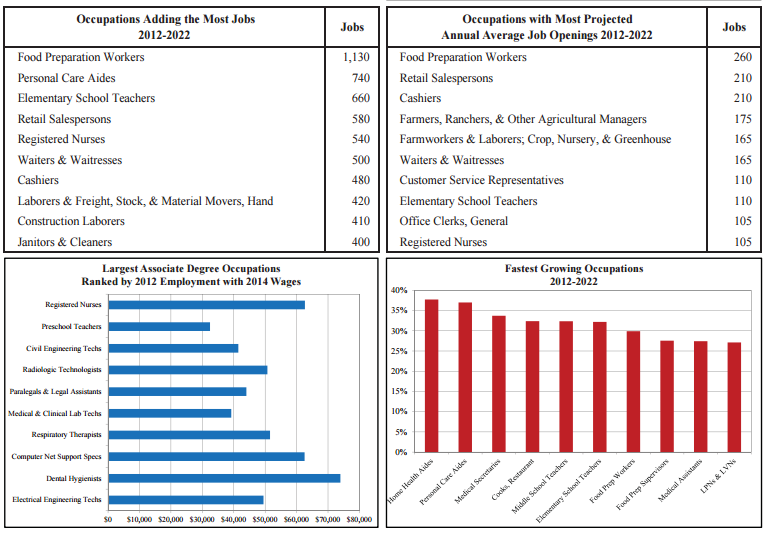
 What does the demand for talent look like in the HOT Workforce Area? Waco is considered the Metropolitan Statistical Area for Heart of Texas (HOT) Workforce Solutions. LMCI analysts and users are particularly interested in K-12 educational programming because it is a pipeline to future employees. A list of targeted occupations can be found at http://www.yestoyouth.com/careers.html. Careers from Aviation to Welding can be found on the targeted occupation list. In demand career clusters include: Transportation, Manufacturing, Health Care, Business, Information Technology, Law and Public Safety. Below is the occupational projections from the Heart of Texas which can be found at http://www.tracer2.com/admin/uploadedPublications/2031_13_HeartOfTexas_2012-2022.pdf
How does LMI meet the need of CTE Students? LMI Matters! It aims to help develop awareness of labor market information (LMI) and to show how it can be used effectively. It is for anyone who is helping adults or young people to explore opportunities for work or further learning. Our K-12 school system is training a future workforce that helps with the recruitment and retention of employers in our region. The HOT P-20 system includes pre-K through career as the pipeline of students that move on to post-secondary after high school graduation. The Greater Waco Chamber of Commerce has identified a talent pool of future employees and encourages training the following targeted industries: Advanced Manufacturing, Aerospace and Defense, Supply Chain Management, Health Care, Professional and Financial Services. Independent School Districts need to focus on the Labor Market Information and the targeted industries to ensure that we prepare our students today for jobs needed by tomorrow’s employers.
 This Act Locally Waco blog post was written by Christine Holecek. Christine is an Education Specialist at Education Service Center Region 12 in Waco. She has worked in the area of Adult Education and Career & Technical Education for the past 25 years. She earned an AAS degree from MCC, a BAAS and Master’s Degree from the University of North Texas and is currently enrolled in the Doctoral Program in Educational Leadership and Policy Studies at Tarleton State University.
The Act Locally Waco blog publishes posts with a connection to these aspirations for Waco. If you are interested in writing for the Act Locally Waco Blog, please email [email protected] for more information.
By Diego Loredo
It’s a new year and for college students a new semester! That means it’s time for relentless classes, long nights of studying, and who knows what else. For me, this is my fourth semester at UNT and I’m preparing myself for another long semester.
My spring semester is looking pretty good so far. I’m taking four classes for my major, public relations, and one foreign language class (Japanese). All of my classes are after 10 so that means I don’t have to wake up too early since I don’t have any 8 am classes anymore. Also, on Thursdays and Fridays I only have one class so that makes it easier for me. I only see myself having a problem in maybe two classes; this semester should be a good opportunity to get my GPA back up.
Now it’s time to get down to business. Going into my fourth semester, I’m getting more and more accustomed to college. Because of that, I’ve developed a few ways on how to start the semester off right. Everyone has their own way of beginning the semester but hopefully these will be helpful to any college student.
Buy a calendar!
Buying a calendar for school has become a habit of mine. You can buy a regular calendar or, like me, buy a dry-erase calendar so you can easily write/erase things. Having a calendar can help you keep track of things and make sure you don’t fall behind in any of your classes. What I do is write everything that I have to do that month so that I know exactly what is due and what I still have to time to do. A calendar is an irreplaceable, and cheap, college investment.
Introduce yourself to your classmates
I’ve said this before and I’m going to say it again. Introduce yourself to your classmates! At the end of each class, introduce yourself to a few classmates so that you have someone to go to in case you’re having trouble in that class. Or maybe you’ll be lucky enough to have a class with some friends. Having someone you can go to for help in a class will be your most valuable asset.
Dedicate a few hours a day to studying
This is hard for me to do, but it’s something I’m trying to get myself to do more. It doesn’t have to take up half your day, but dedicate maybe two or three hours a day to studying. It can even be just an hour, as long as you’re using a part of your day to get ahead in one of your classes. Another thing I do is dedicate a day during the weekend to study and catch up on my classes, then spend the night hanging out with friends. I’m not saying study every day after class, but make a schedule of when you’ll study for each class to make sure you get things done.
I know college can be stressful and not fun at all sometimes. But all it takes to make college enjoyable is to have a plan ready. Once you make that plan and stick to it, it can completely turn around your semester. If you stick to these three things, then I’m sure it’ll make your semester much easier. I’m looking forward to what this semester has in store for me and will do everything I can to make it as enjoyable as possible.
 Diego Loredo is a sophomore at the University of North Texas. He is majoring in public relations. He graduated from University High School in 2014. Although he is still not quite sure what exactly he wants to do, he thinks he wants to work somewhere in sports PR (preferably soccer or college football). His hobbies include playing soccer and golf. He is 19 years old.
The Act Locally Waco blog publishes posts with a connection to these Aspirations for Waco. If you are interested in writing for the Act Locally Waco Blog, please email [email protected] for more information.
By Christine Holecek
Groundhog Job Shadow Day is a unique initiative dedicated to giving kids job  shadowing experiences. Groundhog Job Shadow kick-off day for 2016 will be February 2. On that day we will officially get going started on what we hope will be a spring blooming with job-shadowing opportunities in the Heart of Texas. The idea is to give more of our Waco area students opportunities to “shadow” a workplace mentor as he or she goes through a normal day on the job. This gives the student a chance to get an up-close look at how skills learned in school relate to the workplace.
 Groundhog Job Shadow Day is the joint effort of the Heart of Texas P-20 Council, Greater Waco Chamber of Commerce, Waco Business League, and Prosper Waco. McLennan Community College, Texas State Technical College and school districts in the Heart of Texas Region are also partners promoting this event.
Job Shadowing is a Win-Win situation for all involved. For students it answers the age old question “Why do I have to learn this?” Shadowing demonstrates the importance of academics in reaching college and career goals. Shadowing also motivates students to learn by demonstrating the tangible application of classroom lessons.
For employers, Job Shadowing helps build a future workforce. Shadowing shows students career possibilities in different industries. Also the employee mentors get the feeling of personal satisfaction that comes from mentoring a young person. This opportunity offers a chance to share knowledge and skills and to help a child become a successful adult. Sometimes shadowing even leads to a long-term mentoring relationship.
Whether you are an employer, volunteer or teacher, participating in Groundhog Job Shadow Day is an easy and rewarding experience. Getting involved in Groundhog Job Shadow Day will only take a few hours of your time.
If you are an educator or an employer who would like to get involved, you can contact Christine Holecek at [email protected]. The HOT P-20 has posted some helpful job shadowing documents for you to share at: http://tinyurl.com/zynwu2r
For more information about the HOT P-20 Groundhog Job Shadow Day, please contact [email protected]
This Act Locally Waco blog post was written by Christine Holecek. Christine is an Education Specialist at Education Service Center Region 12 in Waco. She has worked in the area of Adult Education and Career & Technical Education for the past 25 years. She earned an AAS degree from MCC, a BAAS and Master’s Degree from the University of North Texas and is currently enrolled in the Doctoral Program in Educational Leadership and Policy Studies at Tarleton State University.
The Act Locally Waco blog publishes posts with a connection to these aspirations for Waco. If you are interested in writing for the Act Locally Waco Blog, please email [email protected] for more information.
By Diego Loredo
It’s almost 2016 and it’s about that time of year where everyone starts to think of some New Year’s resolutions. I personally don’t make any because I usually don’t end up sticking to them, but this time it’s different. These are really my own personal New Year’s resolutions for college but some of them (or all of them) can apply to other students in college.
The struggle has been real this semester. I moved into an apartment and took tougher classes. The fact that I was in an apartment meant that I didn’t have the luxury of being on campus. That resulted in me, more often than I should have, skipping class because I didn’t want to drive or take the bus to campus. My grades also went down a bit because of the tougher classes I took. So I decided that I would create several New Year’s resolutions that I would, hopefully, stick too for my 2016 spring and fall semesters.
Don’t take 8 am classes!
This semester I learned just how hard going to 8 am classes can be. I am not a morning person and waking up at 7 to get ready for my 8 am classes was harder than I thought it would be. I took one my first semester, but I was living on campus so that made it easier to go to class. However, this semester I was in an apartment that was 15 minutes away from campus. Because of that, I would often choose to sleep in (which resulted in my grades going down). Unless you have to or you’re a morning person, I would avoid taking 8 am classes.
Save money
It doesn’t have to be a lot at once, but it would help to have a little savings in case of any emergencies. Maybe put in $10 or $20 a week. It doesn’t sound like much but eventually it’ll add up. This will come in handy whenever something comes up. My car broke down earlier this year and I had no money saved up that I could use to pay for it. I ended up borrowing money from my mom, which I later paid back. Let’s face it, we’re always going to run into something unexpected. Having some money saved up will be a huge help.
Work out more
I definitely need to do this. I gained weight my first three semesters and really am not as fit as when I was in high school. I worked out for a bit my second semester but then stopped. I play soccer every now and then but that isn’t enough to get back in shape. So next semester I’m going to try to work out more. Working out can also be a good stress reliever for college students. Lifting weights or going for a run can help free your mind from any worries. Eating healthier can also make you more productive throughout the day.
Step out of your comfort zone
Yes I know, everyone says this, but it’s true! We all need to do this. I never really did that my first three semesters and I need to change that. For others, this can mean attending events on campus, joining new organizations, or just introducing yourself to others on campus or in class. For me, it’s going to the gym to work out more. Like I said before, this is something I need to do. The more I do it, the quicker I become comfortable going.
Don’t procrastinate!
This will be the most difficult New Year’s resolution for me. I love to push things off until the last minute. Instead of writing that essay that’s due in a few days, I would just take a nap. This is a really bad habit of mine and I’m sure it’s the same for other college students. We all procrastinate, but we can also control it. Now I’m not saying to finish your work the day it’s assigned. Start out small, plan to finish your assignment a week or a couple days before it’s due to allow some time to look over it and make sure you can turn in your best work. It’s okay to procrastinate a little every now and then, but I need to try to keep it to a minimum.
I’ll be honest, I hate New Year’s resolutions. I never stick to them and I think they’re a waste of time. But this time, I figured that I would give it another try. I think the reason why most people don’t stick to their resolutions (myself included) is because we all make these unrealistic goals for ourselves that we usually give up on a week into the New Year. I think that these resolutions that I made are realistic enough for a guy like me to achieve, and hopefully for others to achieve as well. No matter what your New Year’s resolutions are, hopefully you’ll stick to them throughout the year! Merry Christmas and Happy New Year!
Diego Loredo is a sophomore at the University of North Texas. He is majoring in public relations. He graduated from University High School in 2014. Although he is still not quite sure what exactly he wants to do, he thinks he wants to work somewhere in sports PR (preferably soccer or college football). His hobbies include playing soccer and golf. He is 19 years old.
The Act Locally Waco blog publishes posts with a connection to these Aspirations for Waco. If you are interested in writing for the Act Locally Waco Blog, please email [email protected] for more information.
By Diego Loredo
One of the biggest reasons why college can be stressful is because of final exams. It’s unavoidable. Every student has to take them at the end of the semester (unless your teacher decides to not have one). It can be really stressful studying for these exams, but they’re not that bad if you do the right things.
Final exams are almost here, which always causes students to stress out (myself included). My first semester experiencing college final exams was tough. I wasn’t really prepared and would often be up late at night in my dorm studying for my exam the next morning. But now that I’m a sophomore, I’ve gotten kind of used to finals and have developed my own way of studying for exams.
Review your notes!
I know this seems pretty obvious, but it isn’t something you should underestimate. Some professors do not provide review sheets and just say “your notes are your review sheets.” Trust me, it sucks when that happens. Hopefully this is something that you’ve been doing throughout the semester, if not ask to borrow a friend’s class notes. Read over your notes and maybe compare them with a classmate’s.
Work on the review sheet with your classmates
The more the merrier, right? Although you might prefer to study on your own so that you can focus, studying with a group of classmates has its advantages. You might learn something from your classmates that you might have missed during class. Also, if there is something you didn’t understand, maybe your classmates know and can help you understand. Working on the review sheet with a few classmates is always better in my opinion.
Study early
Don’t wait until the last minute to study for exams. It’s best to study about a week or two before the exam to ensure that you can go over the material as much as possible. Waiting until the night before to study for an exam is the worst thing you can do. I learned this the hard way. During my freshman year, I waited until the day before my final exam for statistics (which is the toughest class I have taken so far). That wasn’t a very smart decision, especially regarding how hard stats was for me, and I ended up getting a D on the exam. I got a C for the class, in my defense I was two points away from a B! Anyway, always make sure you study early on to make sure you don’t miss anything.
Have a friend quiz you
One good method of studying is having a friend quiz you over what will be on the exam. Ask your roommate or a classmate to ask you questions that will be on the exam. Keep track of those you get right and those you get wrong. Doing this will give you a sense of what you need to study and what you already know and don’t need to study as much. Do this several times until you are confident enough to take the exam. This will also help you memorize material for the exam.
Relax!
This is probably the most important thing to remember when studying for exams. Just relax! Don’t stress too much over exams, overthinking it will only hurt your chances of getting a good grade. There’s also such a thing of studying too much. Take a few breaks while studying. Just stay calm and be confident!
Exams can be intimidating, but if you study properly then you should do well. However, don’t get discouraged if you get a bad grade on one or more of your exams. It happens to all students, just think of what worked for you and what didn’t work and use that to come back stronger next semester. These last few weeks of the semester are always hectic, with final projects being due and studying for finals, but as long as you stay calm and study properly you should be fine. Best of luck!
Diego Loredo is a sophomore at the University of North Texas. He is majoring in public relations. He graduated from University High School in 2014. Although he is still not quite sure what exactly he wants to do, he thinks he wants to work somewhere in sports PR (preferably soccer or college football). His hobbies include playing soccer and golf. He is 19 years old.
The Act Locally Waco blog publishes posts with a connection to these Aspirations for Waco. If you are interested in writing for the Act Locally Waco Blog, please email [email protected] for more information.
by Diego Loredo
You just graduated high school, you’ve been anticipating this moment all year, and now you’re finally here. You’re a college freshman! Although it can be fun and exciting, starting college can also be a huge challenge.
Starting college is a huge step in your career and in life. So don’t feel bad if you’re intimidated by it. Everyone goes through challenges during freshman year. Some may include making new friends, getting used to the classes, etc.
I’ve experienced many challenges my freshman year at UNT, so I know how it feels. My first semester was particularly tough. Mostly because of one class, statistics… That was, and still is, the toughest class I have ever taken. There were numerous homework assignments that took me hours to do, several exams that I studied all night for, and concepts that I just could not understand. Luckily, I made a few friends in that class who helped me get by. Statistics was also the first class ever where I got a D on an exam, which was the final exam (I still managed to pass with a C).
I didn’t really have any problems making any friends, literally the first week I moved into my dorm I made a small group of friends. Also, I was roommates with a good friend of mine that I have known since freshman year of high school. I introduced my roommate to my other friends and we all started hanging out all the time. We made a team for the outdoor soccer intramurals and met some other people who joined our team. After the tournament, which we made it to the playoffs but unfortunately lost 3-1, we had our own little group. They made it easier for me in my transition to college.
During my freshman year, I’ve encountered many different kinds of people, such as the guy who walks around campus with a flower pot on his head (I’m serious). I also enjoyed, and disliked, some of my classes and learned many things. Here are a few things that have helped me get through freshman year and will hopefully help you too as you continue to go through your transition into college and for others who will soon start their freshman year.
Find your own clique!
This is what I think is the most important thing to do your freshman year. You may have chosen to go to a college away from home to get a fresh new start, but it always helps to have a group of friends that you can depend on. Start by introducing yourself to people in your dorm or in your classes, or if you are living with a friend, the two of you can introduce yourselves to others. Having your own little clique will no doubt make college a lot easier, and more fun, for you.
Join an organization!
Your college is bound to have something that interests you. Whether it’s a debate club, photography club, or various sports clubs, find something you like! Joining some club or organization is always fun and it keeps you busy so that you won’t be stuck in your dorm all day (more on that later). Plus, joining an organization will help you meet people with similar interests as yours.
Attend events!
College campuses are always holding events to get their students involved. Your college should be no different. I’m sure there are countless events going on at your college every month. Go to a few of them! Get your roommate to go, or a few of your friends. Going to campus events are usually fun and you could win free stuff! Plus, it can get you interested in something you thought you never would.
Get to know your classmates!
This is extremely important. Introduce yourself to your classmates. I suggest you share notes or host study sessions. You never know when you will need your classmates’ help and vice versa. This will especially come in handy when exams start. Also, get to know your professor and attend study sessions held by TA’s.
Don’t stay in your dorm all day!
This was difficult for me. Every day after class I would head to my room and take a long nap. Sometimes I would just stay in bed all day. Luckily, my friends convinced me to get out more. If possible, don’t stay in your dorm all the time. Get out more! Hang out in your dorm lounge or game room, play sports outside, or go to various locations on campus with some friends. Although it’s fine to stay in your dorm every now and then, make sure that you go out too!
I’m not going to lie, freshman year was tough. It took me a while to get used to it but once I did, I became a lot more comfortable at UNT. My friends no doubt played a huge part in it. We made a lot of memories together, such as playing football in the snow and intramural sports. Along with having those friends, getting involved on campus helped as well. I believe these things that I did are what all freshman should do. Make new friends, get involved, study, and just have fun!
Diego Loredo is a sophomore at the University of North Texas. He is majoring in public relations. He graduated from University High School in 2014. Although he is still not quite sure what exactly he wants to do, he thinks he wants to work somewhere in sports PR (preferably soccer or college football). His hobbies include playing soccer and golf. He is 19 years old.
The Act Locally Waco blog publishes posts with a connection to these Aspirations for Waco. If you are interested in writing for the Act Locally Waco Blog, please email [email protected] for more information.
(The Heart of Texas P-20 Council includes representatives from K-12 education, higher education and employers. They meet regularly to help coordinate efforts to launch our young people into productive lives as workers and citizens. This post is one in a monthly series of posts intended to share information about the work of this important group in our community. For more posts in this series, click here: P-20 education.)
By Ashley Canuteson
I have had the privilege of meeting some incredible people through my line of work over the past several years. A key facet of my job as College & Career Readiness Coordinator for Midway ISD is to help make connections between public educators, higher education, and folks in “the real world” – all for the benefit of students. After all, students need to leave us ready for success beyond high school. But students shouldn’t be the only ones who benefit from a group of constituents coming together to share ideas and learn from each other. My experiences have led me to realize that various partnerships coming from all of these efforts are mutualistic – they are not done solely for the benefit of students; rather, they are formed to truly help educate an entire community about how we can all work together for the successful advancement of an economically sound society. Wow! That was a mouthful! So, what does that mean exactly? I can best share an example of the power of mutualistic partnerships by telling the story of a wonderful advocate and community leader.

Rick Tullis
Rick Tullis, president of Capstone Mechanical and member of the Midway ISD Board of Trustees, was named this summer as one of four state Business Leaders of the Year by the Career & Technology Association of Texas (CTAT). He received this recognition because of a nomination written by Donna McKethan of Waco ISD, Christine Holecek of Education Service Center Region 12, and me. Through our work with each other, we came to realize that we all had seen the power of Mr. Tullis’ influence in a variety of ways. In addition to his commitments to Midway ISD, Mr. Tullis has been an active board member of the Greater Waco Advanced Manufacturing Academy (GWAMA), the Board of Directors for the Waco Business League, the Baylor School of Engineering Board of Advocates, the Baylor Scott & White/Hillcrest Board of Visitors, and the Board of Directors for the Waco Chamber of Commerce. Looking at his level of involvement, one can quickly see that Mr. Tullis is invested in the overall success of the Waco community. It is because of this far-reaching commitment and willingness to serve that he continues to make a lasting impact in the educational realm; however, it doesn’t stop there.
I have had the personal honor of working with Mr. Tullis in some of his volunteer roles – most specifically, with his time on the Steering Committee of the Heart of Texas P-20 Council. What I have realized in that time is that Mr. Tullis brings to the table a vision of shared learning for all. He isn’t there simply as a business representative trying to advise educators on what the world needs in its future workforce, although he shares some great perspective on that topic! He is also there to learn about how he can bring his network of colleagues into the world of education so we can all work together on helping our students become successful. “Preparing students is a shared responsibility of families, schools, and business,” said Tullis in a July interview with Hometown News. And he believes this wholeheartedly.
Mr. Tullis was an integral part of the collaboration between Waco ISD and various other school districts and business leaders who came up with the concept of the Greater Waco Advanced Manufacturing Academy. As GWAMA was coming to life, the educators learned plenty about the need for skilled graduates that exists in our local manufacturing workforce. It is fair to say that our local business leaders also learned much about the world of education. Together, these partners realized there are many ways they can work mutually to meet a variety of goals. Some of those goals benefit the educational institutions and some benefit local business. Even bigger than that, however, are the goals that are long term – the goals that focus on helping students today so that we help strengthen our community tomorrow.
It takes vision. It takes commitment. It takes time. It takes service. It takes a willingness to teach and a willingness to learn. It takes a team of partners focused on how they will contribute to the betterment of our community one relationship at a time. So how can YOU become a partner? How can you make a difference in the life of a student, or the life of a colleague, or the life of your community? We must expand our network of partners through open communication lines and specific opportunities for involvement. Mr. Tullis has challenged us all on the Heart of Texas P-20 Steering Committee to invite new partners to the table for discussions about ways we can all be involved in collaborating mutually on building a successful future. Ideas abound! Job shadowing for high school students, externships for teachers, career day involvement for younger students, college tours… the list goes on and on! Where can you find a fit and become a Partner with a Purpose? Our future needs you!
If you would like to get involved collaborating with the P-20 Council, please contact Fred Hills at McLennan Community College. His email is: [email protected].
 Ashley Canuteson is the Coordinator of College & Career Readiness at Midway ISD. She works with the district Career & Technical Education programs and has a passion for working with people. Ashley is a Waco native who graduated from Robinson High School, attended MCC before graduating from Baylor University, received her Masters degree from Tarleton State University, and is currently working on her Doctorate at Baylor. Ashley is the proud mom to two fabulous children – a future video game designer and a future geologist! She and her husband, Wade, enjoy volunteering together and traveling.
The Act Locally Waco blog publishes posts with a connection to these aspirations for Waco. If you are interested in writing for the Act Locally Waco Blog, please email [email protected] for more information.
(The Heart of Texas P-20 Council includes representatives from K-12 education, higher education and employers. They meet regularly to help coordinate efforts to launch our young people into productive lives as workers and citizens. This post is one in a monthly series of posts intended to share information about the work of this important group in our community. For more posts in this series, click here: P-20 education. )
By Rob Wolaver
It is said that progress does not come without change. That’s certainly the case at Texas State Technical College where we are in the midst of change the college hasn’t seen in its 50-year history. The process is all part of a transition to “single accreditation.” It’s a bold move inspired by economic growth and motivated by industry demand for a skilled workforce.
In the past, TSTC’s four legacy campuses, which ran semi-independently under the direction of TSTC System, would get individually accredited through the Southern Association of Colleges and Schools. Now, we’ll be accredited – reviewed for integrity and quality of student learning – as one college.
It may sound simple but as Chancellor Mike Reeser, who has led the efforts, will tell you, this has been, by far, one of TSTC’s greatest challenges, but one which eventually, could prove to be the zenith of our institution’s storied existence. This change will be remembered as a high point that will lay the foundation for the advancement, development and continued success of TSTC.
Already, we have successfully aligned personnel, programs, curriculum and learning outcomes. We now have a statewide course catalog and student handbook. And, we’ve revamped a consumer-friendly website. TSTC, with 11 campuses total, is now one college serving all of Texas.
It has been a demanding endeavor for the 1,715 employees across the state, and while the job is not finished, we’re well on our way. Now, what does this all mean to you and more importantly, what does this all mean to our TSTC students?
For Texans, One TSTC allows the college to standardize operations and eliminate duplications of work associated with separately accredited colleges. Combining resources will set the stage for expansion of instructional services into communities that need skilled workers or specialized training.
For our students, TSTC is better able serve you. The alignment allows us to better improve classrooms and keep our laboratories stocked with the latest industry tools and technology. Imperative, because we are a hands-on technical school with the goal of making sure you are skilled to start work the day you graduate.
For industry and employers, it means you keep getting technically-skilled workers who can hit the ground running. It means we keep meeting with industry leaders, to make sure our students are well prepared for the jobs at hand. It means we keep doing what we’ve always done best – job placement for the state.
For employees, it means that TSTC will continue to be the best place to work. A place dedicated to its mission of student access and success and its even bigger task of making sure Texas has the employees it desperately needs.
For Texas, this means a stronger economy and lower employment. Indicators of prosperity that benefit every proud resident. It means we continue working with state government and elected officials to make sure we are offering the programs that Texas industry needs and the economy demands.
For Waco, it means that TSTC in your community remains the flagship campus for all the college locations. It means that TSTC will continue to be a partner in education with surrounding ISDs as well as institutions like McLennan College and Baylor University.
The transition to single accreditation is further testament to TSTC’s administrative innovation. Just last year TSTC became the only college in Texas to adopt a funding model based entirely on student employment outcomes. Simply put, we’ll get paid when the student gets paid. TSTC as the saying goes, “putting your money where your mouth is.”
Bottom line, we’re not only investing but doubling down on the communities we serve, that includes Waco, Abilene, Breckenridge, Brownwood, Fort Bend County, Harlingen, Ingleside, Marshall, North Texas, Sweetwater and Williamson County.
As we continue the alignment process, we look forward to the next half century with optimism that our investment will pay off for our students and employers. Ultimately, we recognize that bold leadership and initiative will set the stage for success and the future prosperity of this great state we all call home.
 This Act Locally Waco blog post was written by Rob Wolaver. Rob began his professional career in 1989 at Tarleton State University and left Tarleton in 1992 to become the director of Student Activities and Housing at Texas State Technical College Waco. In the 24 years at TSTC, Rob has served in many leadership roles including, Associate Vice President, Vice President, Executive Vice President, Interim President, Provost. Rob is also active in his community where is on the board of Big Brothers/Big Sisters of Central Texas and chair of the Lorena Economic Development Council. Wolaver has served the City of Lorena as a City Council member and Mayor Pro-Tem.
The Act Locally Waco blog publishes posts with a connection to these aspirations for Waco. If you are interested in writing for the Act Locally Waco Blog, please email [email protected] for more information.
(The Heart of Texas P-20 Council includes representatives from K-12 education, higher education and employers. They meet regularly to help coordinate efforts to launch our young people into productive lives as workers and citizens. This post is one in a monthly series of posts intended to share information about the work of this important group in our community. For more posts in this series, click here: P-20 education.)
By Ashley Canuteson
I have a dream – that every high school student be fully prepared to take the next steps toward their own dream after graduation; that they look back on their K-12 experience with a sense of accomplishment; that they have connections in place helping to bridge their postsecondary transition; that they take ownership in their goals and are committed to achieving them. I have that dream… and it guides my work each and every day.
As I conclude my sixteenth year in public education, I find myself looking forward to a summer of rest, relaxation, rejuvenation, and reflection. I know what you are thinking… It must be nice for educators to get three months off to do all of those things! You think we get three months off? Um, not exactly. As many educators do, I am still working long after the last student is gone. If I am not officially on contract, I am attending workshops or reorganizing my school space or meeting my colleagues for (gasp!) an actual meal away from campus! I am closing out last year’s paperwork and thinking ahead in planning for next year. Who has time to sit still when there is work to do that will make next school year even better?? That’s where the “reflection” piece of my summer plan comes in to play. When I reflect on the past school year, I ask myself three questions:
- What did I learn?
- How did I make a difference for kids?
- What can I do to make next year even more awesome?
As I sit here and ponder these questions, I realize there is a theme developing within my reflective thoughts: TEAMWORK. A simple word, really. Well, actually, it is a compound word, but that is a grammar lesson for another day! TEAMWORK. One of my go-to motivational authors, John C. Maxwell, wrote a book in 2002 titled Teamwork Makes The Dream Work. His overarching message in the book is that cooperation enhances the collective comparative advantage of a team, making group specialization more productive than individual concentration. I rather like that explanation of TEAMWORK. There is a lot to be said about the importance of TEAMWORK in the realm of education. Teachers cannot simply educate students in isolation – they need to make connections across disciplines and outside of the classroom. Parents are strong contributors to the educational team by supporting their child’s needs both in the home and at school. Counselors advocate for students, but can’t do it without communicating with college partners and other community constituents. All of these moving pieces must work in tandem to achieve a common goal: prepare today’s students for success in tomorrow’s world. What does that look like? Is it the same for every child? Absolutely not! So how do we develop an individualized educational experience for every student? T-E-A-M-W-O-R-K! We simply cannot do it in isolation. Every member of the community plays an important role in the education of today’s young people! What role do you play? Tax payer? Volunteer? Employer? Parent? Educator? How can you make a difference?
I would love to share with you a story about a really impactful event that took place this past spring at Midway High School. I believe it embodies the very essence of how powerful TEAMWORK can be. This annual college and career experience, called Junior Round-Up, brought together a variety of teammates who were committed to building relationships, developing real-world learning opportunities for students, and finding ways to connect public educators with college and career partners. The event was divided into two parts. First, all eleventh grade students at the high school attended a morning full of breakout sessions where they heard from various college representatives and career panelists. Baylor, Texas A&M, Tarleton, Texas Tech, TSTC, and MCC were all in attendance and talked with students about a variety of college-related hints and processes. Career panelists representing roughly 50 local businesses were selected based on student career goals, and were then grouped into panels based on their career alignment to the Endorsements defined within the new Texas Foundation High School Program graduation guidelines. Student feedback on the event was quite positive! It is designed to be generally informative while also being framed around individual student goals as much as possible. The hope is that students walk away with an idea of how they will work to achieve their dreams beyond high school.
In addition to the student portion of the event, this year we tried something new! In partnership with the Heart of Texas P-20 Council, Midway ISD hosted all of the speakers and panelists for a working lunch graciously sponsored by a local community partner, Capstone Mechanical. Counselors and other staff members from neighboring school districts were invited to join the working lunch, and the time was spent brainstorming ideas about how everyone could work together – no matter what role they play – to develop relationships from which students could benefit. Business representatives shared their willingness to speak to students, offer student internships, give company tours, and serve in advisory roles. College partners talked with high school teachers about bridging expectations to better prepare students for the transition to college. These are just two general examples of the true synergy that was developing. Incredible ideas were born at this event because of TEAMWORK!
The really cool thing is that, because of one of those conversations, several students have already reaped the benefits. One example of this is evident in the continued growth of the relationship between Midway High School and Central National Bank. Bryan Fonville, Marketing Director at CNB, met with several business/technology teachers from MHS at the luncheon and – using TEAMWORK – they came up with the idea that students could help write, direct, film, edit, and produce a video for the bank. The students who were selected got to film on site at the bank, and learned a bit about financial planning while also applying their technology skills to a real-world project. The collaborative effort was a great success and the students walked away from the experience with authentic connections that will positively impact them long after they are out of the classroom. And they demonstrated TEAMWORK in their learning.
Still wanting more examples linking TEAMWORK to student success? Envision in your mind students who get to spend time in the summers as Junior Volunteers at Providence Hospital; teens who are invited to complete an internship with Space X one summer that leads to them getting a job offer after high school; kids of all ages who participate in extended learning through educational camps or college course offerings. What kids learn in these real-world situations helps them explore career interests while applying knowledge they gain during the school year. These opportunities are available to local students so they can gain unique experiences that cannot be replicated in a school setting. TEAMWORK makes these things happen. It’s a commitment made by our community that ensures our current generation is prepared to lead us into the future! Do you believe that TEAMWORK can make the dream work? I do. I have a dream… and I believe in our community team! Though school is out for summer, the work doesn’t stop. Consider joining forces with an educator, a school partner, a co-worker, a volunteer group, or even a student; and find a way to be a part of the TEAMWORK that makes the dream work.
This Act Locally Waco blog post was written by Ashley Canuteson. Ashley is the Coordinator of College & Career Readiness at Midway ISD. She works with the district Career & Technical Education programs and has a passion for working with people. Ashley is a Waco native. She attended elementary and middle school at Midway before graduating from Robinson High School. After two years at McLennan Community College, Ashley attended Baylor University where she received her Bachelor of Science degree in Education. She went on to receive her Master’s degree in Educational Administration from Tarleton State University and is on track to complete her doctorate in Curriculum and Instruction from Baylor University sometime next school year. Ashley is the proud mom to two fabulous children – a future video game designer and a future geologist! She and her husband, Wade, enjoy volunteering together and traveling.
The Act Locally Waco blog publishes posts with a connection to these aspirations for Waco. If you are interested in writing for the Act Locally Waco Blog, please email [email protected] for more information.
(The Heart of Texas P-20 Council includes representatives from K-12 education, higher education and employers. They meet regularly to help coordinate efforts to launch our young people into productive lives as workers and citizens. This post is one in a monthly series of posts intended to share information about the work of this important group in our community. For more posts in this series, click here: P-20 education. — ABT)
By Christine Holecek
AVATAR is not just an icon or figure representing a person in a video game and it is not a blue hybrid alien from a movie. AVATAR in the Heart of Texas stands for “Academic Vertical Alignment Training and Renewal.” It is a joint project, now in its third year, organized by the Education Service Center Region 12 (ESC Region 12) and the Heart of Texas P20 Council to bring together local school districts and local colleges to collaborate on high school transition to college.
 Year one looked specifically at High School English Courses (AP and Dual Credit) and expectations for college English courses. Critical conversations were held on the alignment that needs to happen for students to be more successful in college. Great strides were made. For example, high school and college teachers worked together to develop a tool for all teachers to use to grade essays consistently and holistically.
Year two’s project added math to the equation. Representatives from both ELAR (English, Language Arts and Reading) and Math disciplines began discussing the College Preparatory course requirements introduced by House Bill 5 in 2012. These course offerings are now required by the legislature to help students be better prepared to enter college without remediation. High School and College ELAR and Math teachers worked with McLennan Community College (MCC) to develop a course that was made available the fall of 2014. School districts interested in using the college prep course can complete a Memorandum of Understanding (MOU) with MCC.
A College Prep Course symposium was held in September 2014 to introduce school districts to local college offerings. Representatives from McLennan Community College, Texas State Technical College, Hill College, Temple College, and Central Texas College provided an overview of their new College Prep Courses that provide course content in English/Language Arts and Mathematics. Each college representative answered specific questions related to course design and MOUs. This symposium offered a format that allowed participants to attend one or all of the college overviews.
Year three’s focus brought counselors into the fold. Their discussions about college transition will result in a “Frequently Asked Questions” document about what students need to know as they transition to college. The counselors are continuing their work together with critical conversations around college and career readiness, dual credit courses and college prep courses. They have been meeting once a month (February – May) to discuss trends and issues in college and career readiness. Counselors will also review and critique college and career readiness products: such as the Texas Online College and Career Readiness Resource Center.
Planning for year four has begun. Career and Technical Education (CTE) teachers will be asked to contribute expertise into high school endorsement pathways. Six year plans will be created in the areas of Business and Industry, Public Services, and Science, Technology, Engineering and Math (STEM).
For more information about the AVATAR program, please contact Christine Holecek [email protected].
This Act Locally Waco blog post was written by Christine Holecek. Christine is an Education Specialist at Education Service Center Region 12 in Waco. She has worked in the area of Adult Education and Career & Technical Education for the past 25 years. She earned an AAS degree from MCC, a BAAS and Master’s Degree from the University of North Texas and is currently enrolled in the Doctoral Program in Educational Leadership and Policy Studies at Tarleton State University.
The Act Locally Waco blog publishes posts with a connection to these aspirations for Waco. If you are interested in writing for the Act Locally Waco Blog, please email [email protected] for more information.