
(This post is one in a series on race titled “But Some of Us Are Brave.” The series includes posts from a diverse group of writers from our community. It takes a considerable amount of transparency and vulnerability for the contributors to this series to pen these posts and voice their experiences. We appreciate their courage, and we hope their willingness to be brave will spark some authentic community conversation on this sensitive and important topic. We hope you will read these posts thoughtfully and join the conversation by responding honestly and respectfully, and by sharing them with your friends and acquaintances. — ABT )
A Bad Day – By Shamethia Webb
She was having a bad day.
And what exacerbated it was the fact that it wasn’t unusual.
She awoke on time (which meant early for her). Showered. Brushed her teeth. Scowled at herself in the mirror. And went to work.
All of her co-workers were talking about the black boy who was murdered while walking from a convenience store. They’d been talking about it for days. Talking about it and doing nothing. The same words again and again as if the incessant movement of their mouths negated a seventeen year old corpse.
She hated them.
During her break she washed and rewashed her hands in the restroom. She abhorred being in the ladies room for longer than a few minutes. It smelled like women. Which meant it smelled like pain and fatigue.
She wrenched a paper towel out of the dispenser and cast a frown at the vacant stalls that seemed to mock her loneliness.
She was tired.
She didn’t speak during staff meeting. Didn’t see the point in disturbing her tongue. They always smiled over her suggestions. Or tasted her words with their mouths before spitting them out. It infuriated her. Mostly it hollowed her. Cleaved into her like a perforated knife and emptied her out.
She’d spilled so much of herself over these hallways during her tenure here. Specks of herself all over the walls. Now a permanent grimace clung to her face like love.
The smell of coffee hung in the air. Stale. A room full of spit and disdain. She inhaled. Yes, disdain. She could smell it on them like second skin.
They were talking about him again. Her boss didn’t use the word murder. But defense. And mistake. And misunderstanding.
She hated him.
Her co-worker, the one with a frown for a smile, giggled at her boss’s comment that the black boy should have ducked the bullets.
I thought black boys were fast, he joked. A room full of laughter.
She died a little bit.
But not enough. She still had to clock out. And smile at the receptionist who always mispronounced her name. She still had to leave the building—and them, and them—with as much of herself intact as possible.
She stumbled to her car, trembling in her black woman fury.
She was tired.
In the checkout line at the supermarket, she watched as her few items moved lazily up the conveyor belt. The cashier chatted animatedly with the customer in front of her.
Don’t let this cashier cut her eyes at me, she thought to herself. Not today.
Don’t let her reach for my money with two fingers as if she’s afraid of skin contact. Don’t let her suddenly become mute and unresponsive to my presence, to my human being-ness. Don’t let her. Not today.
She realized with some panic that it wasn’t anger that fueled her thoughts but despair. She recognized that if the cashier did de-humanize her today she wouldn’t respond with fury but with resignation.
The passivity worried her.
I’m dying too fast, she thought.
She tensed as her items moved closer to the cashier, and she couldn’t help but notice that the murdered boy’s eyes stared back from every magazine in the aisle.
The repetition overwhelmed her. She shook.
Pieces of herself broke off. Landed dully on the laminate floor.
She tried to remember her breath. And forget her boss and the restroom stalls and the hundreds of cashiers who’d humiliated her and the tiptoeing gunman and the black corpse and the black corpses theblackcorpsestheblackcorpsestheblackcorpsetheblacktheblacktheblackblackblack
She tried to catch herself but her hands were already gone. Dead.
. . .
I hate soap operas.
A voice behind her.
She opened her eyes. When had she closed them?
A white man behind her scowled at a TV guide featuring frozen celebrities. He turned a full smile on her. The white of his teeth blinding for a moment.
Don’t you just hate soap operas?
She managed a nod.
She did hate them. This aisle was full of things she hated. This city. This world. Full of things she hated. Or perhaps just full of things (No. People, she amended. She liked being correct). Full of people who hated her.
I’d rather read the back of a cereal box than watch TV, the man said.
He picked up one of his boxes of cereal and waved it at her.
This isn’t food but entertainment.
She smiled. Not a full one (she was incapable of that at this point) but a slash of the mouth that surprised her with its suddenness.
. . .
And there was a pocket of time when he wasn’t who he was or had to be and she wasn’t who she was or had to be. They just were.
And there was a glimmer inside of her. Something not quite dead, that stirred.
The cashier was aloof but polite. And that was enough.
She walked to her car without the usual trembling.
The white man (No, man, she corrected) was parked beside her. They chatted as they loaded their items into their cars.
Well, he chatted. She managed to listen without the usual weariness and rage.
Perhaps she would sleep in tomorrow.
Yes.
Perhaps she would grow again.
And as she slid into her driver’s seat, a murmur of a smile across her face, the man waved a crumbled bill in her face and propositioned her for sex.
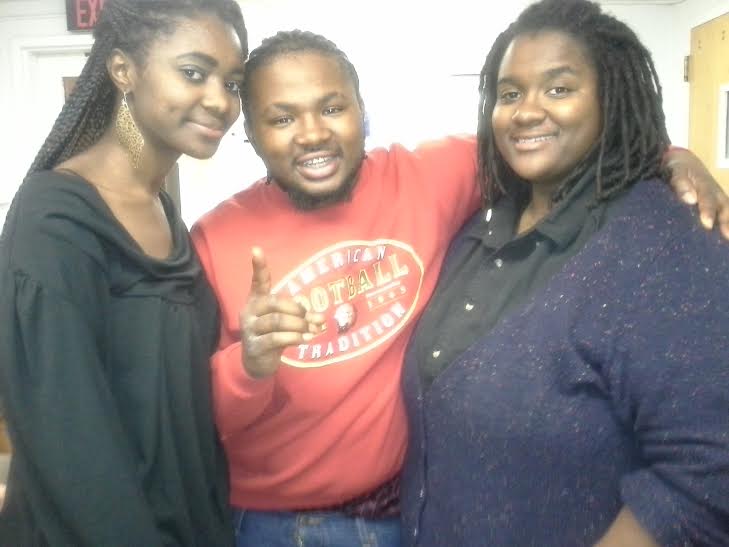 Shamethia Webb (on the right in the picture) is the Regional Director of the Texas Hunger Initiative Waco Regional Office. She grew up in Waco and spends her free time writing, dreaming, and trying to protect her reign as Connect Four Champion from her nephews. Hip hop music, sour candy, and Toni Morrison novels are a few of her favorite things.
(This post is one in a series on race titled “But Some of Us Are Brave.” The series includes posts from a diverse group of writers from our community. It takes a considerable amount of transparency and vulnerability for the contributors to this series to pen these posts and voice their experiences. We appreciate their courage, and we hope their willingness to be brave will spark some authentic community conversation on this sensitive and important topic. We hope you will read these posts thoughtfully and join the conversation by responding honestly and respectfully, and by sharing them with your friends and acquaintances. — ABT )
By DeShauna Hollie
As I sat down to write about this theme of “But Some of Us Are Brave”, I thought of my favorite “super hero” Septima Poinsette Clark. Septima lived from 1898 to 1987. She was born in Charleston, South Carolina and lived much of her life there. Although Septima lived until she was 89, and is considered by many as the grandmother of the civil rights movement, her story isn’t as widely known as those of other civil rights leaders.
As a teacher and avid civil rights activist, Septima helped pioneer some important aspects of the civil rights movement. She helped to create Citizenship Schools that addressed the barriers and unjust laws that African Americans faced when it came to registering to vote in the South. These laws varied by county and state, but many required African-American voters to be able to pass a literacy test in order to vote unless their grandfather had voted in a previous election. This disqualified most Blacks in the South, because their grandfathers had been slaves and barred from voting. Activists like Septima found ways to address these laws while at the same time protesting them.
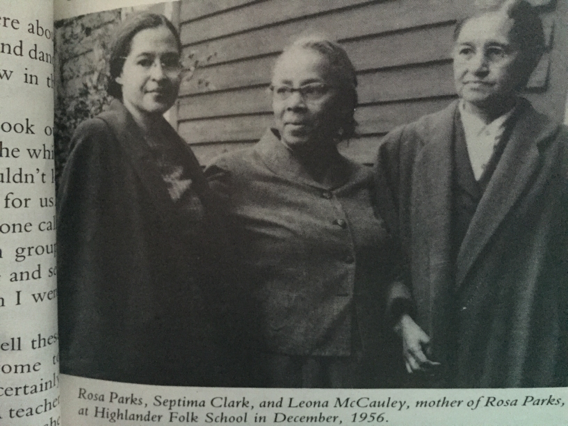
(Clark, pg 33)
Septima also worked with Myles Horton of the Highlander Folk School in Monteagle, TN to train other civil rights leaders and activists in non-violent civil disobedience. Rosa Parks attended one of those trainings and gatherings. Rosa went on to help lead the Montgomery bus boycott a few months later.
Septima used her training and passion as an educator to fight against systemic racism in the South. She consistently spoke up for the rights of marginalized people and continued to speak out even when her life was threatened, even when she was fired from her job as teacher for being a member of the NAACP, even when she was thrown in jail for holding integrated meetings with Whites and Blacks, and even when she was ostracized by many members in her community for using her voice to help others. She is indeed a super hero. In her later years, when asked about her work and contribution to the civil rights movement, she replied, “I don’t expect to see a utopia. No, I think there will always be something that you’re going to work on always. That’s why when we have chaos and people say, ‘I’m scared. I’m scared. I’m concerned,’ I say, ‘Out of that will come something good.’ It will too. They can be afraid of what is going to happen. Things will happen and things will change. The only thing that is really worthwhile is change. It’s coming.” (Clark, pg126)
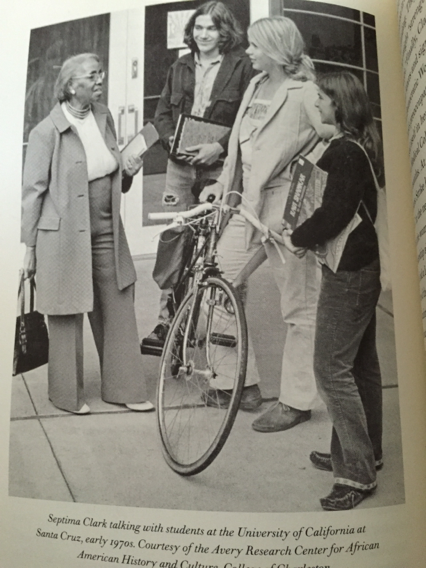
(Charron, pg 359)
Septima chose to continue working towards change her entire life, despite the consequences. Another quote of hers that I love goes: “It’s not that you grow old, but it is how you have grown old. I feel that I have grown old with dreams that I want to come true, and that I have grown old believing there is always a beautiful lining to that cloud that overshadows things. I have great belief in the fact that whenever there is chaos, it creates wonderful thinking. I consider chaos a gift, and this has come during my old age.” (Clark pg124)
Septima Clark is an inspiration to me and what I want my life to be like. I want to work for what I believe in my entire life. I want to work towards a more accepting society, a society that acknowledges that we are not a utopia. We have come pretty far since the days of slavery and segregation but the journey continues.
There is an elephant in the room that we are so afraid to mention. We are afraid and concerned that we may say something offensive, that we may hurt each other. The protests sparked by the shooting of Michael Brown on August 9th in Ferguson, MO, prompted questions in my mind about what I could do to stand in solidarity with that community and with others in my own community of Waco, TX, as we all grieved over the loss of a life. I’m not sure why this particular event spoke to me in a way that other shootings had not, but it made me want to take to the streets and scream “Black Lives Matter” and “Enough is Enough” along with other protesters. I love a good protest. They are invigorating and a great way to let off steam so that I can get down to the business of figuring out how to bring about the change that I am screaming about. Septima’s model of continual work and non-violence remind me that there is always a positive way to go about change.
The anger is real. The despair is real. The hurt is real. I believe it is time we made the conversation real. Although we are not Ferguson, MO,and are in Waco, TX, we have our own history of racism, prejudice and discrimination that is very real. I want Waco to prosper and I want to continue to work towards positive change in Waco. Will you join me in the conversation?
I know that conversations about change, about injustice, about past hurts and about how we move forward can sometimes be scary and hard. But dialogue with each other is the first action that we can take in being allies to each other.
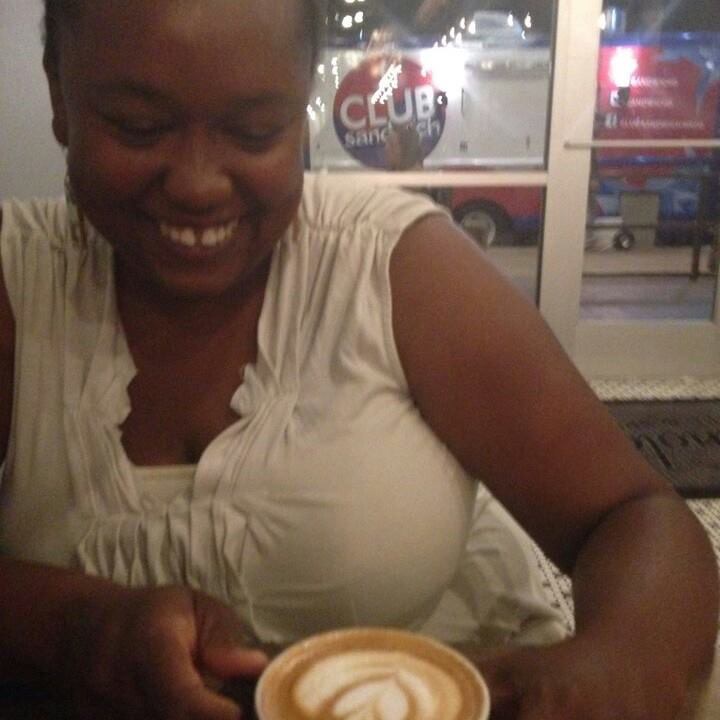 This Act Locally Waco blog post was written by DeShauna Hollie. Deshauna grew up in Waco and is infant/toddler teacher at The Talitha Koum Institute Therapeutic Nursery. The Act Locally Waco blog publishes posts with a connection to these aspirations for Waco. If you are interested in writing for the Act Locally Waco Blog, please email [email protected] for more information.
Resources:
Charon, Katherine Mellen. Freedom’s Teacher: The Life of Septima Clark. The University of North Carolina Press, Chapel 2009.
Clark, Septima Poinsette and Cynthia Stokes Brown. Ready from Within: Septima Clark and the Civil Rights Movement. Wild Trees Press, Navarro, California:1986.
By Ashley Bean Thornton
Like many White, middle-class Americans, I grew up understanding life as a competition, a footrace. The ones who run the fastest, and by that I mean work the hardest, win the prizes. I knew good, hardworking people – my parents for example – who were winning, and I expected to be a good, hardworking person who would also win. In fact, that is exactly how it has played out so far.
Of course… to feel good about winning, you have to believe the race is fair.
I don’t remember having “Black History Month” when I was in school, but we definitely studied slavery and the Civil War. We saw slides of the Little Rock Nine being escorted to class by the National Guard, and of White people turning dogs and fire hoses on Black people. We learned about Rosa Parks taking her seat on the bus in Montgomery, and we learned about Martin Luther King, Jr. and the “I have a Dream” speech.
Without even thinking about it, I interpreted all of this through my footrace metaphor, like so: (1) Slavery was an unthinkably horrible sin. (2) Even after slavery ended, the race was not fair. White people cheated – a lot. (3) Thanks to Dr. King, and the heroes of the Civil Rights Movement, Black people were able to use the legal system to make the race fair. Conclusion: Things were terrible before, but they are OK now; we can quit worrying so much about the Black/White thing, and just concentrate on running as fast as we can.
I was fairly comfortable with this conclusion for a long time.
Recently I came across a 2013 Pew Research Center Report partially titled “King’s Dream Remains an Elusive Goal.” According to this report, Black Americans are nearly three times as likely as White Americans to have incomes below the poverty guideline. The median net worth (wealth) for White households is more than ten times that of Black households, and Black men are six times as likely to be incarcerated as White men. With these facts in mind, I have to ask myself an uncomfortable question: if the race is fair, why do we continue to see such huge disparities?
It seems blindingly obvious now, but it took me a long time to realize that if I wanted to begin to untangle the knot of reasons behind these differences I needed to tweak my footrace metaphor. In my mind the race for success had always been an individual event. If I win it is because of my hard work; if I lose it’s because I should have worked harder. If you lose…well … you get the picture. I still believe this is the truth; it’s just not the whole truth. Hard work matters, but it’s also important to realize that the race is not, and never has been, an individual event. It’s a relay.
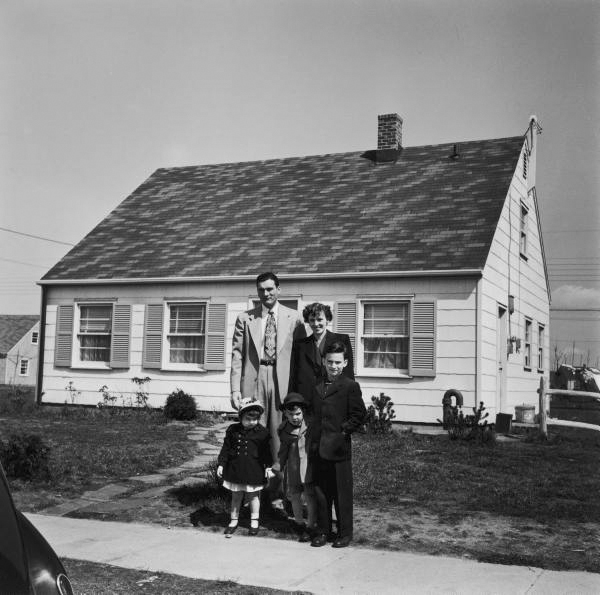 Let’s say, for example, my White grandparents saved their money and bought a house in the suburbs back in the 40’s. That house increased in value and became part of the nest egg my parents used to get an even nicer house in an even better neighborhood. That meant I got to go to a really good high school, and from there to a good university, and from there to a good job. Meanwhile Black grandparents in the 40’s didn’t get to buy that house in the suburbs because of prejudicial deed restrictions (not to mention inhospitable neighbors). To make matters worse, no (White owned) bank would loan them the money to build a nice house in a Black neighborhood because it was “too high risk.” That meant no nest egg, no nicer house for their kids, and a not so great high school in a declining neighborhood for their grandkids – my peers. Multiply this scenario by thousands of Black and White grandparents and you begin to see one reason why there is such a huge disparity in wealth between Black and White households today.
Even if the leg of the relay I’m running now is reasonably fair (or at least fair-er), the previous legs of the race were seriously rigged in favor of White people. I was way, way ahead before I ever started to run.
I do not know exactly what we should do to even out the disparities that have come about as a result of the inequities of the past. Should we invest more in public schools? In rebuilding high poverty neighborhoods? Should we provide more support to Black-owned businesses? Should we take a hard look at our legal system? Maybe we should do all of these things; maybe none of them; maybe there are other creative solutions I can’t even imagine. I don’t know. I just know that there is a limit to how much time even a great athlete can make up in the last lap of a relay. If we care about reducing the Black/White disparities described above any time soon, we are going to have to do something more than just telling people to “run as fast as you can.”
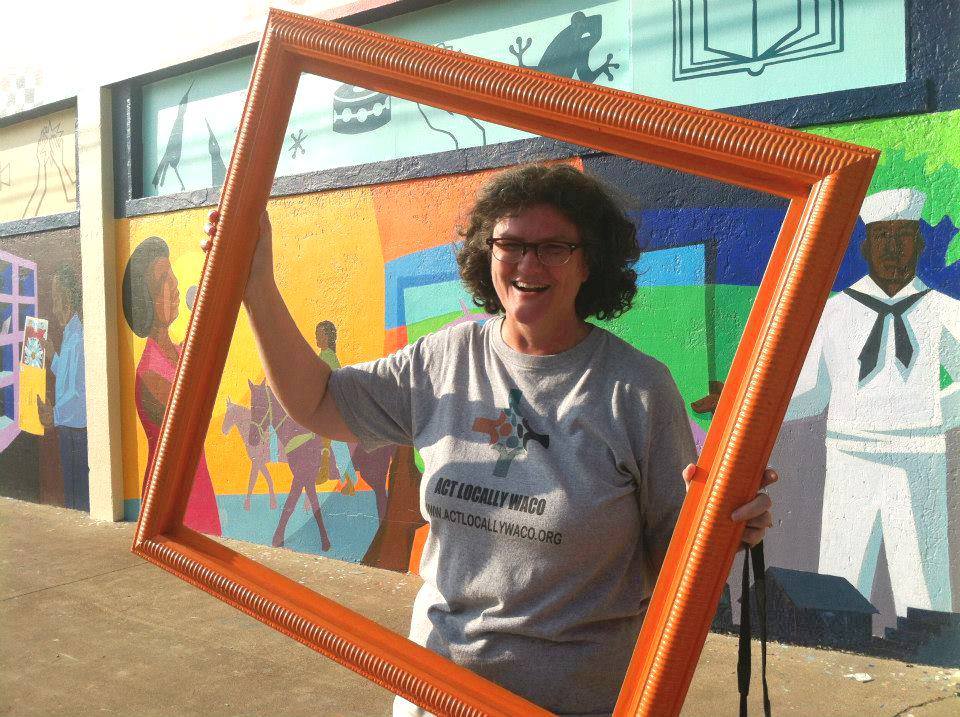 This week’s Act Locally Waco blog post is by Ashley Bean Thornton, the Manager of the www.www.actlocallywaco.org website and the editor of the Friday Update newsletter. The Act Locally Waco blog publishes posts with a connection to these aspirations for Waco. If you are interested in writing for the Act Locally Waco Blog, please email [email protected] for more information.
By Ashley Bean Thornton
After attending two Juneteenth celebrations and the terrific mural celebration party at the East Waco Library, I have seen far more Black people in the last month than I have seen in the 24 months before that combined.
Does that last sentence make you cringe a little? It made me cringe a little to write it. Do I sound like I’m bragging about being the cool White person who hangs out with Black people? Am I supposed to say “Black” or should I say “African-American?” Was I intruding? Would the Black people have liked it better if no White People had come? Should I write a post that focuses only on Black/White racial relationships? How will that make people of other races and ethnicities feel?
When it comes to race, I second guess myself coming and going. That’s OK though. If Waco is going to be a great place to live for every person of every level of income, more of us have got to wade into the sometimes fun, sometimes fascinating, often uncomfortable waters of learning more about other races and ethnic groups. I think Maya Angelou’s advice applies here, “Do the best you can until you know better. Then when you know better, do better.” With that in mind here are five things I’ve done in the last few years that I feel like have helped me “know better.” I recommend them to you, my fellow White people.
1. Shop for kids’ books – Go to Barnes & Noble and try to find a baby book or a kids’ book with an other-than-white person on the cover. I did, and it was shocking to me how few choices I had. Once this opened my eyes I started noticing Black/White differences in all kinds of advertising, especially local advertising. Books and advertising influence our thinking, especially if we don’t notice that they are slanted.
2. Read Some of my Best Friends are Black by Tanner Colby and The New Jim Crow by Michelle Alexander – The Colby book is an easy read by a white man who grew up in the South. It’s a very accessible, somewhat irreverent, look at some of our foundational institutions – education, housing, church – and how they have contributed to our current race relations (or lack thereof). The New Jim Crow is a challenging read. I didn’t agree with every word of it, but it broke open my thinking about crime and race. Everyone should read this book.
3. Watch “Race the Power of an Illusion” – This is a 3-Part documentary about race in society, science and history. It’s a little hard to find, but they have it at the Baylor library. (The Waco-McLennan County Libraries have ordered a copy. It should arrive sometime July 2013.) The information on the science of race and the section on housing were the most interesting to me. It shares a historical perspective that I bet most White people don’t know, but should.
4. Attend a Community Race Relations Coalition (CRRC) meeting – Waco is lucky to have a thriving group of people who care about promoting good conversations about race. I recommend their regular “Dinner and a Movie” meetings as a good way to ease into the conversation. Last Valentine’s Day, for example, they had a full house to watch “Guess Who’s Coming to Dinner?” Steve and Kathy Reid, of Truett Seminary and the Family Abuse Center respectively, led an honest, thought-provoking conversation about bi-racial marriage.
5. Attend a Black church…more than once — A few years ago the CRRC organized a “Church Swap.” Black people went to White churches and White people went to Black churches for three months. Attending a Black church for several Sundays gave us time to get past the initial shock-factor of a completely different worship style, to meet a few people, to learn some of the songs and to get to the point where we were actually worshipping instead of just observing. That experience did more to make me comfortable with being “the only white person in the room” than anything else I have ever done. I highly recommend it.
That’s my list of five? What are yours?
- « Previous
- 1
- …
- 3
- 4
- 5