
By Debbie Wright
Shay Scranton is a Waco local who has recently contributed to the growing list of murals in the Waco Community. His mural can be found at One Day Bar , one of the new coffee-and-cocktails establishments downtown on Columbus Ave. As a local creative, Scranton runs his own graphic design company and has worked with multiple companies around town. His lifelong interests in drawing and illustration, combined with his passion for metal music and the alternative scene, have led to a collection of works with a special focus on death and dark themes.
Scranton describes his most recent mural as “Deisel Punk “ with ties back to stylings of Mad Max, early comic book skylines, and inspirations from artists and creatives like Frank Miller and Kris Straub. “I really dig making these two-dimensional, cut-out looking silhouetted skylines. So, when the idea to do a skyline for this (the mural) it was perfect and really fun,” Scranton said. Though he is not normally a muralist, this passion project was kicked off by his friend Kyler Griffith, who is the owner of the new bar. With previous works with Native Sons, Pinewood Roasters, The Glass Phoenix, and Common Grounds (where he got his start as a band poster artist), his reputation with well-known local brands has grown his company and has made him somewhat of a veteran in the Waco art community. “I’ve seen a lot of things come and go. I’ve been here long enough and been working with local companies in some graphic capacity for 15 years,” Scranton said.
Scranton started his career as an artist right here in the heart of Texas, though he spent his early life as a musician and has traveled far and wide. Since Scranton started in the music industry at the young age of fourteen, with the Waco punk band Well Inside Out, music production and the alternative lifestyle has influenced his artistic style and personal aesthetic. “I am constantly experimenting with new ideas and styles and things, just to see what works…but when I started doing artwork related to music, band T-shirts were my favorite things to do. The style kind of developed around that. It was very detailed oriented and I want to create images so detailed they tell their own story,” Scranton said.
Scranton specializes in shirt designs, band posters and logo designing. With subjects ranging from monsters, Dungeons & Dragons designs. Many of his works are playful yet dark expressions with high contrast colors; complex, hyper-stylized characters; and heavy metal lettering. This has evolved from some of his past projects like Funeral Confetti (his art novelty company), where he designed custom enamel pins, patches and did home screen printing. Along with that, he has worked with other media and even produced a full-length Dungeons & Dragons show called Darkest Dove that can be found on Youtube. He hinted there were some new things in the process of being completed, however, he prefers to keep some things secret until they are complete. For more recent work, you can find him on social media @shayscranton and through his website at http://www.shayscranton.com/. You can also contact him at [email protected].

Debbie Wright runs the local Know Waco Podcast, which features upcoming events and activities happening in and around the Waco area. She is a recent Texas Tech graduate, with a major in communications and minor in public relations. She has lived in the Waco area for ten years and loves to work with local creatives and artists.
The Act Locally Waco blog publishes posts with a connection to these aspirations for Waco. If you are interested in writing for the Act Locally Waco Blog, please email [email protected]for more information.
By Mia O’Suji
Upon entering my first year of college, I was unaware of systemic inequities in our education system and how they would play the largest role in the trajectory of my life.
The residual effects of these systemic challenges led me to obtain a bachelor’s degree in English, with a minor in education. By pursuing a career in education, I envisioned myself eradicaticating structural barriers hindering Black and Latinx students in low-income communities from having access to a high-quality education.
Although I studied education in my undergraduate program, I chose to join the mission of Teach for America and relocated to Houston to serve as an 8th grade English teacher for a public charter school.
While much of my and my students’ successes can be attributed to my undergraduate program and Teach for America, the support I received from a local Alternative Certification Program (ACP) deserves much credit for my growth as a first-year teacher because of the ongoing training and support it provided. The development I received consisted of intensive pre-service training, frequent observations and feedback from an instructional coach, and face-to-face professional development opportunities.
My story supports the vision and mission of Prosper Waco’s Center for Transforming Alternative Preparation Pathways (CTAPP), where I am now director of content development and programming. CTAPP became a part of Prosper Waco and the Greater Waco community in September.
CTAAP believes all prospective teacher candidates deserve equitable, high-quality preparation both prior to and during their first year in the classroom. Many educators still choose traditional, four-year, university-based teacher preparation programs, but a majority of Texas’s newest teachers opt to complete an alternative route to educator certification.
Since 2015, the percentage of total new teacher candidates enrolling in ACPs has increased from 70% to 75% in 2017-18 (U.S. Department of Education, Title 2 data). Given that Texas certifies more new teachers annually than any other state (over 22,000 in 2017-18) and that Texas teacher candidates are more likely to enroll in ACPs, this has created a robust, yet efficient, pipeline for individuals looking to enter the teaching field.
For many candidates, alternative certification routes serve as a bridge between theory and practice — helping those with undergraduate degrees secure the necessary training and skills to enter the classroom without an education degree. For others, ACPs present an opportunity to explore a new career that will impact the lives of future generations of Texans.
For novice teachers, ACPs offer critical on-the-job support and coaching to propel student results forward. Though each candidate brings unique life experiences to an ACP, they all possess a common goal: to learn new skills and provide a public service to better support the students and communities where they will teach.
In Waco, several pathways exist to achieve alternative certification through McLennan Community College. Candidates can opt for MCC’s own ACP program or participate in programs from Tarleton State University and Texas Tech University at the University Center at MCC. Whatever pathway candidates choose, CTAPP exists to ensure that their preparation is top-notch; and soon, these teacher candidates will be filling classrooms around the Waco community to better serve the PK-12 student populations who deserve excellent educators.

Mia O’Suji is director of content development and programming for Prosper Waco’s Center for Transforming Alternative Preparation Pathways. Mia is a graduate of Howard University. Prior to joining Prosper Waco, Mia served as a PK-12 classroom teacher, a district instructional coach, and a dean of instruction in Houston. Her wide array of experiences have provided her with thorough knowledge of the inner workings of teacher preparation facilitation and coaching interactions. Mia’s passion for implementing rigorous, equitable teacher preparation practices has led her to the Waco community to spark innovation and collaboration to ensure the best outcomes for students. Mia may be contacted at [email protected].
(Press Release) The leadership team for the Heart of Texas CROP Hunger Walk invites you to our virtual walk on Nov. 15!
Over the past 50 years, tens of thousands of walkers have raised more than $500 million through the annual CROP Hunger Walk. The Heart of Texas CROP Hunger Walk always raises around $2,500, making it one of the most successful fundraisers for a small community walk.
This year, because of the coronavirus pandemic and the need for social isolation, we are introducing a Virtual walk.
We know that it is crucial that we find new ways to engage our community to continue giving to Church World Service and Caritas of Waco, the two recipients of the walk’s funds. The current pandemic is creating an ever-increasing need for food and resources for our local agencies and around the world. Caritas, for instance, is serving more than twice as many families as it did before COVID-19 reached our community.
The need is greater than ever. Now, more than ever, is the time to give.
This year the Heart of Texas CROP Hunger Walk and some 700 other communities nationwide are joining together in interfaith walks around the theme Ending hunger one step at a time.
Here are four ways to participate:
- You can sign up online at https://www.crophungerwalk.org/wacotx and walk on November 15 in isolation or with your family. (Be sure to take photos and announce on social media that you are joining the walk! Go to https://www.facebook.com/HeartofTexasCROPHungerWalk and tag us!)
- You can sign up online at https://www.crophungerwalk.org/wacotx and walk in spirit.
- You can sponsor someone else who is walking in isolation.
- You can video yourself walking before Walk Day and send us the video, which we will incorporate into our virtual presentation, set for 3:00 pm on Nov. 15. (Videos are due by Oct. 31 to be included in the Nov. 15 presentation. Please email [email protected] for instructions.)
In doing any of these things, you will show your solidarity with the millions of neighbors around the world who must walk to live. You will also show your solidarity with the millions served by local food pantries, food banks and meal sites in the United States and in our community.
The local beneficiary for the Heart of Texas walk is Caritas of Waco. Founded in 1967, it is a community-wide agency with interfaith support. Located at the corner of 15th & Mary in downtown Waco, the organization normally includes an emergency assistance program for utilities, rent and medicine; two thrift stores and a thrift store warehouse; one of the largest food pantries in Central Texas; and a Case Management program. In March, Caritas reorganized its services, implementing a drive-through food pantry, in order to meet the soaring need and keep its staff and clients safe. The number of people coming to the pantry for food (formerly more than 100 families a day) more than doubled and continues to increase. (For information and updates, call 254-753-4593, go to www.caritas-waco.org, or check the Caritas Facebook page at https://www.facebook.com/caritasofwaco.)
The international beneficiary is Church World Service (CWS), the relief and development organization that sponsors CROP Hunger Walks. In an effort to fight hunger and build healthier communities, CWS provides clean water and hygiene training in Vietnam, combats droughts in Nicaragua, and stocks shelves in hundreds of food pantries across the United States. Hundreds of CWS workers are responding in creative ways to COVID-related crises all over the world.
It’s easy to sign up and donate to our walk. Go to https://www.crophungerwalk.org/wacotx and click “register” or “donate.” You and your team members can make donations by credit card and or PayPal, and a receipt will be sent through email for tax purposes. Once you sign up, we will send you a link to the Nov. 15 celebration.
(City council, school board, planning commission, county commissioners – these groups and several others represent us. They do the day to day work of running our community. It is our responsibility to keep informed about their work so that we can help them represent us effectively. “Civic Insights” by Jeffrey Vitarius is a regular feature of Act Locally Waco. Its purpose is to help us understand decisions that shape our community so that we can participate effectively as informed, engaged residents of Waco. – ALW)

By Jeffrey Vitarius
Back in September, we began this series with a broad look at what an impact fee policy is. Two weeks ago, we focused on the legal process for establishing an impact fee. This week we will be taking a look at pipe-related details of the report that serves as the basis for any impact fee policy in Waco. Next week, we’ll take a look at the roadside of things. Then we will wrap up on the 23rd, by looking at the policy the City will be considering on the 20th.
The goal of this report (developed by Freese and Nichols, Inc) is to calculate the maximum impact fees that could be applied under Chapter 395 of the local government code. As we discussed two weeks ago this involves projecting what kind of development will occur, what the demands of that development will be, what projects will be needed to meet that demand, and how the cost of those projects can be divided up amongst the new developments (steps 2 and 4 of the legal process). How these calculations are conducted for pipes and roads are slightly different so we will take a look at each separately, but both follow a similar pattern of calculations. We will be addressing each step in detail below:
- Determine a service area
- Identify a way to connect demand for service to supply for service
- Calculate increased demand for services
- Review existing supply for services
- Determine and cost projects needed to meet increased demand
- Identify service unit to divide costs amongst projects
- Calculate maximum impact fees
Let’s start with the Pipes:
1. Service Area
Service areas are the geographic boundaries of the impact fee policy. All the new demand, all the projects, and all the fees should be contained within the service areas. Chapter 395 provides guidance on what these areas can be or must be. For pipes, the service area is fairly straightforward. It includes the city limits of Waco along with Waco’s extraterritorial jurisdiction (ETJ). An ETJ can be thought of as a “buffer” around the city where the city can exercise certain kinds of authority. For Waco, the ETJ extends approximately five miles beyond the city limits unless there is another city in the way. For example, Woodway is not in the City of Waco’s ETJ since it is its own city.
2. Connecting Demand and Supply
Here we need to find some measurement to connect a new house or business park (demand) to the existing system and potential projects (supply). The measurement needs to be scalable to the variety of demands that will come from new development and be measurable for distinct projects and supply systems. For pipes that measure is millions of gallons per day (MGD). So, for a new housing development, MGD measures the millions of gallons of water needed each day and the millions of gallons of wastewater produced each day.
Water systems have a unique difficulty in that they are not used consistently over days and years. This makes sense if you think through your personal use of the water system. In hot dry summers you are more likely to be watering a lawn than in cold or wet winters. You are unlikely to be using the water system at 1:00 am, but you are likely to be washing your clothes, or taking a shower, or washing your hands sometime in the early morning or afternoon (for those interested these daily patterns are also called “diurnal patterns”).
Due to these daily and annual changes, looking at average MGD does not give a full picture of the demands placed on the water system. Instead we have to look at maximum MGD as well. That is the maximum number of millions of gallons used on any one day during the year. Interestingly, the report uses a “maximum day to average day” ratio of 1.7 meaning it anticipates that on average a maximum day consumes 1.7 times as much water as an average day.
Finally, to calculate increased demand over time the report calculates average MGD per resident and employee (for water its 135 gallons per day per resident and 115 gallons per day per employee). There are some additional complications to the wastewater system, but the process is largely the same.
3. Increased Demand
Above we were able to tie increased demand for pipes to increases in population and employment. Now we need to figure out what that increase actually is and how it is geographically spread out (this impacts the specific projects that will need to be undertaken).
As we touched briefly on two weeks ago, we have to start with a broad look at how much Waco will grow in terms of population and employment into the future. To do that, the study begins with a look at the past. Between 1960 and 2010 Waco’s population grew on average 0.49% per year (the technical metric for those interested is compound annual growth rate). Between 2010 and 2020 the population grew by 1.11% per year. Additionally, the number of jobs in Waco was on average between 45-48% of the total population. So, for about every two people there was about one job. Due to this ratio being fairly constant, jobs can be considered to have grown at approximately the same rate as population.
Freese and Nichols then (in consultation with the Waco Capital Improvements Advisory Committee) took a look at a number of different growth rate scenarios and ultimately determined that 1.2% seemed like the most reasonable projection of population and employment growth in Waco for 2020-2040. Additionally, they noted growth was likely to be substantially greater in the ETJ (as there is more room for development in this area). For the ETJ they projected between 4.9% and 5% population growth and 4.06% and 5.74% employment growth. Now that we have general growth rate numbers, we need to understand how that growth is spread out geographically.
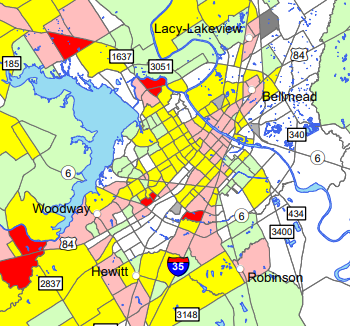
To divide growth geographically, the report uses “traffic analysis zones” (TAZs). These are geographic units used by the Waco Metropolitan Planning Organization (a good topic for a different time) for demographic analysis due to their internal similarity (areas within TAZs are similar to each other) and traffic generation. Here is a map of some of the TAZs within Waco. This map does not come from the impact fee study,but should give some understanding to what TAZs are.
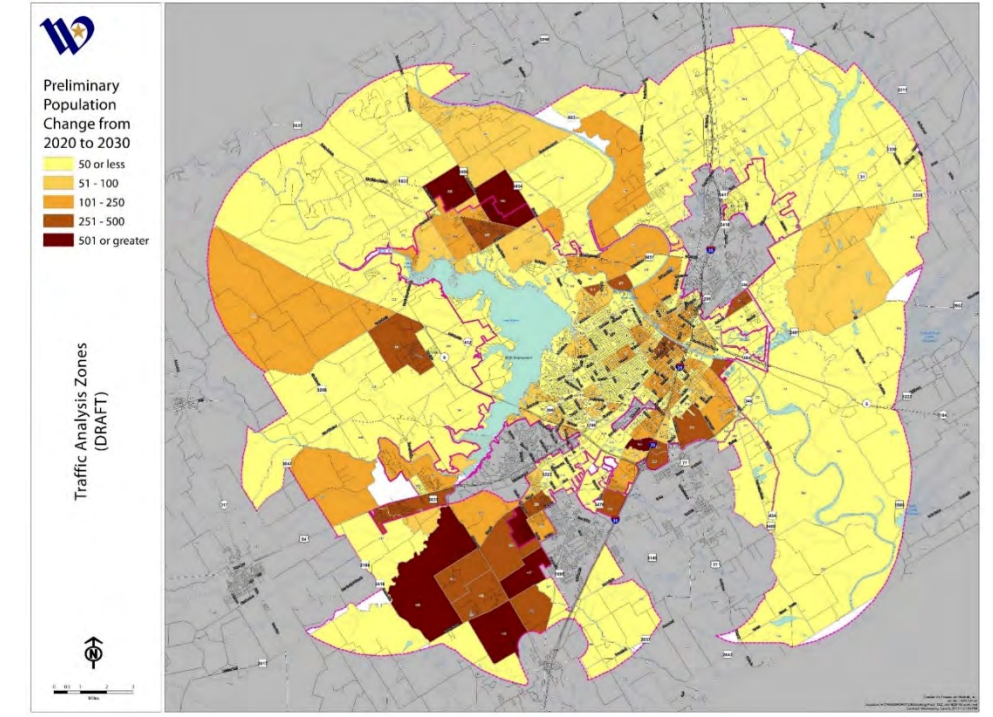
Freese and Nichols along with City Staff analyzed each TAZ. They looked at current development (what is already there), the potential for development (is there a big open field?), projected land use, and any specific projects that were known to be in the pipeline. Based on this analysis they were able to project growth in employment and population within specific TAZs. Here is an example of the result:
A quick side note, the land use assumptions used in this analysis come from Waco’s Comprehensive Plan 2040. This was the same plan that identified the impact fee policy as critical.
Now we know: a) expected new residents and employees in each TAZ and b) expected new pipe usage based on new residents and employees. Combining the two we know how much water/wastewater will be needed and where it will be needed.
4. Existing Supply & 5. New Projects
Now that demand is known geographically, Freese and Nichols along with City Staff were able to identify where the existing system would need to be upgraded to meet with the projected demand (this process involved a review of other recent studies focused on the subject). The result is a list of twenty-three water projects and seventeen wastewater projects. Here are some examples: a 16-inch water line at Peach Street, a 1.0 MG ground storage tank at the airport, a wastewater treatment plant in China Spring, and a lift station expansion at TSTC. Costs for each of these projects were calculated based on the rules established by Chapter 395 (which is fairly specific about what kinds of costs may or may not be included).
Since impact fees cannot be used to support existing development or development that will take place over 10-years from now, the report takes each of these projects and determines what percentage of the project’s capacity would be used right now, and what percentage would be used in 2030. For example, the 16-inch water line at Peach Street would be used at 25% capacity today and 60% capacity in 2030. That means 35% of the project cost can be considered to be the cost of new development between 2020 and 2030.
Combining all the allowable costs together, the report then applies a 50% credit to the costs. This credit is meant to represent the future tax revenues that will come from the increase in development. Essentially it represents how the new development will “pay” for these improvements through the regular tax process rather than the impact fee.
At the end of this process we have the total eligible impact fee cost – the total cost of increased capacity due to new demand after consideration of a credit for future taxes (water – $23,013,034, wastewater – $45,587,622). But how do we divide those costs up so that individual developments pay for them as they come into existence?
6. Service Unit
Chapter 395 calls for the establishment of a “service unit.” It defines “service unit” (in broad terms) as a standardized measure of consumption. Since it would be virtually impossible to determine the exact number of residents or employees a development would have, we cannot use the same metric we used to connect demand and supply (MGD per resident and MGD per employee).
Ultimately, for this study the connection of a single-family residence was used as the base service unit. The study then measures all other kinds of water and wastewater connections on the scale of single-family residence equivalents (on the basis of average flow). For an example a business park connection might be considered equivalent to ten single-family residences since ten times the amount of water flows through it (this is not a number used in the study, but rather a nice round one for an example).
7. Maximum Impact Fee
Knowing our service unit and our total eligible costs, the final step can be taken. A projection is made of the total new service units anticipated by development (in much the way step 3 proceeded). In the case of water and wastewater that number is 12,753. That is, the study anticipates that 12,753 “single-family resident connection equivalents” will be added to the water and wastewater system over the next ten years. With that number in hand, it is a simple matter of division to determine the maximum impact fee. The chart below completes the process.
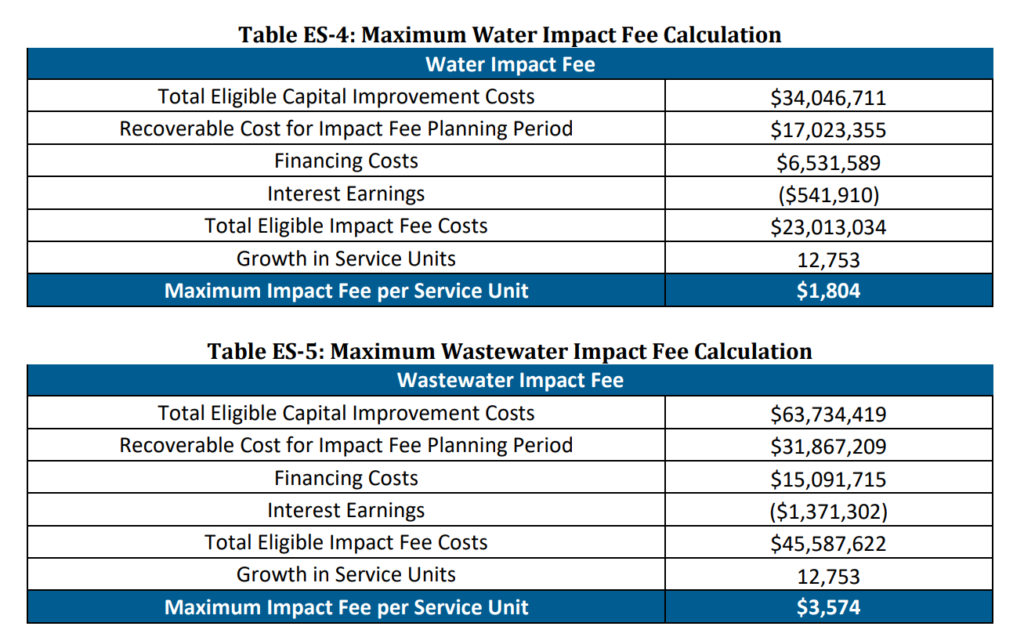
Here we see that after all these steps the maximum impact fee allowable by law for water is $1,804 and for wastewater is $3,574. These numbers are the final product of that could process we discussed at the very beginning of all of this. Whatever the outcome of the should process is, the impact fees cannot exceed these amounts for a single-family residence connection equivalent.

Jeffrey Vitarius has been actively local since early 2017. He lives in Sanger Heights with partner (JD) and his son (Callahan). He helped found Waco Pride Network and now serves as that organization’s treasurer and Pride Planning Chair. Jeffrey works at City Center Waco where he helps keep Downtown Waco clean, safe, and vibrant. He is a member of St. Alban’s Episcopal Church and graduated from Baylor in 2011.
The Act Locally Waco blog publishes posts with a connection to these aspirations for Waco. If you are interested in writing for the Act Locally Waco Blog, please email [email protected]for more information.
By Olivia Evans
More and more jobs are requiring a technical certificate or a college degree. To meet the demands for a more skilled workforce, McLennan Community College offers a variety of classes and programs to help adults in the Waco community develop skills to match the jobs available in the area. These free classes served over 900 adult students in the 2019-20 academic year. MCC’s Adult Education and Literacy (AEL) program offers various pathways and classes including:
- High School Equivalency (HSE) Preparation Classes (formerly GED) improve basic skills in preparation for the High School Equivalency Test.
- English as a Second Language (ESL) Classes equip English language learners with the skills needed to advance in their careers and participate fully in their communities.
- Transition Classes help students improve their workplace and/or college preparedness skills.
- Career Pathway Classes provide college and workplace readiness in an in-demand career field.
In the midst of the COVID-19 pandemic, the AEL program has continued its commitment to help the Waco community achieve their educational and career goals by making swift changes to adjust to the new circumstances. “Within three weeks, our small staff completely switched to remote classes using the Zoom platform,” said AEL Instructor Margie De Laurell.
Currently, all 30 classes offered are held virtually. Despite these unprecedented times, the AEL staff is dedicated to ensuring that individuals in Waco, who are looking to advance themselves in their careers and education, are able to do so. Student success includes adjustments and additional learning not just from students but from instructors as well. “English-language learners and many of our instructors learned how to use their devices like never before! Digital literacy has always been part of the curriculum, but thanks to the pandemic, we all got a crash course,” said De Laurell.
AEL classes are free and open to anyone over the age of 18. There is no cost to community members other than time and dedication. All of the AEL students are extremely hardworking and exemplify the work ethic and positive mental outlook that is required to succeed under very challenging circumstances, including a global pandemic.
“As instructors, we are constantly inspired and motivated by our learners’ perseverance, courage, and resourcefulness,” said De Laurell.
For more information about registration AEL programs, call (254) 299-8777 or visit www.mclennan.edu/adult-education-programs/.

Olivia Evans is an intern in McLennan Community College’s Marketing and Communications office. She is a senior at Baylor University studying Public Relations and Corporate Communications. Olivia is a Houston, Texas native and plans to work in sports and entertainment digital marketing.
The Act Locally Waco blog publishes posts with a connection to these aspirations for Waco. If you are interested in writing for the Act Locally Waco Blog, please email [email protected]for more information.
By Jack Hill
I recently completed poll working training in anticipation of working Early Voting and Election Day sites. I was shocked to learn that, although Waco has mask requirements in place for all restaurants and bars, masks will not be required for anyone who votes, neither during Early Voting nor on November 3rd. Rather, signs will be posted outside voting sites stating only that “masks are recommended.”
Gosh, I wanted to help out, but it is too risky to do so given the lack of safeguards for poll workers in Texas. According to the CDC, three factors especially facilitate the spread of Covid-19: being in
- crowds,
- enclosed spaces with others with limited ventilation and,
- an enclosed space with persons who are not wearing masks.
Evidence indicates that Covid-19 is primarily spread by aerosols—microscopic particles produced when we cough, talk loudly, yell or sneeze. Aerosols may remain in the air long after persons who emitted them have left the vicinity. They may also travel well beyond six feet.
To work in any enclosed space, virtually non-stop for 5-12+ hours, for the 18 consecutive days of Early Voting —in which individuals are permitted to come and go without wearing masks—is not only unnecessary from a public health standpoint, it is like playing Russian roulette—you may not get the bullet, but then again, you may.
Several states, such as Colorado, have state-wide mask mandates in place. Texas is not one of them
The nonpartisan organization, Mi Familia Vota, together with the Texas NAACP, have filed a lawsuit to protest the state of Texas’ decision to tolerate voters who refuse to wear a mask on Election Day. But even in states, like New York, which also do not require masks, it is recommended that each polling site have an isolated area where poll workers in special protective gear can assist voters who are unwilling to wear a mask.
This is a state-level decision. Come on fellow Texans, call Governor Abbott (512- 463-2000). We can do at least as well as New York!

Jack A. Hill is a political activist and Emeritus Professor of Religion and Social Ethics at TCU, where he taught for the past two decades. Prior to coming to TX, he resided in the Caribbean, the Fiji Islands and Southern Africa for 15 years of an international teaching career. He was the first U.S. born Christian Church (Disciples of Christ) Partner in Mission to be ordained by a church overseas—the Jamaican Disciples of Christ (April 8, 1980). He has written eight books, including Ethics in the Global Village: Moral Insights for the Post 9-11 U.S.A. and I-Sight: The World of Rastafari. He was a Fulbright Scholar (Distinguished Chair) in Scotland and served as President of the American Academy of Religion in the Southwest. He has two daughters and six grand-children. Dr. Hill resides in Waco with his wife, Katherine Logue.
By Alicia Jallah
These are challenging times we are currently in. There have been significant changes that we all have had to make to our lifestyles in order to adapt to the COVID-19 pandemic. Even with these changes many in our community are still struggling to meet basic needs such as housing, food and utilities because of unemployment, underemployment and/or trying to catch up on bills that accrued during the shelter-in-place order.
At Caritas we are grateful that we are able to stand in the gap and help those who are having to make difficult decisions during this season.
Do you need assistance or know someone who does? Here is how we can help.
Veterans Case Management
- Veterans receive specialized assistance through a grant provided by the Texas Veterans Commission. Our case manager Mr. Harris, assists with financial needs such as housing, utilities and childcare. He can be reached at 254-753-4593 ext. 233 or [email protected].
COVID Case Management
- Those that have been personally affected by COVID due to layoffs, diagnosis, etc. can receive financial assistance funded by the COVID-19 Community Response Fund created by the Waco Foundation and United Way of Waco-McLennan County. To receive more information about qualifications you can call Ms. Ramon at 254-753-4593 ext. 226 or [email protected].
“I lost my job due to Covid-19, I was in panic mode and unemployment was a mess. I applied and it took months before I even heard from someone. I am a single mom with two kids, it was really rough. I called Caritas and was connected with a Caritas case manager that day and she answered all of my questions immediately. Caritas was able to pay my utility and mortgage bills. It gives me hope to have an organization like Caritas in our community.” — Sabrina, Caritas Client
Utility Assistance
- When funds are available we are able to assist with utilities call the main line at 254-753-4593, to hear more information about qualifications and current assistance.
Food
- Our drive-thru food distribution occurs Monday- Friday from 8:30-11:00 and 1:00-2:00 (weather permitting). The drive-thru line is on the front side of the building facing Mary street and wraps around 15th street. The food will only be loaded into the trunk. Please, make sure that trunks are empty before getting in line. Households can come twice a month and will be asked for a photo id.
Employment Case Management
- We work directly with employees to find and maintain employment. Our case manager, Ms. Tyler can help employees with financial assistance for transportation, housing and child-care. She can be reached at 254-753-4593 ext. 234 or [email protected].
Hidden Treasures
- Our Hidden Treasures thrift stores offer low cost options for our community. They carry household essentials, clothing, furniture and more. Our stores are located at 3912 Bosque Blvd and 3016 Bellmead Dr and are open Monday-Friday, 12:00-6:00 and Saturday, 10:00-6:00.
SNAP
- We offer enrollment assistance for state and federal programs. Clients are individually guided through the application process online or with paper applications. Ms. Morales can be reached at 254-753-4593 ext. 204.
Those who would like to join us in the fight against poverty and food insecurity can do so in various ways. Join us by volunteering your time in the distribution line by loading the food into the trunks of our clients. We need a lot of food to meet the needs; individuals, business and organizations can host food drives for us. Our common needs are pop-top cans of soup and proteins, grains such as noodles and oats and kid-friendly items like applesauce, mac-n-cheese and granola bars. Those who would like to be financial supporters can do so on our website caritas-waco.org or mail checks to 300 S. 15TH St. Waco, Tx 76701.
We could not do this without the continued support of our community and donors. Even during these challenging times, we have seen the best of humanity come together to support those who have been affected the most.
We hope that you and your family stay safe and well!

After earning her Masters of Arts from Denver Seminary, Alicia Jallah, entered the non-profit world to act on her calling of providing dignity and respect to those struggling in poverty. She currently has the privilege of serving as Co-Executive Director at Caritas of Waco. When she is not working you can find her in the glorious outdoors with her husband and son.
he Act Locally Waco blog publishes posts with a connection to these aspirations for Waco. If you are interested in writing for the Act Locally Waco Blog, please email [email protected]for more information.
(press release)
When COVID-19 forced the cancellation of Family Abuse Center’s annual fundraising event, Dancing with the Waco Stars, two donors committed to match up to $40,000 of all donations given before December 1.
The fundraiser, which is live online as Donating with the Waco Stars, has already raised over $8,000 in donations for the Waco shelter.
“The annual fundraiser is crucial for Family Abuse Center because the donations are used to fund expenses that aren’t covered by grants,” Executive Director Kathy Reid said. “Expenses like gas to drive survivors to medical appointments or work clothes for a survivor who is starting a new job.”
In 2018, 211 Texans were killed by their intimate partners.1 According to the National Coalition Against Domestic Violence, one in three women and one in four men have experienced some form of physical violence by an intimate partner.2
Lisa and Larry Jaynes, the donors responsible for the match, said among other reasons, they support Family Abuse Center because it provides a desperately needed service to its community.
“The many programs offered [at Family Abuse Center] are available to hundreds of individuals in our area to help them start a new life without being exposed to the constant abuse of themselves and their children,” Lisa Jaynes said.
Join Family Abuse Center in the fight against domestic violence by donating today and doubling your impact at FamilyAbuseCenter.org/Donate.
To learn more about Donating With the Waco Stars, visit https://www.familyabusecenter.org/dwtws2020/.
For more information about Family Abuse Center, email [email protected] or call 254-772-8999 for more information.

About Family Abuse Center – For 40 years, Family Abuse Center has worked to eliminate domestic violence in Central Texas by sheltering victims of domestic violence and by preventing abuse from occurring through intervention and education. If you or someone you know is at risk, please call Family Abuse Center’s 24-hour hotline at 800-283-8401.
Happy fall, y’all! I hope everyone is enjoying the cooler weather as much as I am.

The fruit I will feature in this blog is often mistaken as a vegetable, an all-time favorite the pumpkin. Pumpkins bring forth a bit of nostalgia, thinking of my late grandmother who would give us sun-toasted pumpkin seeds. I enjoy observing the anticipation and excitement of all things pumpkin spice.
Did you know eighty percent of our United States pumpkin supply is available in October? Let’s not forget our pumpkin patches, fall décor, children’s activities, and oversized sweaters. I look forward to all the new and creative ways individuals and communities will embrace the season while practicing social distancing.
Select pumpkins that are firm and heavy. Look for those with a one to two-inch stem, those with small stems will decay faster. Avoid those with soft spots or blemishes. Pumpkins may last up to two months when stored in a cool, dark, and dry location.
Canned pumpkin is also an option. Pumpkins can also be purchased canned and are safe to consume past the expiration date so long as the can is free of dents, swelling, or rust. For decorative purposes, keep in mind lopsided pumpkins are not necessarily bad.
Pumpkins are 90% water. They’re low in calories, fat free, cholesterol free, saturated fat free, sodium free, high in vitamin A, and a great source of vitamin K.
Get the Facts!
Wash your hands as recommended by the CDC, and clean contact surfaces often.
The U.S. Department of Agriculture MyPlate provides recipes, tips, and resources to guide you in creating a healthy eating plan. Start simple, download the MyPlate App, an easy-to-use app that will help guide you and track your progress.
Enjoy the tasty recipes below:

Pumpkin Smoothie in a Cup
Prep Time: 5 minutes
Serving: 1 cup
Ingredients:
2/3 cups low-fat vanilla yogurt or 1 six ounce container
¼ cup canned pumpkin
2 teaspoons brown sugar
¼ teaspoon cinnamon
1/8 tea spoon nutmeg (optional)
Instructions:
Combine ingredients in a bowl or blender
Mix until smooth
Serve or refrigerate within 2 hours
Enjoy!
Additional suggestions:
Add granola
Excess canned pumpkin can be frozen
Low-Fat Pumpkin Bread

Prep Time: 15 minutes
Cooking Time: 1 Hour
Serving: 20 Slices
Ingredients:
1 ½ cup of whole wheat flour
1 1/3 cup all-purpose flour
2 teaspoons baking powder
1 teaspoon of baking soda
½ teaspoon salt
1 teaspoon of cinnamon
½ teaspoon of grown cloves
¼ teaspoon of ground ginger
¼ teaspoon nutmeg
4 eggs
1 cup canned pumpkin
1 cup applesauce
¾ cup packed brown sugar
¾ cup sugar
Directions:
Preheat the oven 350 degrees
Lightly coat an 8 ½ x 4 ½ inch loaf pan with cooking spray oil and set aside
Combine flours, baking powder, baking soda, cinnamon, salt, cloves, ginger and nutmeg in a medium bowl (dry ingredients)
Combine eggs, pumpkin, applesauce, brown sugar and sugar in a separate bowl and mix (wet ingredients)
Combine wet and dry ingredients. Careful not to over mix
Pour batter onto pan and spread into the corners
Bake for approximately 60 minutes or until a wooden pick comes out clean when inserted in the middle
Remove from oven and cool for 10 minutes
Remove loaf from pan and slice
Wrap and freeze leftovers for up to one month
Enjoy!
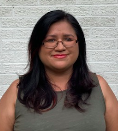
Paula Solano is a Master in Public Health student at Baylor University, a certified Community Health Worker, and is volunteering at the Texas A&M AgriLife Extension Service. A Waco native, she is passionate about serving her community, particularly the underserved and underrepresented.
Due to the continued spread of COVID-19 and the challenges it poses to communities across Texas, Texas A&M AgriLife Extension and many others continue to practice public health recommendations. Whether we are communicating online or face-to-face know that program content will always be research-backed to help individuals navigate decisions for themselves and their families. For information on resources, ideas, and programs for yourself and family visit Texas A&M AgriLife’s HUB.
USDA is an equal opportunity provider and employer. This material was funded by USDA’s Supplemental Nutrition Assistance Program — SNAP. To learn more about the Supplemental Nutrition Assistance Program (SNAP) or to apply for benefits, visit www.yourtexasbenefits.com
References:
Food Hero (2020) Recipes. Retrieved from: https://foodhero.org/recipes/pumpkin-smoothie-cup
Texas A&M AgriLife Extension (2020) Vegetable Fact Sheet Guide. Retrieved from: https://mail.google.com/mail/u/0/?tab=wm#search/lindsey/FMfcgxwJXLmlTmrsWggKBbBkJgmzwHJC?projector=1&messagePartId=0.5
U.S. Department of Agriculture (2020) Pumpkins. Retrieved from: https://snaped.fns.usda.gov/seasonal-produce-guide/pumpkin
University of Illinois Extension (2020) Pumpkins and More. Retrieved from: https://web.extension.illinois.edu/pumpkins/selection.cfm
City of Waco
Strategic Communications Workgroup
MEDIA RELEASE
Ten Waco organizations are partnering with Heart of Texas MHMR to promote free, confidential mental health services available to all Central Texans. Mental health needs have risen with COVID-19, and these organizations want community members to know there is help available at no cost to the recipient.
Heart of Texas MHMR is participating in the Texans Recovering Together Crisis Counseling Program that provides short-term interventions to help people impacted by COVID-19. The program is available to anyone impacted by COVID-19 and is designed to reduce stress and provide emotional support, as well as connect folks with other agencies that can help in the recovery process. All services are free, anonymous, confidential, and available by virtual visit.
While many organizations are working together to promote a safe, healthy environment during the COVID-19 pandemic, mental health can’t be overlooked. The uncertainty brought on by the virus coupled with job loss, financial burdens, education complexities, and health concerns has led to an increase in stress, anxiety, and other mental health needs across the county. Texans Recovering Together is here to help our community get through this crisis.
The organizations participating in the campaign include McLennan Community College, United Way of Waco-McLennan County, Prosper Waco, Baylor University, Cen-Tex Hispanic Chamber of Commerce, Cen-Tex African American Chamber of Commerce, Greater Waco Chamber of Commerce, Waco Foundation, the City of Waco, and McLennan County.
Each participating organization will promote a series of social media posts on specific days in an effort to widely spread messaging about mental health assistance. The Communications Co-op, co-funded by the City of Waco, Greater Waco Chamber of Commerce, and Waco Foundation, will provide grants to each organization for social media promotion of the mental health campaign.
The Strategic Communications Workgroup is one of four committees established by Mayor Kyle Deaver in an effort to provide accurate information to all residents of Waco and McLennan County.
For more information, contact Natalie Kelinske, director of communications & donor services for Waco Foundation, at [email protected] or 254-754-3404.