NEWS RELEASE
Census takers are working to follow up with Waco and McLennan County households that have not yet responded to the 2020 Census.
The current self-response rate in McLennan County is 58.5%. The Census Bureau will need to visit the remaining addresses to collect responses in person.
Households can still respond now by completing and mailing back the paper questionnaire they received, by responding online at 2020census.gov, or by phone at 844-330-2020. Households can also respond online or by phone in one of 13 languages and find assistance in many more. Those that respond will not need to be visited to obtain their census response.
Protecting Health and Safety
The Census Bureau and the Centers for Disease Control (CDC) are working together to protect the health and safety of the public and employees. Participation in 2020 Census interviews should present a low risk of transmission of COVID-19.
Census takers are trained to rigorously and universally follow these CDC recommendations to mitigate the risk of transmission:
- Wearing face masks
- Maintaining social distance of 6 feet or more
- Practicing hand hygiene
- Not entering homes and conducting interviews outside as much as possible or practical
Household members encountered by census staff are encouraged to maintain social distances during interviews and practice the CDC’s other recommendations as much as possible.
Joint statement from the Census Bureau and the CDC
What Households Can Expect
Census takers are hired from local communities. All census takers speak English, and many are bilingual. If a census taker does not speak the householder’s language, the household may request a return visit from a census taker who does. Census takers will also have materials on hand to help identify the household’s language.
If no one is home when the census taker visits, the census taker will leave a notice of their visit with information about how to respond online, by phone or by mail. People are encouraged to cooperate with census takers and ensure that everyone who was living in their household as of April 1, 2020, is counted.
How to Identify Census Takers
Census takers can be easily identified by a valid government ID badge with their photograph, a U.S. Department of Commerce watermark, and an expiration date on the badge. To confirm a census taker’s identity, the public may contact the Denver/Dallas Regional Census Center at 972-510-1800 to speak with a Census Bureau representative.
Media requesting b-roll video or photos on how to identify a Census employee can visit this press kit: https://www.census.gov/newsroom/press-kits/2020/b-roll.html
About the 2020 Census
The U.S. Constitution mandates a census of the population every 10 years. The goal of the 2020 Census is to count everyone who lives in the United States on April 1, 2020 (Census Day). Census statistics are used to determine the number of seats each state holds in the U.S. House of Representatives and informs how billions of dollars in federal funds will be allocated by state, local and federal lawmakers annually for the next 10 years.
For more information, visit 2020census.gov.
By Jeffrey Vitarius
(Civic meetings happen in Waco every week – city council, school board, planning commission, and countless others. Decisions from these meetings affect our lives every day. Many of us are curious about these meetings, but to be honest, it’s just too hard to decipher the jargon and figure out what’s going on and why it’s important. Act Locally Waco is trying something new in August! Jeffrey Vitarius follows civic meetings for his work and out of personal interest. Each week in August he will pick a meeting in our community and highlight one or two items from the agenda to translate from “government-ese” into language we can all understand. We’re calling the series “Meeting Insights.” Let us know what you think! If you enjoy it, we will try to keep it going! — ALW )
The Waco City Council meets every other Tuesday. The work session starts at 3:00, that is where most of the explanation and discussion happens. The business session is at 6:00, that is when the council takes action (votes). The public is invited to attend either or both of these sessions, although, for the time being due to COVID-19, that attendance is virtual through the Waco City Cable Channel (WCCC.TV/live) with public comments sent in ahead of time. Today we will highlighting Ordinance Agenda item 2…the Waco Tourism Public Improvement District (TPID).
Meeting Basics
- Work Session – 3:00 pm / Business Session – 6:00pm
- To watch the live stream click here (City of Waco Cable Channel, wccc.tv)
- For the full agenda click here
- For the meeting packet with the documents pertinent to the meeting click here. Quick note on page numbers: the numbers I will be referring to below are the “packet page numbers” found on the bottom right corner of each page of the meeting packet. These do not always match the number of the page in the pdf. One neat aspect of the packets the city builds for city council meetings is that you can click on the agenda item on the agenda page of the packet and it will take you directly to the relevant materials.
- Details on how to provide public comment are listed in the agenda
A Waco Tourism Public Improvement District (TPID) – A Whole New Kind of District
Ordinance Agenda Item 2 – ORD-2020-576 – Consider an ordinance approving and adopting the final service plan for the Waco Tourism Public Improvement District (“TPID”) for Fiscal Year 2020-21, levying special assessments on properties in the TPID to pay for the costs of services provided in accordance with the final service plan, setting charges and liens against property in the district and against the owners thereof, and providing for the collection of the special assessments. SECOND READING
You may notice that certain items on City Council agendas are labeled “first reading” or “second reading.” This indicates that the item under consideration needs to come to council twice before it can receive a final vote. That is how the Waco Tourism Public Improvement District (TPID) has found itself on two consecutive City Council agendas.
For some of you the “PID” acronym may ring a bell. PID stands for “Public Improvement District.” Waco already has two other Public Improvement Districts. The one you have most likely heard of is the Downtown Waco PID. In really broad terms, a PID is a special district created by a city or county. It allows for the collection of an assessment from properties within a certain geographic area. An “assessment” is kind of like a tax – it’s not exactly the same thing, but that’s an easy way to think of it. The money from the assessment is used to provide services to the property owners in the district. These services supplement what the city or county is already providing. For example, the Downtown Waco PID uses some of its assessment to pay for additional cleaning (grackle poop!) and security downtown.
Similar to the way the Downtown Waco PID supports Downtown, the proposed Waco Tourism Public Improvement District (TPID) would support tourism and visitors across Waco.
The city council endorsed the idea of creating a TPID back in November of 2018 (Trib articles here and here). In June of 2019, a bill allowing for the creation of such a district was filed by the Texas legislature (HB1474).
The next step for the organizers of the TPID was to acquire signatures from property owners representing both 60% of the value of the hotels that would be within the district and 60% of the area of the hotels that would be within the district. That hurdle was cleared in June 2020 (receiving endorsements from 85% of the value, and 79% of the area). Now the city council is considering the TPID’s service and assessment plan – basically the plan that explains what they intend to do with the money collected by the TPID.
I spoke with Carla Pendergraft, the Director of Marketing, at the Waco Convention and Visitors Bureau, about the fine points of what the TPID could do for Waco and am indebted to her expertise for the explanation that follows.
What is a Tourism Public Improvement District (TPID)? And why would we want one? In the broadest sense, it is a way for local hotels to pool resources and encourage folks to visit Waco. The proposed TPID will be made up of all Waco hotels with more than seventy-five rooms. This includes some of the anticipated hotels along that quiet zone corridor we talked about last week. At the moment, there are twenty-seven hotels that have or will have at least seventy-five rooms (there is a full list on page 314 of the meeting packet). The TPID will collect a 2% assessment on each night stay at one of these hotels and then use those assessments to fulfill its service plan. (Note: Technically the City collects the assessment and then provides it to the TPID).
So, let’s say a family member is visiting from out of town and their hotel room costs $100 per night (for a nice round number). At the end of their stay, they will also be contributing $2 per night to the TPID (2% of $100). Ultimately, there should be no direct cost to the hotels in the district.
The TPID is projecting to collect $1,576,067 in funding next year, though this projection is based upon pre-COVID data so it may change in a substantial way.
So how will the TPID contribute to Waco’s visitor and tourism economy? The service and assessment plan breaks it down into four areas (you can find a more details on pages 311-313 of the meeting packet):
- Marketing – Increased marketing through a wide variety of means to promote the hotels in the district. In particular, the ability of the TPID to pool resources should allow for access to larger digital media markets. (45% of funding)
- Sales Initiatives – One of the key takeaways from my discussion with Ms. Pendergraft is that the visitor and tourism market is made up of several different groups. There are leisure tourists (those traveling just for fun), the convention crowd, business travelers, bus trips, etc. Each of these different groups requires a little bit of a different strategy. Groups (conventions, bus trips, etc.) that bring more people per trip, and therefore more economic impact per trip, are particularly interested in sales incentives. These incentives may look like discounted rates at local hotels or the convention center. They might also include assistance with transportation, or even event sponsorship. The ability to pool resources through the TPID would make it possible for Waco to use a wide variety of tools to reach out to these kinds of “bulk” visitors. (40% of funding)
- Tourism Research – Research would help improve the effectiveness of the marketing and sales initiatives noted above. Research might mean gathering information about what specific markets to target for marketing or how particular events impact the Waco’s economy. (8% of funding)
- Administration – This would include things like an annual audit and bookkeeping. (7% of funding)
So, if the City Council approves the creation of the TPID and the service and assessment plan, what happens next? The hotels included the district will most likely to form a non-profit organization that would be charged with directing the services of the TPID and preparing the annual service and assessment plan. This non-profit would enter into a contract with the City to receive the funding and staff support from the hard-working folks at the Convention and Visitors Bureau. The board of this to-be-formed non-profit would be made of a diverse group of hotel representatives with Mr. Todd Bertka (Director of the Waco Convention and Visitors Bureau) representing the City in a non-voting role.
If all works out as it is intended, the TPID could provide significant support to a critical part of Waco’s economy just as it faces a particularly daunting crisis.
Other Interesting (to me) items from the Agenda:
- There are a number of public hearings related to planning at Council this week, things like zoning, subdivisions, short-term rentals. These kinds of items go through a separate group, the Plan Commission, first before making their way to council for final approval. The next scheduled Plan Commission meeting is on August 25th, so be on the lookout for post focused on that meeting soon.
- The city is aiming to reallocate $21,000 in unspent community development block grants towards assisting homeless folks in self-quarantining, a critical health protection for this community during COVID-19. The city had already allocated $10,500 to this program, but that funding is nearly spent.
- The tax rates we touched on two weeks ago have returned for a resolution establishing when the City Council will take their final vote to establish them (September 8th)
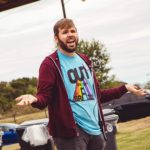
Jeffrey Vitarius has been actively local since early 2017. He lives in Sanger Heights with partner (JD) and his son (Callahan). He helped found Waco Pride Network and now serves as that organization’s treasurer and Pride Planning Chair. Jeffrey works at City Center Waco where he helps keep Downtown Waco clean, safe, and vibrant. He is a member of St. Alban’s Episcopal Church and graduated from Baylor in 2011.
The Act Locally Waco blog publishes posts with a connection to these aspirations for Waco. If you are interested in writing for the Act Locally Waco Blog, please email [email protected]for more information.
NEWS RELEASE
WACO — Prosper Waco Executive Director Suzii Paynter March announced that the local nonprofit is saying goodbye to one leading staff member and welcoming another.
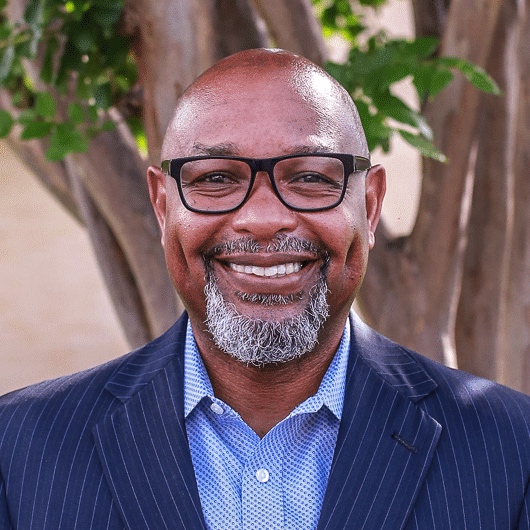
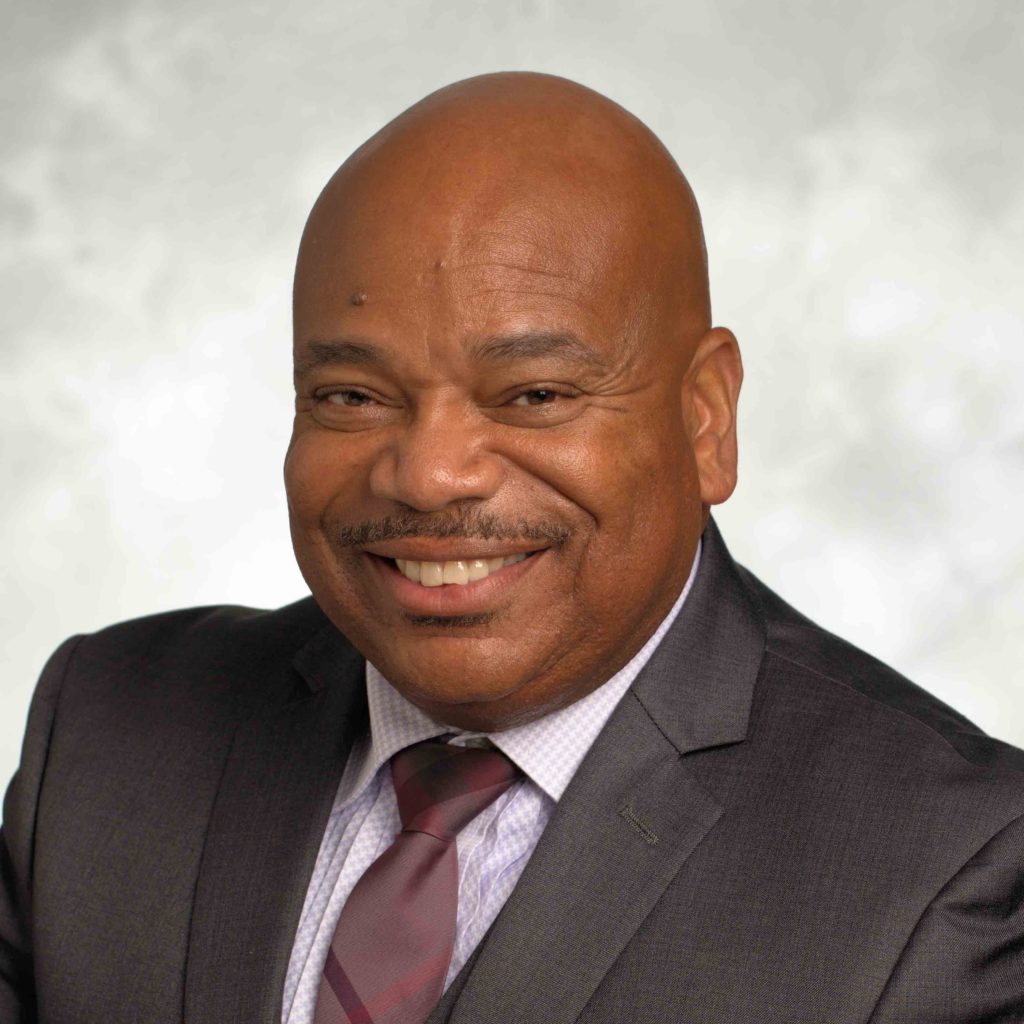
Dexter Hall joined the Prosper Waco staff July 28 as full-time chief of staff and senior content specialist for financial security. It is a new role at the nonprofit but will include many of the functions previously part of the Chief Operations Officer position.
Bryan Dalco left the part-time COO position July 31. Dalco is also a pastor, having recently moved from being pastor of One Fellowship Church in Waco to being pastor of St. James United Methodist Church in Temple and also serving in a new leadership role in the UMC Annual Conference. Dalco will continue to live in Waco.
“We are fortunate to have had Bryan as part of our collective effort in Waco, and we are now fortunate to have Dexter join us,” said March, Prosper Waco’s CEO. “Dexter’s background in banking and finance will help Prosper Waco to advance it’s priority of promoting financial security across Greater Waco. This is even more important now as we respond to the COVID-19 crisis and the economic challenges created for so many people.”
March expressed her deep appreciation to Rev. Dalco for his leadership and the strengths he has brought to Prosper Waco. “Bryan will continue to be a part of our Waco community, and we count on his friendship and involvement even as he leaves the Prosper Waco staff and launches out into his new areas of responsibility.”
In the new chief of staff position, Hall will provide direct support to CEO March and build strong relationships across the organization to optimize Prosper Waco’s resources, business process and administration. As a senior content specialist, he will develop, coordinate and execute projects and initiatives which advance benchmark indicators in financial security.
“I am happy to continue my work and lifelong heart’s desire to make our community, country and world a better place,” Hall said. “The City of Waco gave me birth, pride and my nucleus. I look forward to making our tomorrows better with Prosper Waco in improving the education, health and financial security of our citizens as we work to ensure equity for all.”
Rev. Dalco joined the Prosper Waco staff in April 2018. “I will always treasure my time with Prosper Waco because it has added so much depth to the call upon my life,” he said. “I’ve always felt called to work with people who have been disenfranchised and marginalized. However, much of my work had been done at ground zero with more of a hands-on approach. Prosper Waco gave me the opportunity to do this work from a much higher and broader perspective.
“To be a part of efforts that provided research and data analysis towards impacting systemic issues has been an extremely rewarding effort,” he said. “During my time at Prosper Waco I have learned a lot of things, but one of the most important things I take with me is the importance of collaboration. When we work together we get more accomplished together. Thank you for accepting me and working with me.”
Hall is a native of East Waco and was raised in Oakland, Calif. He is owner of Noir Kith Consultants, which provides business and consumer financial management consulting. Hall retired in 2019 after 28 years with Wells Fargo, his last position being regional banking district manager for Wells Fargo’s Texas Region covering the Waco-Brazos Valley market.
He holds a bachelor’s degree in business administration / public administration from California State University in Hayward. He sits on the boards of LeadersUp, Dr. Pepper Museum and Free Enterprise Institute, YMCA of Central Texas and Black College Expo (advisory board). Hall has three daughters from age 16 to 22.
Rev. Dalco is a native of Beaumont and holds a bachelor’s degree from Prairie View A&M University and master’s degree from Brite Divinity School. He has served several churches under appointment for 20 years in the Central Texas Conference of the United Methodist Church. Rev. Dalco is a mentor at South Waco Elementary School, a member of Waco NAACP and active in other community organizations.
He has served as executive director of two nonprofits in the Houston area. He is married to Tara and has four children.
By Lindsey Breunig-Rodriguez
Recently I have been thinking about the “Wild West” — a time when there was a lot of discovery and a lot of unknown. I must say, it somewhat feels like we are in a modern-day Wild West. I can only imagine how difficult it was to stay hydrated. Someone probably shared a water canteen and planned travels according to where the next water source would be.

Today we do the same when we camp, go hiking or walking, or are outside for an extended time. To avoid dehydration, we must actively think about drinking more water, and even more so in these hot summer months.
Thankfully, we do not have to solely rely on water; fruits and vegetables also provide us with water. This month we are highlighting a vegetable which consist of 95% water, making it a great source for extra hydration and is even named for its season. Introducing summer squash!
Nutrition:
Per USDA dietary guidelines it is recommended we consume 3 Cups of vegetables daily. Vegetables may be fresh, canned, frozen, or dried, and may be whole, cut-up, or pureed. It all counts!
Summer squash is a great source of vitamin C, which keeps our immune system strong and helps our bodies heal quickly. Additionally, summer squash is fat free, saturated-fat free, sodium free, cholesterol free, and low in calories (around 20 calories in 1 cup). It is not recommended to peel summer squash because most all the vitamins and minerals are found in the skin.
Shopping, Storage, and Preparation:
There are two types of squash: summer and winter. Today we are focusing on summer squash. There are many varieties of squash, some names you will see are: patty pan, yellow crookneck, yellow straightneck, chayotes, and zucchini. For all squash varieties, choose firm, glossy, small to medium-sized squash. Avoid squash that is soft, moldy, or sunken in spots. Though usable, larger squash tend to be less flavorful and tougher.
Right before using, wash squash by rubbing the skin under cool running water. Refrigerate summer squash for up to one week or freeze and use within three months. If freezing, cut it into pieces and blanch (placing vegetables in boiling water for a short time and then placing in freezing water.). For more instructions, read here.
Enjoy:
Due to its mild flavor summer squash can be prepared multiple ways. It is important, however, to remember that seasonings or other ingredients added to squash will change the nutritional value. Below are some ways to enjoy it:
Roast — Cut squash in slices and drizzle with olive oil and low‐sodium seasoning before placing on a baking sheet. Cook 10-15 minutes or until tender.
Grate — Add raw, grated squash to green salads, muffins, or cookies. Use a vegetable peeler to make ribbons in place of pasta noodles.
Grill — Pair squash with tomatoes, onions, mushrooms, peppers, or fruit.
Raw — Enjoy in salads or dipped in hummus or a low-fat dip.
Sauté — Heat pan to high, add oil to coat the pan and add sliced squash. Sauté until lightly brown, about 3‐5 minutes, or tender. Use as side dish or add to dishes like stir fry or pasta.
Check out these other tasty recipes too: Italian Spinach and Zucchini Meatballs or Baked Zucchini Sticks
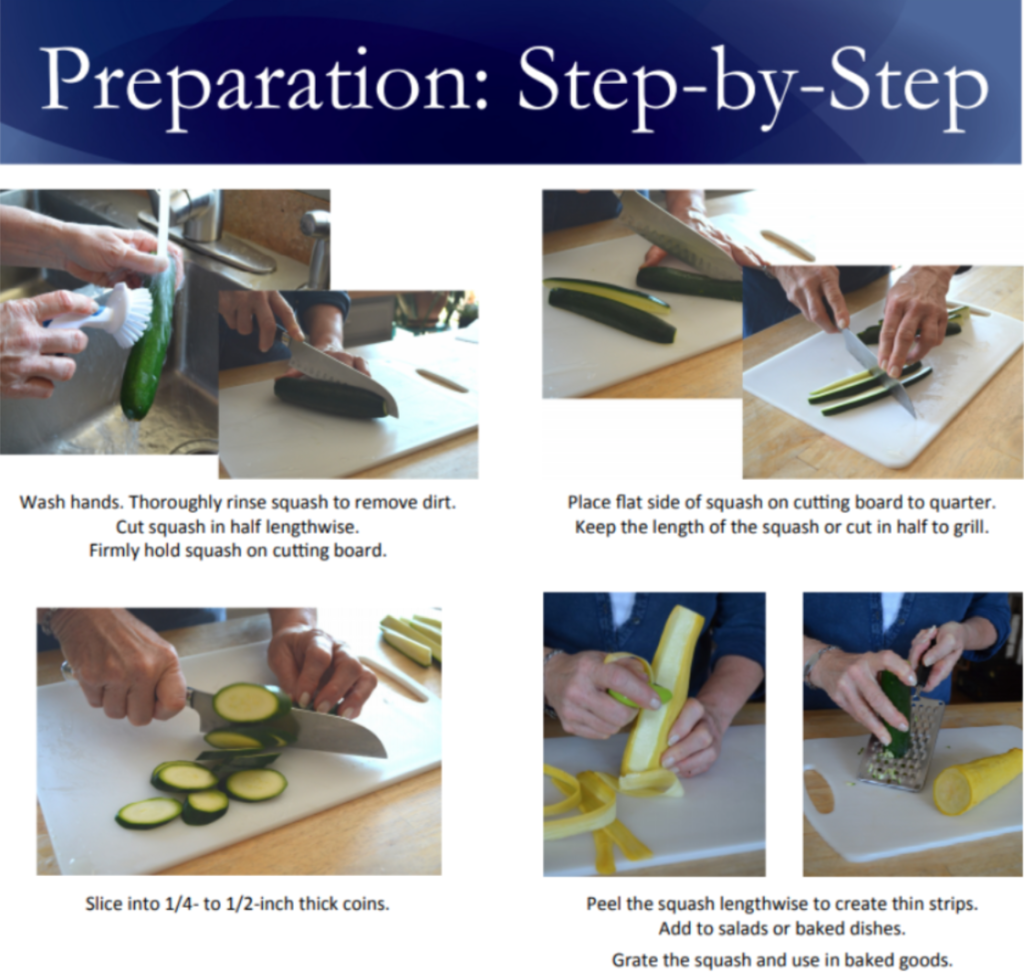
See below different ways to cut and prepare zucchini – thank you to Montana State University Extension for the graphic:
Texas A&M AgriLife Extension
Due to the continued spread of COVID-19 and the challenges it poses to communities across Texas, Texas A&M AgriLife Extension and many others continue to practice public health recommendations. Whether we are communicating online or face-to-face know that program content will always be research-backed to help individuals navigate decisions for themselves and their families. For information on resources, ideas, and programs for yourself and family visit Texas A&M AgriLife’s HUB.
USDA is an equal opportunity provider and employer. This material was funded by USDA’s Supplemental Nutrition Assistance Program — SNAP. To learn more about the Supplemental Nutrition Assistance Program (SNAP) or to apply for benefits, visit www.yourtexasbenefits.com
Lindsey Breunig-Rodriguez is an Extension Agent for the Better Living for Texans program with the Texas A&M AgriLife Extension Service. She is originally from Grapevine but now calls Waco home. A graduate from Baylor University, she loves to venture out to Cameron Park, visit the local Farmers Market, and try out the awesome eateries in Waco. If you see her and hear a loud bark, that’s her pup Lucy Ann just saying hello.
The Act Locally Waco blog publishes posts with a connection to these aspirations for Waco. If you are interested in writing for the Act Locally Waco Blog, please email [email protected] for more information.
By Jeffrey Vitarius
(Civic meetings happen in Waco every week – city council, school board, planning commission, and countless others. Decisions from these meetings affect our lives every day. Many of us are curious about these meetings, but to be honest, it’s just too hard to decipher the jargon and figure out what’s going on and why it’s important. Act Locally Waco is trying something new in August! Jeffrey Vitarius follows civic meetings for his work and out of personal interest. Each week in August he will pick a meeting in our community and highlight one or two items from the agenda to translate from “government-ese” into language we can all understand. We’re calling the series “Meeting Insights.” Let us know what you think! If you enjoy it, we will try to keep it going! — ALW )
The Board of Directors for Reinvestment Zone Number One For Tax Increment Financing (TIF Board) meets every other month on the second Thursday of the month. These are the folks that make recommendations to City Council about how TIF dollars should be spent. Before COVID-19 they would go on a tour of potential projects some time in the morning and then conduct their regular meeting at noon. The public is invited to the regular meetings, although, for the time being due to COVID-19, that attendance is virtual through the Waco City Cable Channel’s YouTube channel (WCCC.TV – YouTube) with public comments sent in ahead of time. There are a few interesting projects on the agenda this week, but we are going to dive into some background and look at how the TIF encourages development in a way you may not expect…silencing train horns in Downtown Waco.
Meeting Basics
- Regular Meeting – 12:00pm
- To watch the live stream click here (City of Waco Cable Channel YouTube channel)
- For the full agenda click here
- For the meeting packet with the documents pertinent to the meeting click here. I will refer to page numbers from this packet in the notes below.
- Details on how to provide public comment are listed in the agenda
A Study in TIF – the Downtown Waco Quiet Zone
Mention of the TIF invites questions. What is the “TIF”? How is it funded? Who allocates the funding and to what? Luckily, Waco 101 has already tackled a number of those topics here. Today we are going to zoom in on one example of a TIF funded project, and follow how that example has had an impact on the direction of downtown development, and potentially even the skyline of Waco.
It all starts with trains and their horns. The locomotives that make their way through Downtown Waco along Jackson Avenue are required to sound their horns as they approach any train track crossing. This is to alert folks that they are coming so they can make sure they are well out of the way. As any Wacoan who lives or works near the tracks can tell you, they certainly accomplish this goal. Everyone knows when the train is coming!
However, all this alerting makes it somewhat difficult to invite investment in the properties next to the tracks. An early morning horn makes these properties a hard sell to anyone looking to place hotel rooms or residences in Downtown Waco, and midday horns interrupt workflow in office spaces.
Enter “the quiet zone.”
The quiet zone amounts to improvements the City and railroad can make to the track crossings that provide sufficient safety so that the horns are no longer required (outside of certain specific circumstances, like construction). Unfortunately, the process of figuring out what improvements are needed and then constructing them can be costly. This is where the TIF makes the difference.
In the summer of 2017, city staff presented first to the TIF board and then to the City Council on the potential benefits of a quiet zone in Downtown Waco. Then City Manager Dale Fisseler noted that increased density of development in the area was an important potential benefit of the quiet zone. He pointed out that the quiet zone could “open up other sites along the railroad track for redevelopment.” That summer the TIF board recommended and City Council approved $450,000 in TIF funding towards the study of a quiet zone. The project essential broke down into three phases:
- Phase 1 – Feasibility – this is checking to make sure that creating a quiet zone is reasonable to do or “feasible”
- Phase 2 – Design – putting together the specific improvement designs
- Phase 3 – Construction
The $450,000 in TIF funding was intended to cover phases 1 and 2 of the potential project. Phase 1 was completed in December 2017 (per later presentations by city staff).
In the summer of 2018, staff produced a summary of the improvements that would be necessary for a quiet zone. Most of these improvements involve installing new crossing gates, efforts to make sure folks don’t drive around those gates (something called “channelization”), changes to Jackson Avenue (that runs parallel with the tracks), and pedestrian safety improvements.
In the fall of 2019, the project was ready to seek funding for phase 3. The TIF Board recommended and the City Council approved $1,528,807 in TIF funding for the construction of the improvements noted above. At the time, the project was estimated to be completed sometime in the fall of 2020 (it is possible COVID-19 has had an impact on this process).
The project has some benefits that do not involve any other development: improved safety at crossing, improved pedestrian connections, and decreased downtown disturbance from the horns.
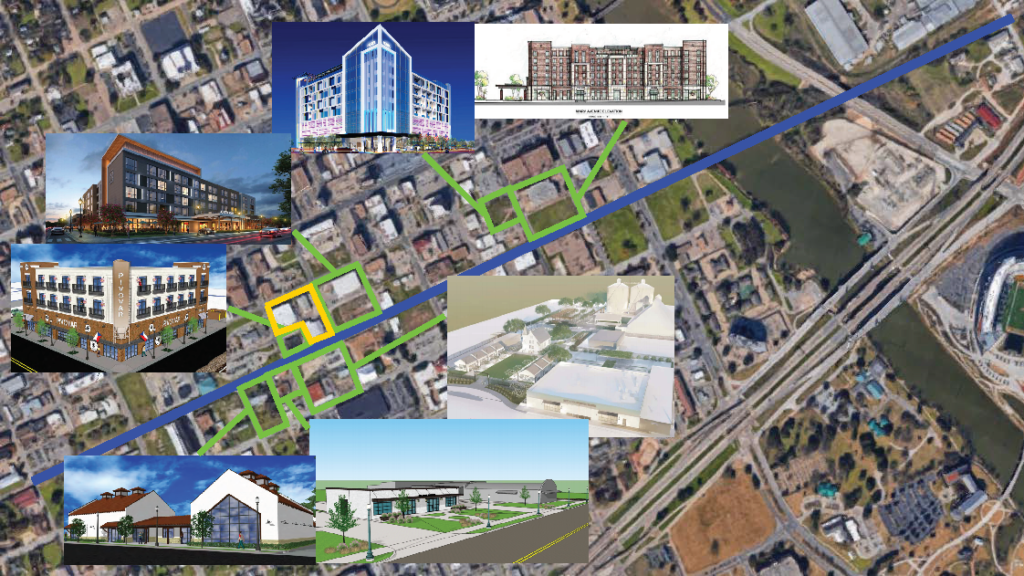
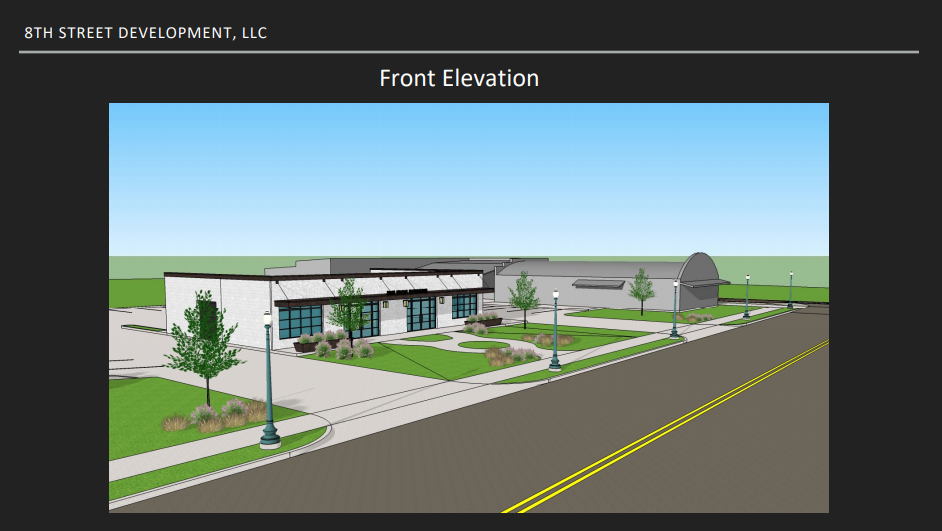
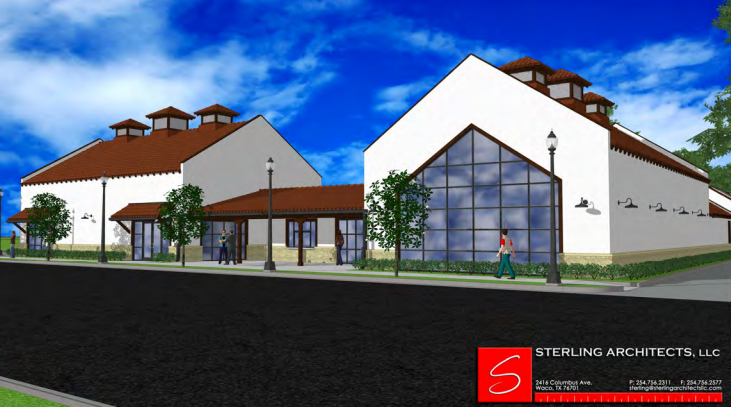
But perhaps, the biggest impact of the quite zone has been in making sites near the railroad track more appealing for development, just like City Manager Fisseler noted back in 2017. Since staff presented the improvements in the summer of 2018, seven projects have sought TIF funding (two this month) for developments right next to the tracks (see map below, the quiet zone in blue and the projects in green).
Before we move on, here are some critical caveats to keep in mind with TIF projects:
- A project being funded may not ultimately be completed. Lots of changes can happen between funding and completion (like a pandemic, for example)
- Sometimes completed projects can look different from their initial renderings.
- The information I have gathered here is from what I could find in the meeting packets from past meetings of the TIF board and City Council. It is possible that some details of these projects have changed since those packets were put together.
That being said, these seven projects represent a combined total private investment (not counting any TIF funding) of $93.9 million. They include 22,000 square feet of retail space, at least 709 new parking spaces (not all public), space for six new restaurants, and nearly 500 new hotel rooms. On top of all of this, a developer announced in June of this year intentions to build a set of office towers next to the tracks that might grow higher than the ALICO Building (site in yellow above). We can’t say for certain that these projects have come about because of the quiet zone, but the logic of less noise, more development and the timing of these projects is convincing for me.
Be on the lookout for more TIF-funded public projects like this that encourage economic development in particular parts of downtown.
Other Interesting (to me) Items From the Agenda
- This month’s agenda includes the annual board report for the TIF board. Each city board or commission produces one of these reports each year, and they can be a pretty good starting place for getting to know what that group has been doing and will do in the future.
- One of the best parts of any TIF board packet are the renderings. Below are those for the projects consider this month.
Jeffrey Vitarius has been actively local since early 2017. He lives in Sanger Heights with partner (JD) and his son (Callahan). He helped found Waco Pride Network and now serves as that organization’s treasurer and Pride Planning Chair. Jeffrey works at City Center Waco where he helps keep Downtown Waco clean, safe, and vibrant. He is a member of St. Alban’s Episcopal Church and graduated from Baylor in 2011.
The Act Locally Waco blog publishes posts with a connection to these aspirations for Waco. If you are interested in writing for the Act Locally Waco Blog, please email [email protected]for more information.
By Deneece Ferrales
It is with great regret and sadness that I write this post about the passing of Christian Kelly Aguilar, BSW. Christian was an active member of the Waco community, devoting his time and talents to social justice and equity. A vital member of the gay community, Mr. Aguilar was supportive of his peers and advocated for LGBTQ rights as well as the rights of persons with mental illness, criminal histories, women and children, and the elderly.
Mr. Aguilar completed his BSW degree with honors at Tarleton State University in the Social Work program on the Waco campus in May of 2019. He was scheduled to graduate on August 7 with his MSW. It was during his time in the social work program that I came to know Christian as his teacher, faculty mentor, and finally as a proud colleague and friend. I have enjoyed the privilege of teaching and mentoring many bright students over the past 8 years that have graduated and become valuable professionals in our community. However, I felt compelled to write about Christian because his impact on others and on me was so strong that I believe his contributions deserve public recognition. I first met Christian when he enrolled in the social work program at Tarleton on the MCC campus in the Fall of 2017. Christian immediately showed his leadership ability through becoming an officer of the Waco Student Social Work Association. Through this work, his community work, and his work in the classroom, I got to know an incredibly strong and committed young man. I will always treasure the gift he gave me by allowing me to mentor him.
Perhaps the most memorable thing about Christian was the impact he had on people. To say that he offered support to his colleagues would be an understatement. One of his fellow students, Stefani LeBlanc, stated, “Christian has forever left an imprint in my life. I can only hope that I can take what I have learned from him and be as great as I know he would have been.” Stefani went on to say that “He was a source of support for many in the LGBTQ community. Over and over I have read people’s stories of his unwavering support, even despite his own battles belonging to the (LGBTQ) community.”
He was close to and supportive of his colleagues. His colleagues respected him so much that he became president of SSWA Waco his senior year. He was described by one of his instructors as having an “almost jolly” demeanor, always pleasant in the classroom, showing leadership and an eagerness to learn.

Christian enjoyed academic success completing his BSW program with honors and was chosen to speak at the Social Work Symposium in Memphis, Tennessee where he won 2nd place for his poster presentation. Christian continued his academic success in his MSW program, despite the imposed limitation due to the COVID pandemic, having earned a spot on the Dean’s list for the Fall and Spring semesters with a perfect 4.0. Christian completed field work training at Regent Care Center, a nursing care facility, and with Cenikor, a substance abuse program. At each place he worked, he successfully provided social work services to the organizations’ clientele. Christian was scheduled to graduate on Friday, August 7, with his MSW.
Beyond academic success, Christian had an unwavering commitment to service and to the Waco community. Stefani LeBlanc said of Christian, “He was a man of unwavering service and his legacy in the social work world will continue through those he knew.” Christian used his time and talents to help in the Waco community in numerous ways: raising funds for Angel trees, helping register people to vote, and helping to organize field days for people with developmental disabilities among many other examples. He was an advocate for people who do not have a voice. He attended Advocacy Day at the Texas Legislature two years in a row and organized children’s activities for a Child Welfare Awareness Rally.
Christian was a person of great promise in the Tarleton Social Work Program. When asked to make a statement about Christian, Dr. Darla Beaty said, “Christian Aguilar embodied the values of social work. Specifically, he provided service as the president of the Tarleton Student Social Work Association, leading his colleagues in community projects in Waco for several years. He demonstrated competence and integrity as an excellent student who used his emotional intelligence to bring out the strengths in his fellow students. He highly valued the importance of his relationships with students, professors, and community partners. He treated everyone with respect and dignity and was a fierce advocate for social justice. He made a positive difference in the lives of those of us whose lives he touched”. This is a profound loss of a remarkable soul – for his friends, family, the social work profession, and the Waco community.
If you knew Christian and would like to express your condolences, you may go online to Lakeshore Funeral Home and Cremation Services. Christian’s death was unexpected, so donations through Lakeshore FH will also be accepted by and helpful to the family.
Deneece Ferrales, Ph.D., is a social worker who has been living in Waco for the past 8 years. Though she has only been in the area 8 years, Dr. Ferrales has adopted Waco as her home and loves being a part of the community. Dr. Ferrales received her Ph.D. in Social Work from the University of Texas at Austin. Dr. Ferrales most recently worked as an Assistant Professor at Tarleton State University. Prior to that, Dr. Ferrales was a court-ordered custody evaluator and parent facilitator and CEO of For A Better World in San Antonio, TX. Dr. Ferrales’ primary interests include community organizing and development, HIV/AIDS, women, children and youth, and social policy. Dr. Ferrales is married to Bobby Ferrales and they have an 18 year old who will become a Southwestern Pirate in September 2020.
By Sarah Pedrotti
The Waco Public Housing Authority received a COVID-19 response grant this summer from Housing and Urban Development. This grant is to increase bandwidth and Internet access across WPHA properties and provide enrichment for students. Transformation Waco has partnered with WPHA to offer enrichment programming at Estella Maxey.
EAST (Enriching All Students Together) Waco allows students the opportunity to learn more about themselves and their passions through the lens of literacy, health and wellness, STEM, and workforce solutions. EAST Waco students will participate in several groups throughout the year, opening the door to more opportunities.
We are looking for several partners to assist us in creating experiences for our students. We need organizations to lead groups for book clubs, STEM-themed activities, physical activities, wellness groups, and a group for 8th-12th graders on workforce development. The calendar allows for three or six-week commitments from group leaders.
Groups will meet weekly noon-1:30 p.m. Saturday. Tentative start date is Sept, 7. Groups have the option of meeting virtually or in-person at Estella Maxey. Groups that chose to meet virtually will have in-person student support at Estella Maxey. We do have funding for supplies and dues.
Waco ISD is asking people to help them gather partners for the endeavor. Pass on this information to any organizations that might be interested in participating and hosting a group or send their contact information to [email protected].
If you have any questions, please feel free to contact me at any time.
Session Calendar:
| Dates: | Session # | # of Weeks: |
| 9/12/2020-10/17/2020 | 1 | 6 |
| 10/24/2020-11/21/2020 | 2 | 3 |
| 12/5/2020-12/19/2020 | 3 | 3 |
| 1/9/2020-2/13/2020 | 4 | 6 |
| 2/20/2020-4/10/2020 | 5 | 6 |
| 4/17/2020-5/22/2020 | 6 | 6 |

Sarah Pedrotti is director of student advocacy for Transformation Waco. She has served in various roles with Waco ISD, including elementary school teacher, instructional coach at the middle school level, and assistant principal and principal at the elementary level. Mrs. Pedrotti received her master’s degree in education from Tarleton State University and her bachelor’s in education from Baylor University. Her heartfelt desire to provide teachers with support and coaching, build strong relationships within schools, and tap into the passions of adult and student learners.
The Act Locally Waco blog publishes posts with a connection to these aspirations for Waco. If you are interested in writing for the Act Locally Waco Blog, please email [email protected]for more information.
escrito por Sara Beth Stoltzfus and Ana Martinez

Criar hijos es difícil. Criar hijos durante una pandemia global es otra cosa. La soledad es algo común en nuestra sociedad y especialmente entre los padres. En esta pandemia estamos aún más asilados, estresados, sin control de las cosas pasando en el mundo. Tal vez también nos estamos sintiendo con menos control de las cosas diarias como nuestras finanzas, el comportamiento de los niños, o nuestra propia salud física y mental.
En MCH Family Outreach, tenemos varios programas de apoyo para padres incluyendo apoyo para una familia individual, utilizando metas creadas específicamente para esa familia, varias clases para padres y al último, grupos de apoyo para padres. ¡Uno de nuestros grupos está en español! Este grupo fue en persona por varios años, pero en este momento, por la seguridad de todos, está virtual por Zoom.
En los grupitos, hablamos de muchos temas diferentes incluyendo: como entender y apoyar los sentimientos de los niños, como disciplinar efectivamente, como comunicar efectivamente entre papas e hijos, como cuidar para uno mismo, como conectar con recursos en la comunidad, y mucho más. A veces hacemos juegos o manualidades y estamos riéndonos y a veces estamos compartiendo las cosas dolorosas de nuestros corazones.
Por todo lo malo que está pasando, también hay cosas buenas. Por ejemplo: hablando por teléfono con familia y amistades, trayendo comida a familiares que no pueden salir de casa, pasando más tiempo con su propia familia y tal vez más tiempo en la naturaleza.
Esperamos que este grupito sea una de las cosas buenas en su vida, que le traiga esperanza, un reconocimiento de su propia fortaleza y un escape de la soledad de estos días. ¡Esperamos conocerlos pronto!
Sara Beth y Ana
*Para registrase, solo llame a uno de los números en el folleto abajo y le mandamos el enlace de zoom. No hay costo para venir. Lo importante es tener un teléfono o computadora con micrófono y camera. Podemos ayudar si se encuentran dificultades.
Sara Beth Stoltzfus es una trabajadora social y ha trabajado con MCH Family Outreach por 6 años. Sara Beth es originalmente del estado de Pennsylvania, pero ha estado viviendo en Tejas por 11 años.
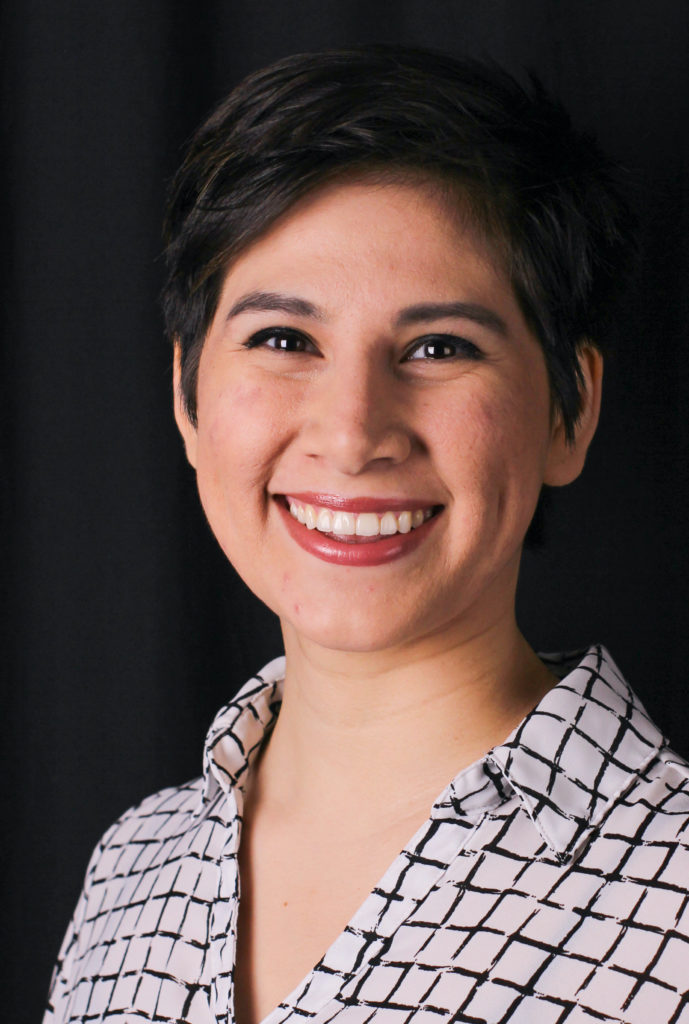
Ana Martinez es una manejadora de casos en MCH Family Outreach y ha trabajado en varias organizaciones en Waco desde 2016. Ella trabaja con familias para dar apoyo y enseñar sobre la crianza y el desarrollo de niños y adolescentes. En su tiempo libre, Ana disfruta salir a caminar con sus perritos y probar comida de restaurantes locales (¡mientras usa su máscara, por supuesto!).
Este blog de “Act Locally Waco” escribe publicaciones con una conexión a estas aspiraciones para Waco. Si quiere escribir algo para el blog de “Act Locally Waco,” por favor envía un correo en ingles a[email protected] para más información.
By Nelissa Davalos
My name is Nelissa, and I am an otherwise healthy 25-year-old female with no prior medical history. In early March, reports of transmission of COVID-19 began to appear in the United States. When my mother learned of the transmissions, she immediately urged us to wear face masks to protect ourselves and those around us. She was terrified of this virus because she has been diagnosed with type-2 Diabetes as well as asthma. Due to these underlying conditions, she is at higher risk of developing serious complications from the virus. When my mother first heard of the virus there were no signs of community spread in Waco, so my small family of three did not wear masks until signs began showing in our county.
My family had previous plans to visit South Padre Island from June 26-30 of 2020 to celebrate my brother joining the U.S. Navy. Our family decided not to cancel this trip. Instead we committed to wearing face masks, sanitizing, social distancing, and quarantining ourselves once we returned to Waco. Although we had made plans to be safe the fact of the matter is – you NEVER know who has been exposed. My father was unknowingly exposed to an infected individual at his workplace Thursday before we left for South Padre Island. Leadership did not inform him right away as I believe they should have. In fact, they did not inform him until two weeks after the incident occurred. Unknowingly, we continued our trip to the beach and followed the rules we had set in place prior to traveling.
Soon after we returned, I received a call from my mother who was in tears. She told me that my father had been notified of his exposure. He had been advised that he and anyone he had been in contact with should get tested. There was dead silence on the phone. I could not believe that we had been put at risk from my own father.
It was frustrating to me to know that no matter the precautions we had taken, we had been put at risk due to the behaviors of others who may have not taken this virus as seriously as we did. Sadly, our test results all returned positive. In the next few weeks my family would begin to experience an array of symptoms. My own symptoms included lower back pain, chills, nausea, diarrhea, a cough which caused shortness of breath, as well as losing my sense of taste. To combat the virus we took vitamin C, ibuprofen, drank ample amounts of water and slept most of the day due to fatigue. Our recovery seemed to be going well.
Then my mother’s recovery took a different route. She was admitted to our local hospital with breathing complications. Her battle with COVID-19 was only beginning. Her doctor explained that her symptoms were worsening, and she was not receiving enough oxygen due to her asthma. The virus was wreaking havoc on her immune system and lungs. Doctors administered insulin and steroids every few hours due to the impact of the virus and her underlying illnesses.
As each day passed, she grew weaker. We were told to prepare for the worst outcome. A blood transfusion was suggested so the antibodies created from a recovered patient would help her combat the virus. We waited anxiously for a match that never came.
Thankfully, days later, my mother began to breathe on her own and was permitted to come home to recover.
As of now, we have all made full recoveries, but there was a moment where we had no idea what would happen. While hospitalized my mother was preparing for the worst outcome. I learned she had made plans for her cremation and written us goodbye letters. This broke my heart to hear. I cried and thanked her as well as my father for doing the best they could with us. Growing up there was never an end to the amount of love and support they provided.
Why is my story important?
Because this could have easily been your story, this could have been your mother, your son, or your husband. I encourage you to read my story and do the following:
Stay home. It is the easiest way to prevent community spread. I have seen first-hand how this virus takes lives. During my mom’s stay in the ICU two women passed away because of this virus. They were only a few doors away from my mother’s room.
Wear a mask. Based on the demographics provided by Mclennan County, the Hispanic population makes up about 50% of positive tests. Of those tested 22 cases are between the ages of 20-29 years of age. You can find this information at coivdwaco.com. We don’t know who is positive and who is not. Wearing a mask can help us slow the spread. Research from the CDC shows some studies have estimated that people without symptoms (whether truly asymptomatic or presymptomatic) could be responsible for up to half of the spread. This is why the virus has been so difficult to contain. You may be harming those you love without realizing it.
If you have recovered, donate plasma. If you have recovered from COVID-19 your body has produced antibodies to combat the virus. I would encourage you to visit Carter Blood Care online and learn how you can provide plasma for treating COVID-19. It may well save the life of a stranger.
You may not be worried about contracting the virus and you may feel as if you have nothing to lose, but there are others with underlying conditions who could lose everything.
If we join together as a community, we can all help keep our loved ones safe so others in our community do not have to experience my family’s story.
Useful links:
- Carter Blood Care – https://www.carterbloodcare.org/plasma-donations-for-treating-covid-19/
- Center for Disease Control – https://www.cdc.gov/coronavirus/2019-ncov/symptoms-testing/symptoms.html
- Covidwaco – https://covidwaco.com/
- Article about asymptomatic spread – https://www.statnews.com/2020/06/09/who-comments-asymptomatic-spread-covid-19/
Nelissa Davalos currently serves as the Marketing and Economic Development Coordinator for the Cen-Tex Hispanic Chamber of Commerce. She is grateful for the knowledge and inspiration that local entrepreneurs and businesses have shared with her. Nelissa and her husband Ralph are the proud parents of their outgoing son Jacob. In her spare time, she enjoys learning new skills, reading, and spending time with her family. She frequently volunteers for local community organizations located in the greater Waco area, one of her favorite volunteering activities is welcoming children on the first day of school. She currently serves on the solid gold neighbor ambassador council as well as the child well- being core committee for United Way of McLennan County. Nelissa is an advocate for holistic health and in her free time encourages family and friends to take a break from their work life and enjoy their family. She looks forward to creating a positive impact in the Hispanic Community, as well as the Greater Waco area by sharing the impact her chamber has had on her life with today’s growing neighborhood and business sectors.
The Act Locally Waco blog publishes posts with a connection to these aspirations for Waco. If you are interested in writing for the Act Locally Waco Blog, please email [email protected]for more information.
By Jamie Willmann
We do not know when the pandemic will end. Thus, we need to be our own light at the end of the tunnel. We must maintain “Hope, Resilience, Humility, and Generosity” to help empower our communities to fight on.
This is why the Crisis Counseling Program (CCP), known as #TexansRecoveringTogether in Texas, is here. Those of us working in the program are here to empower our communities and to offer a voice of help during a time of fear and uncertainty.
CCP is dedicated to serving the needs of those affected by COVID-19. This virus has wreaked havoc physically, but it has also affected us in other ways. Stress, anxiety, depression, irritability, confusion, and frustration are all common reactions that have increased since the start of the pandemic. Our program is here to offer emotional support during these trying times.
There are many individuals who are going through hardships and major changes. Through these events, it is important to maintain a healthy mindset. It is good to be aware of how the pandemic is affecting our emotional and mental well-being.
We have all lost so much; we can’t lose hope now. We grasp hope and know that one day, we will look back, and see how this has changed our world. We search for the positives within ourselves and our communities.
CPP is here to help you cope through the disaster and provide you with the means necessary to continue fighting on. Instead of fear and dread of the future, let’s have hope for brighter days.
We are a team dedicated to providing accessible, caring, and responsive services. These services include crisis counseling for individuals, families, and groups. Referrals and resource linkage to much needed services such as food banks, medical and mental health services, and utility assistance, are also available through the Texans Recovering Together program.
We are here to support, empower, and provide you with what you need to press on. CPP is a network of community support and engagement, taking a strength-based approach, to mitigate long-term reactions to COVID-19.
We are #TexansRecoveringTogether. We believe that we are better together and we are here to help you recover.
To speak with a counselor, call us at (254) 297-7017 or toll-free at (866) 576-1101.
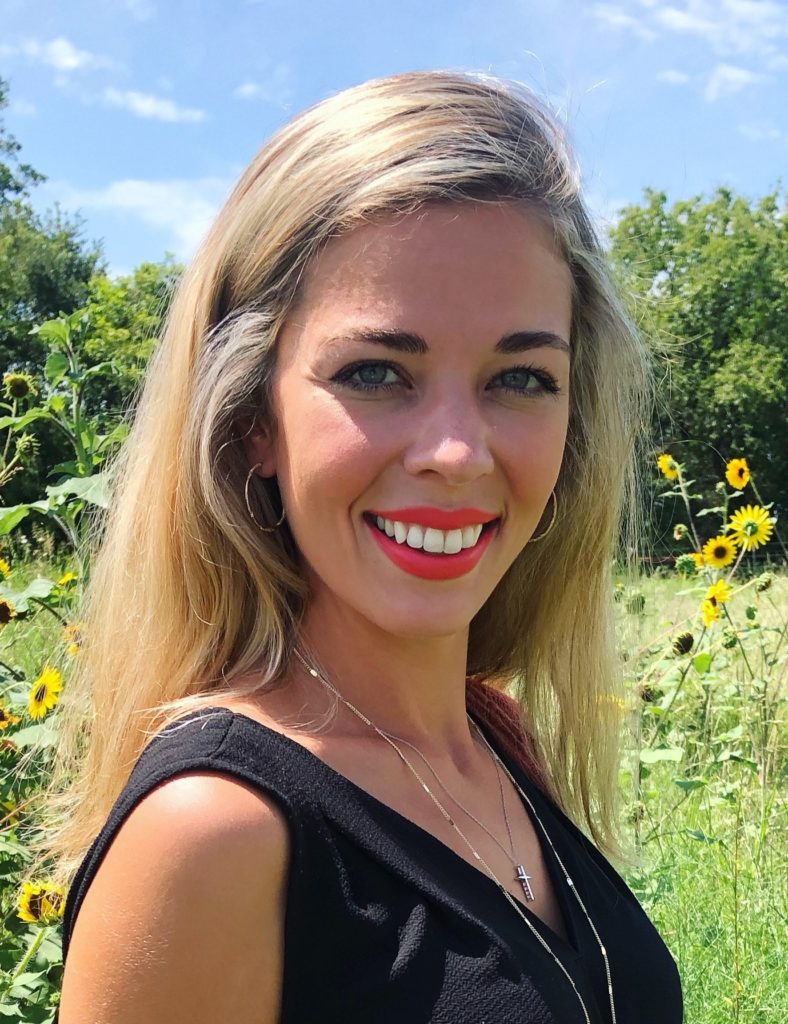
Jamie Willmann was raised in a Christian home and was taught to serve and love others at an early age. She has a passion for making people smile and brightening people’s days. Jamie came from Wisconsin three years ago to attend Baylor, where she graduated with a degree in international studies. She now devotes her free time to self-care, exercising, relaxing in nature, and fellowship with friends.
The Act Locally Waco blog publishes posts with a connection to these aspirations for Waco. If you are interested in writing for the Act Locally Waco Blog, please email [email protected]for more information.