
(Note: This post is part of a series called “Entrepreneurs of Waco.” The series is collaboration between the McLennan Small Business Development Center (SBDC), the Professional Writing program at Baylor University, and Act Locally Waco. The McLennan Small Business Development Center offers technical assistance, business mentoring, training, and resources for all stages of small business. For more information, visit their website: www.mccsbdc.com. To see all the posts in this series, click here: Entrepreneurs of Waco. – ABT)
By Sarah Lesikar
If a music box, a scooter and a rocking horse all had a baby, it might look something like the BearBack hippotherapy device. Sitting on four wheels, it is a black metal box with a rounded cushion, like a half barrel, on top and handle bars in the in front. A window on the side of the black box allows you to see what’s inside: gears and pulleys and cams. The handlebars will offer extra support for a potential rider, something that will be much appreciated when those gears, pullies, and cams are set in motion…because riding the “Bearback” is going to feel just like riding a horse.
Dr. Brian Garner, a humble, soft-spoken engineer, is the founder of Chariot Innovations, the company that is working to produce the “Bearback.” He can be found at the Baylor Research and Innovation Collaborative (BRIC), usually surrounded by BearBack parts and models.
The adventure began with Garner’s research which compared the motion pattern produced by the gait of a horse to that of a person. Using the same technology that captures human motion for movies or video games, markers placed strategically on horses and riders provided Garner with full 360-degree motion patterns of both walking horses and walking people. It turns out that these patterns are remarkably similar.
Garner gathered this data at REACH Therapeutic Riding Center in McGregor, TX, an organization that uses hippotherapy to assist children with special needs. Hippotherapy, which uses the movement of horses, is used by occupational therapists, physical therapists, and speech-language pathologists. It can promote core strength, facilitate focus, help with balance, and build motor skills. Some swear that it also decreases seizure activity. For patients who cannot walk or who struggle to walk properly, horseback riding allows them to experience what a correct motion pattern should feel like, while building the core strength necessary to walk on their own. After realizing how helpful this motion pattern could be, Garner began creating a device that mimics the gait of a horse in order to make hippotherapy accessible to as many patients as possible.
The project began in his garage. Since then he has produced three prototypes and eventually arrived at today’s model. Despite Garner’s enthusiasm, the idea that a mechanical device like BearBack could have the same benefits as actual horseback riding might seem like a tough sell. With its spinning gears and churning pulleys, the machine looks outlandish to say the least. But according to the parents and therapists of patients like Ethan, it is already making a difference.
Ethan’s father pushes him into the barn/clinic, past the many horse stalls and tack, into a small room at the back of the stable. The cool morning air smells of hay. Amid the horse-related paraphernalia, a poster on the wall reads, “The best thing for the inside of a person is the outside of a horse.” Ethan has arrived in a high-backed wheel chair with supports on either side of his torso. In recent years his Cerebral Palsy has worsened, causing his motor function to weaken and his verbal activity to regress. His brain sometimes struggles to tell his hands what to do, and he lacks some of the strength necessary to hold his head upright. But thanks to dedicated therapists, loving parents, and Garner’s technology, things for Ethan are starting to look up.
It takes three people to get Ethan out of his chair and securely situate him onto BearBack. But soon, the therapist, Kristin, turns a knob. The machine hums to life, and Ethan gets to spend a few minutes as a cowboy. Country music from a nearby IPod fills the room, and he leans back in the saddle, like a smug star from an old western film. Kristin scolds him for his “cowboy slouch,” guiding him to correct his posture by engaging his core and oblique muscles. Kristin stands behind Ethan, keeping him securely on the saddle by holding firmly to a band that wraps around his torso, but she encourages him to make any corrections to his posture using his own grit and strength. His mom peers in from the window, making faces and waving to catch his attention, while his dad taps his fingers on Ethan’s helmet, encouraging Ethan to lift his head.
Ethan’s “noble steed” may be a tad less traditional, but his parents and therapists attest that his time on BearBack is helping him to hold up his head and to hold a standing position for longer periods of time. With Ethan’s limited independent mobility, it would be nearly impossible to transfer him onto an actual horse or to give him the necessary support while still allowing him to engage his muscles. BearBack, on the other hand, is stable, low to the ground, and accessible from every angle.
Even though it wasn’t part of the initial plan, REACH decided to keep Garner’s invention. Hippotherapy is beneficial, and it can also be fun for patients who can be overwhelmed with various therapy treatments. That’s one reason why it’s so important to make BearBack accessible to as many patients as possible. As one REACH staff member put it, they just can’t stop “using the tar outta that thing.”
In the future Garner hopes to develop an entire library of motion patterns to meet different patients’ needs. For instance, a horse’s walk is different from a horse’s trot. An engineer at heart, figuring out the mechanics of BearBack is where Garner really hits his stride. The business portion, on the other hand—navigating bills, paperwork, and patents—he admits, “Is not my strength.” One day he hopes to bring in some people to help take over those roles.
Ultimately, for Garner, BearBack is more than an engineering challenge or business venture. It’s an opportunity to fulfill a calling. “I feel like this technology has been a gift from the Lord,” explains Garner, “and I feel entrusted with that gift; using it to help others is what really matters.”
 The entrepreneur…Brian Garner grew up in Austin, Texas, obtaining degrees in Mechanical Engineering at the University of Texas in Austin. In 2002 he joined the engineering faculty at Baylor University. He enjoys working with students at Baylor and teaching courses including Statics, Machine Design, Biomechanics, and the capstone Engineering Design course. He is blessed with a wonderful wife, Margie, and four wonderful children, Abigail, Anna, Noah, and Daniel.
 The writer…Sarah Lesikar is an Oklahoma native studying English Literature at Baylor University, where she will be working on a thesis over Tolkien’s Trees in the fall. An avid traveler, Sarah has visited 19 countries, but she also enjoys chocolate chip cookies, all things ballet, dog-eared books, and spontaneous taco runs with friends.
The Act Locally Waco blog publishes posts with a connection to these aspirations for Waco. If you are interested in writing for the Act Locally Waco Blog, please email [email protected] for more information.
(Note: This post is part of a series called “Entrepreneurs of Waco.” The series is collaboration between the McLennan Small Business Development Center (SBDC), the Professional Writing program at Baylor University, and Act Locally Waco. The McLennan Small Business Development Center offers technical assistance, business mentoring, training, and resources for all stages of small business. For more information, visit their website: www.mccsbdc.com. To see all the posts in this series, click here: Entrepreneurs of Waco. – ABT)
By Allison Le Grice
In what was once a popular saloon on Third Street in McGregor, Texas, Branda Pavlas and Susie Hughlett have realized their dream of owning a bakery. From Tuesday to Saturday, the small “Open” sign inside Cuppiecakes flashes, welcoming guests to enter the historic brick building to enjoy some savory treats. Like a beacon, it has attracted customers from as far as ninety miles away.
Nine years ago, Susie met Branda at church, and they became inseparable. Often mistaken for sisters, Branda and Susie both stand at just about the same height with short blonde hair, inviting blue eyes, and eager expressions. “We’re completely different though,” Susie mentions. “She’s the doer. She’s made everything possible.” “Oh stop, this place wouldn’t be here without you,” Branda responds.
Susie had some experience with baking and was known around church for bringing her creations for the enjoyment of the congregation. When their pastor asked Susie to bake a cake for an upcoming church event, she invited Branda over to help. This one night of baking led to several more, and as word spread, orders started pouring in. Pretty soon, Branda and Susie’s routine became staying up until three in the morning to finish cake orders while balancing the demand of husbands, children, and full-time jobs.
 As they gained popularity, they decided to officially start a business. Although baking from the comfort of their homes worked, they dreamed of something more. “We wanted to be smart about it,” Branda says. “We knew we were too old for debt, and we didn’t want to get caught up in it for what seemed like some frivolous dream of baking cupcakes.” So Susie and Branda consulted Jane Herndon, a business advisor at the McLennan Small Business Development Center, who helped them plan how they could start a business with their available resources. Finally, their goals appeared to be within reach. In May 2014, they settled on a location in Hewitt, where Susie lives. Unfortunately, they missed their opportunity to sign a lease by mere few hours. To make matters worse, Branda’s husband had a heart attack that same week.
“As if things weren’t stressful enough, my husband died.”
“But he’s alive now,” Susie jokes, “We call him Lazarus… get it? Because they resurrected him.” In the midst of these unfortunate events, Branda and Susie had faith. “We’re firm believers in God,” Branda says. “I had to constantly remind myself to be patient and trust in His timing. There were multiple times I broke down ugly-crying because nothing seemed to be working, but I reminded myself of all that I had to be thankful for. My family was well, and despite this business not taking off, I still had my job as a high school counselor. If I had quit that to focus more on the business, I wouldn’t have had insurance to help after my husband’s heart attack. That was a reminder of God’s perfect timing. I took a step back and I heard Him say, ‘Just wait.’”
Not long after, a close friend called to tell them about an available building she thought Susie and Branda would like in McGregor, Texas.
 “McGregor? Really?” Branda rolls her eyes. “The three most important things you have to take into consideration when starting a business are one, location. Two, location. And three, location.” With its approximate population of 5,000, they worried that McGregor was not ideal. But there was one thing Branda and Susie knew, church people love to eat and they love to talk. So despite the uncertainty of business from newcomers, they knew their loyal church community would visit their shop and help spread the word. Finally, they would have their own bakery… that’s if the owners of the building decided to lease it to them. “We definitely understand why they were hesitant,” Branda says. “Their main fear was that they’d be wasting their time on a business that was going to flop. It took a lot of convincing, but they agreed to meet with us.”
“So we brought cupcakes,” Susie adds, “and that’s probably what won them over.”
Today, Cuppiecakes lures customers in with a bright green awning and a huge image of a cupcake. Inside, a display case filled with a variety of flavored cupcakes beckons. Also, in one corner, tables are prepared for one of the many birthday parties Branda and Susie host. Attracting customers is something they no longer worry about. Even on Sundays and Mondays, the days Cuppiecakes is closed to catch up on orders, customers can be found knocking on their door, and on any given day, Branda and Susie can be found baking between 250-350 cupcakes while also completing custom orders for birthday and wedding cakes. Although they tried to wean off of the custom orders, they never stop coming in.
In addition to their baked goods, Branda and Susie have started selling coffee and even sandwiches. Despite this, Cuppiecakes is still best known for its cupcakes, served in small plastic cups. From “Cookies n’ Cream” to “Snowball” coconut cupcakes to “Cup o’ Joe” caramel and coffee cupcakes, Branda and Susie are satisfying all types of cupcake cravings.
“God’s timing really was everything,” says Susie. “It truly is amazing how it all happened.” What started off as two women bonding and baking ultimately led to a booming business.
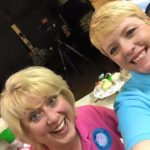 The Entrepreneurs… Susie Hughlett and Branda Pavlas are the owners of Cuppiecakes. Susie is the wife of Kevin Hughlett and mother of Drew (17), Kara (14) and Lindy (11). The family makes their home in Hewitt, and they attend Lorena United Methodist Church. Susie attended the University of Sothern Mississippi on a volleyball scholarship and has been teaching and coaching for 20 years. She now teaches mornings at Woodgate Intermediate as a 5th grade PE teacher and then goes to work at Cuppiecakes in the afternoon. Branda is married to Jake Pavlas, and the couple have 3 children; Jakey (19), Braylin (17), and Jadyn (14). The couple was also blessed to be able to share their home with Ashley Johnson (married to Matthew) who has given them 3 beautiful grandchildren. Branda atteded Texas Tech University and taught English for 16 years before earning a Master’s Degree from Tarleton State University and working as a school counselor for 8 years. She now works full time at Cuppiecakes. Like Susie, Branda and her family also attend Lorena United Methodist Church where they met the Hughlett family. The “Pavlas Hughlett Clan” enjoy dinner together every Sunday night and sometimes take family vacations. Life is good at Cuppiecakes!
 The writer…Allison Le Grice is an English student at Baylor University. She is passionate about literature, mental health, and recycling. In her free time, she is most likely binge-watching “Chopped.”
The Act Locally Waco blog publishes posts with a connection to these aspirations for Waco. If you are interested in writing for the Act Locally Waco Blog, please email [email protected] for more information.
(Note: This post is part of a series called “Entrepreneurs of Waco.” The series is collaboration between the McLennan Small Business Development Center (SBDC), the Professional Writing program at Baylor University, and Act Locally Waco. The McLennan Small Business Development Center offers technical assistance, business mentoring, training, and resources for all stages of small business. For more information, visit their website: www.mccsbdc.com. To see all the posts in this series, click here: Entrepreneurs of Waco. – ABT)
By Kellie Fawcett
As you enter the Uncommon Healthcare office you don’t see tile floors or fluorescent lights. There aren’t dozens of people in the waiting room sniffling while they flip through year-old lifestyle magazines. There isn’t a TV playing cooking show reruns. The carpeted waiting area includes plush chairs and a soothing water feature. Complimentary drinks are available. In fact, if anyone is in the waiting area, it is because he or she has arrived early. When Dr. Macik schedules your appointment for 10:30, she’ll be with you at 10:30.
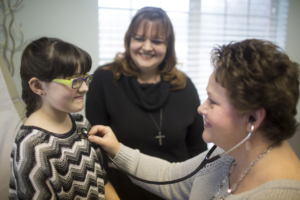 Dr. Felicia Macik, the founder, owner, and physician at Uncommon Healthcare, is the only direct primary care family physician between Austin and Dallas. When she greets her patients, she is not in a hurry. She greets each one with a smile and usually a hug. She is in casual clothes, not scrubs. The only way you would know she is a doctor is the stethoscope draped around her neck.
Aside from being owner, founder, and physician at Uncommon Healthcare, she is also the accountant, manager and marketer. None-the-less, when you meet with Dr. Macik in her office she sits next to you, ignoring the office chair she has at her desk. In doing so she lets you in on her secret to success: relationships.
Dr. Macik used to work for a hospital system but left employed practice after 17 years.” She had expectations of herself as a physician, the hospital system had expectations of her as an employee, and the insurance companies had their own expectations set by government regulation. This presented an obvious problem. Her solution: to pursue a new career path that she discovered via talk radio.
“My husband actually discovered it,” she says chuckling, “I was miserable in the system and was trying to figure out if I was going to leave medicine. I really thought, ‘If I can’t find another way to do this I’m not going to be a physician any more. I don’t want to continue to do this for the rest of my career.’ My husband was listening to talk radio and some physicians came on. They were leaders in the nation in direct care and were talking about their model of practice and how physicians were looking into this. So he came home and said, ‘Felicia, oh my gosh, you have got to listen to this and check this out. This is so who you are, this is exactly what you need to do.’ And so that was on a Friday afternoon and I will never forget, I went home and the entire weekend listened to podcasts about direct care and listened to those guys.”
 This was a week before her sons’ spring break. She sat the family down and asked them to forgo their previously planned ski trip in order to road trip to Wichita, Kansas, to meet with the direct care physicians from the radio.
After meeting with six other well-known primary care physicians, interviewing their patients, and extensively researching direct primary care, Dr. Macik learned that roughly half of direct primary practices fail the first year. “So going into it I knew that was the case and that was a risk for me and my husband also knew. But, I also knew that this is who I am as a doctor.”
Dr. Macik feels strongly that healthcare should not be a source of physical or financial stress. Earlier this year she partnered with another entrepreneur to establish a pharmacy program to help her patients receive prescription medication at wholesale prices. “I have a patient who is a small business person. She just launched a business and her son developed a seizure disorder and the medication was so expensive that they literally could not afford it. We put them on the pharmacy program and now they’re only paying $47 per month for the medicine that was going to be right around $300 per month retail. So yeah, its life changing…”
At Uncommon Healthcare patients pay a monthly fee to receive high quality care tailored to each specific patient. Patients don’t go through insurance companies or hospital hierarchy. They are promised at least 30 minutes of personal questions and care each time they see Dr. Macik. Hospitals discourage their doctors from spending more than 10 minutes at a time with a single patient.
Dr. Macik makes herself available 24/7 through an after-hours phone number that allows patients to text pictures or Skype her if there’s an emergency. “I had a patient that had an abscess and she sent me pictures of it on my phone and those pictures dropped right into her chart so it’s all integrated. It prevented her from having to go to the emergency room because she was able to access me. We were off on Good Friday and I was kayak fishing with my son, and I was on my phone treating an abscess while we were kayak fishing because I can do that.”
Right now, Dr. Macik is living her dream. She has a loving and supportive family, she has started her own business, she is doing what she loves, and she’s succeeding in it. “It is still very stressful, but I know that if I stayed in the system it was never going to get better… this at least offers me the opportunity to ultimately have stability and to have satisfaction with what I am doing every day.” Success for Dr. Felicia Macik is not about cutting costs or maintaining a strict schedule, it’s about loving and serving her patients.
 The entrepreneur… After graduating Summa Cum Laude from Tarleton State University with a BS in Biology, Dr. Felecia Macik attended medical school at the UNT Health Science Center in Fort Worth. She completed family medicine residency training at UTMB Conroe and then a women’s health fellowship at the University of Tennessee at Memphis. She previously served on the faculty of the Texas A&M Health Science Center and as the Assistant Program Director of Texas A&M’s Brazos Family Medicine residency training program. Dr. Macik has received numerous awards including being twice named Faculty of the Year and being honored with the Waco Tribune Herald’s Reader’s Choice Award for primary care physicians. She has a passion for patient care and has enjoyed serving the patients of this area for over 10 years. Uncommon Healthcare, 1000 State Hwy 6, Suite 100 Waco Texas 76712, 254-339-1360, www.uncommonhealthcare.com.
 The writer…Kellie Fawcett graduated from Baylor in 2016 with a Bachelor of Business Administration in Marketing. She is from Brentwood, Tennessee. While at Baylor she participated in Baylor Buddies and Baylor women’s Lacrosse.
The Act Locally Waco blog publishes posts with a connection to these aspirations for Waco. If you are interested in writing for the Act Locally Waco Blog, please email [email protected] for more information.
By Amanda Walker
Besides the title of “entrepreneur,” CEO, and programmer, Zach Krizan proudly bears the title of “nerd.” Since the age of 10, Zach could be found playing Pokémon, Yu-Gi-Oh!, or Magic: The Gathering at The Game Closet in Waco. It was in that card store that Zach found both a community and an identity as a nerd, and through Nrd Feed he is giving back to that same community.
Zach wanted to bring a little bit of that card shop to players everywhere. To do that he decided to create a website, Nrd Feed. It’s basically a social network for nerds. On the website, nerds can find prime information regarding their favorite “fandoms.” Fandoms are communities for fans of television shows, comic books, video games, etc – some of the most popular include Game of Thrones, Doctor Who, Sherlock, and Harry Potter. Within these fandoms, fans are given a platform to create their own unique culture and clique by sharing information, conversations, and memes (humorous images).
One thing that sets Nrd Feed apart from the competition is the way it generates content. In order to create the best content possible for consumers and fans, Zach wanted experts for each of the different fandoms instead of a few “generalists” writing about several different fandoms. Thus, the infamous “Guru Test” was invented. The Guru Test consists of 25 questions pulled randomly from a bank of 100 potential questions. Would-be fandom experts have 5 minutes to answer all 25 questions and prove their expertise. With a 95% fail rate, The Guru Test separates the true fans from the lightweights. As Zach puts it, he wants those who “live and breathe” their fandom. If a user passes the test with over 90 percent, they are then allowed to write articles and posts on the Nrd Feed website. Nrd Feed has over 40 writers/gurus, a fact that Zach is extremely proud of because it further separates his company from others who have a maximum of ten writers. Zach’s writers are passionate about their topics, actively searching for more information to get out to Nrd Feed followers.
Nrd Feed launched its website in 2014, thanks in large part to Waco’s Chamber of Commerce. In 2013 the Chamber of Commerce partnered with Baylor University to create ThincSpace, an incubator for creative startups. ThincSpace provides companies a place to meet and use as a home-base to allow the companies to grow. During this time, local entrepreneurs pay a very reasonable rent for space and access to professional support and networking.
And a good deal on office space is important, because Zach is an entrepreneur on a budget. “You have to budget like you’ve never budgeted before,” Zach remarks. It’s one of the toughest challenges of being an entrepreneur. Besides the crazy hours and the stress of starting a new company, Zach must also balance a part-time job outside of Nrd Feed in order to pay the bills. Before starting Nrd Feed, Zach quit his previous salaried job as a database administrator in order to work on Nrd Feed full-time. Once Nrd Feed was firmly established, Zach went back to work in order to maintain the funding for his business.
At around 6:30 p.m. Nrd Feed workers start coming into ThincSpace to start their work “day.” All workers come armed with a personal computer and one or two sugary drinks to fight exhaustion. Zach pays his gurus from his own pocket, he is not yet able to pay his seven employees. These students, interns, and nerds with time to spare, all work for free to help Zach achieve his dream. Part of the reason why Zach’s employees are not paid is because the website does not have advertisements. Instead of ads, Zach wants to gain revenue in a way that is worthwhile to his users. One of his business plans is to establish a system on the website that enables users to buy and sell high-quality, fandom-specific items that fans can collect. Not only would Nrd Feed earn revenue, but nerds would also have access to desirable merchandise.
Robert Toups, the Nrd Feed Chief Operating Officer, sometimes comes into the office with only five hours of sleep after pulling a full shift at his job. Working with Zach is nothing new for Robert. Friends since childhood, the two have been both partners in business and partners in prank. Unlike others, who were skeptical about Zach’s Nrd Feed dream, when Zach approached Robert with the idea of creating the website, Robert was completely invested. With an entrepreneur for a father, Robert understood the challenge before them but was confident in his friend. “It sounded like opportunity.” From that point, the two childhood friends never looked back.
Our conversation is interrupted for a moment as Zach greets one of his writers coming in for the night. The writer’s name is James. James has Asperger’s. Yet, as everyone at Nrd Feed brags, he is one of the best and most detail-oriented writers. Here, he is just like everyone else, if not more capable to handle fandom information. Zach not only wants his company to be different from the competition in terms of content, but because of its heart. “That’s one of the things with Nrd Feed. We want to be accepting of everybody. [James] is actually not the only writer with Asperger’s either. Nerds have always had a problem with being pushed away or judged, so we’re trying to be as open as we can.”
Being a self-proclaimed nerd is a point of pride for Zach, and through his website he wants others to feel confident with this label. To him, everyone is a nerd. “Being a nerd is just being open-minded and being passionate about something. There’s nothing wrong with liking something and being publicly open about liking it. You want to be a nerd because those are the best types of people.”
 The entrepreneur…Zach Krizan is former professional card player and full-time entrepreneur. He lives and breathes everything nerdy. Using his experience in the nerd world and his background in software engineering Zach is the founder and developer of NrdFeed.com.
 The writer…Amanda Walker graduated from Baylor University with a Professional Writing degree. In her spare time, Amanda enjoys reading romance novels and binge-watching political comedies.
The Act Locally Waco blog publishes posts with a connection to these aspirations for Waco. If you are interested in writing for the Act Locally Waco Blog, please email [email protected] for more information.
(Note: This post is part of a series called “Entrepreneurs of Waco.” The series is collaboration between the McLennan Small Business Development Center (SBDC), the Professional Writing program at Baylor University, and Act Locally Waco. The McLennan Small Business Development Center offers technical assistance, business mentoring, training, and resources for all stages of small business. For more information, visit their website: www.mccsbdc.com. To see all the posts in this series, click here: Entrepreneurs of Waco. – ABT)
by Chae Canale
For Courtney Rogers, the owner of Co-Town Crepes, venturing to Waco from Dallas was supposed to be temporary. Little did she know that it would become so much more than just a short pit stop, it would become a life changing decision.
After attending a discipleship training school at Antioch Church, Courtney enrolled at MCC and picked up a part-time job at the local restaurant, Sironia. There, she met Juanita, one of the chefs who encouraged Courtney’s passion for flavorful food. Even though Courtney was on the wait staff, she would slip into the kitchen to pick Juanita’s brain about food combinations. A year later, Juanita and Courtney ended up working together at The Epicurean, a vegetarian and vegan restaurant.
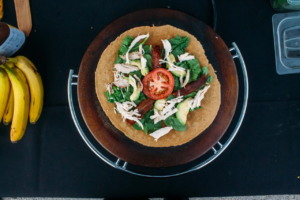 This experience resurrected an interest in nutrition that Courtney’s mother planted when Courtney was just a child. This history would later impact the menu choices for her business. While owning her own business was not part of her Waco plan, the aptitude for entrepreneurship stemmed from her childhood as well. Her father Cyrus Cozart said, “We taught the kids that money is earned, so the kids started selling bread at a very young age to earn their own money.” Courtney and her brother and sisters would sell bread to church members and the neighbors. This helped them make enough money to pay for their clothes and other things they wanted. So it is no surprise that her parents’ values set the guidelines for her future. Through these values and the passion for the Waco community, Courtney wanted to use her love of food to touch those around her.
 “I have always loved crepes. Everywhere I would travel, I would get a crepe. So I got a recipe from a friend and I just started tweaking it and playing around with different ingredient combinations.” Courtney would spend hours in the kitchen experimenting. A friend mentioned that a Downtown Farmers’ Market was starting so Courtney started thinking about how she could be a part. “My husband and I actually started at the Farmers’ Market just out of a love for Waco back in 2011. We wanted to make it a fun place to live and really give people a fun food experience.” Courtney also wanted people to watch the crepes being made. “I see crepes as a very nostalgic food, tied to sweet memories.” Courtney’s mother believes her daughter’s passion for community outreach came from her youth pastors in Dallas. “They had a huge impact on Courtney’s life. They always had someone living with them, and they modeled the idea of community living—living for those around them,” explains Diane Cozart.
The Farmers’ Market also served as a learning experience for Courtney and her husband Kyle. It taught them how to run a business and how to manage different finances. During this period, the business grew by word-of-mouth. Periodically, they would evaluate the future of Co-Town Crepes. The name “Co-Town” was inspired by the kids in the youth group of Antioch, who jokingly referred to “wa-CO” as Co-Town.
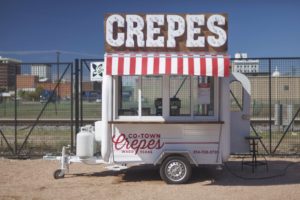 Courtney and Kyle loved the business, but they weren’t sure about expanding; the timing didn’t seem right. That’s until the beginning of 2015 when Courtney felt God directing her to expand her business and to utilize her passion for the community through her love of food even more. After much thought, Courtney took this leap of faith. She gave up her full time teaching job and purchased her first food truck. The food trailer, purchased off of Craig’s List, was made in China, it didn’t have standard electrical outlets, and all the writing was in Mandarin. She admits that trying to register it was an adventure. “And I had a lot of help converting it into what it is today,” she says.
Between catering and the two locations, a site at the Magnolia Silos that operates six days a week and the popular booth at the Waco Downtown Farmers’ Market on the weekends, the expansion of “Co-Town” has surpassed each goal Courtney has set forth. Moreover, she has used her business to offer jobs to some people who just needed a second chance. In other words, Courtney isn’t content running a business; she wants her business to change lives. While it is about crepes, it’s so much more than crepes. Through her passion and love for the city of Waco, flavorful food, and community living, Courtney pours grace into the city one crepe at a time.
 The entrepreneur…after graduating from Tarleton State University through the University Center at MCC, Courtney Rogers taught Family and Consumer Sciences at Axtell High School. In the summer of 2015, she began working full time, expanding Co-Town Crepes. She met her husband Kyle after moving to Waco in 2007. Kyle is a graphic designer, Co-Town’s longest standing employee and the kindest man you’ve ever met. She is passionate about investing in people and being a part of Jesus changing their lives.
Co-Town Crepes’ Locations:
Food truck park @ Magnolia Silos (Monday-Saturday)
Waco Downtown Farmers Market (Saturdays from 9am-1pm)
Contact Courtney at [email protected] or get more information and pictures of this yummyness at www.cotowncrepes.com
 The writer…Chae Canale is a senior at Baylor University currently pursuing a degree in Child and Family Studies. At the age of 32, she decided to follow her dreams and go back to school in order to pursue her passion. Chae lives in Ft Worth and enjoys spending time with her 12-year- old daughter when she is not attending school. Her purpose in life is to inspire those around her to reach for their dreams!
The Act Locally Waco blog publishes posts with a connection to these aspirations for Waco. If you are interested in writing for the Act Locally Waco Blog, please email [email protected] for more information.
(Note: This post is part of a series called “Entrepreneurs of Waco.” The series is collaboration between the McLennan Small Business Development Center (SBDC), the Professional Writing program at Baylor University, and Act Locally Waco. The McLennan Small Business Development Center offers technical assistance, business mentoring, training, and resources for all stages of small business. For more information, visit their website: www.mccsbdc.com. To see all the posts in this series, click here: Entrepreneurs of Waco. – ABT)
By Payten Arthur
The Waco Hippodrome is a historic gem on the corner of Austin Avenue and 8th street. The distinctly shaped, bright red sign declaring the building the “WACO HIPPODROME” shines bright in the night. The interior of the theatre has maintained many features that remind guests of the building’s history. The red velvet curtains at the entrance to the theatres, the muted greens and reds of the carpet in the lobby, the brass candelabra sconces lining the aisles, the detailed lattice of gold, plaster rosettes that climb the walls and cover the ceiling, all whisper the stories of years gone by.
The Waco Hippodrome opened in 1914 as a vaudeville theatre, and has survived a fire and many changes in management. Since the late 1970’s the theatre has struggled to stay open. Many have tried to bring the Hippodrome back to its former glory, but were unsuccessful. Shane Turner and his brother, Cody purchased the Hippodrome in 2012. After a two-year renovation that involved adding a mezzanine level restaurant, they opened the Hippodrome’s doors to the public once again. Now the theatre is a versatile venue for seeing a film, having a meal, watching live theatre and music performances, and hosting charity events.
Shane Turner is a man who follows his heart. He describes this as “going with the flow” and has followed this practice throughout his life. He never planned on being an entrepreneur. He studied political science and had plans to become a lawyer. He even took the LSAT, but decided soon after that his heart wasn’t in legal work. Instead, he went into business with his brother, Cody. Their parents were entrepreneurs in construction, so it was natural for the Turner Brothers to go into real estate. The brothers have been developing properties in Waco for years. In those years, Shane has developed a love for building up and improving Waco.
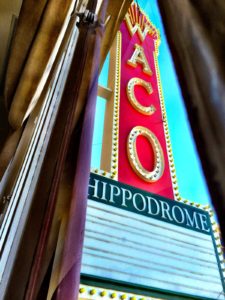 Shane and his brother have found success in real estate. They own several multifamily properties and loft condominiums in the Waco area, including Tinsley Place and the Altura Luxury Lofts that are currently being constructed. But, the Hippodrome is different from those other properties. Why would they choose to purchase a movie theatre, especially one that has been sitting unused for years? The Hippodrome’s history of unsuccessful runs was surely not encouraging for potential business owners. Also, Shane had no experience running a movie theatre and restaurant. He has had to learn how to deal with studios and musicians and how to face the many challenges of running a restaurant, like employee turnover and understaffing. Money wasn’t the motivation. Shane’s passion to develop downtown Waco is what guided him to take on the Hippodrome. “We did the Hippodrome to help promote downtown. We didn’t walk into the Hippodrome expecting to be in the black the first month.”
The transformation Shane Turner desires is more than just seeing the downtown area fill with businesses. He loves the Waco community. “In Waco, people are easy to get along with. Some communities are closed off and they don’t want to share the wealth, but Waco isn’t like that.” He wants to make a difference that benefits the people in more than just economic ways.
The work he has done opening the Hippodrome is doing exactly what he hoped it would. The theatre adds some prestige to downtown and provides a place for people to enjoy themselves. Shane especially enjoys hearing the stories of the people who grew up watching movies or had their first date with their husband in the theatre. One big way Shane has had a social impact on downtown has been by providing the Hippodrome as a venue for Harris Creek Baptist Church on Sunday mornings.
Harris Creek’s mission is to “seek the welfare of the city.” In August 2011, Harris Creek they started a downtown campus in a building across the street from the Hippodrome, called the Palladium. It was a huge success. The two Sunday morning services were always packed. The problem was the level floor and columns in the Palladium made it almost impossible to see past the person standing in front of you. Shane, a deacon at Harris Creek, offered the Hippodrome as a new location. In November of 2014, the church made the move across the street.
It is easy to get lost in the wonder, beauty, and warmth that is created in the Hippodrome on Sunday mornings. The Hippodrome becomes a modern day cathedral, where people are praising God in an ornate, beautiful building. On a recent Sunday the pastor even started a series called “God in the Movies.” It seemed fitting to hear the sermon in a movie theatre.
After the service, people spill out of the theatre and mingle in the lobby or on the sidewalk outside. Everyone is smiling and laughing, making new friends and catching up with older ones. The feeling of love and community is tangible.
Shane Turner doesn’t brag about his accomplishments. He says “Go with the flow. See where it takes you. I never thought I’d be doing this and I’m enjoying it.” He acts as if his accomplishments just sort of happened and had nothing to do with him. It seems possible that he is not even aware of the impressive impact he has made.
Galan Hughes, Director of Ministry Development at Harris Creek, says of Shane, “He would say ‘I’m not the most articulate person, and I’m not a champion or a cheerleader,’ but he has an incredible heart to transform this city.” Looking at the Hippodrome and the lives touched by it, it definitely seems that way.
 The entrepreneur… Shane Turner Graduated from Baylor University in 2002 with a degree in Political Science. Since graduating Shane has made a career in Real Estate and Real Estate Development. He started his first development almost 7 years ago and since that time has completed numerous other developments in multi-family, office, and commercial retail. He and his brother own a Real Estate Investment company whose portfolio ranges from single-family residential rentals, multi-family units, retail space, office space, and restaurant space. Shane is very active in his community and serves on the Boards of numerous charitable and community organizations. He is an active member of Harris Creek Baptist Church in McGregor, Texas.
 The writer…Payten Arthur is a social entrepreneurship major at Baylor University. She lives in an apartment with her twin sister, her best friend, and her Great Dane, Marlowe.
The Act Locally Waco blog publishes posts with a connection to these aspirations for Waco. If you are interested in writing for the Act Locally Waco Blog, please email [email protected] for more information.
(Note: This post is part of a series called “Entrepreneurs of Waco.” The series is collaboration between the McLennan Small Business Development Center (SBDC), the Professional Writing program at Baylor University, and Act Locally Waco. The McLennan Small Business Development Center offers technical assistance, business mentoring, training, and resources for all stages of small business. For more information, visit their website: www.mccsbdc.com. To see all the posts in this series, click here: Entrepreneurs of Waco. – ABT)
By Shannon Lesko
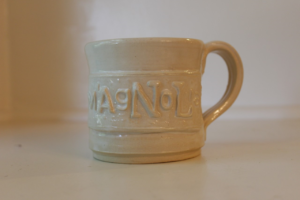 Two minutes to throw, three minutes to assemble and stamp, another minute to trim, two days to fire, 30 seconds to glaze, and there you have it– a finished Magnolia Market mug. At the end of the week Black Oak Art has 1200 Magnolia Market mugs, at least, that’s what they’re averaging these days.
Meet Jonathan Martin, the mastermind behind this production. As a Baylor graduate Jonathan is, in some ways, back home in Waco, although he originally hails from Los Angeles. At Baylor he thought he might end up teaching for a living, which he did for a while. Then he returned to Los Angeles where he and his wife, Sara, helped plant a church. After living with their first child in a small one-bedroom apartment, he decided to move his family to Waco. He admits, “When we came back to Waco it felt like a defeat, but somehow I felt like God had spoken to me and that we were coming back into the promised land.”Jonathan smiled, almost in disbelief in what he was saying, “We had all these dreams in our hearts for whatever reason, and we had this sense of hope that God was going to bring us into those when we came back to Waco.”
 Waco was not always the “promised land” though. Jonathan did his time as a “starving artist.” Well maybe not starving, but as he says, “peddling my wares wasn’t quite cutting it.” Initially he would fill his truck with boxes of pottery and drive around, stopping any place he thought might sell his pottery. Thinking back on those early days, he laughs.
It was a college friend who ignited Black Oak Arts workflow. Joanna Gaines, owner of the now famous Magnolia Market and star of HGTV’s hit show Fixer Upper, took note of Jonathan’s craftsmanship. “Joanna’s first order was for these gift baskets she and Chip would give to their realty clients, but at that point no one really cared if their logo was on the side of a mug.” That original order was for 25 mugs; now Jonathan is trying to get 1500 out the door every week.
 Needless to say, Jonathan is not a one man show anymore. He has assembled a team and his dream of cultivating a workplace where potters could collaboratively create pieces together has come to life. That doesn’t mean that Jonathan has stopped getting his hands dirty; his clay splattered Black Oak Art apron can attest to that. While he maintains a friendly banter with the other potters, his hands carefully begin morphing a lump of clay into a cylinder and then, in one graceful motion, he gently draws out a recognizable shape. Effortlessly it seems, he lures a mug out of the shapeless lump. Jonathan explains that it’s not an exact science, and even though they try to get the same look every time, each one ultimately is unique – that is the magic of it all.
“There is something tangibly different about a hand-made piece,” Jonathan knows. At the Magnolia Silos, the patrons recognize that each piece is different. They carefully sort through the mugs to find the right shape, size, and look to complete the experience of enjoying their morning cups of Joe. Since the opening of the Silos in October, twenty-four thousand handmade mugs have gone home with Magnolia fans; that’s a whole lot of mornings that Jonathan gets to be a part of.
Jonathan’s dreams for the future include more than mugs. “I have these really cool pots and wall pockets in the works for Magnolia,” he says. Black Oak Art also plans to open a new storefront called Gather. “Gather is a sort of marriage between my passion for artisanship and my wife’s passion of entertaining,” Jonathan smiles. The retail store will hold tabletop treasures, all designed and hand thrown by Jonathan himself, ready to enrich the homes of patrons in new and unexpected ways.
Jonathan smiles as he remembers back to the days they only had twenty mugs on dock for a month, now he produces three hundred times that, “but it’s cool to look back and see that when we came back to Waco it really wasn’t a defeat but God was bringing us into this new thing. I don’t necessarily feel that we are promised years and years more of this, I mean, I could be back peddling my wares again someday, but I’ve learned it’s one day at a time.”
 The entrepreneur…Black Oak Art is a local ceramic shop in Waco TX. Founded by Jonathan Martin a 2000 Studio Art graduate from Baylor University. Black Oak Art specializes in custom ceramic designs. We work with each client to create the pieces that match their needs and personality. We sell both wholesale and retail pieces.
 The writer…Shannon Lesko puts her degree in Professional Writing to good use at the intersection of business strategy and creativity, as a Content Strategist. She is a lover of words, beginnings and Waco. You might find her around town exploring hidden gems, hiking, or brainstorming her next project with her husband. She believes there is power in telling stories and cultivating the dreams of the people behind them.
The Act Locally Waco blog publishes posts with a connection to these aspirations for Waco. If you are interested in writing for the Act Locally Waco Blog, please email [email protected] for more information.
(Note: This post is part of a series called “Entrepreneurs of Waco.” The series is collaboration between the McLennan Small Business Development Center (SBDC), the Professional Writing program at Baylor University, and Act Locally Waco. The McLennan Small Business Development Center offers technical assistance, business mentoring, training, and resources for all stages of small business. For more information, visit their website: www.mccsbdc.com. To see all the posts in this series, click here: Entrepreneurs of Waco. – ABT)
By Allison Le Grice
“I love owning a business where I only succeed if my clients succeed,” Melissa Pardun explains as her dog Josie leaps onto her desk to lick the palm of her hand. Along with her husband Rick Pardun, Melissa owns Maker’s Edge. Maker’s Edge is a “maker space,” a full-featured do-it-yourself studio for anyone from teens to hobbyists to high-tech entrepreneurs who want to make things. According to the website, Maker’s Edge is a “…a space that brings together a community of DIY people with wonderful fabrication equipment in a way that supports collaboration, creativity, ingenuity and personal development.”
Melissa, with her thick royal blue rimmed eyeglasses and zebra print nails, sits in her office conveniently at the front of the maker space. This allows her to shout a greeting to every member who walks in. “Community is our number one emphasis,” Melissa says, pointing to a banner in shop that reads “Look around you, here are your fellow doers. Here is your creative team.”
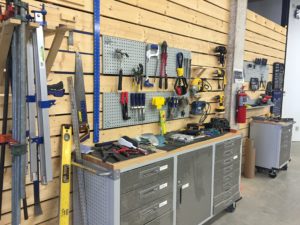
Upon walking into Maker’s Edge, you see a huge open workspace with tables and stools where members work on their projects in the presence of other members. Surrounding this open space is a collection of private working spaces — Wood Shop, Metal Shop, Welding Shop, and Electronics Shop, to name a few — that are available to members upon completing proper training.
“Once we finally got started, our biggest battle was having to define what a maker space was. No one knew what the heck we were,” Melissa chuckles. Even among the engineer and maker community, it was rare that people in Waco had heard of, much less been to, a maker space. Small town curiosity helped. People were constantly wandering in to ask about Maker’s Edge; some of those curious visitors stuck around to become members. Now some of those members are making products that are being sold at Magnolia Market.
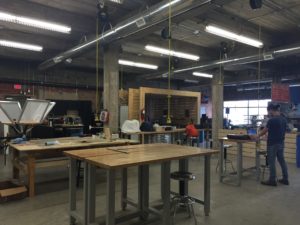 Maker’s Edge is one of the largest maker spaces around that isn’t a part of a franchise. This is largely because the Pardun’s decided to establish a for-profit business instead of the more typical non-profit maker space. The for-profit model allowed them to get big quickly and fill the shop with mostly new, efficient, and precise tools. Additionally, this business model allows Maker’s Edge to team with Circle Hardware to provide an in-house mini-hardware store for those “forgotten materials”. And a hidden benefit of avoiding the non-profit makerspace “club” approach: members never have to take their turn cleaning the bathrooms!
Maker’s Edge charges membership fees. Members use the space and everything in it for a monthly fee that goes towards the maintenance of the building, tools, and material that makers wish to use. The membership types range from “Unlimited Open Shop Membership” for $125 a month to a “Youth Membership” for $30 a month. There’s also an “Entrepreneur Package” that provides 24-hour access, an enclosed office, a professional address and mailbox, and more benefits for entrepreneurs.
The idea for Maker’s Edge came about when Rick Pardun, an engineer, grew frustrated with engineering applicants who could not design well. They had all the education necessary for their job, but they couldn’t physically do anything because they had never touched a tool. As an avid reader of Make Magazine, a magazine dedicated to DIY and all types of building, Rick was aware of the maker space movement and thought that it might be a good idea to start one with his wife Melissa, who was very familiar with nonprofit work.
Initially they worried that Waco would not be the ideal place to start a business, but Melissa did not want to leave Waco until her children were out of school. Waco eventually proved itself to be a fine location – big enough to ensure business in the shop, but not big enough to attract much competition from the franchises. The Parduns grew up in that small town environment. They appreciate that Waco seems to embrace a small town feel despite not being a “small town.” They wanted to be able to have a business where their members appreciated that the owners treated them like neighbors.
Melissa and Rick decided to get help actually creating this business idea.
 First, they sought some advice from Bradley Norris, an entrepreneurship instructor at Baylor University who was familiar with teaming up technology with entrepreneurship. Bradley had played with the idea of creating a maker space himself, but never had the time or the means. He offered Melissa and Rick some guidance on the technicalities of starting that kind of business as well as constant emotional support. Next, they got help from the LAUNCH program. This program included a three-day intensive workshop, where entrepreneurs gathered all of their business ideas and proposals together in order to actually begin the process of starting their business. After this, they got in touch with Jane Herndon of McLennan Small Business Development Center. Jane helped Melissa and Rick create a cohesive plan to present to a bank. Finally, Melissa and Rick got access to the most important part of the business process: connections. The Greater Waco Chamber of Commerce provided the Parduns with access to other business people who could help them get started and helped them get their business name out to more entrepreneurs around Waco.
“One thing I would tell entrepreneurs is that an independent spirit does not work…We live off a community philosophy,” Melissa says with a large smile. “It takes a community to start a business. It takes a community to complete a project. It takes a community to do everything in this life. Embrace it.”
 The Entrepreneurs…Melissa Pardun is the Executive Director of Maker’s Edge. Melissa is a life-long thinker and maker and strongly identifies with teaching the ideals of the DIY spirit to the next generation of innovators. Rick Pardun is the Chief EDGe-ineer, the creative force responsible for initial workshop design and ongoing training and tool acquisition. As a mechanical engineer, Rick has 18 years of experience in prototyping and design in the aerospace industry.
The writer…Allison Le Grice is an English student at Baylor University. She is passionate about literature, mental health, and recycling. In her free time, she is most likely binge-watching “Chopped.”
The Act Locally Waco blog publishes posts with a connection to these aspirations for Waco. If you are interested in writing for the Act Locally Waco Blog, please email [email protected] for more information.
(Note: This post is part of a series called “Entrepreneurs of Waco.” The series is collaboration between the McLennan Small Business Development Center (SBDC), the Professional Writing program at Baylor University, and Act Locally Waco. The McLennan Small Business Development Center offers technical assistance, business mentoring, training, and resources for all stages of small business. For more information, visit their website: www.mccsbdc.com. To see all the posts in this series, click here: Entrepreneurs of Waco. – ABT)
By Allie Drain
Spin Connection is nearly empty by five p.m. Classic rock and modern pop songs play from the speakers, mixing with the soft rustle of plastic – the sound of customers flipping through records.
It’s a comfortable atmosphere. Relaxed. Posters from popular bands and movies, both modern and vintage, plaster the walls behind the displays that line the sides of the store. In the middle are two rows of wooden displays, each row made of eight total bins. These displays show the real treasure of the store: they hold the thousands of vintage records that Spin Connection is known for.
It wasn’t always like this. “When we started, we had a couple of these racks set up,” Stan Wojciechowski explains, pointing his thumb at the bins in the middle of the store. “We were having them built, and so we just had like four racks and about five hundred, eight hundred albums out here.”
“I never thought I would have my own business,” he says. “A few years ago, we did the Austin Record Convention, which is one of the biggest record shows in the United States if not the biggest, and we decided we’d maybe try to have a store here in Waco because vinyl was having a comeback of some sort. Not a huge comeback, but a comeback nonetheless.”
Stan and his wife, Alicia, opened Spin Connection about two and a half years ago. Stan had come to Waco in 2007 for his work with industrial equipment—a job that he still holds on top of running his store. He’d always had his own collection of records though, which he started selling even before opening Spin Connection to help with bills and his children’s tuition.
“I think it’s something that he’s kind of wanted to do for a while and when he did it, his determination, I think, just made it happen,” Stan’s son, Josh, says.
Josh, who helps out at Spin Connection on top of going to school and working, recalls his father’s lifelong hobby of going to flea markets and auctions for music, which often turned into family trips with his parents and older siblings. He didn’t always appreciate it when he was younger until he started learning more about the work behind having a stall or a small business, something he’s become more aware of with his father’s store. “To me, I would say it gives me some inspiration on how to find that something you like doing and turn it into something that you’re proud of,” Josh explains, clearly impressed with his father’s accomplishments.
One of the most challenging parts of owning a record shop is finding the right inventory. With very few exceptions, the records which fill the racks of Spin Connection are all vintage, brought in by either customers looking to sell, or found through an auction of some sort. “I just have to find them, because I want to find them for a good price so my prices are reasonable for the customer,” Stan explains. “Some of the titles we can’t keep. Dark Side of the Moon by Pink Floyd, we can’t keep it. The Wall, also by Floyd. Michael Jackson’s Thriller, it doesn’t stay very long. Those kind of albums, you put it out here, ‘Ahhhh, look!!!’ It’s gone.”
While Spin Connection is never as busy as the chain stores, there is a steady flow of people from all ages and walks of life. There’s a good number of Baylor students who are part of the new record culture, but also plenty of older people. Many of them, Stan notes, come in looking for albums or artists they were fond of in the past, and some come in looking to sell. “You hear them out here laughing and looking like ‘Honey, look at this,’ and they’re laughing. It’s not even a comedy album, it could be anything. They just get a kick out of it.”
Spin Connection’s customers are drawn in mostly by word of mouth, however Stan also mentions the importance of location in starting a business. “You wanna be where there’s a lot of traffic,” he says. For that reason, Stan opened Spin Connection at 3703 Franklin Avenue, right near the intersection with North Valley Mills Drive. Beneath the upbeat music of the store’s soundtrack there’s a steady thrum of passing cars on the street outside. Traffic is a constant on Franklin Avenue, proving the worth of Stan’s words. The location provides Spin Connection with the opportunity to both attract more customers and avoid the heavy fees that helped close some smaller businesses he knew in the downtown area. “Waco is a good place to open a business, but you have to know what you’re doing,” he says. “Do your homework.”
“Having more live music would be good,” Stan says about his future goals. Bringing in bands is one of his favorite parts of the business. “We had a band up here from Austin that was really good and they did an acoustic set. They were doing headbanging music in clubs, but I asked them if they could do acoustic and they said yes,” he recalls. “It was really good.” The live music adds to the unique atmosphere that sets Spin Connection apart from many other music stores.
“He’s involved in all facets of the business,” Josh explains about his father’s work, “and I’ve learned that if you find something that you really like doing, you should really just do it. There are risks involved. My dad didn’t know how exactly it would turn out for him. I guess that’s part of the fun, but his resolve to just open the store and just take that risk … I guess I’ve learned that I should take risks for stuff that I love and try to really focus on those things that I love.”
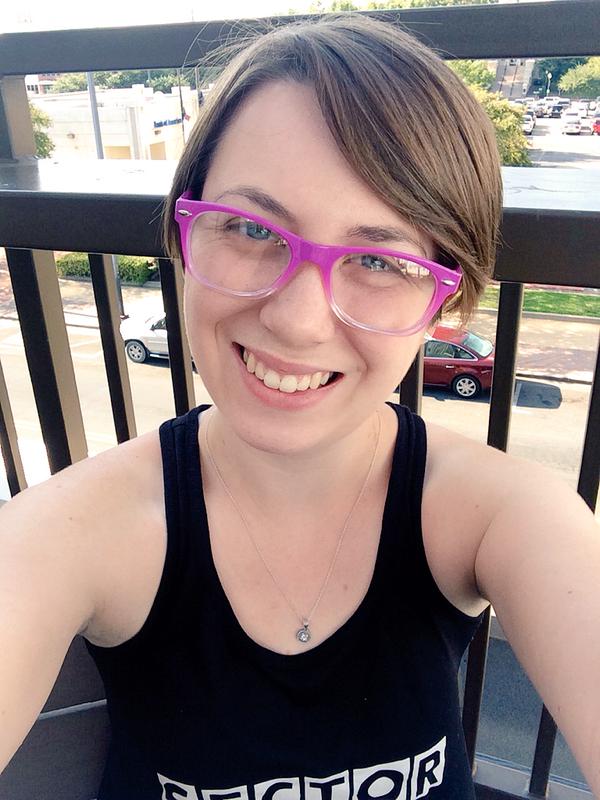 The writer…Allie Drain is a recent graduate of Baylor University, Class of 2016. While at Baylor, she focused her studies on English and Creative Writing while also acting as Co-Editor in Chief of The Phoenix, Baylor’s literary magazine. She loves reading, writing, and sharing stories, and hopes to one day enter the publishing industry.
The Act Locally Waco blog publishes posts with a connection to these aspirations for Waco. If you are interested in writing for the Act Locally Waco Blog, please email [email protected] for more information.
(Note: This post is part of a series called “Entrepreneurs of Waco.” The series is collaboration between the McLennan Small Business Development Center (SBDC), the Professional Writing program at Baylor University, and Act Locally Waco. The McLennan Small Business Development Center offers technical assistance, business mentoring, training, and resources for all stages of small business. For more information, visit their website: www.mccsbdc.com. To see all the posts in this series, click here: Entrepreneurs of Waco. – ABT)
by Hailey Nelson
 “Photography is an art form, and everyone has their own unique touch,” says Aaron Jetelina, or AJ, the proprietor of WTX Media. This is the main reason AJ works alone. Photographers have their own fingerprints on the photos, especially when it comes to editing, and the difference can usually be seen in the final product.
For AJ, it all started in high school when his photography teacher left suddenly, and AJ began taking over all of his teacher’s photographing responsibilities. He started out photographing football games and sports events, but that slowly morphed into taking over the rest of the school’s events. Today, AJ’s photography hobby has grown into a well-known business. Beyond finding something you’re good at, he says, “You have to find your niche, because it’s so important to be unique in this business and have focus. There are many new photographers out there, but if you find something interesting, like pet photography or newborn photography, you’re sure to receive more business.”
AJ found his “niche” while taking pictures for a few local dance studios. He realized the typical process that has been used for decades in school and sports photography, does not work with dance photography. When photographing a dance studio one must account for the multiple outfits dancers have, and you need to be able to accommodate a variety of poses. Parents want to see their child’s portraits before making purchasing decisions. AJ developed a new system in order to meet his customer’s needs. Instead of parents pre-paying for pictures without seeing their images, Aaron uses multiple computers as viewing stations. After the dancer finishes his or her photography session, the images are viewable on the computers to help in making purchasing decisions. Along with his professionalism and experience, this innovative way of making sales has enabled AJ to grow his client base to over 20 dance studio across Texas. Last year he photographed over 1000 dancers – which equates to 3000 outfits and 20,000 poses/images – all in the span of 10 weeks.
AJ is now using his knowledge of dance photography to develop a training program to help other photographers across the country learn how to be successful in this very specific photography niche. “I figure I can’t work in more than one state at a time,” he says. With the training program, other photographers can learn to use AJ’s process to expand their businesses.
 AJ’s interest in developing efficient business processes goes back to college where he earned a business degree. Since AJ started his photography business in junior high, he already had quite a bit of knowledge about photography by the time he entered college. He decided that earning a degree in business would be beneficial in continuing his career. AJ’s business degree and his expertise in photography programs have both been integral to his success. For instance, he uses editing programs such as Photoshop and Lightroom to fix minor cosmetic issues such as teeth whitening, and to do major editing such as full background changes, postermaking and more. He spent over seven years mastering these two editing systems, and has been able to use this to his advantage when it comes down to setting himself apart. “Everyone wants the perfect Pinterest shot. They see photos of perfect sunset weddings and immediately assume that’s how it’ll work. When in reality, it takes a massive amount of editing to get those.” This is only part of the reason that photographers can be expensive. It takes two hours to edit every one hour of shooting. So a full eight-hour wedding, can take sixteen hours or more to complete all the basic edits.
Another reason for the cost is that photography is an art. It’s like selling a painting or a movie. It’s something that can never be recreated the same way, and the artist takes pride in his or her work. This is especially evident when the photographer gives away the printing rights to customers. Typically photographers will have a second meeting with their clients where they select the photos they’d like to keep, and they are only allowed to print through the photographer. For his clients, AJ creates a flat rate depending on what they want done; then he provides all of the edited pictures on a flash drive for the customers to use as they please. It’s another innovation, and it has drawn many customers. “The world is relying so much more on technology than it used to, and no one wants the photos printed anymore, they want to put them on Facebook or Instagram,” he says.
AJ’s photographs also appear on Google; he is the only Google photographer between Dallas and Austin. No, he isn’t the guy who rides around in the car. He takes panoramic business images that appear on Google. These help businesses advertise, and they help customers get sense of what a place looks like when they search online. AJ’s experience and his vast array of equipment, including a camera with panoramic capabilities and a swivel tripod that allows the camera to move in a complete circle, helped him land the Google job. AJ owns several cameras and a multitude of different lenses that enable him to capture images from a great distance or up-close and in detail. In other words, he’s prepared because he knows no two photo-shoots are ever the same.
One thing that is the same is Waco, or at least AJ in Waco. He graduated high school here and returned here after college to continue his business. “I grew up here, and the best part is I get to do what I love and capture moments in people’s lives that they can cherish for years to come.”
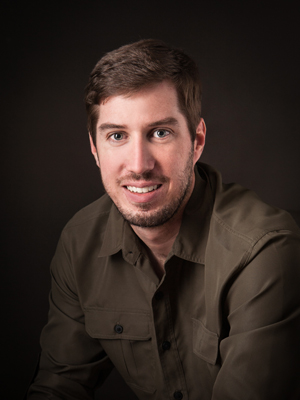 The entrepreneur…Aaron Jetelina started out his career in photography back in 2000 photographing portraits and events. Over the years he has developed the skills and knowledge in working with companies to meet their specific branding and marketing needs. He graduated from Sam Houston State University in 2007 with a bachelors in business administration and management.
 The writer…Hailey Nelson is a secondary education major with a concentration in English. She has moved around to five different states, but Texas is her favorite. She is a semi-pro photographer and loves animals more than anything. Baylor is her second home. She is a member of both Kappa Delta Pi honors society and Alpha Delta Pi sorority.
The Act Locally Waco blog publishes posts with a connection to these aspirations for Waco. If you are interested in writing for the Act Locally Waco Blog, please email [email protected] for more information.
- « Previous
- 1
- 2
- 3
- Next »