By Cheryl Allen
If you have a child in the public school system, you probably already know — this is Red Ribbon week!
Red Ribbon is a national campaign observed annually on the last week of October. It highlights the benefits of living drug-free. It also provides a valuable opportunity for adults to engage children and youth in dialogue about making positive life choices, including avoiding harmful substances. This year’s theme “Life is a Journey, Travel Drug-Free” reminds us of the importance of avoiding substance abuse throughout our lives.
The Red Ribbon campaign began in 1985 when drug dealers killed DEA (Drug Enforcement Agency) agent Kiki Camarena. Camarena grew up in a dirt-floored house with hopes and dreams of making a difference. He worked his way through college, served in the Marines and became a police officer. When he decided to join the U.S. Drug Enforcement Administration, his mother tried to talk him out it. He told her, “I’m only one person, but I want to make a difference.” After his death, his friends began wearing red ribbons to honor the sacrifice made by Camarena, and as a symbol of their commitment to live drug-free lives.
The movement spread and in 1988 Congress established Red Ribbon Week to bring awareness to the value of living drug-free, and to pay homage to all men and women who have made sacrifices in support of our nation’s struggle against drugs.
Many schools have special activities planned, and VOICE is assisting them by conducting educational presentations and distributing red ribbons, banners, and other items.
The Red Ribbon campaign is an important, but small, part of VOICE’s work. As a nonprofit funded by the Texas Health and Human Services Commission, VOICE offers a variety of free programs in schools and the community. Using an evidence-based curriculum, we teach healthy living skills, including tobacco, alcohol, and drug prevention. Visit texasschoolsurvey.org/report for data that reflects the critical need to reach children and youth at an early age.
VOICE also provides support for VASA (Voices Against Substance Abuse). This coalition is comprised of individuals from a variety of sectors who meet regularly to address ways to create a drug- and alcohol-free culture for youth in McLennan County. We encourage anyone who is interested in serving to contact us.
One of VASA’s initiatives is to encourage residents to dispose of unused prescription medication properly. On October 27, the DEA (Drug Enforcement Agency) is conducting a Drug Take-Back Day in our community. Please visit takebackday.dea.gov for times and locations. Another option is to take the drugs to a permanent disposal site at the Baylor Police Department or come by the VOICE office where we can provide disposable bags.
When children and youth choose not to abuse drugs, the communities and individuals benefit. Students who remain drug-free do better in school, are less likely to end up in the judicial system, and have a better chance of becoming productive citizens. With that in mind, effective drug abuse prevention education is a good bargain for our communities. The cost of a school-based prevention program is approximately $220 per student compared to the $4,000 per student costs associated with substance use treatment, emergency room visits, lost productivity, etc.
Please visit voiceinc.org for information about programs that address substance abuse prevention in our community.
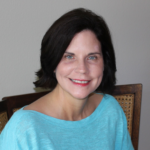 This Act Locally Waco blog post was written by Cheryl Allen. Cheryl has served the community professionally and as a volunteer for many years. She is the Director of Program Development for VOICE and is an adjunct lecturer in Civic and Community Service at Baylor University.
The Act Locally Waco blog publishes posts with a connection to these aspirations for Waco. If you are interested in writing for the Act Locally Waco Blog, please email [email protected] for more information.
By Graham Duncan
If you’re like me, one of the first things that pops into your mind when you think of local government is the small town of Pawnee, Indiana, home of NBC’s hit comedy Parks and Recreation. In the show the politics of Pawnee are quirky, unreasonable, and unique. While the show may not be based on a real town, local politics can be all of these things. I imagine the politics in Waco are no exception. Sometimes situations can create quirky political solutions. Other times, political, social, or legal realities can force decisions that may be considered by some to be unreasonable. And Waco is unique; the city has its own history, its own problems and its own way of solving those problems in the political arena.
But sometimes it can be hard to know what is going on locally or confusing to figure out how things work in the city. I’m new to Waco and I wanted to learn more about how local politics work here. And I wanted to share what I found with everyone! So, here goes!
City Council
Waco’s local government is set up in a council-manager model. What does this mean? Basically we, as Wacoans, vote to elect council members to represent the five districts in the city. The “mayor” is elected at-large and becomes the sixth member on the council. The mayor serves as the head of the government for ceremonial and emergency purposes. The mayor is also the only council member with a term limit. No one may be mayor for more than three two-year terms. So, the council has six members, five directly represent each district, and the mayor represents the city as a whole. All council members and the mayor are volunteers, by the way. They don’t get paid for their service.
These elected officials, working on behalf of their constituents (the citizens of Waco) hire a professional public administrator (aka the city manager) to be the planning and executing arm of the government. The city manager is in charge of executing the vision the council has for the city. Day-to-day operations, making sure the city is responsive to the needs of the citizens of Waco, and providing feedback to the council on how things are going are part of what the city manager does for the city. So, in a nutshell, the city council provides a forum for the people’s voice to be heard in the legislative process of the local government. They are the elected representatives of the people and have a certain function granted to them by the city charter. The city manager provides the city with an executive power, granted that position by the elected members of the government.
So what does this mean in a practical sense?
I spoke with Councilman John Kinnaird, who represents District Three, about the relationship between the council and the other parts of city government. The council, as mentioned above, provides a vehicle for the people’s voice to be heard. Whenever there is a problem in the city the public has the opportunity (and the responsibility) to let the city know about it. The council ensures that taxpayers’ dollars are being put to use on projects the public cares about. One practical example of this is the roads in Waco. People have been bringing up issues with the city’s roads and the council has begun responding. Typical road maintenance costs the city about $3.5 million in a given year. When I spoke with Councilman Kinnaird I learned that, in response to citizen’s complaints about the roads, the city is putting $16 million this year towards road repairs. The council decides how the money will be spent and works to ensure the different parts of city government are working to accomplish the tasks desired by you, the citizens of Waco. The response may not always be as quick as we would like, but the council listens to the citizens and works to make sure problems in the community are solved.
Another example is the local animal shelter. There was an increasing demand on the limited services provided by the Waco Humane Society. They were taking in 10,000 animals per year and two-thirds of those animals were being euthanized because the shelter could not keep up. The council saw the need and worked to help provide support for the shelter. The council worked to fundraise money, they partnered with nonprofits in the community providing excellent care to the animals of Waco to learn how those organizations were serving the needs of those animals. There was a concerted effort to make the public humane society work for the community and for the animals that found themselves without a home. As a result of all this collaborative work, more recently the shelter was taking in around 6,000 animals per year and had a more than 90% live exit rate. That’s pretty cool.
Local government may not always be “sexy”; it may not always be exciting or even interesting. But what happens on the council affects each and every one of us. Talk to your city council representative. They want to hear what you have to say, and they are members of the community just like we are. They care about what happens here and they want you to care as well. Find out who your representative is. All of the information is available at www.waco-texas.com/council.asp; you can find district maps as well as the names and contact information of the council members.
You can also attend the city council meetings, which happen the first and third Tuesday of each month with the “Business Session” starting at 6 PM. There is always space made for citizens to address the council at each meeting. Get to know your representative. Get involved. Help make the Waco community better and stronger.
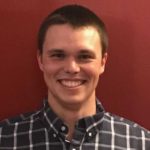 Graham Duncan is 24 years old, recently married, and recently moved to Waco. He graduated from Asbury University in Kentucky in 2016 with a degree in Political Science. Since graduating, he spent a year as a full-time service volunteer in Tucson, Arizona, and after that started working at The Home Depot. His wife is currently studying for her Master’s in Higher Education at Baylor and he is doing his best to support her!
The Act Locally Waco blog publishes posts with a connection to these aspirations for Waco. If you are interested in writing for the Act Locally Waco Blog, please email [email protected] for more information.
By Jeffrey Vitarius of the Waco Pride Network
Waco had celebrated LGBTQ Pride in the past, but had not had any kind of organized, city-wide celebration for ten years. That changed last year. After a crop of conversion therapy billboards sprouted up around Waco, organizers took the initiative to bring Waco’s LGBTQ community back out into the open. They had originally planned on a small picnic…what ultimately occurred was the first “OUT on the Brazos Pride Festival.” Over four hundred people turned out, the event was a huge success, and the organizers were able to raise considerable funds for future Pride events.
 The 2018 festival focused on building a family-oriented welcoming environment featuring live performances, speakers, vendors, sponsors and a great sense of community. As planning began for Waco Pride 2018, it was obvious that the OUT on the Brazos Pride Festival should continue. But what about offering a more adult-oriented event in addition to the family-friendly festival?
Then we had a thought. What if we celebrated the numerous LGBTQ-friendly establishments downtown? And just like that, the concept for “OUT on Austin” was born. A few conversations with the wonderful Rebekah Geare Hagman of Cultivate 7Twelve later and we had an event plan.
 OUT on Austin will be centered on Cultivate 7Twelve where we will hold an art auction and raffle as well as offer refreshments. We will connect the event with various other locations up and down Austin Avenue with a social media scavenger hunt, encouraging participants to take in all that the Austin Avenue District has to offer. The event will close with a short presentation and the announcement of the raffle winner back at Cultivate 7Tweleve.
The theme of the evening will be “Celebrating the Beauty in Grayscale,” we will be recognizing that we are moving from a world of stark contrasts to one of gradients and subtlety.
 The plan is ambitious, and we are absolutely confident in its success. We hope you will join us this year, next year, and in many years to come. We don’t plan on going anywhere. Find out more at www.wacopride.org or on social media @WPrideNetwork.
The art auction portion of OUT on Austin will take place from 6:00 pm to 9:00 pm on October 12th at Cultivate 7Twelve and will be followed by a short presentation.
The OUT On the Brazos Pride Festival will take place from 11:00 am to 4:00 pm on October 13th at Brazos Park East.
 Jeffrey Vitarius is an active member of the Waco Pride Network. The Waco Pride Network was official founded in July 2018. It is a non-profit organized to serve the LGBTQ community of Waco, Texas. Waco Pride Network’s keystone event is the annual Out on the Brazos event held each October. We strive to foster a positive, open, and compassionate LGBTQ community by promoting events with integrity and excellence.
The Act Locally Waco blog publishes posts with a connection to these aspirations for Waco. If you are interested in writing for the Act Locally Waco Blog, please email [email protected] for more information.
By Brett Mills
“Let’s take Easter to the strip clubs,” my wife said to me 15 years ago. Little did I know my “yes” would be my death sentence.
I experienced a “gentleman’s club” only once before as a bright-eyed Baylor freshman. I ducked in with trepidation, curious about what I would see. Two decades later, that experience is still seared into my memory, though for different reasons than you might expect. From the back, I watched as a half-naked dancer swayed around a 50-something-year-old man. He stared at her…as close as he could get without touching. His gaze was empty, robotic, disconnected from reality. I thought to my 18-year-old self, “I don’t want to be that guy”, and played pool the rest of the night. But I am no hero. I, too, am that man. A man who has been culturally conditioned to view women as objects, to “conquer the girl,” “chase the skirt,” belittle her mind and question her power.
Good Friday 2004, I drove my wife to several Waco stripclubs. She carried gifts inside, I sat in the car. It was the beginning of what would later become Jesus Said Love: a statewide movement sharing the love of Jesus with those impacted by the commercial sex industry.
This death of mine has been slow. In my 20s, I knew everything. I understood the way things worked. And, without a shadow of a doubt, I knew this reality of mine was made up of black-and-white, clear-cut, God-given truth. Today, at 42, my reality is more shades of living color than anything else, a hundred tones stacking and overlapping and spreading wide. This didn’t happen overnight. Every time we would visit a strip club, death. Every conversation with a club employee or manager, death. Every crisis, death. Dinners at my house with entertainers and their children, death.
My thoughts on everything from the sex industry to government, social justice to the church…everything in me, at some point, has experienced one of these deaths. And it makes sense. When macro issues suddenly become intimately personal, your response is wildly different than it was when you were a mile away. For those concerned that I’ve abandoned my faith, I can assure you: my views on Jesus have only deepened and grown stronger. In fact, these deaths I died were exactly what Jesus meant by “losing your life” to find the life that is life indeed. Yes, I die and rise again on the daily. I have awakened to greater truths: that numerous times in Scripture, Jesus relates to women, empowers women, listens to women, respects women. Jesus stands with women, positioning himself between oppressor and victim.
Several years ago, another level of death smacked me in the chest when we launched an empowerment program called ACCESS. I was scheduled to spend every day of 8 weeks with women who have been to hell and back: sisters with bravery beyond comprehension (because facing your own trauma is a serious and gutsy thing).
I sat around the big table in the Great Room at our JSL office with 8 future ACCESS students. It was our first chance to meet—an orientation of sorts. There came a point in our visit when the atmosphere shifted. There was a bit of silence. And then she spoke up. She said “I don’t trust men. I never have and never will. All they’ve ever done is hurt me. Abuse me. Lie to me.” She went on to say, “but I can honestly say you, Brett, are the first man I think I trust. There’s something about you that’s different.”
Tears. From everyone.
I swallowed and looked around the table. “I’m sorry for the way men have treated each of you,” I managed to say. “You are worth infinitely more than the words and actions that have been done to you at the hands of men. I promise this will be a safe place for you.”
I went home that night and the grim reaper was waiting…again. I kept thinking about her words: “You’re the first man I think I trust…” In a moment of honesty, I struggled with her comments because I thought about all the times I’ve objectified women. The crass jokes I’ve made around other guys, or (worse) the times I’ve heard other men say horrible things about women and I’ve kept silent – also known as “the bystander effect”. The times I thought, “She can’t handle that…we need a man to do it,” or the times my wife asked me to help with laundry, and, almost instinctively, my gut quietly said, “Wait, that’s your job.”
I don’t want to find myself sitting around the deer campfire talking about “tits and ass,” thinking it’s harmless. Or, conversely, diminishing its harm by saying, “It’s just guys being guys,” or, “I was just kidding.”
That night, in light of these deaths over the past 15 years, I wanted to create a space for men to come and die with me, learning about issues affecting women today. Yes, this was to be a brotherhood of sorts, made up of men who are willing to take back the language of the locker room and golf course. A band of brothers willing to look at these issues affecting women and realize they are, in fact, also inherently men’s issues.
Man In the Mirror Collective is that space where, together, we will put our minds, hearts, and pocketbooks together and make a difference in the current culture of domestic and gender violence. Men coming together in numbers strong enough to make a cultural shift.
The objectives of MITMC are simple:
- Courage to Look Inward
To stand against gender violence, we must be willing to examine our own attitudes, biases, and behaviors regarding women, approach to sex, and masculinity. - Support Survivors
Most sexual abuse goes unreported. Most who report are telling the truth. Offer support by listening intently to survivor stories, not minimizing or criticizing them. - Refuse Sexist and Abusive Behavior
Help to create a climate in our male peer culture that discourages sexist attitudes and behaviors. Refuse to be a bystander. - Contribute Financial Resources
Help fund programs and organizations, providing resources for victims of domestic, physical, and sexual violence.
Now, this collective is not about helping the “poor, weak woman.” It’s not about charging in, muscles flexed, ready to rescue with a savior mentality. Rather, it’s about doing what any logical human would do: listen first, link together – arm in arm, feet lined up unified at the front lines of the battlefield. In standing with women, we not only become better men, but (ultimately) better human beings in a better world for the next generation. This is legacy. This is good and true and right and reasonable.
The bells are tolling, men. Will you join me in making a change? Let’s start with the man in the mirror.
 Brett Mills is the CEO of Jesus Said Love, a movement across Texas working with those impacted by the commercial sex industry. He also works closely with those arrested for buying sex through an intervention program of JSL called Stop Demand School. A graduate in Communications from Baylor University, Brett lives in Waco, TX with his wife Emily, and children Hattie, Lucy and Gus. For more information about how to participate in the Man in the Mirror Collective visit jesussaidlove.com/mitm or or email [email protected]
The Act Locally Waco blog publishes posts with a connection to these aspirations for Waco. If you are interested in writing for the Act Locally Waco Blog, please email [email protected] for more information.
By Melissa Mullins
Anyone who’s been around Waco for very long has no doubt noticed the remarkable growth and development occurring, with everything from home construction to hotel revenue on the rise. All the new construction I see around me daily got me to wondering: how do cities around Texas and around the country encourage “green” infrastructure and what’s planned for Waco?
Sustainable Development
Sustainable development is loosely defined as meeting the needs of the present without compromising the ability to meet future needs. It is often discussed in terms of the ubiquitous “three-legged stool” metaphor with strong economic, environmental and social legs (people, planet, profit) all required if you don’t want a wobbly stool. Since my background is in biology (and not economics or social sciences), I wonder most about interactions of the natural and the built environment when communities grow.
In my neighborhood and around Texas
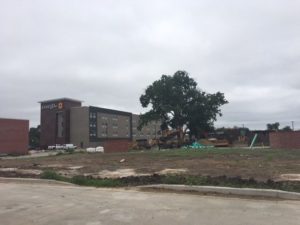 So, for instance, as the city block (pictured) that I pass by daily was converted from older houses to a new shopping center this year, what changes will take place in terms of water movement, soil, and plants? How can we capitalize on the new structures that are in place (such as rooftops)? Waco has lots of great outdoor green spaces- but are there things we can do to promote linkages and greenbelts in our community? I don’t claim to know the answers to these questions, but I do think we all should be a part of the conversation. And it’s a conversation that is not unique to Waco. About 85% of Texans currently live in urban areas, and the population of Texas’ cities is expected to double in the next 40 years, with metropolitan counties (including ours) accounting for nearly all the growth that will occur in the state.
Waco City Plan
There is certainly no shortage of information on the internet about “greening cities” around the country and around the world. Closer to home, The Waco City Council adopted the City Plan, Waco Comprehensive Plan 2040 a couple of years ago, and this plan discusses specifics for Waco related to economic development, growth management, transportation, community livability and the environment. In addition to outlining broad goals and objectives for Waco, specific implementation strategies are identified related to sustainable growth. For instance, City Ordinances could be adopted such as a parkland ordinance that would require developers to contribute to construction of parks, and creek beds could be developed as linear parks that could link neighborhoods to the Brazos River Corridor. There are recommendations to adopt stormwater utility fees that would encourage green infrastructure. The section of the plan on the Environment contains implementation strategies aimed at reducing impervious cover, conserving water, and encouraging sustainable planting practices using native plants. Some of the most exciting implementation strategies are related to energy and encourage considering the adoption of a green building code, promoting the use of solar power in residential, commercial, and industrial development, and taking specific actions to decrease the urban heat island effect.
What can I do?
A city plan is only a starting point of course, and only as good as the action that comes from it. There are other entities besides government (such as non-profits) that play an integral part in advocating for all three legs of sustainable growth in Waco and surrounding communities. How can interested citizens be involved? We are often given lists of individual actions we can take that are sustainable (recycling, taking our own bags to the grocery store, etc.) and while these are all great ideas, our real strength and ability to promote sustainability is as a community, which is more than a loose affiliation of individuals doing their own “green” thing. So maybe for me that means forcing myself to go to public meetings (though I hate them) where issues I care about are on the agenda. What does it mean for you? Some places to look for inspiration might include: Keep Waco Beautiful, the Waco Sustainable Resource Practices Advisory Board, Sustainable Waco Facebook group, Heart of Texas Master Naturalists, McLennan County Master Gardeners – feel free to share others you know about in the comments section!
 Melissa Mullins coordinates water education and outreach at Baylor’s Center for Reservoir and Aquatic Systems Research. She’s lived in various neighborhoods in Waco and McLennan Co over the last 25 years, loves spending time outside, and is a library patron.
The Act Locally Waco blog publishes posts with a connection to these aspirations for Waco. If you are interested in writing for the Act Locally Waco Blog, please email [email protected] for more information.
By Jessica Maxwell
In July 2015, Waco Transit System assumed operations of the newly-formed McLennan County Rural Transit District (MCRTD). MCRTD offers appointment-based, door-to-door service that anyone can use to travel anywhere in McLennan and adjacent counties. The program, which replaced a former rural program operated by another agency, was created to improve the mobility of rural residents and enhance access to jobs, education, community services, healthcare and more. Public transportation was previously not an option for most people in these rural areas, due to limited service.
“By combining the urban and the rural systems to one provider, we’ve been able to maximize our efficiencies, which has allowed us to extend service hours and create Saturday service,” said Waco Transit System General Manager, Allen Hunter. “This program gives people who don’t have transportation a chance to lead independent lives – and we’re just glad to be a part of that.”
Take, for example, rural transit passenger, Jerry Kucera. Mr. Kucera is unable to drive and uses rural transportation every day during the week to get to his job in Waco at Goodwill. He lives at home with his parents in West, and his mother, Dorothy, said the service has been a “godsend” to their family.
“My husband cannot drive anymore, because he’s on oxygen 24/7, and I needed somebody to help me with the driving,” said Mrs. Kucera. “The drivers handle him [Jerry] with kid-glove care, they’re there on time, and they make sure he gets to work on time.”
Public outreach has been instrumental in generating awareness on MCRTD and educating on rural transportation’s affordability and ease of use. To help promote the program even more, MCRTD partnered with Texas country music artist, Holly Tucker, to create an eye-catching TV commercial and full-length PSA.
- Link to award-winning, full-Length “Anyone. Anywhere.” PSA: https://youtu.be/SJB_KKx7SHw
- Link to award-winning, :30 “Anyone. Anywhere.” commercial: https://youtu.be/eponEyXXWGU
MCRTD has grown exponentially and continues to flourish. The service provided more than 54,000 trips in 2017 and experienced 114% growth from the previous calendar year. This year, MCRTD is projected to transport more than 63,000 passengers. Ridership has increased above expectation, and transit officials expect those numbers to rise even more as word continues to spread about the program.
Additionally, MCRTD was named the “2018 Outstanding Rural Transit System of the Year” by the Texas Transit Association. This award is given out each year to an agency in the state of Texas that displays exemplary service in the transportation industry.
“In a time when ridership has been declining in the state and in rural transportation, our ridership has actually gone up each year,” said Mr. Hunter. “We’ve worked very hard to grow this program, and we’re excited for what the future holds.”
Rural transit service is available from 5:15 a.m. to 7:15 p.m., Monday through Friday, and 6:15 a.m. to 8:15 p.m., on Saturday. Trips can be arranged by calling Waco Transit System at least 24 hours in advance at (254) 750-1620 or 877-875-RIDE (7433). Fare for one-way, in-county trips is $3.00, and fare for one-way, adjacent-county trips is $5.00. Fees also apply for guests. Destinations include anywhere in McLennan or adjacent counties, as long as one leg of the scheduled trip originates from, or travels to, a rural address.
For more information about the McLennan County Rural Transportation District program, call (254) 750-1620. Additional information can also be found on the Waco Transit System website at http://www.waco-texas.com/transit/rural_transit.asp.
 Jessica Maxwell is the Director of Marketing for Waco Transit System. She graduated from Northern Illinois University with a BA in Journalism and Communication Studies. Originally from Illinois, she moved to Texas with her husband in 2013, and they have been happily settled in Waco ever since. She enjoys spending time with her family, traveling and experiencing all the great outdoors has to offer. You can reach Jessica at [email protected].
The Act Locally Waco blog publishes posts with a connection to these aspirations for Waco. If you are interested in writing for the Act Locally Waco Blog, please email [email protected] for more information.
By Robert Saucedo
If you are a student looking for a job with longevity, you should look into the concrete industry. If we citizens want to invest our tax dollars into vocational training for trades that have withstood the test of time, then we tax payers and parents should take a serious look at the concrete industry, in particular the precast concrete industry.
The use of concrete dates back to ancient Egypt and shows no signs of slowing down. Concrete is the second most consumed material in the world after water. It’s used mostly in the construction industry. “The precast concrete market is expected to grow from $104.03 Billion in 2017 to $138.96 Billion by 2022, at an estimated compound annual growth rate of 5.96%. The precast concrete market is expected to witness high growth as a result of the rising urbanization, large-scale investments in infrastructure & industrial sectors, and rising construction activities in emerging economies. (Researchandmarkets.com, DUBLIN, May 22, 2018 /PRNewswire/)
I have been in the concrete industry for my entire adult life. It has been a family trade for over 40 years. We in the concrete industry have a passion for what we do, and we take pride in the fact that we are building America daily.
That being said, our industry, like many of the construction trades, is hurting for skilled labor. It reminds me of that old country music classic that George Jones used to sing, “who’s gonna fill their shoes.”
We have a whole generation of kids that are going into college, many of them coming out with crippling debt. Training in the construction industry offers a different path. For example, according to Indeed.com, the average salary for a construction inspector in Texas is $51,693. This is the kind of work that an 18-year old with a little initiative and the right training and industry certifications could do at beginning his or her working career, right out of high school.
We are an industry that is waiting for that next young individual that we can invest in. I can’t help but feel bad for the 18-20 year olds that walk through our doors who can’t read a tape measure. It is great,on the one hand, to teach our young people to use computers and ipads and other tools and technology of the 21st century. But, I believe we are failing our kids by not encouraging them to take trade classes like drafting, shop, and welding.
What can we as Wacoans and Texans do to encourage our youth to enter into these trades? I think that if we offer industry certifications such as ACI (American Concrete Institute)/PCI (Precast Concrete Institute) and then find local companies that would be willing to offer summer jobs for these trades, our youth will not automatically default to student loans and degree programs that will not pay off for many.
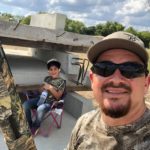 Robert Saucedo is a 3rd generation American (no-hyphens). He grew up watching his dad and uncles build roads and bridges from Waco to Dallas and watching his mom overcome countless obstacles with grit and compassion. He started working in the precast concrete industry 12 years ago. The company that hired him helped him earn his associates degree in business management and multiple industry certifications that have helped him grow in his career. The precast/prestressed industry and committing his life to Christ have been blessings in his life and he has a passion for sharing about both.
The Act Locally Waco blog publishes posts with a connection to these aspirations for Waco. If you are interested in writing for the Act Locally Waco Blog, please email [email protected] for more information.
By Carla Pendergraft, Director of Marketing, Waco Convention & Visitors Bureau
 What’s up with the pineapple? The pineapple has long been recognized as a traditional expression of welcome and hospitality throughout the South. Appearing on all sorts of décor, including gateposts, door knockers, and fountains, the fruit symbolizes those things we appreciate in a home: warmth, welcome, friendship and hospitality. So it is not surprising that we have chosen the pineapple as the symbol of a new Waco Tourism Ambassador program!
“Be a Pineapple”
There is an old saying that we should all be like pineapples: stand tall, wear a crown, and be sweet on the inside. We are asking Wacoans to be pineapples! If we are more like a pineapple to our visitors (around 2.5 million annually), WE will become part of their lifelong memories. A happy visitor spends more money in our economy, thereby creating more jobs for Wacoans. Over 5,700 people are employed in the tourism industry in McLennan County – that’s a lot of jobs! Wacoans that love our City are what create the memories people remember.
In the soft launch of this program we have received so many great ideas to move forward and had so much enthusiasm from residents, merchants and new organizations to Waco. So many have asked to be involved and offered their help, we appreciate it!
Making Visitors Feel Welcome
Need ideas? Here are a few ways Wacoans can make sure visitors feel welcome:
- When you see someone who looks a little lost, offer your assistance with directions.
- When you hear people ask about what there is to see and do in Waco, offer your recommendations and suggest something fun that Waco has to offer! Not sure about what’s going on? Visit the Convention and Visitors Bureau website at: https://wacoheartoftexas.com/
- If you own a business, use a pineapple as a conversation starter with visitors. Maybe a stencil of a pineapple on the side of your building with the hashtag #wacopineapple, or a real pineapple at the front desk.
- When you see someone who looks like a tourist, reach out to them and ask them where they are from! Start a conversation! We have had visitors from all over the world recently.
There are so many ways to help people have a wonderful visit to Waco.
How the Program Works & How to Get Cool Swag
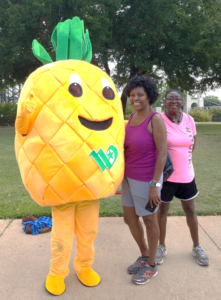 Just reach out and help a visitor in some positive way. Catch a photo of you and the visitor, and then nominate yourself (or someone else) at whatswiththepineapple.com. We’ll send those selected a Waco Tourism Ambassador t-shirt or a pin.
Visitors to Waco can get involved, too. If someone in Waco goes the extra mile to make them feel welcome, the tourist can nominate them as a Waco Tourism Ambassador. Photos are needed so we can celebrate! Let’s build that hashtag of positivity online!
The EVENT
We are launching the campaign with a free event, August 31st at the Waco Convention Center, Brazos Room South. Join us from 3 p.m. to 4:30 p.m., with a brief program at 3:30 p.m., and a performance by Waco’s own, Holly Tucker who will unveil a new song specific to this program. We’d love to see as many Wacoans there as we can!
Share Your Waco Pineapples
Do you see a pineapple that a business is using as a conversation starter with visitors? Or have you spotted a pineapple used in an architectural element? Share them with us by posting on Facebook or Instagram, and use the hashtag #wacotxpineapple!
The Pineapple in History
Christopher Columbus encountered the pineapple on his second voyage to the Caribbean region. Due to its rarity, expense, and striking beauty, it became a special gift for gift-giving occasions. Dinner guests served the exotic fruit felt particularly honored by a hostess who obviously spared no expense to ensure her guests felt special. Over time, it becomes incorporated into decorative elements in the home and in public spaces.
The Pineapple in Waco
Waco has long been a crossroads for travelers to Texas. The historic Suspension Bridge, built in 1870, allowed travelers to safely cross the Brazos River.
Pineapples appear as decorative elements in at least two downtown Waco locations: a wrought-iron fence in Indian Spring Park, and the Waco Foundation fountain in Heritage Square. If you find pineapples featured elsewhere in Waco, be sure to take a photo and let us know.
Want to be an extra in a video with Holly Tucker?
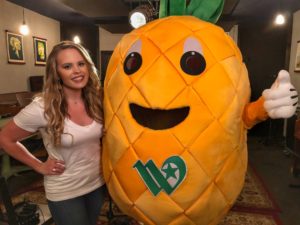 We’re shooting a scene with Holly Tucker for our ‘Welcome to Waco’ Tourism Ambassador campaign video and we need some extras for a shot on Austin Avenue. (You don’t have to do anything but clap and smile and it won’t take long at all.) We’ll be walking Austin Avenue in front of the Hippodrome. Everyone is welcome, wearing uniforms is fine. Dogs and kids are also welcome.
- Date: August 21
- Time: 10 AM – 10:45
- Location: In Front of the Hippodrome
 Carla Pendergraft is the Director of Marketing for the Waco Convention & Visitors Bureau, the official destination marketing organization for the Waco area. She has worked since 1990 in various positions within the Convention Center and CVB. She has a master’s degree in business from Texas State University. Her early career was with Citicorp Diners Club in Chicago, Illinois in management and marketing communications. Carla is the proud grandmother of Aviana, who is 6 years old, and a newborn granddaughter named Rose.
The Act Locally Waco blog publishes posts with a connection to these aspirations for Waco. If you are interested in writing for the Act Locally Waco Blog, please email [email protected] for more information.
By the Greater Waco Chamber of Commerce Staff
What is it about Waco that makes it so appealing to new businesses? At the Greater Waco Chamber of Commerce, our economic development team is constantly working to grow the economy through the attraction of new businesses to the region and the expansion of our existing industry base. Having already announced $119 million in new industrial investment for 2018, the level of interest in the community is strong. Not only has Waco become a desired destination for visitors, more businesses and individuals are taking notice of our strong assets and choosing this city as the ideal location for both professional and personal success. In fact, McLennan County is outpacing the seven-county region, Texas and the U.S. in labor force, making Waco a magnet for talent and commerce.
Here are five things that we think make Waco a great place to do business:
1. Waco is centrally-located. Waco’s location in the “Texas Triangle” positions the community as a central point for connectivity and growth. Identified as one of 11 mega-regions in the United States, is roughly formed around the D/FW region, Austin, San Antonio and Houston, with Waco located right in the middle. A recent article published by D Magazine in Dallas, indicates this region is home to more than 20 million people and produces nearly $1.3 trillion a year in economic output, ranking 17th among world economies. Interstate 35 also plays a big part in Waco’s economic success, providing easy access throughout Texas and the United States.
2. Waco is home to five outstanding, diverse institutions of higher education. Waco is fortunate to have higher education opportunities for people of each and every walk of life, which is important to businesses who are looking for a strong talent pipeline. Baylor University, the oldest institution of higher learning in the state of Texas and the largest Baptist university in the world, offers a combined 258 baccalaureate, masters and doctoral programs, according to the Baylor website. McLennan Community College (MCC) offers multiple associate degree programs at affordable costs that are designed to be transferable to bachelor’s degree programs at senior-level institutions. Through its partnerships at the University Center at MCC with universities across Texas, including, Texas Tech University at Waco and Tarleton State University Waco, students can easily transition into affordable bachelor’s degree programs without having to leave Waco. Texas State Technical College (TSTC) is the technical training college for Texas. Headquartered in Waco, this diverse two-year technical college focused on student success in learning and preparation for future careers offers over 40 associate’s degree and/or certification programs and boasts a high student job placement rate after graduation.
3. Waco provides an awesome quality of life. The cost of living is affordable, and the business climate is supportive and welcoming. With initiatives like Start Up Waco, partnering with resource providers across Greater Waco to provide knowledge, work space and access to capital, entrepreneurs will have more connectivity into the Waco-McLennan County entrepreneurial ecosystem than ever before. Already, new businesses are popping up across the community and finding success entering the marketplace. Waco is home to an abundance of natural resources, including the Brazos River and Lake Waco. Cameron Park is one of the largest municipal parks in the state, with beautiful trees, a natural habitat zoo, access to the Brazos and Bosque rivers, and a huge network of trails that vary from beginner to expert level.
4. Waco has a strong spirit of collaboration. Waco believes in partnering for success. Few places see local governments, the business community, education institutes, and non-profit organizations working together on common goals for growth and success. We all are working together to grow and diversify our economy and create prosperity for everyone.
5. Waco’s flourishing tourism market is evidence of what an incredible place Waco truly is. With over two million visitors every year, it’s obvious that people enjoy visiting Waco. Visitors see Waco in a different light – they meet the kind, loving community of people who live here; they interact with the positive, supportive businesses; they have wonderful experiences that keep them coming back again and again.
Waco has transformed into a truly vibrant community that is primed and ready for new businesses to put down roots. We’re experiencing a very unique, exciting time here in Waco, and we are so thankful to have opportunities to show off our city.
Written by Greater Waco Chamber of Commerce Staff.
The Act Locally Waco blog publishes posts with a connection to these aspirations for Waco. If you are interested in writing for the Act Locally Waco Blog, please email [email protected] for more information.
By Minister Sandra Henry
History and Birth of the Cattleya Foundation of Hope
May 22, 2015, I went to Baylor Scott and White Hillcrest Medical Center for my annual mammogram. This time it was different, I was diagnosed with breast cancer! My first reaction, as I tried to listen to the doctor explain medical procedures, was the fear of death but God spoke to me with the words, “Fear not, all is well.” Throughout my traumatic experience, with the love of my husband Joseph, love and encouragement of family, friends, cancer survivors and my church, Abundant Love Fellowship Church, I was strengthened by faith to persevere.
In August 2015, I planned a Celebration of Life luncheon at the Spa at Canyon Oaks in Crawford, Texas, where my family, friends, local community partners and cancer survivors came to celebrate my life journey. I watched in awe as God’s vision and plan began to unfold in such a miraculous way. So many people attended this event that I knew God was about to do an amazing work. At that moment, I said yes to God’s Will for my life journey.
On February 15, 2016, I met with Sister Shelia Ross (who attended the event in August), Sister Toria Smith-Loughridge, Sister Lisa Ware, and Sister Sandra Montgomery at Panera’s in the Central Texas Marketplace Shopping Center. We prayerfully discussed plans of establishing a local cancer foundation in Waco for all cancers. We formed a board and started this foundation with our own money. We have worked diligently to plant seeds of hope in cancer survivors and continue to passionately serve the McLennan County community. The Cattleya Foundation of Hope has now grown to twenty-two members.
We adopted the orchid as our symbol because of its strong roots and its ability to persevere through adversities, its beauty, and grace. We adopted the color purple because of its royal heritage; the color gold because it represents courage and passion; and the color ivory/cream because it represents elegance, warmth, and tranquility (peace).
Our core values are Christ first, compassion, commitment, communication, courage to be steadfast and unmovable, excellence in all we do, integrity, accountability and transparency, service, and teamwork (unity).
Our mission statement: We are a team of Christian women and men who understand the plight of those recently diagnosed, cancer survivors continuing on their journey, and those who are in the fight to regain their health and wholeness. We stand together to provide spiritual and emotional support for those who have been diagnosed with cancer and are continuing on their journey. We stand together to give hope, faith and life to men, women, and children cancer survivors and their families.
We are unique because spirituality, prayer, and love are the essence of our foundation and our service to cancer survivors in this community. In Cattleya, our cancer clients are not alone!
Cattleya Whispers of Hope Programs
After completing a confidential assessment application, we may provide transportation and/or bus passes for doctor appointments and treatments. We may sit with cancer clients to give relief to their primary caregiver, which is important to everyone affected by cancer.
How do cancer survivors learn about our services? We receive our clients through Scott and White Hillcrest Medical Center – McClinton Cancer Center; Community Cancer Association, and through word of mouth.
Cattleya has partnered with McClane Children’s Hospital in Temple, Texas, because it is the nearest facility available to McLennan county children who have been recently diagnosed with cancer and our children cancer survivors continuing on their life journey.
Last year, Cattleya was able to visit the children at McClane Children’s Hospital during October for the October Harvest and December for Christmas expressions of love. On both occasions we were inspired by the smiles and their willingness to grasp life with all she has to offer. These courageous children and their families are why we are in this fight to end cancer in our world.
We brought socks, gloves, blankets, newly donated books and gift cards. During Christmas we also brought donated snowmen outfits for the children to wear and have fun!
This summer, through fundraising, we were able to give a monetary donation to their Dreamcatcher Camp. This is a week-long camp that allows the children to spend time in an environment where they can be a kid, have hope and enjoy having fun. If any of you readers would like to contribute to Dreamcatchers, please contact McClane Children’s Hospital or go on their website.
Celebration of Life
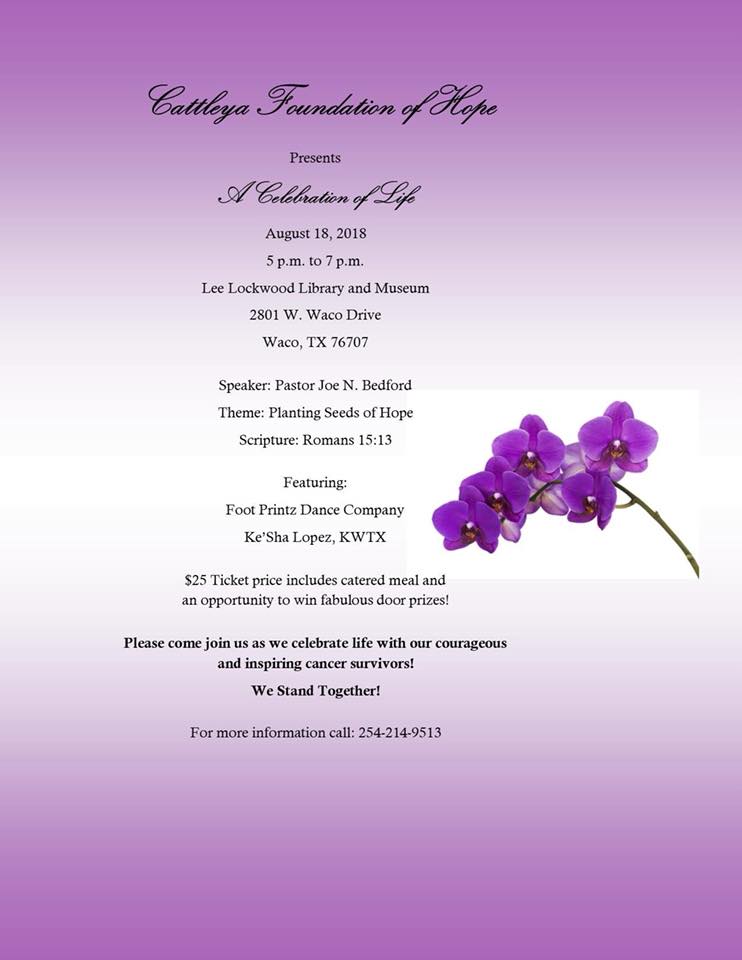
Each year, Cattleya hosts “A Celebration of Life” through fundraising and donations. This event is to honor those recently diagnosed with cancer, cancer survivors continuing on their life journey, family members of those who stand with cancer survivors, and family members of those courageous warriors who have transitioned home.
This is a night we celebrate life, plant seeds of hope, and inspire one another to continue the fight. We welcome our community to come and support our courageous women and men as we continue our life journey. We offer a catered dinner, inspiration from a local speaker, and gifts for our cancer survivors. It is a special time set aside for us to pamper cancer survivors in a special way.
It is also a time for us to reach out to our community in support for the programs and services that we provide throughout the year for our cancer clients.
Cattleya’s wish list is simple. We need a facility where women, men and children cancer survivors can come and read a book, write a journal, enjoy a time of serenity. A place we can transform into a tranquil setting and build programs for cancer survivors in Waco, Texas. If you have a place to offer to us, please contact Min Sandra Henry at [email protected].
And finally a quote from Maya Angelou
“My mission in life is not merely to survive, but to thrive; and to do so with some passion, some compassion, some humor, and some style.”
 This Act Locally Waco blog post was written by Minister Sandra Henry. Min. Henry serves as associate minister of Abundant Love Fellowship Church, Dr. E.L. Ross, Pastor. She has been a member for 3 years. Min Henry preached her first sermon at the New American International Baptist Institute and Seminary in Harker Heights, Texas in December 2012 and received her license in March 2013 at Pleasant Olive. She received her Master of Theology and Doctor of Theology at NAIBI Seminary. She is an honorably discharged veteran from the United States Army with four years of active service. Min Henry and her husband, Joseph Henry, relocated to Waco, Texas in 1985 after he retired from the United States Army with 20 years of service. Min Henry is retired from Department of Veterans Affairs Regional Office with twenty-four years of service. They have four children, five grandchildren and two great grandchildren. Bro and Min Joseph Henry love the Lord and they serve Him together. Min Henry’s focus is a faithful and humble servant rooted in the word of God.
The Act Locally Waco blog publishes posts with a connection to these aspirations for Waco. If you are interested in writing for the Act Locally Waco Blog, please email [email protected] for more information.