By Katie Schaeffer
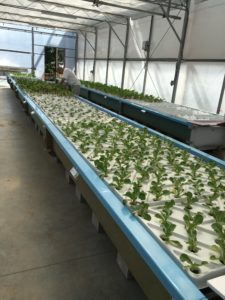
Jimmy Dorrell, CEO at Mission Waco, believes that “creation care” is not a side bar issue, but rather, “Christian justice demands that the creation must be protected, because every thing and every person is made in the image of God.” That is why he has worked tirelessly to put together Mission Waco’s Urban REAP (Renewable Energy & Agriculture Project). The project has commercial composting, rainwater harvesting and purification, solar power, an aquaponics greenhouse, raised grow beds, and a small training center for groups to come learn as a part of Mission Waco’s effort to be about “creation care.”
 The passion Jimmy has about the privilege and responsibility God has given mankind to care for and harness his good gift of creation, and not abuse it for personal gain is based on the cultural mandate found in Gen 1:28, where he believes we receive God’s expectation that everyone should be good stewards of creation. Jimmy was also profoundly influenced in this area by the teaching of theologian Francis Schaeffer, who among many things, wrote Pollution and the Death of Man (1970). Jimmy recently posted on Urban REAP’s facebook page, a quote from the book, in which Schaeffer suggests that many in the church need an ecological conversion, “lamenting that much of evangelical Christianity had adopted a dualistic view of the world that did not take nature seriously.” He posted “For Francis Schaeffer, our shared finiteness created a bond of common grace with the rest of creation that calls for responses of stewardship, regardless of one’s religious worldview.” In another post, Jimmy expresses why creation care is so important, “Statistics profoundly show global deterioration of God’s perfect ecology that affect basics of food, water, land and weather”. He hopes that Mission Waco’s efforts in addressing these issues, will encourage individuals and corporations in Waco and the country to think about their impact on our ecology and what changes they can make to be better stewards of God’s great gift.
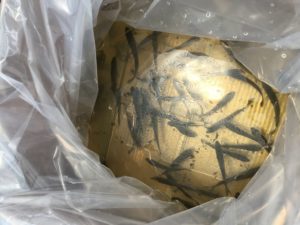 Ground breaking for the Urban REAP project, which was funded mostly through a generous grant from Green Mountain Energy Sun Club, began on January 18th, 2017. Every month since has seen the anticipated additions of the project come together. Just this week, 315 Hybrid Striped Bass fingerlings were added to the aquaponics system, which will provide organic produce to Jubilee Market, and up to 500 lbs of fish and 720 pounds of crawfish annually. Next week the commercial composter arrives which will turn biodegradable waste from Jubilee market, local restaurants and businesses into compost. This compost will be available for purchase at the upcoming greenhouse nursery behind Jubilee Market.
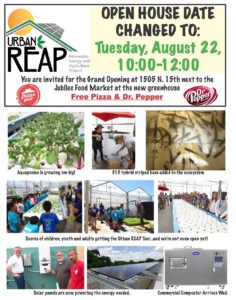 Come see and learn about all of these developments at Urban REAP’s Grand Opening on August 22nd from 10am-12pm. Those who can’t make it are always welcome to drop by for a quick tour and sign up to be a volunteer! All this news and much more can be found on Urban REAP’s Facebook page: mwurbanreap, and Mission Waco’s website.
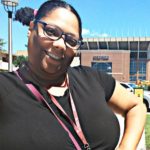
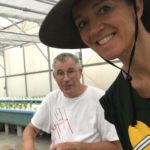 Katie Schaeffer and her husband Rick consider it a real privilege to be managing Mission Waco’s amazing Renewable Energy Agricultural Project (REAP). Katie and Rick came to Waco at the end of 2015, from CA. This week they are moving into a house they have been renovating, just a few blocks from Mission Waco and are really looking forward to being part of the neighborhood community. Katie is happiest being in nature and tending to plants, and eating good food with friends and family. She and her husband Rick are also grateful for the privilege and deep joy of raising two sets of twin boys, who are now amazing 23 & 24 year old men. That is Tony in the photo with Katie. He is her “angel” volunteer who is there everyday she is, and the reason the aquaponics greenhouse is so beautiful and well run.
The Act Locally Waco blog publishes posts with a connection to these aspirations for Waco. If you are interested in writing for the Act Locally Waco Blog, please email [email protected] for more information.
.
(A follow-up to https://actlocallywaco.org/2016/07/19/service-learning-at-indian-spring-helping-kids-learn-to-be-citizens/)
By Travis Cheatham
Last July I wrote a blog about what service learning looks like at Indian Spring Middle School (ISMS). I explained the structure, the value, and the potential of the program. Today I write about the rewards, challenges, and opportunities of this last year through a few stories. (Names have been changed to protect student identities)
Rewards
Ava is a good student in class but she’s the queen of eye rolling. Throughout the year, I frequently had to coax Ava to get to her service learning group, which ironically she liked, but for some reason, she frequently dawdled in attending. This, by the way, is a common theme among students and is really a fact of life for middle schoolers.
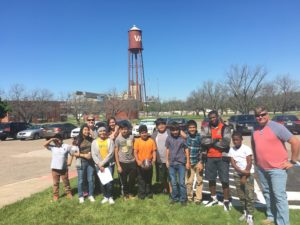 In March, our school planned an event with the VA Medical Center thanks to funds from The Meadows Foundation. Our students decided to use the funds to donate plants, games, and activities for VA residents. Ava was sure to help out with all of the last minute preparations and came to the event on a Saturday morning, no less. The following Monday morning, I was poised at the school’s main entrance to greet students (as I usually do) and Ava came running up to tell me how great a time she had. She then asked if there was any way that she could go back on her own to meet with residents.
The lesson: Are you sharing power with your child, mentee, or student? They will relish it and will thrive. I never see our students more fulfilled at school than when they are given a task to perform. Our students have power, talent, and desire, but we have to activate it. In this next year, I hope to have more opportunities to empower our students.
Challenges
“Everyone knows service learning is boring; you’re wasting your time.” This was a common greeting from Tim as I corralled students to get to their service learning groups. I’d love to say that Tim was alone in this belief, but he wasn’t. Last year, our goal was to place all 6th and 7th graders in a service learning group based on surveys of their interests. By the time students met in their first service learning group many were confused about why they were there (even though I spent a week prepping the students).
Although middle schoolers’ decisions are inherently confusing (even to themselves), forcing students to go to something that they have no stake in is an act in vain. With no grades or requirements, our program really depended on a good hook for students’ interest and sometimes the gradual development of interest.
The lesson: This next year students will attend a service learning fair and sign up for any groups they are interested in. If they’re not interested there will be no arm twisting, but we will require students to at least take a look at their options.
Opportunities
“Hey Mike, I’m just calling to …let you know we need to cancel tomorrow due to ______
…remind you that I need you to turn in paperwork for last week’s outline
…apologize for the delay in setting up the field trip, could you do it on …”
The lesson: Although program flexibility is great, universal policies make for a well-oiled machine. As I look at the future sustainability of the service learning program I need to refine a model that can be easily administered and replicated.
How can you help?
Become a facilitator! Facilitators meet with students 1-2 hours once a week throughout the school year to guide the students in developing service projects. This year we hope to use your passions as a volunteer as the springboard for connecting students. Training will start mid-August and the program should start mid-September.
One More Good Story
Every month throughout the school year I would hold a roundtable meeting for all of our service learning facilitators to talk about upcoming events, how things were going, and to provide ongoing training. My favorite part: listening.
I’m under no delusion that I am a master of anything; do you want to know the good news for volunteers? You don’t have to be either! In those discussions, even our facilitators who were not veterans of the program contributed in a way that generated new ideas for the whole group. Those sessions produced innovative and self-critical observations which are essential for fostering real growth both individually and as a program. I am incredibly thankful for the work of my awesome volunteers and cheerleaders of this program.
Not ready to jump in? Give me a call or email and I’ll let you know about other ways to get connected at ISMS. You can also visit our website at http://indianspring.wacoisd.org/cms/One.aspx?portalId=13246&pageId=424889
to learn more about our service learning program or http://www.prosperwaco.org/mentor-coalition/ to see other ways you can mentor students in Central Texas.
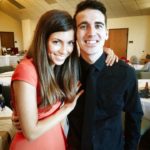 Travis Cheatham is the Service Learning Manager for Indian Spring Middle School. Before ISMS, Travis was the Executive Assistant at Mission Waco and helped lead a culinary class with the MPowerment job development program. Travis is also the Chef/Owner of Cuppa, Waco, TX a catering and food consulting business that was a regular at the farmers market in 2015. Travis is a ’06 Baylor grad who loves this community and loves to travel with his wife, Amy, whenever possible.
The Act Locally Waco blog publishes posts with a connection to these aspirations for Waco. If you are interested in writing for the Act Locally Waco Blog, please email [email protected] for more information.
By Scott Bland
It has been about 16 months since I was approached about helping to put together a Construction Science program at the Greater Waco Advanced Manufacturing Academy (GWAMA). There has been an amazing the amount of progress that has been made since that time a year ago.
We have received approval from the Waco ISD school board to create the Construction Science program at GWAMA with the first classes starting in August of this year. The team of people tasked with getting the program off the ground has succeeded in receiving about $200,000.00 in cash and in kind donations from the private sector to help renovate the space at GWAMA and secure the necessary tools and supplies.
Most impressively, our team, in conjunction with the Texas Association of Builders and Representative Doc Anderson, has succeeded in proposing and passing state legislation that removes the liability insurance concern regarding businesses employing paid student interns while they are in the program. This is exciting not only for the Construction Service program, but it allows all the GWAMA programs to incorporate the paid internship model for its high performing students. Not to mention what this means to career and technical programs all over the state. In a legislative session that has seen a record number of vetoes and a special session, this was an amazing accomplishment.
I believe we are seeing a turn in the general public’s perception of technical and career education. We have ignored and stigmatized this segment of our educational system for so long, the workforce shortage has reached crisis levels. This has resulted in ever increasing costs of both residential and commercial construction. The trickle down effect means the costs of housing and essentially all goods and services go up as a result to offset those costs.
The field of construction has seen a dramatic change as well. Building a home or commercial building is no longer as simple as putting up four walls and a roof. Advancements in technology mean that we can now build structures that are extremely energy efficient and wired into all the current digital demands and capable of advancing into the future with the changing technical capabilities. This means that not only do we need more workers in construction; we need highly educated workers in the workforce.
This means that our construction workforce must be better educated than ever before. The Construction Science program is the gateway to introducing our young students to a dynamic and ever changing industry that is as challenging and rewarding as any industry in our country. Our program is designed to direct students into post-graduate certification and degree programs with the background they need to be successful.
While attitudes towards jobs in the trades are seeing a dramatic turn-around, we need another common belief to begin to change as well. With the high cost of secondary education going even higher every year, the concept of the 4-year degree needs to be re-evaluated. With the senior year paid internship allowing our students to develop relationships with employers in the construction industry, it should be an easy transition from high school to advanced education while continuing to earn a wage. The shortage of qualified workers provides a strong incentive for companies in the industry to work with a young student’s work and school schedule, giving the student an opportunity to earn that advanced certification or degree without student loans.
However, working while learning comes with a cost in terms of time. Instead of thinking along the line of a traditional 2-year advanced certification or 4 year degree program, students (and their parents) should be thinking along the lines of a 4 or 6 year educational term. It should be obvious that a debt-free 6 or 7 year degree is much preferable to a 4 year degree and $150,000.00 worth of student loans.
In just a little over a year we have created a program from scratch and succeeded in passing legislation in the process. We have raised more money than the cost of a typical college degree in that time as well and seen attitudes and opinions regarding career and technical education finally begin to change. In August we will see our first students begin the journey towards changing their lives and our industry for the better.
For more information about the Construction Sciences Program, visit the website or contact Donna McKethan, Director of Career and Technical Education. Her email address is [email protected].
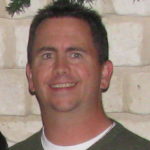 Scott Bland was born and raised in Waco. He is an alumnus of Baylor University. He worked for Highland Homes in the Dallas area from 1998 to 2001, then joined the United States Secret Service as a Special Agent after the 9/11 attacks. He retired his commission in late 2006 to return to Waco and take over the family business, Jim Bland Construction, where he has served as Owner and President of the company for the last 10 years. He is currently the President of the Heart of Texas Builder’s Association as well as a member of the Board of Directors for the Greater Waco Chamber of Commerce.
The Act Locally Waco blog publishes posts with a connection to these aspirations for Waco. If you are interested in writing for the Act Locally Waco Blog, please email [email protected] for more information.
By Kimberly Trippodo
I moved to the Waco area from Austin two years ago July 1. Prior to that, I lived in Washington DC and other similarly large cities. I saw urban centers as a sort of adult playscape, featuring subcultures to try on for size and see if any stick as community. I care deeply about non-judgement and respect for people’s self-determination, and large cities provided me with a huge range of culture, identities, and backgrounds to embrace.
When I moved to Waco, I was at the peak of a life that was quintessentially Austin. My first home in Austin was an art commune, which I shared with a writer, a couple painters, a photographer, and a carpenter. My favorite pastime at that home was playing my violin in living room jam sessions. My calendar was always packed to the gills with Austin art and nature events. On any given weekend I might participate in a hill country camping trip, a spontaneous concert in abandoned buildings and drainage piping to enjoy the acoustics, a warehouse dance party, a spoken word coffeeshop, an aerial art production, a hula hoop drum circle, an art or music festival, an effigy burn with glorious pyrotechnics, a costume birthday party, a city bike ride, a hippie swim in a natural watering hole, a hike or spelunking adventure, and more. I loved having such an arrayed tapestry of easily accessible events.
Austin was a place I felt more accepted & more free to explore, while connecting with closer community and chosen family than anywhere I lived prior. At the same time, city subcultures have the luxury of choosing exclusivity because there is a vast number and personalization of the alcoves for each talent, interest, and identity label. There is a collective acceptance that one may try a subculture on for size and be met with, “You’re not exactly what we are looking for here. You’re not ____ enough.” I experienced that exclusivity from time to time. I believe in safe spaces for specific identities to experience cohesion, and I believe there is always someone out there more talented and/or fitting, so I was very understanding of this exclusivity.
Probably one of the moments this exclusivity was the most vivid was when I was trying to learn to play bluegrass fiddle in Austin. I played violin most of my life, from first grade through my senior year in college, and I was trying to learn a new style as an adult in Austin. I carefully prepared a piece to demonstrate my abilities and went to Fiddler’s Green to take a lesson. My instructor was someone who played multiple instruments in many bands locally, who wore a leather jacket, who had a kind of hungover, tragically hip presence. He listened to me play and without a moment’s pause mumbled in a raspy voice through his thick beard I was “too classically trained,” to be able to play bluegrass. I remember having a moment of, “Who are you to tell me that?” An internal rebellion, which would prepare me for my life in Waco, was emerging.
My move to Waco was not the most graceful of transitions. I found people I connected with right away, but I struggled to find experiences I craved. I tried to stay positive and find purpose, but it took a lot of effort and focus to land in Waco. My then fiancé, now husband was more than patient as I constantly edited our schedule in, “Let’s try this,” fashion. Fortunately, my stepson has an adventurer’s heart like me and enjoyed all our community explorations.
At the start of this year something clicked for me. I made a New Year’s Resolution to “be a good neighbor” and figure out exactly what that meant in my current home. Mostly lately, that means contributing my abilities to create a vibrant artistic and culturally diverse home. Waco is an up and coming city. People from all walks of life are moving here. My husband and I hope to create a venue and possible living space in which artists can gather. I just began bluegrass lessons with Tabitha Hymer, in hopes of creating music again and collaborating with other musicians. This year will mark my second year of participating in Ekphrasis, a downtown display of the paired works of visual arts and musicians. Jenuine Poetess, host of In the Words of Womyn and Shay MacMorran, Graphic Designer at the Waco Tribune are the lovely friends who connected me to this event. I recently took an interior design class with Leslie Myrick and a bed & breakfast class with Rick Allen, through MCC’s Adult Continuing Education program, which expanded our horizons in considering spaces for artists to gather. My mother-in-law, Lee Trippodo, is helping me learn to sew. She recently gave a sewing machine to our church, in support of an effort to teach women how to sew in third world countries as a form of economic independence for them. These are just a few of the examples of beautiful people and inspiring efforts everywhere.
Yet another example, a few weeks ago, I had the opportunity to attend the Public Deliberation Initiative Conference at The Mayborn on Baylor Campus. Ashley Bean Thornton was the opening presenter at the event, and she said something which represents my experience now perfectly. She invited us to not be mere consumers of Waco, but to “live in a state of optimistic discontent, with the constant inquiry of ‘how can I make my community even better?’” In one sentence, she encapsulated the journey I am embarking on, in my new home.
Living in Waco caused me to grow up and “do” in my artistic participation. While in the past I would often wait to be “voluntold” or would step meekly aside if I was not seen as perfect for the job, in Waco I am learning I must be brave enough get in there, try my best, and actively support the growth that is happening. We need to figure out how to use our gifts to make it go, whether or not we can create the most perfect version. I am learning to participate more widely, instead of limiting myself to the alcoves of subculture which most reflect my identity, and in shedding those limitations, I feel challenged to expand outside my comfort zone, more myself, and happier. I am learning a new form of inclusive volunteerism here. I am not pretending I have the time to attend everything Waco has to offer, but I am a vocal supporter of events, an optimist about what is next for our city, and one who will devote as much creative energy as possible to get efforts off the ground. There is an amazing bouquet of everything from nonprofit to small business, from secular to faith-based, from antique to modern grassroots initiatives. We have so much potential, so many newly emerging and smaller scale opportunities which need our support to get going. It takes our collective enthusiasm to make community thrive.
 Kimberly Trippodo is a social worker in the Waco area. She always had a passion for writing. She writes fiction, poetry, creative prose, policy analyses, and blog posts. Her other modes of creative expression are playing her violin and participating in art collaboration events and festivals. She assisted in founding Journal to Save Your Life, a nonprofit providing an online therapeutic art outlet to youth. She loves the connection and closeness of the art community in Central Texas.
By Liz Ligawa
There is something endearing about “firsts.” Before them, life is a bit different and requires our participation in a certain way. First words. First steps. Even our first crush- which sometimes ends up becoming our first heartbreak. Firsts are important. Perhaps the significance lies in how firsts introduce us into a new way of being in the world. There are usually many similar incidents that follow the initial event, but nothing else has quite an impact on us as the first. As I rambled on in a half-conversing/ half-processing-out-loud space of contemplation as I prepared for this piece, I realized that I had developed a deep sense of intrigue around the idea of firsts. And for these next moments, I want to share how firsts, especially on an institutional level, are just as worthy of attention, celebration, and commitment as our own individual experiences.
 In my professional career, I have experienced something that is common, but still makes me wonder. I often find myself being the first. Whether it is the first in a specific department, or the first in an entire organization, the experiences are similar. The first I am speaking of is being the first African-American. In settings where individuals have little experience with one another, the tendency is to operate from a set of generalizations and assumptions about a specific group. This type of relational process was investigated in a study which addressed academic success in schools: “In the absence of prior contact with a person or institution, participants may rely on the general reputation of the other, and also on commonalities of race, gender, age, religion or upbringing….The more interaction parties have over time, the more willingness to trust one another is based upon the party’s actions,” (Brewster & Railsback, 2003). When you are first, you know it.
Almost 10 years ago, our nation experienced a significant first. When Senator Obama became President, our country entered a new way of being in the world. If our country had any reason to be celebratory, then this was it. Even with our disordered and painful history concerning race, we elected our first African-American president! But take a look at some of the other things that occurred during that time. There were nooses displayed on college campuses, Google searches for the n-word spiked, stuffed dolls were hung reminiscent of our country’s lynching history, and many other responses to a change in the original pattern. Although there was much to celebrate in our progress, there was much support that our institution needed from us to assist it through its first.
A couple weeks ago, I attended the reception of Waco ISD’s first African-American superintendent, Dr. Marcus Nelson. In his address to a very welcoming audience, he was engaging, transparent, and candid about his strong belief in serving children and his commitment to their future. The room was filled with so much hope that evening. As Dr. Nelson recalled the shock and pride among the elders he recently met along the route of the Juneteenth Parade, I recalled that same type of pride I witnessed among elders as I waited in line the six hours to cast my vote on Election Day in 2008. Our elders were experiencing a reality they thought they secured for their grandchildren- not expecting to taste it in their lifetime. I understood that their tears, and their hope was a debt already paid. And it was mine to do the work of this hour.
Whenever we break patterns that have been similar for a long time (like the pattern of U.S. Presidents), it is important for us to pay attention to the things that are also happening around that shift. When Senator Obama was elected President, it not only meant something but it also did something. Systems do not change easy, and the unwritten rules of their arrangements critically deserve our attention in times of change. As I welcomed Dr. Nelson with pride, hope, and expectation, I also committed to pay close attention to what our district would need from us during its institutional first. We have reason to celebrate, but we also must remember that as our institution is going through a first, it will be our willingness to have direct contact and conversation with one another that will make the biggest difference. And while we’re at it, let’s make these kinds of things normative. It’s such a great time be in Waco!
Welcome, Dr. Nelson! We’ve been waiting for you.
 Elizabeth Ligawa is a recent graduate from Truett Theological Seminary, and the Diana R. Garland School of Social Work, earning both her Master of Divinity, and Master of Social Work. Though her prized role is being a mother to her dear son, Elijah, Liz has a love for encouraging people to come together in ways that engender healthy communities. Her role as the Director of Community Engagement at Prosper Waco allows her the room to work in and among the many faces of her beloved Waco community. She may be reached at [email protected].
The Act Locally Waco blog publishes posts with a connection to these Aspirations for Waco. If you are interested in writing for the Act Locally Waco Blog, please email [email protected] for more information.
Reference
Brewster, C. & Railsback, J. (2003). Building trusting relationships for school improvement: Implications for principals and teachers. Oregon, USA: Northwest Regional Educational Laboratory.
by Candice Kelm
Entering the “real world” is a major step in the lives of young people, and McLennan Community College wants to make it an easy transition for its students. Young people often struggle with personal finances. MCC has partnered with Inceptia to provide access to Financial Avenue, an online program, to give students “a leg up on financial education” by providing “smart resources to help demystify the world of personal finance while talking to them on their level.”
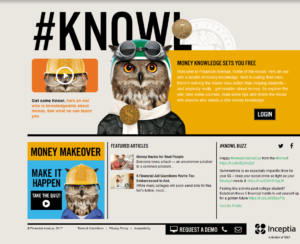 According to its website, Financial Avenue is an online program that helps students “identify their personal money philosophy, gain knowledge of key personal finance concepts from budgeting to investing, and come away from each course with a customized action plan to translate concepts into behaviors.” The course uses quizzes, videos, interactive tools, and easy-to-understand tips to help students become money-savvy.
Topics such as paying for college, budgeting, credit, identity theft, career planning, managing student loans, and understanding a paycheck are covered in the following 10 courses:
- Psychology of Money
- Foundations of Money
- College and Money
- Free Application for Federal Student Aid (FAFSA)
- Loan Guidance
- Earning Money
- Credit and Protecting Your Money
- Spending and Borrowing
- Debt and Repayment
- Future of Your Money
Each student receives a customized experience that adapts to their interaction within the courses that are based on the U.S. Department of the Treasury’s Financial Literacy and Education Commission’s financial education core competencies.
To learn more, visit FinancialAvenue.org. Click “Log in” then “Sign up now,” and use access code 23mc45.
 Waco native Candice Kelm has served as the Sports Information Specialist for MCC Athletics since 2006 and lends a hand as a writer to the Marketing and Communications department. She received her bachelor’s degree in education with an emphasis in journalism and business from Baylor University in 2002.
By Tami Nutall Jefferson
I don’t know the correct term for that awkward feeling you get when the light bulb flashes on and you suddenly realize “OMG, I’m going to be an Aggie — and an Aggie mom at the same %$@# time!”. It started off as pride. Then rounded the base to old. Then another base at nausea, before finally sliding back to home at pride.
This is what I experienced while I was leisurely strolling Shadow, my dog, down my North Waco block this afternoon after I finished reading an invitation – my first of many I hope – to attend the Annual Howdy Party at Cameron Park Zoo. The party is hosted by the Waco-McLennan County Aggie Moms & The Greater Waco A&M Club. I mean, really? Who wants to hang out with a bunch of moms? I was about to dismiss it until I read the midsection that extolled meeting A&M Yell Leaders and other Aggie families in McLennan County. Then a glimmer of excitement set in. I get to meet other Waco Aggies! Maybe I won’t be here all alone next school year. That clinched it for me. Then my eyes fell on the Aggie Moms logo, and that’s when the “awkward” emerged.
But at the end of it all, pride was left. In case you haven’t heard of me, let me introduce myself. I am Tami – the loudest and the proudest member of the fighting Texas Aggie class of 2020. A Whoop! Sidebar – I don’t know my class yell yet, so I adopted the one from the 2019 class because it just sounds good. But you can bet there will be a story from me about it when I learn it. End of sidebar. I’m also a wife. A mother. A doting dog baby owner. And a future Waco changemaker. Ready for more awkard? I met my husband at college a few years ago. He happens to be one year older than my daughter who is currently a sophomore at college and in the middle of moving from Maryland to Texas this week. In another year or so, she will become a part of the fighting Texas Aggie family as well. So what does that make me? That makes me a 40-something year old grandmother – sexy might I add – who is heading back to college for the second time this millennia to grab hold of her bachelor’s degree.
The second-first time I returned to college was in the fall of 2011. I said during my thirties that I would go back and finish school whenever my daughter graduated high school. So one day in May 2011, I woke up and realized that my daughter was exiting high school. I couldn’t let me lie to me, so I decided to go for it. Perhaps, the universe decided for me. At that time, I was jobless, homeless, and surfing on my best friend’s couch in Maryland with no prospects for the future. Somehow, in 3 days, God took me from $0 to $120. Just enough to pay for my airfare from Maryland to Texas. I had a laptop, a suitcase, and a loosely defined plan to be an Aggie graduate. The only thing I didn’t have was my then 17-year-old daughter who refused to return back to Texas with me.
On July 31, I landed in Houston, at my mom’s house and by August 19th, I had a desktop computer, a full-time class schedule, tuition, and a room on campus. And $114 from my 4-week stint at Sonic. An angel of a woman picked me up in Houston and drove me to Waco and dropped me off at my new apartment. I was now a full-time student at Texas State Technical College with a twitter account called @TamisBigDoOver. That was my motto for my life. My goals were few – only 16. By the end of 2013, I had accomplished all 16 goals, and graduated TSTC with a degree in Architectural Drafting and 3.9 GPA. Not on that list, was a husband, but I also left TSTC with that.
I started working in Waco as a building designer. When I started, I swore to myself and my husband, that December 31, 2016, would be my last day there. Three years – that’s all they get. It’s funny how the universe listens and responds to what you say. Funny as in ironic. Because on January 2, 2017, I was laid off from my job. I couldn’t stay past my expiration date even if I wanted to.
I was happy. But I was sad. I wanted my freedom. But I wanted my paycheck. But, I remembered my promise to myself, and I figured “I have to do this now. I don’t have 20 more years to waste.” I logged onto ApplyTexas.org and began completing my application to Texas A&M University. This was the most nerve-wrecking thing I’ve ever done. You see, I’ve wanted to be an Aggie since I was 8 years old. I grew up an unwittingly poor, country, black girl in Bryan, TX in the 80s. Texas A&M was a BIG thing to me. We didn’t see black people go to college in my city back then. But something in me wanted to. I wanted to be a world-traveling architect. I could have taken the easy way out and said that my dream was never realized because I became a single mother at 17 in my senior year of high school. But I’m really not a fan of self-lying. The only reason my dream never materialized was because when my mother handed me the TAMU admission application at 17 years old, the biggest ball of fear I’d never felt before came rolling in. I couldn’t bring myself to open myself up to that much rejection. So, I let the application stay in my room where I could keep an eye on it before it eventually moved its way to the trashcan.
That feeling of fear has become a familiar one since that day. What moved me beyond that fear to actually turning in my Aggie admission application? The Dean of Students at TAMU’s College of Architecture told me in February of this year that he better see my application in his email box that Monday or else I wasn’t getting in. I had two days to write five essays – about ME… hardest thing ever. But I did it.
Then I waited. And waited. And waited.
I checked my application portal daily for almost two months. Nothing. No word. Then on April 19th, I finally emailed Dr. F and asked him when decisions would be made. No response. But on April 20th, I received that email saying “You’ve been accepted.” It was a surreal moment. Fear subsided. Aggie pride crept in. Happiness crept in. I could finally say to my mom – who’s been my biggest yet quietest supporter of this my whole life – that “I am an Aggie. I got in.” Then stupidity slithered in. Honestly, I did feel really stupid because I could have done this 24 years ago – or 20 or 10 or 5. My life and my daughter’s life would have been completely different. The only saving grace is that now, I know my place in the world. I know what I want from my career. I know how to control my education plan to get the most out of my degree and time and money. I know exactly how my education will position me to influence Waco – now my forever home.
But this is not my first go around. Remember, it’s my do over. The first time I came to Waco was to go to TSTC in 1994. I knew I wanted to transfer on to TAMU and become an architect. But I had no idea what that meant. I knew when I was working downtown in Waco in 1997 and I would stand in the middle of Austin Avenue, I wanted to transform the ugliness into a vibrant place for people to enjoy. But I had no idea how to do that. I knew when I graduated in 2013 after returning to Waco some 10 years later, that that decades old vision was still burning inside me. But I had no idea how to bring that out of me. Now, after living here and activating myself in the community and meeting local government and business leaders and getting involved in grassroots development efforts, NOW, I know how to harness my education to make Waco a more prosperous, beautiful, sexy city for the next generation to thrive in.
So this is my journey. For the next two and a half years, I’ll share with you what it’s like to be the old, married, grandmother on campus. I’ll share with you my collegiate research and lessons and projects and discoveries on what happens when real estate and life meet here in The 254. I’ll share with you my testimonies and inspirations as I attempt to attend university without taking on anymore student loan debt. And I hope that you will share with me – because we’re not alone in this journey of life “do overs”.
 Tami Nutall Jefferson has over a decade of experience in real estate sales and management and currently works as a home and building designer. This Fall she will begin her first academic year at Texas A&M University pursuing a Bachelor’s Degree in Urban Planning and Real Estate Development while commuting between Waco and College Station. Her hope is that Waco becomes the most attractive, modern, vibrant, and prosperous version of itself as an inclusive city and her professional mission is to help make that happen. Tami is also a 2017 graduate of the Leadership Plenty Institute and volunteers her time and voice to many downtown Waco placemaking and economic development causes and organizations.
To engage and share your non-traditional student experiences with Tami, contact her at [email protected] or connect with her on Facebook https://m.facebook.com/tami.nutall1
By Kathleen Geiger
Have you noticed that almost everything you buy comes with an owner’s manual? I recently bought a pasta maker and the manual was a 35-page detailed booklet describing the ways to use the equipment and what to do if I wanted a certain “noodle” outcome. In contrast, when we have children there is absolutely no manual, paperwork, leaflet, or website given that tells us how to parent in a way that would enable our children to have a particular outcome. So it’s tough, trying to figure out how to parent when there are so many opinions about what is right and wrong. When asked what we hope for our children, what we want the outcome to be, most parents say they want their children to be happy, healthy, and a functional member of society. But how does that happen?
I believe the healthiest parenting model is one which recognizes the critical importance of the parent-child relationship. The way you relate to your child now sets them up for how they will relate to others in the future. And how we relate to others has everything to do with being happy, healthy and a functional member of society. The way we develop and maintain relationships has to come from somewhere. Who do children spend the most time with during their development? Us! The parent or major caregiver. Through your relationship with your child, you teach them how to relate to teachers, family, and friends. Telling your child how to relate appropriately does very little, but YOU relating to your child, being relational, has everything to do with what his/her future relationships will look like.
A relational parenting approach is one which focuses on the critical importance of the parent-child relationship. It means having a deep desire to be closely connected to your child. Your strength as a parent lies in the relationship. Children who are deeply connected have less behavioral difficulties, less academic failures, and are significantly less involved in substance abuse and sexual risk-taking.
The brain is a social organ—that is, it is constructed and built through experience. From the moment we are born, we begin taking in the world around us. What we experience becomes a reference for how the world works together. Humans have a biological NEED for closeness. Being close to your child may be the most important tool you have for ensuring your child’s overall development. So what are the components of relational parenting?
Developing a Bond – A bond is the connection formed between two people. A bond happens, when over time, parents show a desire to listen to their child’s thoughts and feelings. It means listening more than talking. It means being actively involved. It means having uninterrupted time together. Bonding requires focus and intention. When parents and children are actively engaged the potential for strong connection is powerful. Together parents and children create intimacy – literally, as my grandmother would say, “in-to-me-you-see.” Bonding is something we cultivate. Preoccupation with electronics is the opposite of close connection. There are times when your relationship in person is much more important than the on-line ones. Setting the limit so you can get close in the now means no cell phone, no computer, no Netflix, no Pinterest, no Facebook, no Instagram, no snapchat…at times when being together is more important. When parents desire to know their child’s thoughts, feelings, intentions, wishes, and worries, that child will feel valued and grow to have a strong sense of self-esteem. Together, this creates their ability to form strong relationships with others throughout life. Your child comes into the world wanting a relationship with you….literally needing and hungering for it. You as the parents are the ones that make the decision whether to foster a nurturing relationship.
Being a parent who “gets it” — “Getting it,” means being more concerned with how your child feels than how you feel. A desire to understand your child’s feelings through words, body language, and facial expressions helps you understand your child from the inside out. Being the mirror and reflecting back to your child what you are hearing is powerful. Showing empathy is also important. You can do this by thinking of a time when you felt the same feelings and sharing that experience with your child. You may not understand fully, but you can get close to understanding by seeing the world through their eyes. That doesn’t mean you are in agreement with everything your child thinks, it means that you better understand where your child is coming from – all important for good communication. That’s what being relational is all about!
Having their back – This includes being available, responsive, and reliable. Your child needs to know they can come to you for comfort and support under stress. Feeling safe within the family relationship allows children to take risks to become independent. There is no time when a child should be completely independent and manage things entirely on their own. They need you all along the way. Growing up happens incrementally. It takes many years of trial, error, and practice for children to develop the multitude of skills needed to live independently. An important skill that is sometimes overlooked in parenting is helping a child learn to manage their emotions – soothing sadness, calming down anger, slowing impulsivity, and managing fears and anxieties. Difficult emotions such as fear, anger, shame, and grief become less overwhelming when a child knows they have a secure person at home who will help them feel safe and “regulated” again.
Giving up the need to be “right” – You can win the battle and lose the war this way. Being right is about showing power, demanding your child have your viewpoint, and agreeing with everything you think. This leaves little room for your child to share their own feelings without being judged. Seeing your child’s view as valid does not again mean you are permissive; it means that you allow differences without feeling threatened as a parent. When a parent stops needing to be right, they are able to see the child’s behavior in a broader context. For example, misbehavior is oftentimes about something much bigger – something your child does not know how to communicate appropriately. Holding a respectful limit with your child (the discipline part) while desiring to understand the emotions behind the behavior (the relational part) is a top priority.
A relational parenting approach is your choice. It is hard. It takes time and thought. It takes a lot of energy- especially at the end of the day. But the payoff is huge. It is more fun. Your child wants to spend time with you throughout life. But, most importantly, it is this relationship that gives a child a sense of his/her self-worth, competence, lovability, value, and the ability to continue to have relationships with others and to be a happy adult. And, isn’t that what it’s all about?
Relational Parenting
- Affirm rather than criticize
- Nurture rather than neglect or abandon
- Set limits rather than indulge
 Kathleen Geiger has been licensed by the Texas Board of Licensed Professional Counselors since 1990 and has been in private practice in the Central Texas Area for close to 25 years. Kathleen has many areas of expertise and provides psychological services for individuals, children, adolescents, couples, and families. She works with children is play therapy and Cognitive Behavioral Therapy and enjoys working with teenagers, adults, and families in various methods of counseling practice. She is trained in Developmental Trauma work by Pia Mellody and has earned her certification as a Somatic Experiencing Practitioner. To learn more about Kathleen, her practice, or to contact her, please visit: www.kgeiger.com.
(During December we will be reprising some of “2017’s greatest hits” from the Act Locally Waco blog. I couldn’t possibly pick my favorites – so I used the simple (cop out?) approach of pulling up the 10 blog posts that got the most “opens” according to our Google Analytics. It is an intriguing collection that gives at least a little insight into the interests and concerns of Act Locally Waco readers. I hope this “Top 10” idea inspires you to go back and re-read your personal favorites. There have been so many terrific ones… If you would like to see the Top 10 according to Google Analytics, here’s the link: 2017 Greatest Hits. Merry Christmas! — ABT)
by Ashley Bean Thornton
I have a cloudy memory from when I was very young, six or seven years old at the oldest, maybe even as young as four or five. I was born in 1961, so this would have been sometime between 1966 and 1968, I guess.
Some adult in my life, a woman, sat me down and explained to me why, according to the Bible, black people were meant to be subservient to white people. I don’t remember who gave me this lesson. I think it was at my grandmother’s house, but I don’t think it was my grandmother. It might have been an aunt or maybe just one of my grandmother’s friends. It doesn’t really matter. Plenty of people would have told me the same story.
The explanation had to do with Noah after the flood. Noah had gotten drunk and was lying naked in his tent. One of his sons, Ham, saw his father in this sorry state and reported it to his brothers. When Noah found out about this, he cursed Ham saying that Ham’s offspring should always be slaves to his brother’s children. So, Ham’s children became black people and the brothers’ children became white people and that is why black people were always meant to be subservient to white people.
Nowadays I’m sure every white person I know would cringe at hearing this story. I imagine most of my friends find it downright offensive. I hope they do. It’s a terrible story. I’m ashamed to even tell it.
The reason I am telling it is because I have thought of it often these last few years as I have watched gay people gain more and more rights and have observed the strong resistance to that progress. I thought of it this morning as I read that two years after the Supreme Court ruled that same sex couples have a constitutional right to marry, gay people still cannot get a courthouse wedding in Waco.
You may be thinking that the woman who sat me down and told me the story of Noah and Ham and black people must have been some kind of mean, ignorant, “white trash,” low-class person. Even though I can’t remember exactly who she was, I can tell you that was not the case. Any adult woman I would have met at my grandmother’s house would have been cut from basically the same cloth as my grandmother: hardworking, educated, church-going, white women who had all endured some hard times, and who, despite that, liked to laugh, tell stories, watch Laurence Welk and talk behind each other’s backs about who had the best pound cake recipe.
In other words, I imagine the woman who tried to pass her racial prejudice on to me was a good person by most every measure. I believe she took the time to make sure a small girl understood the lesson about Noah and Ham because she believed the story was true and that it was right and important to pass it on to me.
In the same way, I think that many people who oppose gay marriage and other gay rights believe very deeply that they are correct in their opposition. They believe God’s word is clear. They believe it viscerally. They feel all the way down to their bones that they are right.
This story from my own childhood reminds me that at one time, not so long ago, many otherwise decent people felt the same way about racial segregation and opposing the civil rights of black people. You can see it in the angry faces of the white people in the pictures of the mob scenes when schools were being integrated or black people were marching for their rights. I have heard it in angry words coming out of the mouths of my own family members. These white people who opposed civil rights for black people believed they were right. Being told they were wrong caused a kind of outrage on two fronts. On one front, they were outraged because black people were demanding to “rise above their rank” and were “disrupting the natural order of things.” On the other front, they were outraged because other people, black and white, were judging them for standing up for what they believed was right.
They felt viscerally, to their bones, that they were right.
But, they were wrong.
Thanks to legislated integration, my grandmother, by the time she retired, had taught many African-American second graders and worked with at least a handful of African-American teachers. She realized, at least partly, that she had been wrong about black people. Her attitude changed. Not as much as it should have, perhaps, but it changed some. My mother’s attitude has changed even more. Mine has changed even more. We’ve changed enough that I feel ashamed of a story that at one time was accepted and defended among my kin as “what the Bible says.”
I believe a generation from now we straight people will feel just as ashamed at having tried to deny gay people the right to marry as we white people feel now at having tried to deny black people the right to vote and to be treated equally and fairly.
I’m not sure what I would have done if I had been born in my grandmother’s generation or my mother’s generation instead of my own. I don’t know if I would have recognized the way black people were treated as being wrong, or if I would have gone along with the prevailing beliefs of most white people in the South at the time. But, living here and now, and having learned from that example, I will say that I would be proud for gay people to be able to get married in our courthouse in Waco. I am sorry that we have not reached that point already. I hope we get there soon.
 This Act Locally Waco blog post is by Ashley Bean Thornton, she has lived in Waco almost 20 years now. Far longer than she ever lived anywhere else. She likes to walk. If you see her out walking, honk and wave and say “hi!”
The Act Locally Waco blog publishes posts with a connection to these aspirations for Waco. If you are interested in writing for the Act Locally Waco Blog, please email [email protected] for more information.
A picturesque limestone bluff situated high above the Bosque River, Lovers’ Leap is as dangerous as it is beautiful.
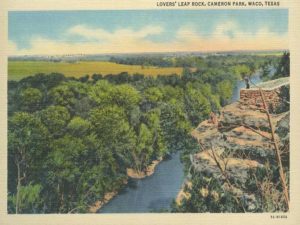 On June 28, 1917, the Cameron family purchased a tract of sixty acres featuring the cliff area known as Lovers’ Leap. Though it had been the site of many picnics and romantic excursions, Lovers’ Leap had yet to receive formal designation as a park site. The Camerons originally leased the land to the federal government with the understanding that when Camp MacArthur troops no longer needed it as a recreation space, it would be added to Cameron Park. On September 3, 1920, the Cameron family acquired the remaining 191 acres between Cameron Park and Lover’s Leap, thereby ensuring the bluff would remain a central attraction in one of Texas’ largest municipal parks.
Associated with the cliff is a folktale involving two star-crossed Native American lovers. As recounted by Decca Lamar West in her popular 1912 booklet The Legend of Lovers’ Leap, Waco Indian maiden Wah-Wah-Tee secretly accepted a marriage proposal from a handsome Apache brave despite the enmity between their tribes. The two hoped to elope but were thwarted in their effort to run away quietly at night by Wah-Wah-Tee’s father and brothers who objected to the union. Cornered at the edge of a steep cliff above the Bosque, Wah-Wah-Tee and her brave chose to embrace one another and leap into the swollen river below rather than face a lifetime apart. The bodies of the two, still holding tightly onto one another, found a final resting place on the banks of the river close to the site of their first meeting. While stirring, no historical basis exists for the tale. It is most likely a byproduct of late-Victorian romanticism and efforts to promote one of Waco’s natural wonders to outsiders.
Since its establishment as an official outlook, Lovers’ Leap has presented a genuine safety concern. In an effort to safeguard the public from the cliff’s edge while not obstructing the splendid view of the surrounding countryside, park authorities constructed short stone walls. However, select visitors in pursuit of a better vantage point sometimes ignored these barriers, leading to personal injury or in certain cases death. In order to improve safety at the outlook and spruce up its appearance in time for the park’s centennial, the city of Waco constructed new fences in 2009 and removed foliage on the cliff face to enhance the view from the designated overlook plaza.
For close to one hundred years, Wacoans and tourists alike have been drawn to the dangerous beauty of Lovers’ Leap.
 Waco History is a mobile app and web platform that places the past at your fingertips! It incorporates maps, text, images, video, and oral histories to provide individuals and groups a dynamic and place-based tool to navigate the diverse and rich history of Waco and McLennan County. It is brought to you by the Institute for Oral History and Texas Collection at Baylor University. This post: Prisca Bird, “Lovers’ Leap,” Waco History, accessed June 21, 2017, http://www.wacohistory.org/items/show/38.
The Act Locally Waco blog publishes posts with a connection to these aspirations for Waco. If you are interested in writing for the Act Locally Waco Blog, please email [email protected] for more information.