By Craig Nash
Through the No Kid Hungry Campaign of Share Our Strength, the Waco Regional office of Texas Hunger Initiative has had the benefit of two Baylor Students serving as Youth Ambassadors (YAs), charged with the task of providing support for and increasing participation in the Summer Food Service Program. This summer’s YAs are Keyanna Taylor from San Antonio and Steven Kuipers from Reading, Pennsylvania. Both Keyanna and Steven have hit the ground running and are providing tons of creative energy to summer meal sites. I wanted them to have an opportunity to share with the Act Locally Waco community about themselves and what they are learning this summer.
—
Keyanna Taylor
 My name is Keyanna Taylor. I am from San Antonio, Texas, and a sophomore at Baylor University studying Public Health on the Pre-Medical track. I am passionate about learning how hunger and overall poverty impacts the health of communities and the individuals that make up these communities. I love being a part of the Texas Hunger Initiative and Share our Strength’s No Kid Hungry Campaign, because it allows me to make a difference towards improving the health of children, adults, and whole communities from a unique angle.
Since being a Youth Ambassador, I have been exposed to a lot of different parts of Waco, and I have learned about many different organizations and efforts that work for the community. It has been so eye opening to truly see how big and diverse Waco actually is. Before this experience, I thought it was a tiny town with not much going on. But I have learned that it is very large and active. This intrigued me and made me even more excited about my role this summer, because now I feel a calling to give back to this community.
More specifically, we recently visited the YMCA of Central Texas to see what its meal sites look like and to propose implementing some of the programs Steven and I are creating to increase meal site attendance. While visiting the YMCA, I got to see how many kids participate in the different camps and programs over the summer, and I was amazed. I was surprised to see how many kids they have in different summer camp programs, and it got me thinking. Would these children make it to meal sites if it weren’t for these programs here? Would they still be involved in physically and mentally engaging activities without the YMCA? This stood out to me as interesting and formed a connection in my thinking of how summer meal sites work alongside other organizations to impact the overall health of children. The children in these programs have access to healthy breakfast and lunch. They have access to games and activities that keep their minds stimulated, and they are being physically active to also keep their bodies healthy. I now see hunger being directly related to the holistic health of individuals.
After this experience at the YMCA, I realized how excited I was to be doing this work with the Texas Hunger Initiative. It is a way for me to explore the connections between hunger and mental and physical health of individuals and their communities. I would like to encourage others in the community to actively seek out ways they can learn more about different organizations in Waco. I believe that efforts from all different avenues must work alongside each other to improve the health of all citizens. So whether it be volunteering at the YMCA, Caritas of Waco or visiting a summer meal site, there are many ways to improve the health and quality of life for all here in Waco.
—
 Steven Kuipers
Hello! My name is Steven Kuipers, and I am from Reading, Pennsylvania. Currently my studies revolve around Economics, Chinese, and Religion during my time as a student at Baylor University. I am also a community leader at Arbors apartments and a proud member of the Baylor Men’s Choir!
This summer I had the opportunity to travel with the Men’s Choir to sing and minister in Kenya. While there, I was taught a valuable lesson that I hope to bring to my work here in Waco. I learned it after we finished serving in the Pokot Village: a remote area about seven hours from Nairobi. Immediately after we arrived, we worked tirelessly to improve the living condition for the people there; we built water irrigation systems, painted classrooms, planted gardens, and even opened a medical clinic to treat the ill and infected. For nine hours, we served until the sun set and it was time to go home.
During our dinner at the hotel, we shared some of our feelings about the day. Surprisingly, there was a common feeling among the group: a sense of helplessness. We felt that even after all the time we spent working, we didn’t even scratch the surface of the problems there: hunger, illness, and poverty were still going to be present in the village after we left. After hearing this, our choir director stood up and gave us some encouragement. He explained to us that attacking something as big as third-world poverty could not be done in a single move. He explained that this kind of thing takes time and consistency, and that we did our part faithfully. He concluded by saying, “You cannot do everything, but you can do something.”
Those words resonated with me as I thought about my work here this summer addressing hunger. A lot of hunger in our community stems from the multi-rooted tree of poverty, and trying to chop down the tree by myself is an impossible goal. That is why it is not my responsibility to obliterate poverty in its entirety because, “I cannot do everything. But I can do something.” For me, my “something” is addressing hunger. I find great contentment in doing my part here at the Texas Hunger Initiative, because I realize that my work is part of a bigger picture of our community effort. Our organization focusing on hunger allows other groups and organizations in Waco to specialize in their own areas. And everyone chipping in to do their part will be the effort that makes a serious impact on our city.
That is why I want to encourage you, the reader, that when you want help your community, you alone don’t have to take down poverty. All you have to do is something. It can be anything, big or small, to address the cause. And when we have a community that collectively chips in to do its part: serious change happens in our lives and in our communities.
 Craig Nash has lived in Waco since 2000. Since then he has worked at Baylor, been a seminary student, managed a hotel restaurant, been the “Barnes and Noble guy,” pastored a church and once again works for Baylor through the Texas Hunger Initiative. He lives with his dog Jane, religiously re-watches the same 4 series on Netflix over and over again, and considers himself an amateur country music historian.
The Act Locally Waco blog publishes posts with a connection to these aspirations for Waco. If you are interested in writing for the Act Locally Waco Blog, please email [email protected] for more information.
By Trey Crumpton
 Did you know that people have always loved living in Central Texas?…and I mean ALLLWAAAYS! There are archaeological sites in the Waco area which appear to have been continuously occupied by humans for at least 12,000 years. One of those is a rock shelter on the banks of the Brazos River in Bosque County. Naturally carved out of bedrock by the river, the Horn Rock Shelter contained one of the most completely preserved records of human habitation ever discovered. From roughly 1966 to 1989, avocational archaeologists and locals Frank Watt, Al Redder, Robert Forrester, and L. T. Francis accomplished the huge task of excavating and mapping the site.
The Smithsonian has taken a keen interest in artifacts associated with two skeletons found at the site, and much of the material is now under the care of the Division of Physical Anthropology in Washington, D.C. The burial of an adult male and a teenage girl appear to be some of the oldest documented remains in North America.
 For a worthwhile daytrip out of Waco, visit the Bosque Museum in Clifton. They have a great exhibit on the Horn Shelter, and also focus on the vibrant Norwegian settlement and heritage in this area. This facial reconstruction (see picture at left), displayed at the Bosque Museum, was derived from a reproduction of the adult male’s skull discovered at the Horn Shelter by Al Redder and Frank Watt in 1970. Examination of features of the skull establish that the Horn Shelter Man could not be related to the American Indians. A date has been determined for the site of approximately 11,200 calendar years ago. This makes the adult male skeleton found at the Horn Shelter the first known inhabitant of Bosque County.
Ongoing DNA analysis could reveal a lot about our collective history, and our assumptions about the first Americans. Artifacts from the site, including stone and bone tools, and human-modified remains of several animals, can tell us about the landscape before our memory. We learned through this excavation that giant armadillos roamed along with bison, beaver, deer, badger, coyote, hawk, and giant tortoises (yes, they lived here too—maybe not as big as the Galapagos ones, but still pretty huge). Humans hunted and used many parts of these animals to survive in their harsh environment.
Come visit the Mayborn Museum and the Bosque Museum to see artifacts from the Horn Shelter, and you might learn a little more about yourself!
 Trey Crumpton is Exhibits Manager for the Mayborn Museum Complex at Baylor University, where he has been on staff for 11 years. He has lived in Waco since 2001, is working on his Ph.D. in Leadership Studies, and has two energetic kids who help him discover. His beautiful wife Ashley is an early childhood educator, and together they are proponents of all things enriching and fun. Trey loves family, friends, the outdoors, the lake, pizza, good books, and good film.
By Caitlin Giddens

(photo credit: Rae Jefferson)
You can hold a piece of Waco in your hands. Creative Waco has released a deck of playing cards called “Waco 52.” Each card captures the spirit of Waco and McLennan County by featuring a piece created by a local artist. The Waco 52 cards are currently for sale, and each purchase supports new arts and cultural initiatives in our community.
Waco 52 began as an art exhibit displayed in the lower rotunda of the Texas State Capitol Building in May. This exhibit served as part of the celebration of Waco’s designation as a State Cultural District and resulted from an invitation from State Representatives Charles “Doc” Anderson and Kyle Kacal. The project united different parts of the community by featuring the original artwork beside quotes from local businesses and leaders who support the arts.
To compile the exhibition, Creative Waco called for submissions from local artists at the beginning of the year. Then, Martha Peters, vice president of public arts at the Arts Council for Fort Worth, and Sarah Derrick, head of learning at Dundee Contemporary Arts in Scotland, judged and selected the pieces over the course of several months. The judges looked for high-quality art that depicted Waco and conveyed the power of its growing creative sector.

(photo credit: Rae Jefferson)
The deck of cards features a diverse cross-section of the many cultures, generations, and perspectives that enrich our community. It also serves as an offering of hospitality that conveys all are welcome here. Within the deck of cards, each suit reveals a different aspect of Waco’s “personality.” The hearts speak of our passions; the clubs tell the story of our town’s history and landscape. The spades depict the earth and the work to be done; and the diamonds reveal some hidden gems that locals will love to see.
As Fiona Bond, Executive Director of Creative Waco, says in the introduction to the exhibit catalogue:
“Waco 52 marks with pride the launch of Waco as one of the State of Texas’ newly designated Cultural Districts, and it is symbolic of a community that has come together to support the growing identity of Waco as a vibrant hub for artistic and cultural excellence.
Behind every one of these artworks is a story that captures something of the distinctive spirit of our remarkable community. Here you will find celebrity photographers; rising stars of the international art world; educators dedicated to inspiring the next generation of creative minds, young artists and designers just starting their careers; master craftspeople bringing relevance to ancient skills; and the only US-based artist who designs for the Paris fashion house, Hermes. They represent the diversity, passion and talent that characterize Waco at this time.”
Click here to browse the exhibit catalogue and see pictures of the pieces in the exhibit.
Waco residents will have an opportunity to see the full exhibition and meet the artists when it opens in Waco in August. In the meantime, learn more about the artwork, the stories behind the art, find local vendors, or purchase a deck of cards, by visiting creativewaco.org/waco52.
 Caitlin Giddens is a local English teacher and writer. She graduated from Baylor University’s Honors College in 2013. When she’s not teaching or writing, she enjoys leading yoga and barre classes at Yoga Pod Waco.
By Ashley Weaver, Director of the SmartBabies Initiative, Waco Foundation
In McLennan County, approximately 45% of women have their first child at age 21 or younger. Research tells us that children born to young mothers are at higher risk for low birth weight and infant mortality, have fewer skills and are less ready to enter kindergarten than their peers. They are also more likely to give birth as teens.
Waco Foundation is committed to improving quality of life for all McLennan County residents. In 2009, the Foundation’s Board of Trustees recognized a deep need to focus efforts on improving the community for our youngest residents, so they commissioned an early childhood study to better understand quality of life for children ages 0-3. The study found the average early childhood quality of life measured at 41.67% on a scale of 0 to 100 and was significantly lower than the average found in some neighborhoods. Those results, coupled with Waco Foundation’s goal to engage in more proactive and strategic grantmaking, laid the groundwork for the launch of the SmartBabies Initiative.
SmartBabies works to facilitate cross-sector collaboration with professionals who provide direct services to parents and families. Waco Foundation provides fiscal resources, staff time and neutral facilitation to ensure the success of this community-wide initiative. Many times, organizations have similar goals but lack the capacity to engage with each other because the work is vast and time is limited. SmartBabies is designed to bring these organizations together to collectively address early childhood quality of life.
One of the great things about our community is the willingness to participate in this type of collaboration. Often times, this means setting aside agendas to work on something that may not be in direct relation to an organization’s goals but will ultimately benefit the entire community. As a native of Waco, I was eager to be a part of this because I want to see change happen in my community for families and children — somewhat like LeBron James has been for Cleveland and basketball (if you’re not a basketball fan you can contact me for clarification). My work allows me to engage with the organizations that want to see real change happen, and early childhood is the best place to begin a successful trajectory for children in Waco.
Our community is in the perfect position for initiatives like SmartBabies. The size, willingness and commitment to see change from so many individuals and organizations are strengths we must continue to build on. While we are primed for this type of work, it’s important for everyone to understand the length of time it takes to fully understand the skillset needed to see the change we want. This is truly a marathon, not a sprint.
We’ve learned a great deal since we officially launched the SmartBabies Initiative in 2011. Through the extensive research we’ve conducted through partnerships with many local, state and national organizations, we’ve learned that preventing an unhealthy environment is the key to improving quality of life for our children. While this may not seem surprising, it confirms that we have to continue to look at a woman’s health and quality of life before she ever gets pregnant if we truly want to impact the life of her children. This means focusing on things that we may not have thought about initially, such as the importance of well-woman exams, access to affordable birth control for women
and families to plan their pregnancies and teen pregnancy prevention, to improve life for our children.
We’ve experienced many successes along the way, including collaboration with the Healthy Babies Coalition and the launch of Nurse Family Partnerships and Healthy Outcomes through Prevention and Early Support (HOPES). These partnerships serve as examples of how effective collaboration works for the benefit of our entire community. In fact, Nurse Family Partnership and HOPES will bring in $3 million of outside funding to the Waco community, specifically for the purpose of improving quality of life for our children. For women and families who are planning to become pregnant, are pregnant or have small children, I highly recommend looking into these programs for fantastic resources about raising children. You can visit their websites here:
Waco Foundation has also learned many lessons from the SmartBabies Initiative that will help us continue to best serve our community. Our Board and staff have developed a deeper understanding of our role as a strategic grantmaker. We now know the longevity necessary to see long-term success, and we’ve gained a better understanding of the pace of this type of work. As the community foundation for McLennan County, Waco Foundation believes this type of work is necessary to accomplish our mission. In addition, the Foundation has invested in Prosper Waco, which has helped us achieve continuous collaboration for the long-term. Our hope is to be able to replicate the SmartBabies model to address other pressing community challenges.
Waco Foundation’s SmartBabies Initiative is directly tied to long-term objectives and goals. The work is difficult as there is no exact prescription for how we can produce real change, but we’ve proven over the last few years that progress can be made when we focus our efforts as a community. I’m excited to see the continued impact of our work and am grateful to the Waco community for embodying the work of SmartBabies, so we can create meaningful change in the place we all call home.
 Ashley Weaver, a native Wacoan, brings to her position as Director of the SmartBabies Initiative extensive knowledge, background and passion. She holds a Bachelor of Science from Texas State University in Elementary Education as a certified teacher. She continued her education at Brown University where she received her Master of Arts in Urban Education Policy. Having served as project coordinator for the Greater Waco Community Education Alliance, Ashley gained valuable knowledge about the successes and challenges of this great community. She has extensive experience with community-based projects at a local and national level, bringing together stakeholders to achieve a goal. Ashley’s experience make her uniquely qualified for this most pressing position as we strive towards a community of SmartBabies.
By Fallon Bain
Having graduated from Waco High School hardly a week ago, I have yet to entirely wrap my head around what I just completed. Whoever told me that senior year would be simple assumed that I would not gleefully overcommit myself and would, instead, slow down to enjoy the ride. That was far from the case. If you can look beyond the heaps of college applications, financial aid forms, scholarship essays, and existential crises, yes, this past year was a breeze. It was a breeze in the sense that a never-ending tornado is a breeze – it was an incessant whirlwind of events, deadlines, and activities. Even so, I would not change the past four years for anything. I learned more in my high school career than I ever anticipated, and for that, I am very grateful.
More than any other lesson, high school impressed upon me the importance of finding a healthy balance between my different obligations and commitments. It was only after several years of overcommitting myself that I realized I could not participate in everything I wanted to. On the other hand, some activities, like theatre, were well worth the investment of time and energy. Anyone who has been involved in theatre knows that it entails countless hours of rehearsals and workdays often lasting several months. At the outset of every new production, my instinct was to become as heavily involved as possible. It quickly became apparent that this was unreasonable, and that I would have to restrain myself to a practical amount. It was important to remember that although I had committed myself to the shows, I needed to carefully manage my time to keep up with my school work, responsibilities at home, and wellbeing. Sometimes I failed to maintain a workable balance, but theatre was always well worth the struggle. The joys, fellowship, and pride from every show are some of my favorite memories from high school. I now feel prepared to manage my time adequately in college because my high school teachers had much more understanding and leniency than I expect from my professors, and I learned my limits in a lower-stakes environment.
One of the most difficult lessons I learned in high school, and am still struggling with, is not comparing myself to others. There will always be someone better (and worse, for that matter) than me in any realm I can imagine; there will always be someone prettier, someone smarter, someone more approachable, more talented. It’s hard to not compare my successes and my life with those of others around me when all I see on social media are highlights and carefully curated experiences. It’s natural to want to be the very best, but unrealistic to make it a primary goal. Any competition served as a healthy reminder of that; only one person could be in first place, and more often than not, it wasn’t me. It helped me take inventory of the many positives in my life, and not base my personal worth on the values of others.
In the halls and classrooms of Waco High, I interacted with others with whom I shared very few qualities or interests. Coming from a school filled with diversity opened my eyes to other cultures and family dynamics; I learned empathy for other’s situations and struggles with which I had no personal experience. Developing an understanding of other cultures reminded me that the real world is not homogenous, and I need to be able to communicate effectively with my roommates, classmates, and peers in college and beyond.
From a very young age, Baylor had a large presence in my life. I grew up visiting many homecoming parades, attending Lady Bears’ basketball games as often as possible, and possessing almost as much Baylor gear as the university bookstore itself. When I began applying to colleges, I made sure that I applied to as many as possible, as I wanted to thoroughly explore all my options before making a final decision. I deliberated for months, officially choosing Baylor the week before the enrollment deposit was due. This indecisiveness has carried over into my selection of an academic major; while I know that I want to study science, I have not been able to narrow my interests down to a specific discipline. My dream is to work in some capacity as a researcher, but I will defer my decision until I have had time to formally study within my fields of interest. Very frequently when I tell others I am still undecided, I hear the same words of reassurance: “You have more time to decide.” While this may technically be the case, it seldom feels like it. For this reason, I often wish that I had thought about what I had wanted from my education prior to my graduation.
It is important to be mindful of the lessons you will not learn in school. Therefore, it is important to make an effort outside of the classroom to better yourself and learn on your own. Classrooms will prepare you academically, but there are many life skills you need that are not a part of the curriculum. Ask questions! Try to figure things out; don’t be content with being unaware. My final piece of advice to current students is simple – remember that soon, it will be over. Whenever I had a major deadline or stressor in my life, I had to remind myself that in a week or month I would no longer be worried about it. It may seem crushing at the moment, but time does not stop and this situation will not last forever. Make the most of your current circumstances, and be prepared to move on to the next challenge.
 Fallon Louise Bain is the daughter of Judge Virgil and Glenda Bain. She recently graduated as salutatorian of Waco High School and will be attending Baylor University in the fall. While at Waco High she participated in the National Honor Society, The German American Partnership Program (GAPP) and Academic Achievers. She is a Senior Company Dancer at Laurie’s Stepping Out Studio, a Symphony Belle and a SkillsUSA member.
By Rachel E. Pate
Looking back on some of my fondest childhood memories of growing up in Waco, I can remember summers filled with family, fun and celebrations. It seemed like every summer we visited Indian Spring Park along the Brazos to partake in the fanfare of the Juneteenth festivities. The crowd would be filled with families from my church, neighborhood friends and citizens from throughout the community. I especially enjoyed the snow cones, cotton candy, soda pop, barbecue, talent shows and the variety of activities. As a kid, I can remember wondering, “This sure is fun, but why do we celebrate Juneteenth?” Through my childhood eyes it was simply a day for celebrating community and having fun, but I’d later learn that this sacred day of remembrance was quite more significant in our American history.
Juneteenth is the oldest known celebration commemorating the abolishment of slavery in the United States. Dating back to 1865, it was on June 19ththat the Union soldiers, led by Major General Gordon Granger, landed at Galveston, Texas. The troops brought news that the Civil War had ended and the slaves were now free. This was two and a half years after President Lincoln’s Emancipation Proclamation – which became official January 1, 1863. The Emancipation Proclamation had little impact on the enslaved Texans due to the minimal number of Union troops to enforce the new Executive Order, and in part due to the isolation of the state. However, with the surrender of General Lee in April of 1865, and the arrival of General Granger’s regiment, the forces were finally strong enough to influence and overcome the resistance.
A name for the celebration of June 19th was coined – “Juneteenth” – and the remembrance grew with more participation from former slaves and their descendants over the last century. The Juneteenth celebration is traditionally a time for reassuring each other, for praying and for gathering remaining family members. Juneteenth continues to be highly revered in Texas, and many of my own family members make an annual voyage back to Waco on this date every year.
As an adult, I have invested more time in learning exactly what Juneteenth means to me. It is an opportunity to rise above our beginnings, take pride in our heritage and move forward in the knowledge that it takes a community to enforce change. This year I’ll be celebrating with my extended family on Sunday the 18th at a private cookout in the park.
 You can take part in Waco’s celebrations on Saturday, June 17:
10th Annual Juneteenth Parade hosted by the Cen-Tex African American Chamber of Commerce – Saturday, June 17th, 10:00am-12:00pm (Parade route begins at Quinn Campus and will proceed along on Elm Avenue, ending at Indian Spring Park)
Juneteenth Block Party & Voter Registration Event hosted by the Waco NAACP and the Project Vier Coalition – Saturday, June 17th, 12:00pm-4:00pm at Oscar Duconge (Carver) Park- 1661 JJ Flewellen Road
 Rachel E. Pate is a native Wacoan and 1999 graduate of University High School. She currently works as the Public Relations person for the Cen-Tex African American Chamber of Commerce and serves as Coordinator for the Esther’s Closet program for women. She’s also a proud mom of one, lifelong member of Toliver Chapel (TCMBC) Church, lover of the great outdoors, avid sports fan and dedicated wearer of Converse’s Chuck Taylor shoes.
Historical Information Sources:
Website, Juneteenth.com – “History of Juneteenth”
By Karen Brown
AHEC or Area Health Education Center, has been a part of the Waco community and region for nearly 20 years, but what the heck is it? Area Health Education Centers were first proposed by the Carnegie Commission on Higher Education in the early 1970’s as a means of addressing the maldistribution of health professionals in medically underserved areas throughout the nation. Today, 56 AHEC programs with more than 240 centers operate in 49 states and the District of Columbia.
Texas AHEC East – Waco Region is a part of the Texas AHEC East Program which is run out of the University of Texas Medical Branch in Galveston, Texas. Together, our federally and state funded program, covers 111 counties and over 17 million people. Your local Waco Region is charged with 18 counties in the Heart of Texas. To quote Wikipedia, “AHECs are nonprofit organizations strategically located within designated regions where health care and health care education needs are not adequately met. An AHEC works within its region to make health care education (including residency and student rotations) locally available, on the premise that health care workers are likely to remain in an area where they train. An AHEC also works to support practicing professionals with continuing education programs and other support resources and to attract youth (particularly those from minority and medically underserved populations) to health care professions. An AHEC partners with community organizations and academic institutions to fulfill its mission.”
Why AHEC? Because in 2015:
- 35 Texas counties had no physician of any kind
- because 80 counties had five physicians or less
- because 185 counties had no general psychiatrist
- because the physician workforce is disproportionately located in the five most populous counties in the state
- because there are 438 designated Primary Care Health Professional Shortage Areas (HPSA) in Texas
- because in Texas, only 12% of Texas physicians identify as black or Hispanic
So what do we do?
- We help young people learn about and gain access to education to become their community’s health professionals.
- We provide real-life community educational experiences for health professions students.
- We facilitate recruitment and retention support for providers.
- We provide health career development education and training opportunities for health professionals
- We host community presentations to encourage healthy life styles.
- We assist communities in providing systemic change to address health inequity in their community
In short, we want to grow our own healthcare. It’s essential that our students know that we need them to be our future healthcare workforce. They need to know that we NEED primary care doctors, we NEED nurses, but there is also a place in healthcare for everyone. Below are just five of the many health care careers that can be completed in Waco in two years or less.
Certified Coding Specialist
- Coding specialists work in hospitals, health agencies, medical clinics and other facilities and process data for patient care, research and reimbursement purposes.
- 1 year certificate program
- Average Salary: $15/hr
Occupational Therapist Assistant
- Occupational therapy assistants and aides help patients develop, recover, and improve the skills needed for daily living and working.
- 2 year associate degree
- Average Salary: $50,000/yr
Respiratory Technician
- Respiratory therapists provide care for patients with lung disease or injuries that affect lung function.
- 2 year associate degree
- Average Salary: $54,000
Biomedical Equipment Technician
- Biomedical equipment technicians are responsible for all aspects of the installation and maintenance of biomedical equipment.
- 2 year associate degree
- Average Salary: $55,000
Community Health Worker
- As an individual who promotes health or nutrition within the community in which the individual resides
- 160 hour training
- Average Salary: $12/hr
We are thankful to our many community partners and supporters as we work toward “Making Our Communities Healthier.” It is because of our valued relationships within the community that make our programs successful! For more information, please visit: http://txaheceast.org/waco/
 Karen Brown is the Center Director for Texas Area Health Education Center (AHEC) – Waco Region. She holds a BA from the University of North Carolina – Wilmington, and a MAEd. from East Carolina University. She serves on the Board of Directors for the Texas Rural Health Association and the Texas Society of Public Health Educators. Originally from North Carolina, she enjoys exploring all that Texas has to offer. You will often see her with her husband and son attending local community events and festivals, and she will be the first in line at Waco’s latest culinary addition. Karen may be reached at 254-753-4392 ext. 13 or email [email protected]
by Candice Kelm
For over five decades, McLennan Community College has established and pursued its mission to engage, educate, and enrich its community. MCC’s Visual & Performing Arts division takes the mission to heart in providing numerous performances throughout the year by students and professional artists in the College’s state-of-the-art performance facilities. RiverSounds, the annual free outdoor concert series, is a prime example.
RiverSounds is held on Thursday evenings each June at the Bosque River Stage, a 350-seat amphitheater nestled along the banks of the Bosque River. The venue features stadium-style seats along with lawn seating where patrons can relax and enjoy the performances of their favorite local and regional artists.
The 2017 RiverSounds lineup will include four nights of outstanding performers from various musical genres and is sure to provide something enjoyable for everyone.
We kicked of the season last Thursday with Grammy Award nominee and legendary barrelhouse boogie and blues lady Marcia Ball. According to the B.B. King Blues Club & Grill where this legend has performed several times in the past, “The Texas-born, Louisiana-raised musical storyteller’s groove-laden New Orleans boogie, deeply soulful ballads and rollicking blues have won her an enormous, loyal and still-growing fan base.” What a great way to start the summer!
The Purple Hulls will open the June 8 concert. Identical twins Katy Lou and Penny Lea Clark, from the deep piney woods of East Texas, will entertain guests with their repertoire of Bluegrass Gospel tunes. The night will continue with Contemporary Christian music along with Praise and Worship by Antioch ‘Live’.
Eclectic fun music will take center stage on June 15 with the MCC Faculty Jazz ensemble opening for Brave Combo. MCC’s Faculty Jazz ensemble performs original compositions and standards from a wide variety of musical styles. Brave Combo brings a mix of everything from Japanese pop and Latin American dance tunes to orchestral classics and rock and roll.
Country and Americana will be featured on June 22 with local ladies Kayla Ray & Jonna Mae opening for Bruce Robison & Kelly Willis, the “King and Queen of Americana Country.” Austin City Limits said of these local icons, “If Austin’s happily egalitarian music scene suddenly switched to a monarchy, Bruce Robison and Kelly Willis might have to learn to perform while balancing hefty crowns.” (http://acl-live.com)
Admission is free to all RiverSounds concerts. Gates will open at 7 p.m. each Thursday evening with the first band taking the stage at 8 p.m. Blankets, lawn chairs, food, and drinks are welcome, but no glass containers or pets are allowed.
 Waco native Candice Kelm has served as the Sports Information Specialist for MCC Athletics since 2006 and lends a hand as a writer to the Marketing and Communications department. She received her bachelor’s degree in education with an emphasis in journalism and business from Baylor University in 2002.
By Christina Helmick
One of the three main parts of the Prosper Waco mission is to help build an environment in which all members of our Waco community are able to improve their financial security. During our 2016 Annual Summit, Matt Meadors, President and CEO of the Greater Waco Chamber of Commerce, talked about upcoming collaborations and partnerships planned to help accomplish this part of the mission. One of those collaborations is now coming to fruition: Workforce Readiness Certification (WRC).
Local employers have reported for years that they need employees with good work readiness skills. The purpose of the WRC is to provide a certification that employers can trust to identify job candidates who have those important skills.
A development team including representatives from the Center for Occupational Research and Development (CORD), McLennan Community College (MCC) and the Greater Waco Chamber of Commerce (GWCC) began work on this project in January 2016. To make sure the certification would meet the need, the development team first met with a focus group of local employers to hear their top concerns regarding employee behavior and skill. The team also worked with the employers to collect specific, real-life case studies of situations in which workforce readiness skills would come into play at work.
The conversations with these employers were documented and that information was used to create a survey which was then emailed to 136 larger local employers. The results from this survey provided additional guidance for developing the certificate program. The development team then validated the findings with a follow-up meeting with employers.
Based on this work, the development team developed two certificate programs:
- Work Ethic: dependability, honesty and integrity, interest in working, commitment to improve, positive attitude & enthusiasm, and respect
- Being an Employee: attention to detail, taking ownership, listening and communication, meeting production goals, and teamwork
To obtain certification, cohorts of Job candidates participate in 24 hours of instruction (per certificate). The curriculum includes real-life scenarios directly from employers. One facilitator and six local employers will interact with each cohort group. Skill attainment is assessed through self-assessment, cohort assessment, facilitator assessment, and assessment by employers. Only those students whose cumulative assessment reaches a fixed level of proficiency are awarded a certificate.
For a full list of what the certification will include, please contact Dr. Richard Hinckley of CORD ([email protected]) and for a copy of the survey contact Frank Graves of McLennan Community College ([email protected]).
The first “pilot” cohort of WRC students will start later this month. Initial students will be selected by the Reintegration Roundtable (For more information about the Reintegration Roundtable contact Jamie Schmitt by email at [email protected]). The development team will use information collected from this group to fine-tune the curriculum before making it available community-wide.
Developing the Workforce Readiness Certificate was a collaborative effort. It could not have been done by one organization, but several organizations working together have developed a certificate program that will help our community build a better-prepared workforce. Through collaboration and partnerships, there are endless possibilities!
For more information about efforts like the WRC, please visit prosperwaco.org or call 254-741-0081.
 Christina Helmick is the director of communication at Prosper Waco. She is a recent graduate of Baylor University with a BA in Journalism, Public Relations & New Media. Originally she is from Washington, D.C., but has stayed in Waco post-graduation. She is an active mentor at J.H. Hines Elementary School, enjoys spending time with her family and watching Baylor football. Sic ’em Bears!
The Act Locally Waco blog publishes posts with a connection to these aspirations for Waco. If you are interested in writing for the Act Locally Waco Blog, please email [email protected] for more information.
By Robin McDurham
In a few short days, the teachers in Waco ISD will be giving our students hugs and high fives and send them home for summer. However, learning does not have to stop for ten weeks. There are several things families can do to engage the brain and prevent summer learning loss. Applying academic skills to everyday activities can keep the learning in the forefront. Wouldn’t it be great if this blog posts could start a conversation with the Act Locally community about how we keep learning alive during the summer? Here are a few of my favorites:
- If you are taking a road trip, consider listening to a book on tape together. If you want to push the learning, do a Google search for book discussion questions ahead of time. Focus on questions that require everyone in the car to consider what the author is trying to convey.
- Give the list making duties to the kids. By organizing and writing down items on grocery shopping list, packing list, and chore lists, children are using critical thinking skills and taking ownership of family responsibilities. The potential for learning increases when taking the lists further by creating a weekly meal plan, developing a budget, and charting progress.
- Have a yard sale or open a lemonade stand, and put your child in charge.
- Turn on the closed caption feature on your television to encourage reading along with the shows. When they get good at reading the captions, push them by turn off the sound.
Parents don’t have to prevent summer brain drain all by themselves. Several organizations offer learning opportunities for students during the summer. The short list provided below is a snapshot of opportunities provided by Waco ISD campuses and educators:
Elementary Schools
June 6th-June 30th (8:00 am to 3:00 pm- Monday through Friday). Language Acquisition Summer School for all current English Learners in PK and Kindergarten. The program will be presented at Bells Hill Elementary. We have a great plan for the children filled with intense direct instruction in literacy, language, math, and other disciplines! Transportation is available. Breakfast and lunch will be served. Contact the department at 254-755-9525 for more information.
June 6-8, 12-15, and 19th (8:00 am to 1:00 pm) J. H. Hines Elementary School – Summer Enrichment Program – J.H. Hines is partnering with the YMCA, and other organizations to offer exciting opportunities for students including Tours of McLane Stadium, The Cameron Park Zoo, Waco Wetland, Mammoth Site, World Hunger Relief Farm, Cameron Park, Mayborn Museum, and a Spectacular Science Day. Breakfast, lunch, and transportation will be provided.
Saturday, June 10, 2017 (2:00 pm – 3:30 pm) Author’s Alley at the Waco-McLennan County Library- Waco ISD teacher, Mary Evans, will present a lively reading of her book, Thunder and Lightning. She will talk to the kids about writing a book and what it’s like to be an author. There will be a fun craft for kids to make and take, too. Books will be available for purchase and signing. A percentage of the proceeds will benefit the Friends of the Waco-McLennan County Library.
June 12-15, 10 a.m.-noon – McLennan Community College summer camps- Cooking with the Rainbow – This four-day session will highlight stovetop-based recipes for pre-teens and teens. Main dishes, sides, and desserts will be featured while focusing on a “rainbow” of ingredients. Young chefs will be educated about making meals with a focus on both taste and nutrition. Your son or daughter may even offer to make dinner after this week is done! For ages 13 to 17. Class will be taught by Waco High teacher, Wendy Moulds. Cost: $79 Class ID: AVC 5245.01
June 26-July 14 (8:00 am to 3:00 pm- Monday- Thursday) West Avenue Elementary is hosting VOICE Inc. summer camp from 8am-3pm for students enrolled in 1st through 5th grades.
July 10-15 Waco High School Overture Summer Theatre Camp for Kids – Students entering the 2nd-9th grades and may be enrolled in schools other than WISD. We’re producing 101 Dalmatians. We still have “spots” available. Email klynn.childress@wacoisd.org for more information.
Saturday, August 12 (9 am – noon) Family Fest – food, fun, vaccinations & information, school supplies and backpacks for registered WISD students
Date and times to be announced. The Waco ISD Education Foundation awarded a grant to Kendrick Elementary to refurbish the existing outdoor classroom that had become overgrown and unused. Much of the work will be done this summer so that Kendrick students can start using the garden in the fall. Projects such as building a deck for seating, constructing raised garden beds, and establishing an area for a butterfly garden are on the agenda. Skilled workers and volunteers would be much appreciated. Local businessman Thomas Arnold, the owner of Central Crushed Concrete, has graciously donated the materials needed for a walking path. This will be another task that will require many hands. Work dates have not been determined at this point, but anyone interested in helping can call Dina Hoffman at 254-495-0070.
Middle Schools
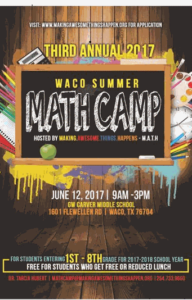 June 12-15 (12:30-2:30 pm.) McLennan Community College summer camps Pasta and Sauces for Teens – Get a taste of Italian as you learn to make a different sauce for each day of this four-day cooking session for preteens and teens. You will learn about different pasta types and salads as well as finish off your meal by making an Italian dessert! For ages 13 to 17. Class will be taught by Waco High teacher, Wendy Moulds. Cost: $79.
June 26- July 20th (9:00am-4:00 pm Monday through Thursday) Bulldog Summer Enrichment Program at Indian Spring Middle School for students attending Indian Spring in the 17-18 academic year. Activities include a robotics program, kayaking, rock climbing, swimming, leadership training, team-building, arts & crafts, tennis, soccer, kickball, basketball, gardening, hiking, educational trips, and more.
June 6th – July 20th excluding July 3rd & 4th (1:00 pm – 5:00 pm) – Texas ACE Summer Camp at Carver Middle School campus and Doris Miller YMCA for swimming. The camp is for Carver students who just completed 6th, 7th, and 8th grades. Activities involved: swimming (at the YMCA), gardening with World Hunger Relief, Zumba, Y fitness, reading club, and art.
High Schools
June 5-8 and 12-15 University High School STEM team is hosting Project SOAR a two-week Project Based Learning program that incorporates fun, hands-on activities while learning the important skills needed in Pre-AP, AP, and Dual Credit classes. The two-week program is based on real-world experiences and helps you to develop creativity, critical thinking, problem-solving, and teamwork. The theme for this summer is “Destination Mars.” The program is for students in the UHS 2019, and 2020 cohorts Call Ms. Stephanie Bailey at (254) 756-1843 ext. 2196 or Mr. Jeffrey Cunningham at (254) 756-1843 ext. 2124 for more information or to register.
July 17-20 8:00am to 1:30pm. Freshmen institutes- Waco High School and University High School will be hosting Freshman Institutes for incoming 9th graders to introduce them to high school life. The class of 2021 will learn about study skills required for success, earning credit, getting involved in campus activities, and building the relationships that will help them navigate the next four years of learning.
A few additional plugs
Monday, July 24: 8 a.m. – Registration for the 17-18 school year begins. Parents may register online or at campuses.
Summer Meal Program – Any child up to 18 years old can participate in the Summer 2017 program by showing up at one of the campus, city or mobile sites on the days and during the meal time(s) indicated on the SFSP schedule. Sites will be open all summer from June 5, 2017, through August 14, 2017. Please note the dates and times of service at each location. Meals will not be served before or after the scheduled serving times. Meal times and dates are subject to change. Some sites will be closed on Monday, July 3, 2017, and Tuesday, July 4, 2017, in observance of Independence Day. Click here for the list of Summer Meal Program Sites.
So now for the action part for all of us Act Locally faithfuls. Let’s see how many folks can add to this post by sharing ideas and events for preventing summer learning loss. Add a comment and pass it along. There are roughly 70 days of summer can we shoot for a new learning idea or event for each day?
 Robin McDurham is an assistant superintendent with Waco ISD. Although she and her husband Doug are currently enjoying life as emply nesters, they had a great experience as Waco ISD parents for 16 years with their sons Zane and Dakota. Robin is passionate about providing opportunities for students that make learning relevant. Contact information: Robin McDurham, Ed.D., Area Assistant Superintendent, Waco ISD. 254-755-9601. [email protected].