By Meilana Charles
Even as the Waco temperatures rise into the triple digits, many holiday celebrations still move outdoors. Here are a few tips on how to have happy, healthy summer celebrations outdoors.
 Enjoy healthy options– Incorporate My Plate into the menu. Replace food high in sugar, salt and saturated fat with 100% whole grain, fruits, vegetables and lean meat and seafood options. Try fruit parfaits, grilled vegetable kabobs, 100% whole wheat buns and salmon patties. Additionally, use smaller plates to help with portion control.
Incorporate physical activity into the celebration-After the meal, enjoy the warm weather by going on a brisk walk with family members, have a scavenger hunt, play tug-of-war or have a jump rope competition.
Keep water handy-Stay hydrated by sipping on cold water instead of soda or other drinks. Too many caffeinated beverages are high in sugar and calories and can lead to dehydration. Try alternating caffeinated drinks with water.
Keep food safe-To reduce the chance of foodborne illness, use the four food safety principles-Clean, Separate, Cook and Chill.
- Clean – Wash hands by using warm water and soap for 20 seconds before rinsing. Also, clean and sanitize surfaces and appliances and thoroughly rinse produce.
 Separate – Always keep fresh produce and cooked food separate from raw meat, poultry and seafood. Use different cutting boards, utensils and plates for cooked and uncooked foods.
- Cook – Keep hot food at an internal temperature of 140 F or higher. Use a food thermometer to make sure cooked foods are safe until it’s time to eat. For safe cooking temperatures of meat, poultry and seafood go to: https://www.foodsafety.gov/keep/charts/mintemp.html
- Chill – Keep cold food at 40 F or below by transporting and storing it in an insulated cooler with ice, dry ice or frozen gel packs. Additionally, keep food safe and out of the “Danger Zone” (40 F – 140 F) by eating or storing it within 2 hours (1 hour if the temperature is 90 F of higher).
 This Act Locally Waco blog post was written by Meilana Charles. Meilana is a Family and Consumer Sciences Extension Agent at Cooperative Extension Program at Prairie View A&M University. Meilana’s priority areas for providing educational resources to McLennan County are general nutrition, money management and parenting. She has a M.S. in Child Development from Texas Woman’s University and is a certified Human Development and Family Studies professional through American Association of Family and Consumer Sciences.
The Act Locally Waco blog publishes posts with a connection to these aspirations for Waco. If you are interested in writing for the Act Locally Waco Blog, please email [email protected] for more information.
References: MyPlate Tip Sheet-Be food safe: http://www.choosemyplate.gov/foodgroups/downloads/TenTips/DGTipsheet23BeFoodSafe.pdf MyPlate Tip Sheet-Enjoy your food, but eat less: http://www.choosemyplate.gov/foodgroups/downloads/TenTips/DGTipsheet18EnjoyYourFood.pdf MyPlate Tip Sheet-Make celebrations fun, healthy and active: http://www.choosemyplate.gov/foodgroups/downloads/TenTips/DGTipsheet20MakeCelebrations.pdf MyPlate Tip Sheet-Make healthier holiday choices: http://www.choosemyplate.gov/foodgroups/downloads/TenTips/DGTipsheet32MakeHealthierHolidayChoices.pdf
By Christina Helmick
When people first learn that I’ve lived all around the world, their immediate question is “why Waco?” I’ve really come to love answering that question.
Here are a few things you should know about me:
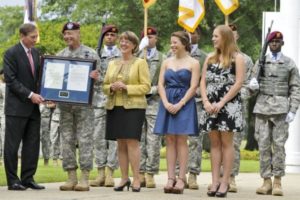 I’m a military child (GO ARMY! BEAT NAVY!)
- I’ve moved more than 12 times in my life (before college)
- I lived in Italy for two years during high school
- My dad served three tours in Iraq
- Waco is the place I’ve lived longest in my life (going on six years!)
All of that to say….I’m an expert packer.
Some people cringe at the idea of moving so often; I wouldn’t change a thing about how I grew up. I have met dynamic people and learned about different cultures first hand. I became the outgoing person I am today through the hundreds of “new kid ice breaker” games I’ve had to play. I also got a chance to live in different cities, ranging from Fort Riley, Kansas, with a population of a little over 8.000 to Arlington, Virginia, with a population close to 400,000 people. Each city opened my eyes to how the world works, and I learned to love a city for the unique experiences it has to offer.
Being a recent Baylor alumna, I enjoyed the Waco community while I was in school. I got involved in a local church and gained insights about Waco from community members that have lived in Waco their entire lives. I knew after I graduated from Baylor I wanted to stay in Waco. That sentiment is becoming more and more common. Many of my sorority sisters are looking for jobs in Waco so they can move back. More and more recent college graduates are wanting to stay in Waco and forego that enticing Dallas-type salary because the quality of life is better in Waco.
Waco embodies what I believe to be an up-and-coming city. It has the nightlife, the young professional environment, great education institutions, a culture of collaboration between community organizations and a thriving downtown area. Our community does have certain issues to work on together, which are being addressed through strategic conversations between community partners within the Prosper Waco initiative.
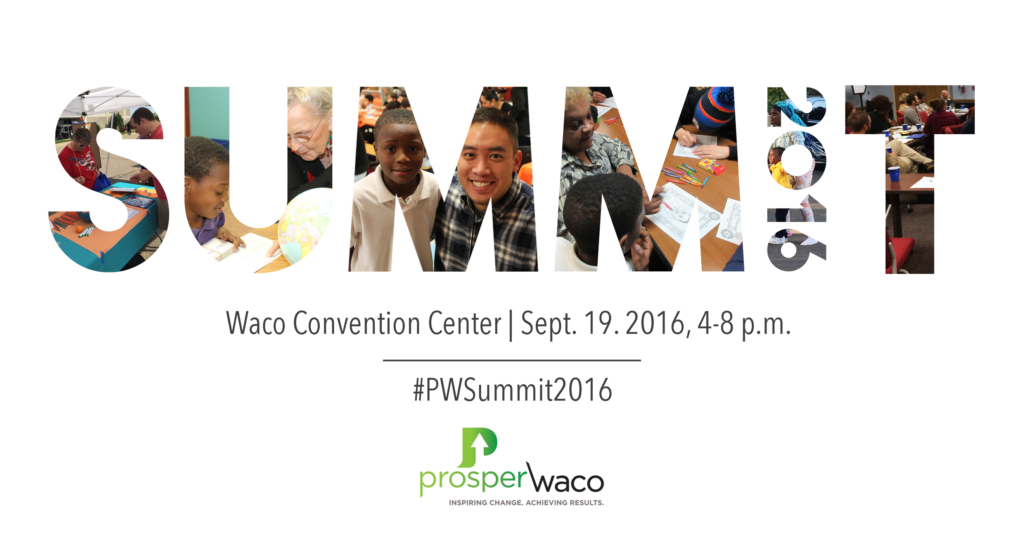
I believe in this town and I hope you do, too! To learn more about the efforts our community is taking to address the issue of increasing education, health and financial security, visit www.prosperwaco.org. You can also register for prosper Waco’s Annual Summit Event, which will be held on Monday, Sept. 19 from 4:00-8:00 p.m. at the Waco Convention Center. The Summit will be an opportunity for our community to come together to celebrate the progress of the initiative in the last year and discuss the vision for the initiative moving forward. Dinner and childcare will be provided for Summit attendees. Here is the link to register!
Christina Helmick is the director of communication at Prosper Waco. She is a recent graduate of Baylor University with a BA in Journalism, Public Relations & New Media. Originally she is from Washington, D.C., but has stayed in Waco post-graduation. She is an active mentor at J.H. Hines Elementary School, enjoys spending time with her family and watching Baylor football. Sic ’em Bears!
The Act Locally Waco blog publishes posts with a connection to these aspirations for Waco. If you are interested in writing for the Act Locally Waco Blog, please email [email protected] for more information.
(Note: This post is part of a series called “Entrepreneurs of Waco.” The series is collaboration between the McLennan Small Business Development Center (SBDC), the Professional Writing program at Baylor University, and Act Locally Waco. The McLennan Small Business Development Center offers technical assistance, business mentoring, training, and resources for all stages of small business. For more information, visit their website: www.mccsbdc.com. To see all the posts in this series, click here: Entrepreneurs of Waco. – ABT)
By Payten Arthur
The Waco Hippodrome is a historic gem on the corner of Austin Avenue and 8th street. The distinctly shaped, bright red sign declaring the building the “WACO HIPPODROME” shines bright in the night. The interior of the theatre has maintained many features that remind guests of the building’s history. The red velvet curtains at the entrance to the theatres, the muted greens and reds of the carpet in the lobby, the brass candelabra sconces lining the aisles, the detailed lattice of gold, plaster rosettes that climb the walls and cover the ceiling, all whisper the stories of years gone by.
The Waco Hippodrome opened in 1914 as a vaudeville theatre, and has survived a fire and many changes in management. Since the late 1970’s the theatre has struggled to stay open. Many have tried to bring the Hippodrome back to its former glory, but were unsuccessful. Shane Turner and his brother, Cody purchased the Hippodrome in 2012. After a two-year renovation that involved adding a mezzanine level restaurant, they opened the Hippodrome’s doors to the public once again. Now the theatre is a versatile venue for seeing a film, having a meal, watching live theatre and music performances, and hosting charity events.
Shane Turner is a man who follows his heart. He describes this as “going with the flow” and has followed this practice throughout his life. He never planned on being an entrepreneur. He studied political science and had plans to become a lawyer. He even took the LSAT, but decided soon after that his heart wasn’t in legal work. Instead, he went into business with his brother, Cody. Their parents were entrepreneurs in construction, so it was natural for the Turner Brothers to go into real estate. The brothers have been developing properties in Waco for years. In those years, Shane has developed a love for building up and improving Waco.
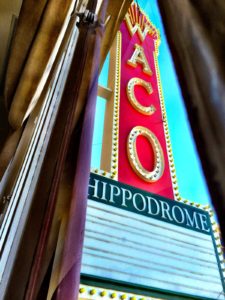 Shane and his brother have found success in real estate. They own several multifamily properties and loft condominiums in the Waco area, including Tinsley Place and the Altura Luxury Lofts that are currently being constructed. But, the Hippodrome is different from those other properties. Why would they choose to purchase a movie theatre, especially one that has been sitting unused for years? The Hippodrome’s history of unsuccessful runs was surely not encouraging for potential business owners. Also, Shane had no experience running a movie theatre and restaurant. He has had to learn how to deal with studios and musicians and how to face the many challenges of running a restaurant, like employee turnover and understaffing. Money wasn’t the motivation. Shane’s passion to develop downtown Waco is what guided him to take on the Hippodrome. “We did the Hippodrome to help promote downtown. We didn’t walk into the Hippodrome expecting to be in the black the first month.”
The transformation Shane Turner desires is more than just seeing the downtown area fill with businesses. He loves the Waco community. “In Waco, people are easy to get along with. Some communities are closed off and they don’t want to share the wealth, but Waco isn’t like that.” He wants to make a difference that benefits the people in more than just economic ways.
The work he has done opening the Hippodrome is doing exactly what he hoped it would. The theatre adds some prestige to downtown and provides a place for people to enjoy themselves. Shane especially enjoys hearing the stories of the people who grew up watching movies or had their first date with their husband in the theatre. One big way Shane has had a social impact on downtown has been by providing the Hippodrome as a venue for Harris Creek Baptist Church on Sunday mornings.
Harris Creek’s mission is to “seek the welfare of the city.” In August 2011, Harris Creek they started a downtown campus in a building across the street from the Hippodrome, called the Palladium. It was a huge success. The two Sunday morning services were always packed. The problem was the level floor and columns in the Palladium made it almost impossible to see past the person standing in front of you. Shane, a deacon at Harris Creek, offered the Hippodrome as a new location. In November of 2014, the church made the move across the street.
It is easy to get lost in the wonder, beauty, and warmth that is created in the Hippodrome on Sunday mornings. The Hippodrome becomes a modern day cathedral, where people are praising God in an ornate, beautiful building. On a recent Sunday the pastor even started a series called “God in the Movies.” It seemed fitting to hear the sermon in a movie theatre.
After the service, people spill out of the theatre and mingle in the lobby or on the sidewalk outside. Everyone is smiling and laughing, making new friends and catching up with older ones. The feeling of love and community is tangible.
Shane Turner doesn’t brag about his accomplishments. He says “Go with the flow. See where it takes you. I never thought I’d be doing this and I’m enjoying it.” He acts as if his accomplishments just sort of happened and had nothing to do with him. It seems possible that he is not even aware of the impressive impact he has made.
Galan Hughes, Director of Ministry Development at Harris Creek, says of Shane, “He would say ‘I’m not the most articulate person, and I’m not a champion or a cheerleader,’ but he has an incredible heart to transform this city.” Looking at the Hippodrome and the lives touched by it, it definitely seems that way.
 The entrepreneur… Shane Turner Graduated from Baylor University in 2002 with a degree in Political Science. Since graduating Shane has made a career in Real Estate and Real Estate Development. He started his first development almost 7 years ago and since that time has completed numerous other developments in multi-family, office, and commercial retail. He and his brother own a Real Estate Investment company whose portfolio ranges from single-family residential rentals, multi-family units, retail space, office space, and restaurant space. Shane is very active in his community and serves on the Boards of numerous charitable and community organizations. He is an active member of Harris Creek Baptist Church in McGregor, Texas.
 The writer…Payten Arthur is a social entrepreneurship major at Baylor University. She lives in an apartment with her twin sister, her best friend, and her Great Dane, Marlowe.
The Act Locally Waco blog publishes posts with a connection to these aspirations for Waco. If you are interested in writing for the Act Locally Waco Blog, please email [email protected] for more information.
(Note: This post is part of an on-going series on financial literacy. Two of the goals of Prosper Waco have to do with accumulating wealth: (1) Reduce the percentage of Waco-area households living without three months’ worth of savings if they were not able to work. (2) More than 50 percent of Waco households will have a net worth above $15,000. Our hope is that this series will help move our community towards accomplishing these goals both by sharing information about some of the challenges, complexities and practicalities of managing finances. For other posts in this series, click here: Financial Freedom. — ABT)
By Phil Oliver
Financial patterns are established over time through both experiences and family practice. Sometimes these patterns turn into family spending habits that lead to some type of financial deficit. So, these patterns must be considered and addressed if true change will be accomplished.
It all begins with a spending plan and knowing exactly how much money you have coming IN and how much going OUT–where it actually goes by week-month-year. Once you know your patterns and habits, you can then decide where YOU want it to go by week-month-year. If you don’t know how much you have and where your money is going, you’ll never be able to make any new choices about it.
Remember, borrowing from others (even family) CANNOT be part of your plan!!! ATMs CANNOT be part of your plan!!
Debit cards and cash cards can continue to cause you to overspend if not part of your agreed plan. Practice spending cash—it hurts more than swiping plastic! (As explained in previous blogs, you might want to implement a cash envelope system in your household spending plan.)
Also, it is vital that all members of the household participate in MUTUAL, agreed sacrifice to attack and deficit. This is where EVERYONE in the household is required to participate (age appropriately) in the monthly FLOW process decisions both for family spending and PERSONAL spending. This brings the buy in and commitment that is critical into growing future SUCCESS! The financial deficit should give opportunity for conversations of changes that could be attempted and new goals to be discussed and decided on. These mutual, self-determined changes become the basis for ACTION STEPS that can be tried, discussed, revised, and then fully practiced.
When this is in place, THREE WAYS to address the deficit can begin:
1.Save (by spending less) – This is not just putting money in savings to have for emergencies, but looking at ways to save money and cut back on what you’re already buying by becoming a smarter shopper and intentional spender.
Some universal saving strategies are: competitive shopping using coupons, sales, buying in bulk, buying generic (the products are always satisfaction guaranteed so you can try it to see if you like it and want to substitute it regularly……..if not, take it back and try another.)
Here are some websites to give practical ideas you could use in your household financial discussions. Some will not apply to your household, but some will. Part of the discussion and financial education is deciding what will work the best for your household at this time.
- 54 Ways to Save Money – America Saves
- 100 Great Ways to Save Money – The Simple Dollar
- How to Save Money : 75 Super Easy Ways to Save Money
- 97 Easy Ways to Save Money – Simple Savings on a Budget
2. Sell Something – Yep….collect those things you no longer need or haven’t used for awhile and have a Garage Sale or list it on an electronic forum. Here are the most popular and most used:
- Craiglist
- Ebay Classifieds
- Sell.com
- Geebo
- Oodle Marketplace
- Backpage.com
There are also MANY emerging apps for your smart phone that will allow you easy, quick ways to “click and post” Some even specialize in certain type of merchandise.
Here are a few:
- Letgo
- Neerbuy
- Mercari
3.Work More – I know that many of you readers are finding it increasingly hard to just maintain your current standard of living, and many are already working several jobs to just make ends meet, especially with wages continuing to stagnate. That being said, I highly recommend that if you do seek more employment, to set up an account with the Texas Workforce Commission. The account is free and once you set it up, you can modify and adjust any of your job seeking choices at any time. There are many local and national employers who extensively use this service to help them find employees.
Another great possibility is to find a product or service you really enjoy, get familiar with it so that you become an expert on it then look for sources to buy and sell it. I have worked with people who were able to supplement their income by buying and selling golf clubs, baby items, sports equipment, or anything else that they already knew about because they used them personally during the week.
It really doesn’t matter what your (legal) choice is because once you know a product or service thoroughly, you know the prevailing cost or charges and can then buy it cheap and sell it for a quick profit. You can even use some of those same selling sites to find customers.
Finally, As you look to adjust your finances to match your INs and OUTs, be aware that you can’t do it alone. Enlist and engage your entire household in the process, and then bring in others that have shown financial stability and wisdom over time that you know in your family, fellowship or favorite civic organization.
I have found in my many years of financial coaching that healthy finances tend to flow from healthy relationships. I believe the approach I have presented here will help you make sure that you are investing in your relationships while you are attacking your deficit. The biggest product will be to grow mutual financial freedom now, and the tools to continue the legacy in your family’s future.
If you have further questions, please feel free to e-mail me directly: [email protected].
 Phil Oliver is a retired educator. He is an independent Financial Coach, active mentor, and community activist. He has spent the last 8 years empowering individuals and families to take charge of their finances through his FLOW system. He is active in many community efforts to grow financial literacy and responsibility including Prosper Waco and Citizens for Responsible Lending. He consults with many local organizations to teach and inspire their efforts to empower clients in personal finances. You can contact him at: [email protected]
(Note: This post is part of a series called “Entrepreneurs of Waco.” The series is collaboration between the McLennan Small Business Development Center (SBDC), the Professional Writing program at Baylor University, and Act Locally Waco. The McLennan Small Business Development Center offers technical assistance, business mentoring, training, and resources for all stages of small business. For more information, visit their website: www.mccsbdc.com. To see all the posts in this series, click here: Entrepreneurs of Waco. – ABT)
By Shannon Lesko
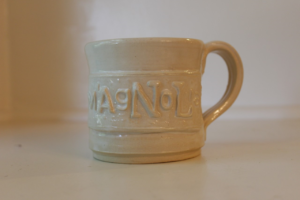 Two minutes to throw, three minutes to assemble and stamp, another minute to trim, two days to fire, 30 seconds to glaze, and there you have it– a finished Magnolia Market mug. At the end of the week Black Oak Art has 1200 Magnolia Market mugs, at least, that’s what they’re averaging these days.
Meet Jonathan Martin, the mastermind behind this production. As a Baylor graduate Jonathan is, in some ways, back home in Waco, although he originally hails from Los Angeles. At Baylor he thought he might end up teaching for a living, which he did for a while. Then he returned to Los Angeles where he and his wife, Sara, helped plant a church. After living with their first child in a small one-bedroom apartment, he decided to move his family to Waco. He admits, “When we came back to Waco it felt like a defeat, but somehow I felt like God had spoken to me and that we were coming back into the promised land.”Jonathan smiled, almost in disbelief in what he was saying, “We had all these dreams in our hearts for whatever reason, and we had this sense of hope that God was going to bring us into those when we came back to Waco.”
 Waco was not always the “promised land” though. Jonathan did his time as a “starving artist.” Well maybe not starving, but as he says, “peddling my wares wasn’t quite cutting it.” Initially he would fill his truck with boxes of pottery and drive around, stopping any place he thought might sell his pottery. Thinking back on those early days, he laughs.
It was a college friend who ignited Black Oak Arts workflow. Joanna Gaines, owner of the now famous Magnolia Market and star of HGTV’s hit show Fixer Upper, took note of Jonathan’s craftsmanship. “Joanna’s first order was for these gift baskets she and Chip would give to their realty clients, but at that point no one really cared if their logo was on the side of a mug.” That original order was for 25 mugs; now Jonathan is trying to get 1500 out the door every week.
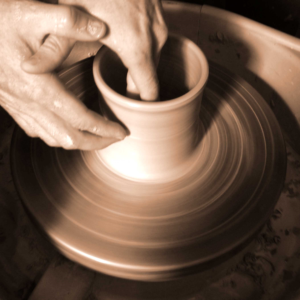 Needless to say, Jonathan is not a one man show anymore. He has assembled a team and his dream of cultivating a workplace where potters could collaboratively create pieces together has come to life. That doesn’t mean that Jonathan has stopped getting his hands dirty; his clay splattered Black Oak Art apron can attest to that. While he maintains a friendly banter with the other potters, his hands carefully begin morphing a lump of clay into a cylinder and then, in one graceful motion, he gently draws out a recognizable shape. Effortlessly it seems, he lures a mug out of the shapeless lump. Jonathan explains that it’s not an exact science, and even though they try to get the same look every time, each one ultimately is unique – that is the magic of it all.
“There is something tangibly different about a hand-made piece,” Jonathan knows. At the Magnolia Silos, the patrons recognize that each piece is different. They carefully sort through the mugs to find the right shape, size, and look to complete the experience of enjoying their morning cups of Joe. Since the opening of the Silos in October, twenty-four thousand handmade mugs have gone home with Magnolia fans; that’s a whole lot of mornings that Jonathan gets to be a part of.
Jonathan’s dreams for the future include more than mugs. “I have these really cool pots and wall pockets in the works for Magnolia,” he says. Black Oak Art also plans to open a new storefront called Gather. “Gather is a sort of marriage between my passion for artisanship and my wife’s passion of entertaining,” Jonathan smiles. The retail store will hold tabletop treasures, all designed and hand thrown by Jonathan himself, ready to enrich the homes of patrons in new and unexpected ways.
Jonathan smiles as he remembers back to the days they only had twenty mugs on dock for a month, now he produces three hundred times that, “but it’s cool to look back and see that when we came back to Waco it really wasn’t a defeat but God was bringing us into this new thing. I don’t necessarily feel that we are promised years and years more of this, I mean, I could be back peddling my wares again someday, but I’ve learned it’s one day at a time.”
 The entrepreneur…Black Oak Art is a local ceramic shop in Waco TX. Founded by Jonathan Martin a 2000 Studio Art graduate from Baylor University. Black Oak Art specializes in custom ceramic designs. We work with each client to create the pieces that match their needs and personality. We sell both wholesale and retail pieces.
 The writer…Shannon Lesko puts her degree in Professional Writing to good use at the intersection of business strategy and creativity, as a Content Strategist. She is a lover of words, beginnings and Waco. You might find her around town exploring hidden gems, hiking, or brainstorming her next project with her husband. She believes there is power in telling stories and cultivating the dreams of the people behind them.
The Act Locally Waco blog publishes posts with a connection to these aspirations for Waco. If you are interested in writing for the Act Locally Waco Blog, please email [email protected] for more information.
By Ashley Bean Thornton
Ten years ago this summer I took a trip to New Orleans that changed my life. I went there for youth camp with the kids from my church. The camp had a focus on “missions,” and the “mission” that year was Hurricane Katrina clean up. Even though it had been a year since Katrina, the Ninth Ward where we were working was still the biggest mess I have ever seen or ever hope to see. The devastation from the storm was terrible, but that’s not what changed my life. It was like the storm had ripped the lid off the city so that it was easy to see the poverty and the wealth and everything in between. It seemed like the mess was already there, the hurricane just laid it bare.
I was 45 years old and I don’t think I had ever thought about “the systems” of a community and how they worked, much less whether they were fair or good. I think for my whole life I had been mainly just a “consumer” of my community. Busy using what I liked – schools, hospitals, roads, fun things to do — I hadn’t given much of a thought to what a community “should” be like, or the work that goes into shaping a community, or that I might have some responsibility for helping to create a good community.
That week in the Ninth Ward flipped a switch in me. I felt like the systems in New Orleans were broken – that all these people living in poverty was a terrible waste of potential and that our society couldn’t afford that waste. When one of the youth on the trip reminded us that the rate of poverty in Waco was just as bad as that of New Orleans, I began to feel a personal responsibility. I began to feel strongly that for all our sakes, we had to do better. I started trying to learn more about poverty, about what we could and should be doing, about what I could and should be doing.
Learning about poverty has been like dropping through Alice In Wonderland’s rabbit hole into a whole confusing, tangled spaghetti bowl of problems and opinions and statistics and theories and theology and political stratagems and turf issues about education and workforce development and affordable housing and health care and neighborhood development and all kinds of other interwoven issues. I learned that there’s a name for these kinds of tangled up messes where nobody knows what to do to make it better – they’re called “wicked problems.” Appropriate name. Trying to work on the “wicked problem” of poverty here in Waco has been an exercise in self-doubt and generally always feeling overwhelmed and ignorant.
All that to say…I wish I had never gone on that trip to New Orleans!
Ha! Kidding! (sort of…) It is frustrating, but it also feels like work worth doing, and I am in love with the idea that a community of people can work together to set goals and solve problems and accomplish things together if we can only figure out how and stick with it. Ten years in, I would like to think I had figured out a few things in that regard…kind of a unified theory of how to get things done…but I haven’t. All I have to show for my efforts is a pile of random, half-formed ideas. Here are a few of them…maybe you can help me make sense out of them as we are working together these next ten years…
- Focus on what you want, not what you don’t want. – We want a great community for everyone who lives here, not just “not poverty.” Keep the real goal…the higher goal… in mind.
- When it gets right down to it, relationships are what make things happen.
- Have faith that the faith you have is enough faith to keep going and to do some good.
- Participate and help at least ten times more than you criticize.
- It’s not enough to just be compassionate; we have to also try to be smart. We have to learn to use information better. But, we have to be compassionate too.
- Work with the people who want to work with you…if the others come along later, great, but don’t waste time and energy trying to drag them.
- Don’t feel like you always have to invent a new thing. Chances are, someone is already doing something. Listen to them. Learn from them. Build on what they are doing.
- It does cost money to do stuff. Not everything can be done for free or cheap. (But if you don’t have money, there is still stuff you can do.)
- Try things – they might not always work, or work like you think they will, but you will almost always learn more than you would by talking and not trying.
- It’s easy and more comfortable for White people to ignore the role that race plays in all this. Don’t ignore it.
- When in doubt, err on the side of boldness.
- Do what you think is right – people are going to gripe at you either way, so you might as well do what you feel good about.
- If you don’t have any ideas about what to do, go around the table and have everyone share their ideas. There is probably some quiet person who has a great idea, but hasn’t said it.
- Sometimes you don’t need a new idea, you just need to apply the ideas you already have more consistently. Sometimes, though, you need a new idea.
- Keeping up with the details – the to-do list, the email list, the meeting notes – is half the battle.
- When in doubt, over communicate.
- “Them” is always us.
- Art and song and dance and joy and play and fun are central. They are not “fluff” to be ignored until we are done with the “important stuff.” They are the things that fuel the creativity and energy and passion we need to do the “important stuff.”
- Don’t forget to say “please” and “thank you.”
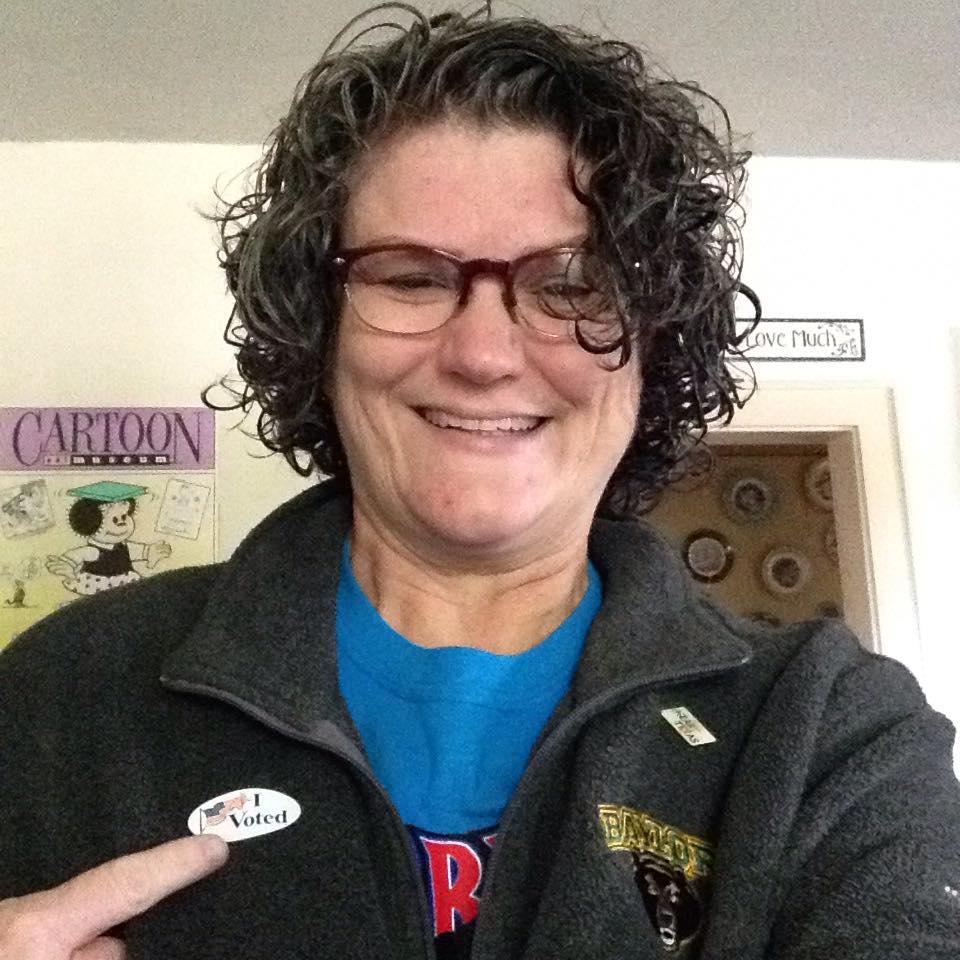 This Act Locally Waco blog post is by Ashley Bean Thornton, she works at Baylor, helps out with Act locally Waco, and facilitates the Waco Foundational Employment Network which is a part of Prosper Waco. She likes to walk and doesn’t mind at all if you honk and wave when you see her.
The Act Locally Waco blog publishes posts with a connection to these aspirations for Waco. If you are interested in writing for the Act Locally Waco Blog, please email [email protected] for more information.
By Major Anita Caldwell
Dear Waco,
Over the past twenty-seven years as a Salvation Army Officer, I have learned the many journeys of those in poverty. There are those who seek lasting change in their lives. There are those who manipulate with great skill. This blog is written to consider the pan handler. There are generally three or four types:
The desperate pan handler is that person who is desperate for alcohol or drugs. My first experience was in El Dorado, Arkansas, on a cold Christmas Eve with a drunken man, his sign and his little dog, Joshie. When we got him to the local hospital, he had $300 in his pockets. In that small, Christian community everyone was giving him money. He then took it a few steps to a nearby wine store, purchased his drink of choice, slept under a nearby tree and returned the next day to the same corner.
The professional pan handler is that person who is skilled to the point that he or she can make as much as $300 or $400 per day. This person will use any and all types of “crutches.” Locally, we have a man who pan-handles using a wheel chair. At the end of the day, he wheels to his vehicle, stands up, folds up his wheelchair, gets into his car and drives home.
The syndicate pan handler gathers a group of people and uses them to collect money. These people are much like traffickers because they only give their pan handlers food and shelter but gather the remaining income for their own purpose. In Moscow, Russia, where we lived for six years, pamphlets were placed in all expat locations such as clinics with a clear warning to not give to any person begging because they were all part of a crime syndicate. They would place an elderly person in the metro and pick her up at the end of the day, take her money and continue the same routine day after day. These organized groups are here in Waco as well.
Finally, only on very rare occasions, will there be a truly needy person asking for money. However, they generally go to the many social service locations in town and seek the help needed.
Pan handlers prey on giving people. They will find a giving community and gather in that giving city. Waco is a Christian community with Christian people traveling here to visit our fair city. The pan handler has the best of both worlds in Waco: new people and giving, caring people.
 The Salvation Army has developed a small card you can give to the pan handler so they can have a free meal and you can be guilt free. We don’t fear that too many people will come; the pan handler typically wants money, not food, not gas for their car. Please send them to one of the many local agencies who can help them. Our commitment is to build a relationship with those who are willing to overcome their needs and to seek how we can best support their pathway to hope.
Should God speak to you and ask you to give, follow His guidance and give, but please do not give purely out of guilt. Such guilt does not guarantee that you will assist a genuine need.
May God bless you and bless those in need.
Major Anita Caldwell
 Major Anita Caldwell was born in Olean, NY, to a family of ministers. She attended and graduated from Kentucky Mountain Bible Institute with a BA in Religion. Her MA is in Pastoral Leadership from Olivet Nazarene University. She and her husband, Bradley Caldwell are Majors in The Salvation Army and are Regional Coordinators for this area. They have served as ministers of the gospel in The Salvation Army for 23 years. After serving in three USA appointments, they were transferred as Regional Leaders in Moldova, Romania, Russia and the country of Georgia over a twelve-year period. They received their Waco assignment after serving at International Headquarters in London, UK.
The Act Locally Waco blog publishes posts with a connection to these aspirations for Waco. If you are interested in writing for the Act Locally Waco Blog, please email [email protected] for more information.
By Dr. Emma Wood
Humans need touch. I was reminded of this recently while listening to a podcast in which a woman shared about her partners’ struggle with cancer treatment. The treatment caused touch to be unbearable for her partner, and in turn caused her a different kind of pain- the absence of touch. She shared that she would often leave the hospital and get a manicure just so that she could be touched by someone.
This story, poignant in many ways, reminded me of the necessity of touch. Most people fall on a spectrum of interacting with touch. Some people are “touchy feely” types who hug everyone they meet. This does not describe me, but I do enjoy being friends with those sorts of people. You can always expect a warm embrace when meeting at common grounds or Cameron Park. Other people only like touch when it is offered by a loved one, or a partner, and a handshake or high five is sufficient for their day to day interactions. Most of us probably fall somewhere on a spectrum between these two people. But all of us have in our human DNA the need for physical touch.
I remember during my first semester at college feeling starved for physical touch. I was 7 hours away from home and knew no one. Relationships take time to build and discovering how touch will be received by a new friend is always a bit of a risk. Eventually I found my friend group, some of whom were compatible with me in terms of physical affection, but it wasn’t until my sister joined me at college that I really felt a secure sense of physical comfort.
The touch I am talking about is clearly non-sexual in nature. It is about nurturing, sensing, conveying compassion and acknowledging our physical selves. The mind-body connection is a significant pathway. If you have taken Psychology 101 you might have heard about Harry Harlow’s Monkeys, who chose a fake furry mother to get comfort over a wire mother that provided milk. The monkeys chose physical connection over sustenance; Harlow concluded that “contact comfort” was essential to the psychological development and health of infant monkeys. There have also been studies that show infants that are not touched often display developmental delays and often develop life-long relational deficits that prevent them from feeling intimacy in relationships. Other studies have shown that absence of touch in infants may account for failure to thrive and even death.
The importance of touch to emotional health and wellness has also been well established with research showing that touch triggers the release of oxytocin, a hormone that decreases stress-related responses. Additionally stimulating touch receptors under the skin can lower blood pressure and cortisol levels, effectively reducing stress.
Being mindful of your need for touch can be an important piece in your mental health repertoire. It can come free in the form of hand holding, pats on the back, hugs, and casual touch in our relationships. Another wonderful tool, as mentioned at the beginning of this blog is a professional service.
Massage is one of the healthiest things an individuals can do to improve the wellness of their mind-body connection. I know that often massage is a luxury one may struggle to afford, but what differentiates the expense from other ways we spend money is that it has lasting effects for our physical and emotional wellness. Getting a massage causes muscles to unclench, a racing heart rate to slow, heightened blood pressure to fall, and levels of the stress hormone cortisol to drop. In that relaxed state, your body is able to regroup and recharge. Additionally massage can help to create a more robust immune system. Knowing what the research shows it is clear that massage is not just good for our muscles; it’s good for our entire physical and mental health.
Michelangelo said “To touch can be to give life.” Act Locally Waco and LaBella Visage want to help you reduce your stress and increase your mind-body health by offering readers 20% off massage services for the month of July. When you book use coupon code ACTLOCALLYWACO20.
Whether through massage or the hug of a dear friend, make sure you get your vitamin T this summer.
 Dr. Emma Wood is a licensed clinical psychologist, public speaker, trainer, consultant and blogger in Waco. You can see more of her work and get more information about the services she provides at www.dremmajwood.com
The Act Locally Waco blog publishes posts with a connection to these aspirations for Waco. If you are interested in writing for the Act Locally Waco Blog, please email [email protected] for more information.
By Craig Nash
I had to learn a new lingo when beginning my work at the Texas Hunger Initiative, and it was challenging. (The very use of the word “challenging” in the previous sentence is an example, and proof that I have begun to absorb the lingo, choosing a more tame term over a collection of other, more colorful, words that I would have chosen before.) And it wasn’t just the acronyms connected to social services that were, uh, challenging. It was a whole new lexicon full of words meant to convey how we are doing our work, but words that are usually used with different meaning outside the non-profity world in which we exist. Words and phrases like “value-add,” “capacity,” and, my personal favorite, “bandwidth,” would often leave me looking around the room wondering if I am the only other person suffering from a mental condition that prohibits me from understanding. I eventually picked up the pace and figured the new language out, although I am still much slower at translation that most of my colleagues.
One word, though, that resonated with me early on is the term “access,” often used when describing how easy or difficult it is for a particular person or group to receive basic human needs. In other fields of conversation we may say that someone can or can’t afford a particular need, or someone is or isn’t able to provide for themselves or their families. But access opens up a different line of thought altogether. It guides us into a more compassionate mode of thinking for those without it, as well as for those who have it. It equals the playing field, if you will.
With regards to access to food, there are a number of reasons someone may or may not have it. Money is one, but so is availability, location and safety. I’ve witnessed an army of people in our city whose very job and mission is to make access more widespread.
 One way that Waco and La Vega ISD’s Child Nutrition departments have been making access to food more widespread to our local children is through their mobile meal-bus programs. If location is a barrier (there’s another one) to access, then they are working to remove that barrier. Rather than requiring children to come to one of the dozens of stationary Summer Food sites around town, they are bringing Summer Food sites to neighborhoods, parks and clinics all around the area. Like the other sites, food on the buses are free to children under 18, and require no id to, um, access.
One way you can help increase access is to spread the word. All summer sites can be found by visiting Summerfood.org. Below is a list of Waco and La Vega ISD Meals on the Bus location stops and times.
Waco ISD “Meals on the Bus” – Monday through Friday
Bus #1
Waco Apartments, 2724 Robinson Drive 10:40-11:00am
South 18th Street Community Center, 1800 Gurley Lane 11:10-11:30am
Elm Street Community Center, 609 Elm 11:45am-12:05pm
Waco Central Library, 1717 Austin Avenue 12:20-12:40
UBC, 1701 Dutton Avenue 12:50-1:10
East Waco Library 1:25-1:45
Bus #2
Scott & White Macarthur Center, 2201 Macarthur Dr. 10:40-11:00am
Family Health Center, 1000 Delano Street 11:15-11:35
Barron’s Branch Apartments, 819 Colcord 11:45am-12:05pm
Estella Maxey Apartments, 1000 Delano 12:15-12:35
Guthrie Park, 7400 Brookview Drive 12:50-1:10
La Vega ISD “Lunch Bus Express” – Monday through Thursday
JMJ Wrecking, Corner of Campground Road and Harrison St. 10:10-10:30am
Maranatha Church, Ashleman and Latimer Streets 10:40-11:00am
La Vega High School Tennis Courts 11:10-11:30
Brazos Village Apartments, Lakeshore and Gholson Rd. 11:40am-12:20pm
Brame Park, Hogan St. and Briarwood 12:30-1:10
 Craig Nash has lived in Waco since 2000. Since then he has worked at Baylor, been a seminary student, managed a hotel restaurant, been the “Barnes and Noble guy,” pastored a church and once again works for Baylor through the Texas Hunger Initiative. He lives with his dog Jane, religiously re-watches the same 4 series on Netflix over and over again, and considers himself an amateur country music historian.
The Act Locally Waco blog publishes posts with a connection to these aspirations for Waco. If you are interested in writing for the Act Locally Waco Blog, please email [email protected] for more information.
(Note: This post is part of a series called “Entrepreneurs of Waco.” The series is collaboration between the McLennan Small Business Development Center (SBDC), the Professional Writing program at Baylor University, and Act Locally Waco. The McLennan Small Business Development Center offers technical assistance, business mentoring, training, and resources for all stages of small business. For more information, visit their website: www.mccsbdc.com. To see all the posts in this series, click here: Entrepreneurs of Waco. – ABT)
By Allison Le Grice
“I love owning a business where I only succeed if my clients succeed,” Melissa Pardun explains as her dog Josie leaps onto her desk to lick the palm of her hand. Along with her husband Rick Pardun, Melissa owns Maker’s Edge. Maker’s Edge is a “maker space,” a full-featured do-it-yourself studio for anyone from teens to hobbyists to high-tech entrepreneurs who want to make things. According to the website, Maker’s Edge is a “…a space that brings together a community of DIY people with wonderful fabrication equipment in a way that supports collaboration, creativity, ingenuity and personal development.”
Melissa, with her thick royal blue rimmed eyeglasses and zebra print nails, sits in her office conveniently at the front of the maker space. This allows her to shout a greeting to every member who walks in. “Community is our number one emphasis,” Melissa says, pointing to a banner in shop that reads “Look around you, here are your fellow doers. Here is your creative team.”
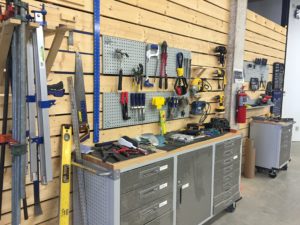
Upon walking into Maker’s Edge, you see a huge open workspace with tables and stools where members work on their projects in the presence of other members. Surrounding this open space is a collection of private working spaces — Wood Shop, Metal Shop, Welding Shop, and Electronics Shop, to name a few — that are available to members upon completing proper training.
“Once we finally got started, our biggest battle was having to define what a maker space was. No one knew what the heck we were,” Melissa chuckles. Even among the engineer and maker community, it was rare that people in Waco had heard of, much less been to, a maker space. Small town curiosity helped. People were constantly wandering in to ask about Maker’s Edge; some of those curious visitors stuck around to become members. Now some of those members are making products that are being sold at Magnolia Market.
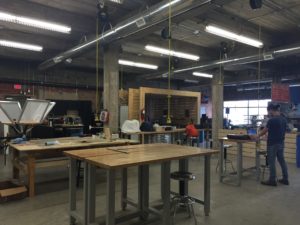 Maker’s Edge is one of the largest maker spaces around that isn’t a part of a franchise. This is largely because the Pardun’s decided to establish a for-profit business instead of the more typical non-profit maker space. The for-profit model allowed them to get big quickly and fill the shop with mostly new, efficient, and precise tools. Additionally, this business model allows Maker’s Edge to team with Circle Hardware to provide an in-house mini-hardware store for those “forgotten materials”. And a hidden benefit of avoiding the non-profit makerspace “club” approach: members never have to take their turn cleaning the bathrooms!
Maker’s Edge charges membership fees. Members use the space and everything in it for a monthly fee that goes towards the maintenance of the building, tools, and material that makers wish to use. The membership types range from “Unlimited Open Shop Membership” for $125 a month to a “Youth Membership” for $30 a month. There’s also an “Entrepreneur Package” that provides 24-hour access, an enclosed office, a professional address and mailbox, and more benefits for entrepreneurs.
The idea for Maker’s Edge came about when Rick Pardun, an engineer, grew frustrated with engineering applicants who could not design well. They had all the education necessary for their job, but they couldn’t physically do anything because they had never touched a tool. As an avid reader of Make Magazine, a magazine dedicated to DIY and all types of building, Rick was aware of the maker space movement and thought that it might be a good idea to start one with his wife Melissa, who was very familiar with nonprofit work.
Initially they worried that Waco would not be the ideal place to start a business, but Melissa did not want to leave Waco until her children were out of school. Waco eventually proved itself to be a fine location – big enough to ensure business in the shop, but not big enough to attract much competition from the franchises. The Parduns grew up in that small town environment. They appreciate that Waco seems to embrace a small town feel despite not being a “small town.” They wanted to be able to have a business where their members appreciated that the owners treated them like neighbors.
Melissa and Rick decided to get help actually creating this business idea.
 First, they sought some advice from Bradley Norris, an entrepreneurship instructor at Baylor University who was familiar with teaming up technology with entrepreneurship. Bradley had played with the idea of creating a maker space himself, but never had the time or the means. He offered Melissa and Rick some guidance on the technicalities of starting that kind of business as well as constant emotional support. Next, they got help from the LAUNCH program. This program included a three-day intensive workshop, where entrepreneurs gathered all of their business ideas and proposals together in order to actually begin the process of starting their business. After this, they got in touch with Jane Herndon of McLennan Small Business Development Center. Jane helped Melissa and Rick create a cohesive plan to present to a bank. Finally, Melissa and Rick got access to the most important part of the business process: connections. The Greater Waco Chamber of Commerce provided the Parduns with access to other business people who could help them get started and helped them get their business name out to more entrepreneurs around Waco.
“One thing I would tell entrepreneurs is that an independent spirit does not work…We live off a community philosophy,” Melissa says with a large smile. “It takes a community to start a business. It takes a community to complete a project. It takes a community to do everything in this life. Embrace it.”
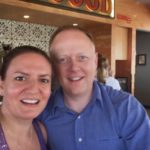 The Entrepreneurs…Melissa Pardun is the Executive Director of Maker’s Edge. Melissa is a life-long thinker and maker and strongly identifies with teaching the ideals of the DIY spirit to the next generation of innovators. Rick Pardun is the Chief EDGe-ineer, the creative force responsible for initial workshop design and ongoing training and tool acquisition. As a mechanical engineer, Rick has 18 years of experience in prototyping and design in the aerospace industry.
 The writer…Allison Le Grice is an English student at Baylor University. She is passionate about literature, mental health, and recycling. In her free time, she is most likely binge-watching “Chopped.”
The Act Locally Waco blog publishes posts with a connection to these aspirations for Waco. If you are interested in writing for the Act Locally Waco Blog, please email [email protected] for more information.