By Christina Helmick
Have you ever been working on a project, article or something else in the health-realm of things, and wanted to see how Waco stood against other cities? If so, you were met with the reality that health data is only available at the county level, until now. The Robert Wood Johnson Foundation, National Resource Network (NRN) and the NYU School of Medicine have piloted a joint venture of analysis and producing city-level health data.
 Waco, along with other cities across the nation, took part in a competitive application process to pilot this program. Accompanying Waco in this pilot program are three other cities: Flint, Michigan; Kansas City, Kansas; and Providence, Rhode Island. What is a common thread between us and the other three cities? We all face economic challenges and are working hard to improve the overall quality of life.
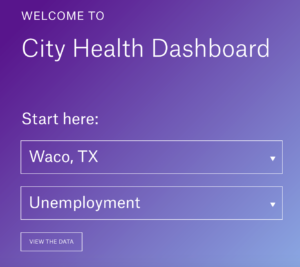
You can view the City Health Dashboard by clicking here.
Okay, so let’s look at a metric together. Click “Waco, TX” and are click “Unemployment.” What appears is a whole bunch of numbers and a visually pleasing map. What does that all mean?
Waco’s average for unemployment is 8.5%. Particularly useful, the dashboard also notes how far above or below the national average Waco sits. Waco’s unemployment rate is 3.5% above the national average of 5% — meaning Waco has more people seeking jobs and unable to find a job than the national average.
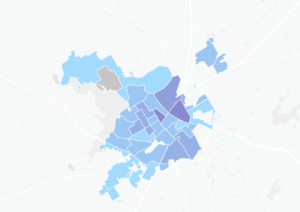 The map shows what parts of the city have higher rates of unemployment than others. A darker purple means higher unemployment and light blue means lower rates of unemployment. In our city, there are pockets of high and low unemployment rates—the lowest rate being 1.4% and the highest rate being 24.4%.
Also useful is the notation of the data source, years of collection and the definition of how the measure is calculated. When looking at unemployment, the data comes from the Census data using a 5-year estimate. The 5-year estimate means the data was collected between January 1, 2010, and December 31, 2014. The definition of unemployment is as follows: percent of the civilian population age ≥ 16 that is unemployed but actively seeking work.
Being able to have this disaggregated data allows our community to better target our efforts. So, by looking at the Unemployment data from the City Health Dashboard, we are able to connect the Waco Foundational Employment Network’s efforts to certain areas in our community. The city-level data can be passed to community partners, such as Skillpoint Alliance, to help them target recruitment efforts for their free rapid workforce training program. Or, to Goodwill Industries to promote their career fairs and the free job training classes they offer.
I know (first-hand) data can be intimidating and confusing, so don’t forget that the Prosper Waco team is here to help. Our director of data and research, Brittany, is a data guru and loves to help organizations and people better understand how to find data, understand data and (better yet) how to effectively use data. She can be reached by sending a quick email to [email protected].
 Peruse the health dashboard to look at the 26 different measures. Is there one that sparks your interest? For me, it’s the walkability measure. Waco scored 34 out of 100. We can do better! One group in town that is working to improve walkability is Waco Walks. I’m adding their next meeting to my calendar so I can help be part of the solution of improving our community, one step at a time.
 Christina Helmick is the director of communication at Prosper Waco. She is a recent graduate of Baylor University with a BA in Journalism, Public Relations & New Media. Originally she is from Washington, D.C., but has stayed in Waco post-graduation. She is an active mentor at J.H. Hines Elementary School, enjoys spending time with her family and watching Baylor football. Sic ’em Bears!
The Act Locally Waco blog publishes posts with a connection to these aspirations for Waco. If you are interested in writing for the Act Locally Waco Blog, please email [email protected] for more information.
By Courtney Restivo Wollard
As a follow up to a previous healthy blog post, I wanted to highlight one of the partners in the Healthiest Cities and Counties Challenge (HCCC) – The CenTex Hispanic Chamber of Commerce.
 Throughout the years, the Chamber has hosted free family funfests and women’s conferences during the month of February. This year, the event will focus on empowering women’s health, heart, soul, family, and home. It’s called the Hearts & Homes Ladies’ Conference. The event will include several vendor booths to provide information on resources to the community including career building and home buying assistance, home maintenance tips, and a wellness zone plus door prizes! Lunch and snacks will also be provided. Something new this year that the Chamber will offer as a partner in the HCCC will be providing a healthy traditional Hispanic meal cooking demonstration and food sampling during the event.
If you didn’t catch the previous blog about the Healthiest Cities and Counties Challenge, I will briefly describe its importance for our community. This is a national challenge consisting of 50 other communities (Waco-McLennan County included) all working to improve the health of their residents in many different ways. Communities could choose to improve on one of five metrics including community safety, built environment, social/economic factors, environmental factors, and healthy behaviors. Some communities are focusing on improving asthma rates for children, others are working to prohibit smoking in vehicles with children, some working to improve physical activity opportunities, and some are working on improving wastewater management. Waco-McLennan County will be working on the healthy behaviors metric more specifically increasing healthier eating and consumption of fruits and vegetables. The top communities at the end of the two year challenge (which began October 2016) that show an improvement in their metrics compared to baseline data submitted could win prize money for the community between $25,000 and $250,000 for our community tier.
All of that to say, it is important that residents know how to cook meals in a healthier way and learn how to incorporate more fruits and vegetables into their daily diet. That is where our partner, the CenTex Hispanic Chamber of Commerce comes in. They will be hosting three healthy traditional Hispanic meal cooking demos and samplings throughout the two year challenge in order to educate community members on cooking their favorite comfort foods in a healthy way and in a way that tastes great. The Hearts & Homes Ladies’ Conference is where the first of the three cooking demos will occur. We are very grateful to have the Chamber join in this fun and healthy challenge and we challenge you to eat more fruits and veggies! Be sure to attend the event on February 25th 2017 at the Waco Convention Center in McLennan Hall from 10am-3pm so you can be a part of the Healthiest Cities and Counties Challenge!
 Courtney Restivo Wollard is a lifelong Waco resident who works as Public Health Planner at the Waco-McLennan County Public Health District and serves as Chair for Live Well Waco, the group working to decrease obesity rates under the Prosper Waco Health Committee Initiative. She is also an alumnus of the Waco Foundation LeadershipPLENTY Institute. Courtney graduated with her Masters of Public Health from Baylor University and right away began her career as a health advocate. She is married to Kyle, with whom she has two fur babies – a Chihuahua and a Labrador. Courtney hopes to continue to create healthier environments for McLennan County residents.
The Act Locally Waco blog publishes posts with a connection to these aspirations for Waco. If you are interested in writing for the Act Locally Waco Blog, please email [email protected] for more information.
By Bruce Gietzen
Remember the Jeff Foxworthy TV show “Are you smarter than a 5th grader?” I remember watching, and too many times the answer to that question was a resounding “No”!
That was old school. Waco ISD has a newer – and younger version that may make you feel even more embarrassed unless you’re a parent of one of our 4-year olds in the District’s acclaimed prekindergarten program.
Every Waco ISD elementary campus plus University High School has at least one of those early success classrooms – there are 55 in all. Each and every one of nearly a thousand students in the program get a great start on being smart.
Plus, it’s not just the little folks who learn. Moms and Dads in those families are having intelligent dinner conversations with their children because of our family engagement plan.
Kids go home with letters – in English and Spanish – that explain the Science, Technology, Engineering and Math they’re learning. Those letters also include questions parents can ask about the class day, so students barely old enough to tie their shoes can tell Dad how heat can turn a solid into a liquid.
It’s all pretty cool, and apparently state lawmakers agree. They appropriated $118 million dollars for high quality prekindergarten programming. Waco ISD got nearly $650 thousand dollars of that to spread over two years, and those funds are making a good program even better.
To qualify to get money, school districts were required to meet enhanced quality standards in curriculum, teacher qualifications, academic performance and family engagement. WISD was already on board with most of those.
The comprehensive science curriculum encourages learning by doing, and doing it a lot more often. Two years ago Waco ISD teachers reported spending an average of 36 minutes each day on STEM related instruction in preschool classrooms. The national average was about two minutes per day.
That 6,120 minutes – or more than 100 hours of added STEM learning – led to astounding results.
A 2016 Meadows Children at Risk Pre-K report found economically disadvantaged third graders who attended full day Texas pre-kindergarten had 40 percent higher odds of reading at a college-ready pace in the third grade (the key grade to measure reading proficiency).
Those same students also scored approximately 80 points higher on the 3rd Grade STAAR Reading exam.
I haven’t even gotten to the best part. If your child qualifies for the Waco ISD program, it’s FREE!
When the state provided the funds to pay for half a day of instruction for these young people, WISD’s Board found the money to pay for the other half. Thank you, Trustees, for that wise investment in our future!
You should know not everyone qualifies for the program. Family income is a factor, and so is age. A child is eligible for enrollment if he or she is at least four years old by Sept. 1, and meets at least one of the following criteria:
- Unable to speak or comprehend the English language;
- Educationally disadvantaged (which means a student eligible to participate in the national free or reduced-price lunch program);
- Homeless (This is more common than you think. Waco ISD has more than 1,000 homeless kids in K-12);
- The child of an active duty member of the U.S. armed forces;
- The child of a member of the U.S. armed forces who was injured or killed while serving on active duty;
- Is or ever has been in foster care.
There is a teacher and a teacher’s aide in every classroom, which means an 11-1 ratio of educator to student.
What kinds of things will they learn? Simple science investigations help them ask the right questions, gather information, and make informed decisions. Then they will knock your socks off explaining their findings.
These young students will study several new vocabulary words each day, and by the end of the year the ones who are learning English as a second language will know 1,000 more words and the correct sentence structure for using them. By the 2nd grade those kids will be fluent in two languages.
There’s also classwork in reading, writing, fine arts, and social studies – including the importance of voting. For good measure, preK students also practice basic functions on computers and related digital technologies, which breeds self-confidence.
Interested? Registration is in May, and if your child is the right age and meets one of those requirements listed above, it’s free. It’s one of the best investments you can make in your children.
That’s something even a 4-year-old can figure out. Especially one of ours!
I wonder if Jeff Foxworthy has been to Waco?
 Bruce Gietzen made the move from News Anchor at KXXV-TV to the Director of Communications at Waco ISD last June. He crossed from one side of the media fence to the other to help tell stories about some of the great things happening in WISD, including the efforts to revive the Planetarium at Waco High School. Bruce is also on the Board of Directors for Communities in Schools and the Texas Sports Hall of Fame, and he’s a member of the new Communications Task Force for Prosper Waco. He enjoys Waco with his wife, Dana, and if he had more spare time it might be spent on the golf course.
The Act Locally Waco blog publishes posts with a connection to these aspirations for Waco. If you are interested in writing for the Act Locally Waco Blog, please email [email protected] for more information.
By Janessa Blythe
When I was a kid, my parents placed a bookshelf next to my room and my brother’s room. Every night, we’d pick a book, pick a parent, and spend a little time in another world. I remember always reading Amelia Bedelia with my dad, fairy books with my mom, and Harry Potter with the whole family.
Because that was all I had ever known, I assumed that most children grew up in households that emphasized reading daily.
In the fall of 2015, I ran a small book drive as a part of a course I was taking at Baylor. I knew that children from lower-income households probably had fewer books than their more affluent peers, but did not realize how great that difference was. The books we collected were given to some of the children at Estella Maxey Public Housing Complex here in Waco. When I delivered the books, I heard over and over again from the volunteers, “These kids just don’t have books at home.”
It turns out that the research shows that children from low-income households tend to lack access to books, and have few books in their homes. The US Department of Education found that 61% of low-income families have no books at all in their homes (US Dept. of Education, 1996). One example of this is low-income neighborhood in Philadelphia, where the University of Michigan found that the ratio was 1 book for every 300 children (Neuman and Celano, 2001).
Lack of book access is a huge issue for many of the children in our country, and it affects them every day both in an out of the classroom. According to the Education Equality Index, 60% of students in Texas are eligible for free and reduced lunch. The socioeconomic status of these children indicates that they more than likely lack access to books.
This is a problem because not all learning happens at school; children are only there about 7 hours a day, and they are only in school 9-10 months each year. This becomes an issue for lower-income students, because they lack learning resources at home. A study by the RAND Corporation about the “summer slide” found that “results in reading show that middle-income students maintained achievement levels over the summer while high-income students improved and low-income students lost ground” (RAND, 2011). Low-income students lose ground because they have fewer opportunities to practice their reading, or improve their reading when they are not in school.
There are a number of reasons for the lack of books in low-income households. There are libraries, but they are often far away and parent’s either don’t take their children, or don’t know that they should take their children regularly. School libraries often don’t allow books to be taken home, and are often unavailable in the summer. Finally, books are expensive and are difficult for low-income parents to afford.
When children from lower-income households go home, they don’t have the resources they would need to continue learning.
Scholastic’s Family and Community Engagement Research Compendium from 2013 puts the argument for book access succinctly:
- Children from less affluent families do not perform as well on achievement tests compared with children of more affluent families.
- These gaps related to families’ socioeconomic status are present even before children enter school.
- Reading to young children is related to stronger subsequent academic achievement.
- Children in low-income families have access to fewer reading materials than children of middle- and upper-income families.
Their conclusion is that “the only behavior measure that correlates significantly with reading scores is the number of books in the home,” and that “the most successful way to improve the reading achievement of low-income children is to increase their access to print” (Scholastic FACE, 2013).
We spend millions of dollars each year on education in America, but not all learning happens at school. Mortimer J. Adler once said that “the principle cause of the learning that occurs in a student is the activity of the student’s own mind.” When a child picks up a book, and struggles to understand what the letters on the page are communicating, that child activates his or her mind and is learning. This learning is unaided by a teacher, but it is learning all the same.
If a child has no books in their home, in the many hours they spend there, there is no prospect of picking up a book and learning to learn.
 Janessa Blythe is a junior at Baylor University originally from Colorado Springs, CO. She is studying Great Texts, Political Science, and Classics in the University Scholars Program, and anticipates attending law school when she graduates in May of 2018. She hopes to eventually work in education policy. In her free time, Janessa loves to spend her time outside, especially on the trails in Cameron Park.
The Act Locally Waco blog publishes posts with a connection to these aspirations for Waco. If you are interested in writing for the Act Locally Waco Blog, please email [email protected] for more information.
By Jamie Graham
Twenty-two years ago, I found myself lying on a massage table with fine thin needles being inserted into various parts of my body. The problem that had brought me to this unusual position was a monthly fluctuation in moods called Premenstrual Syndrome, accompanied by severe debilitating cramps. During my monthly cycle, I would swing between tears and irritability. Acupuncture had been recommended to me by a friend whose sister was attending the Academy of Oriental Medicine at Austin (AOMA). My friend assured me her sister, or one of her fellow interns in the student clinic at AOMA, would be able to help both with the pain and the moods.
 Being in such misery, I was willing to try anything. During my treatment, which included two interns and an instructor asking questions, taking my pulse and looking at my tongue, I mentioned I often had a feeling of something being stuck in my throat that wouldn’t go down when I swallowed. A look of understanding passed between the two interns and one of them explained this was something Chinese medicine called Plum Pi Qi and it clearly was indicated in my diagnosis of Liver Qi stagnation. After the needles were removed, they also gave me an herbal formula and recommended I return for future treatments.
I was amazed at the results. I felt calmer, more centered and as a bonus, during the next monthly cycle, my cramps were much reduced. I was hooked.
Six years later, I was the intern seeing clients in the student clinic at AOMA. Many of those clients had mental health issues, ranging from depression, anxiety, grief, anger, PTSD and many others.
At AOMA, we learned emotional issues were related to stagnation of an energy called Qi (pronounced chee). Each emotion was also related to a specific organ system. Grief was related to lungs, anger and depression to liver, fear to kidneys, worry to spleen, overjoy (mania) to heart. By releasing this stagnation with the acupuncture needles and rebalancing the specific organ system, these mental health issues could eventually be resolved.
After graduation, I began to research how acupuncture helps resolve these issues. Western medicine had begun doing research studies on acupuncture. While many of these focused on pain, several of them also focused on mental health issues. There are many theories as to why acupuncture helps pain and other issues such as depression, anxiety and PTSD, one of the things we do know is acupuncture affects brain chemistry. It causes the body to release endorphins, serotonin, and enkephalins and other brain chemicals that help our body with pain, emotions and our immune system. It also increases receptor sites for these chemicals to attach to within the body.
One of the most interesting continuing education classes I have taken was working with veterans suffering from PTSD through an organization called Vet TRIIP (Veterans Team Recovery Integrative Immersion Process). This organization uses a multi-disciplinary approach to working with veteran PTSD. They incorporate tai chi or qigong, acupuncture, massage therapy, chiropractic, talk therapy and other modalities to help the veterans in their recovery.
The first veteran I treated was one who was, “wound very tight.” He had chronic pain in his lower back and neck. Using just a few acupuncture needles and sitting with him quietly, I watch as the tension left his body. After the needles were removed, he stood up, and a smile came across his face as he realized his pain had eased. “I feel so relaxed,” he said, “and the pain is much less.”
Another veteran I worked with was also a survivor of sexual assault. She was having severe anxiety and insomnia. She also had chronic pain. She, too, was very tense—emotionally and physically. During the treatment, she was actually able to fall asleep, and afterwards told me she felt calmer, like she could finally take a deep breath.
Of course, veterans with PTSD aren’t the only ones to benefit from acupuncture’s effects on mental health issues.
Another training I took is called NADA (National Acupuncture Detoxification Association). This simple 5 needle acupuncture, done entirely in the outer ear, has been used to help people wean off drugs, alcohol and tobacco. One of its main effects is to help reduce stress and anxiety. It was used by acupuncturists to help first responders and victims deal with stress after 9/11, Hurricane Katrina and many other disasters. It’s also used by Acupuncturists Without Borders when they respond to disaster sites around the world.
I use NADA quite often in conjunction with body acupuncture for my clients experiencing stress, depression or anxiety. One of the main points in this treatment is Shen Men, which translates as Spirit Gate. Quite often, if someone is in a stressful situation, I will add a very tiny (.06 mm) needle on a piece of tape to Shen Men, to help them deal with stress after they leave the clinic.
During my 16 years of treating clients with acupuncture, I’m still amazed when someone sits up from the treatment table with a relaxed smile on their face as they tell me how calm and energized they feel. And often, that’s just a side benefit from other issues we’ve been addressing. It’s one of the reasons I love my work.
 Jamie Graham is the owner of Healing Touch Acupuncture and is a licensed acupuncturist practicing in Waco. She has a Master of Science in Oriental Medicine from the Academy of Oriental Medicine at Austin. She and her husband, Bob, will be celebrating 43 years of marriage in March. She has one daughter and one grandson who are the joy of her life. She is owned by a Russian blue cat named Walter and a very spoiled shih tzu named Brandi. When she’s not using needles as an acupuncturist, she uses different kinds of needles in her textile art, quilting, knitting and embroidery work.
You may contact Jamie at Healing Touch Acupuncture: 254-759-8050 | [email protected] | www.healingtouchacupuncture.com | www.Facebook.com/HealingTouchAcupuncture
The Act Locally Waco blog publishes posts with a connection to these aspirations for Waco. If you are interested in writing for the Act Locally Waco Blog, please email [email protected] for more information.
(The Heart of Texas P-20 Council includes representatives from K-12 education, higher education and employers. They meet regularly to help coordinate efforts to launch our young people into productive lives as workers and citizens. This post is one in a monthly series of posts intended to share information about the work of this important group in our community. For more posts in this series, click here: P-20 education. – ABT)
By Christine Holecek
 ESC Region 12 and the HOT P-20 Council celebrates February as Career and Technical Education Month (CTE), as well as, the kick -off of Groundhog Job Shadowing. Students and faculty in Region 12 will join others across the nation during the month of February to celebrate national CTE month. This year’s tagline is Celebrate Today, Own Tomorrow! CTE Month provides CTE programs across the country an opportunity to demonstrate how CTE makes students college and career ready and prepares them for high-wage, high-skill, and high-demand career fields. School districts are encouraged to promote CTE programs and give their students the opportunity to job shadow during the month of February. February 2nd is Groundhog Day and a perfect day to job shadow.
“The activities planned over the next month will illustrate the rigor and relevance CTE courses offer our students,” said Fred Hills, Chair of the HOT P-20 Council. “By partnering with the business community, CTE programs are investing in students and providing them with the latest technology and skills that will prepare them to become successful employees and future leaders”
CTE is a major part of the solution to a myriad of national economic and workforce problems, such as high school dropout rates, a weakened economy, global competitiveness and massive layoffs. At a time when the opportunity for employment is so critical, CTE programs in every community are ensuring students are equipped with the skills to successfully enter the workforce.
 Members of the Greater Waco Chamber of Commerce have expressed interest in hosting high school students in the workplace for shadowing experiences. (Click here for the list of members and contacts.) The HOT P-20 Council has provided materials for school districts and employers to utilize for Job Shadowing at http://www.hotp20.org/page2.
Please share your CTE program initiatives and job shadowing successes to [email protected].
 This Act Locally Waco blog post was written by Christine Holecek. Christine is an Education Specialist at Education Service Center Region 12 in Waco. She has worked in the area of Adult Education and Career & Technical Education for the past 25 years. She earned an AAS degree from MCC, a BAAS and Master’s Degree from the University of North Texas and is currently enrolled in the Doctoral Program in Educational Leadership and Policy Studies at Tarleton State University.
The Act Locally Waco blog publishes posts with a connection to these aspirations for Waco. If you are interested in writing for the Act Locally Waco Blog, please email [email protected] for more information.
By Jenuine Poetess
There is an age-old stereotype that artists thrive in chaos…or maybe not thrive, but that artists exist in disorganized mayhem. And admittedly, I have my fair share of disorderly conduct around my home and studio. The good news is, that there are more and more creative solutions for implementing and maintaining order in one’s life.
If you’ve been feeling a bit out of sorts in your life, now is a perfect time to integrate some new habits, new creative outlets, and new methods for tracking your life. Whether you would like more regular joy intervals in your week, or you need a way to track those art commissions coming up for spring, or you have writing goals you keep forgetting about, my hope is that by the end of this post you will have some practical tools for artfully organizing your days, weeks, and months.
Jars
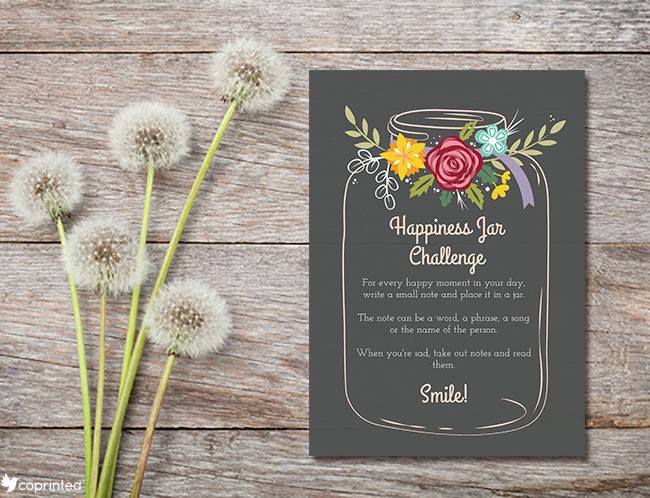
Over the past few years there’s been a growing trend to find a jar, mug, bowl, box, journal, some kind of beloved receptacle, in which individuals, couples, or families place slips of paper on which they have written their gratitudes, joys, happinesses, made-it-happen victories, favorite memories, or whatever else you wish to collect! Some people review them weekly, some monthly, and some annually as a New Year’s Eve tradition. In my knowledge, author Elizabeth Gilbert was one of the pioneers of this kind of project but many others have modified, expanded, and customized the concept. The fun part is you can get as creative as you like with the container, the papers, what you document, and how you revisit them!
(image source)
Art Journaling
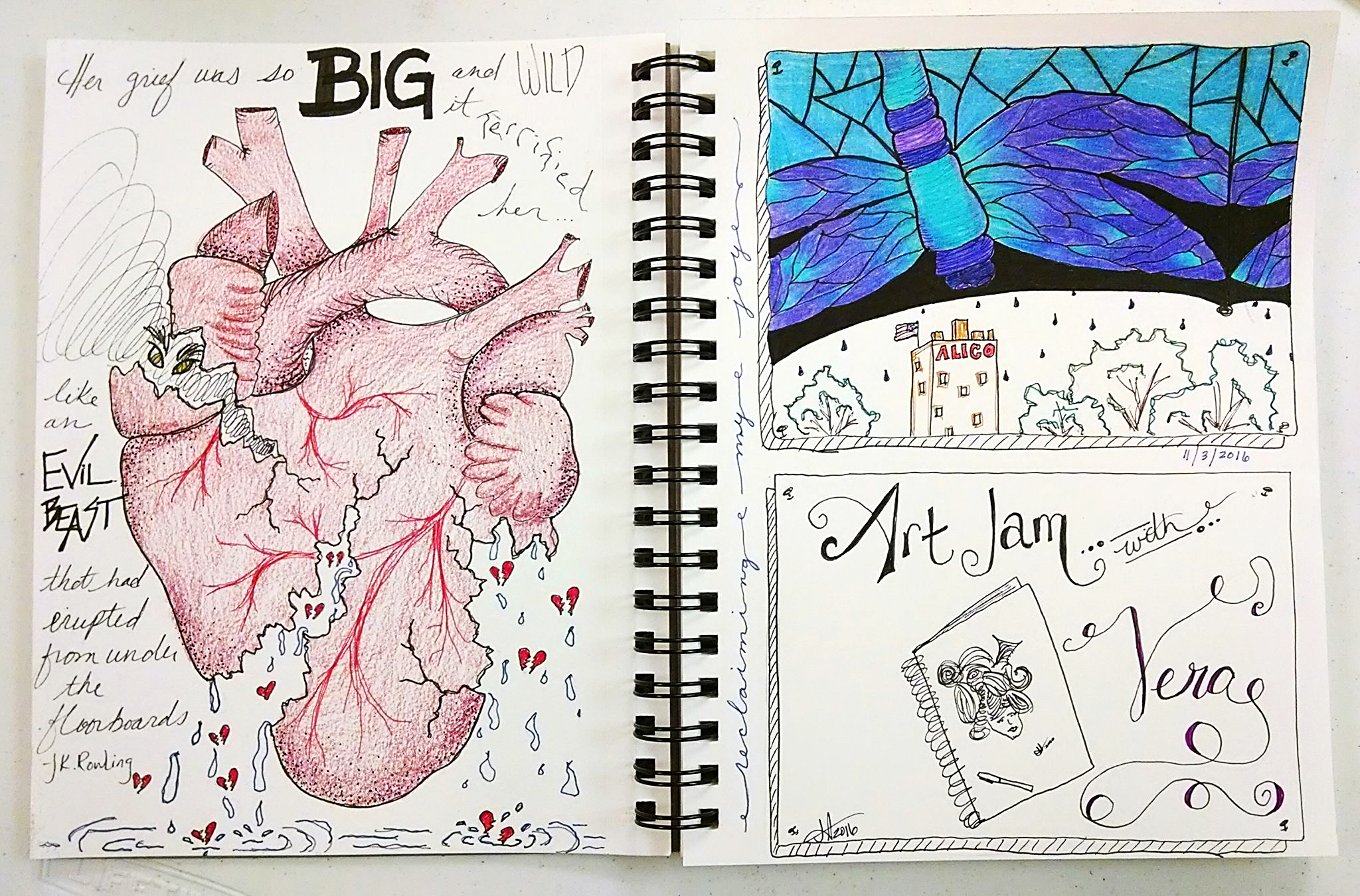
Some people prefer to process their lives, thoughts, memories, and goals via journal. Art journaling is a process that integrates a mixed media approach to the reflection/meditation process. This site has a collection of techniques, prompts, and inspirations for visually documenting important moments in life. As I move through my personal healing and growing process, grief is a big work I am moving through. To cultivate balance, I decided to document moments of joy alongside my grieving. Here is a sample from one of my art journals: a visual interpretation of a J.K. Rowling quote on grief, and a collection of joyful moments from that day: walking in the rain with my favorite umbrella (a stained glass lamp inspired design) and an artjam session with a good friend.
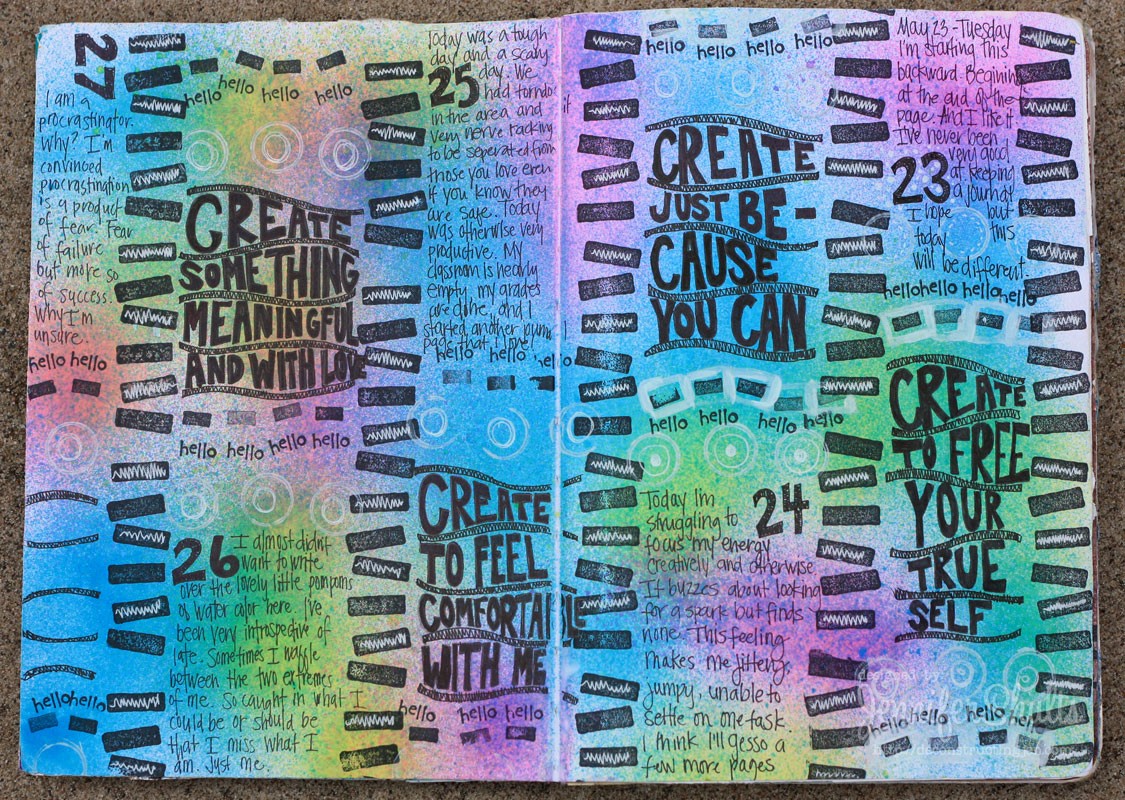
If you’re feeling at a loss for what to art journal about or where to begin, this blog post offers 10 ideas/prompts to get you started. This example shows several mantras interspersed between daily reflections. Whether you’re collecting poems, creative projects, your personal reflections, or notes from class or a meeting—using art to visually document your work can also help your mind remember and recall the content in ways different than text-only notes can offer. This is especially useful for anyone who is a visual learner!
(image source)

Bullet Journaling
You may have heard the recent buzz about bullet journaling…it’s taken off like a shot 😉 In my research, I discovered that this system of organizing, recording, and tracking life was developed by Ryder Carroll, a designer from Brooklyn, NY. The practice is meant to be tailored to suit each person’s creative outlets and personal needs.
Many bullet journals include monthly sections and ongoing sections. In a monthly section one might find logs such as: habit tracker, food & water intake log, gratitude diary, task lists, brain storm pools, budgets & expenses, meal and grocery planning, and future planning. Ongoing logs might include: movies/shows to watch, books to read, items out on loan, birthday & holiday calendar, savings tracker, workshops to take, hobbies to learn, garden planning, blog/social media post ideas, recipes to try, vent session/solution ideas, travel, experiences, quotes, art projects, and more! There is no limit to what you can record and gather in your bullet journal but if you need some ideas to get you started, this list is a great beginning.
Administrative responsibilities are not always an artist’s favorite chores, but if there is a way to do it artfully, we just might be inspired to stick with it…and maximize our creative play time while we’re at it! Check out these amazing examples:

Why make a regular list when you could create a visual index?! Image source.
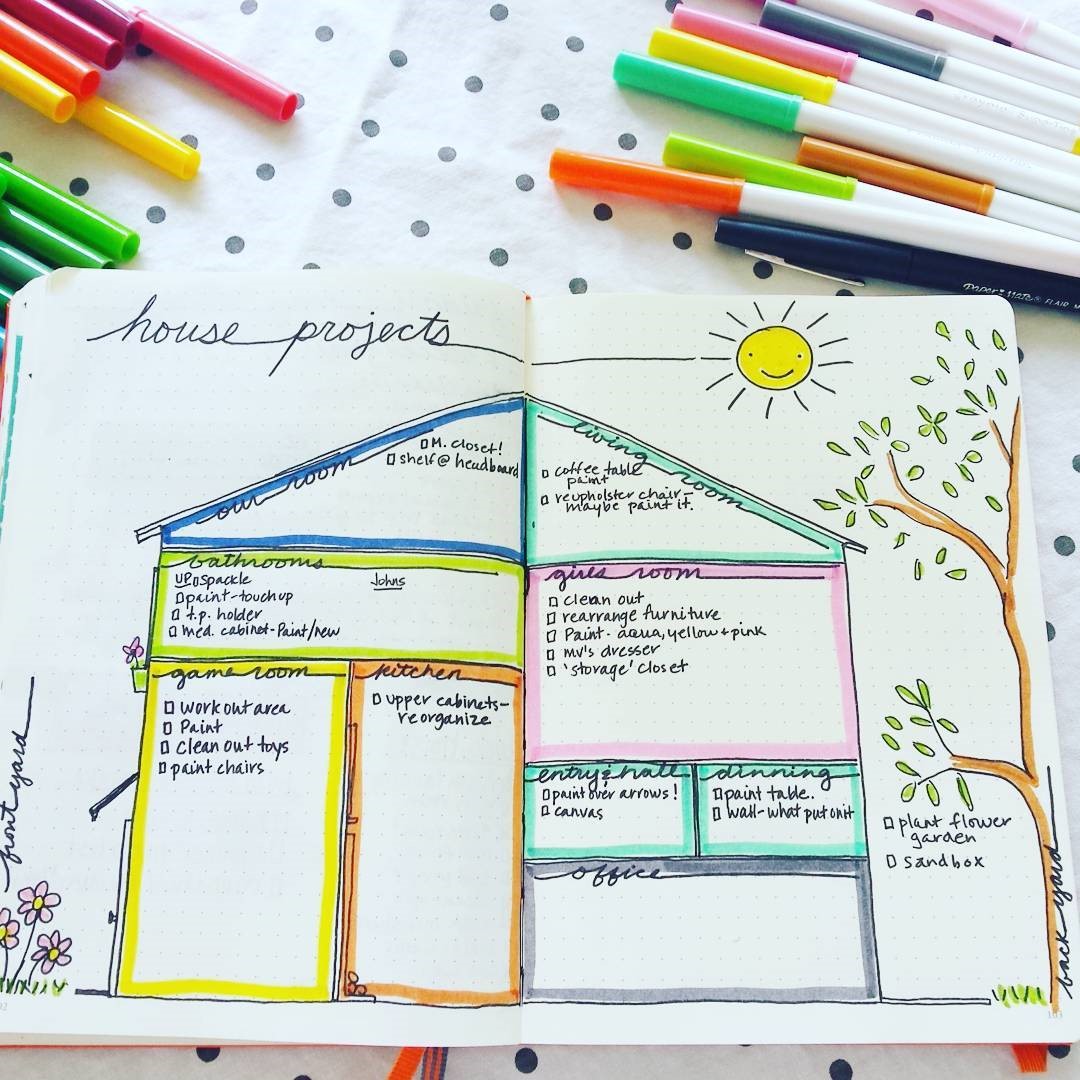
House projects and chore lists just got a whole lot more exciting! Image source.
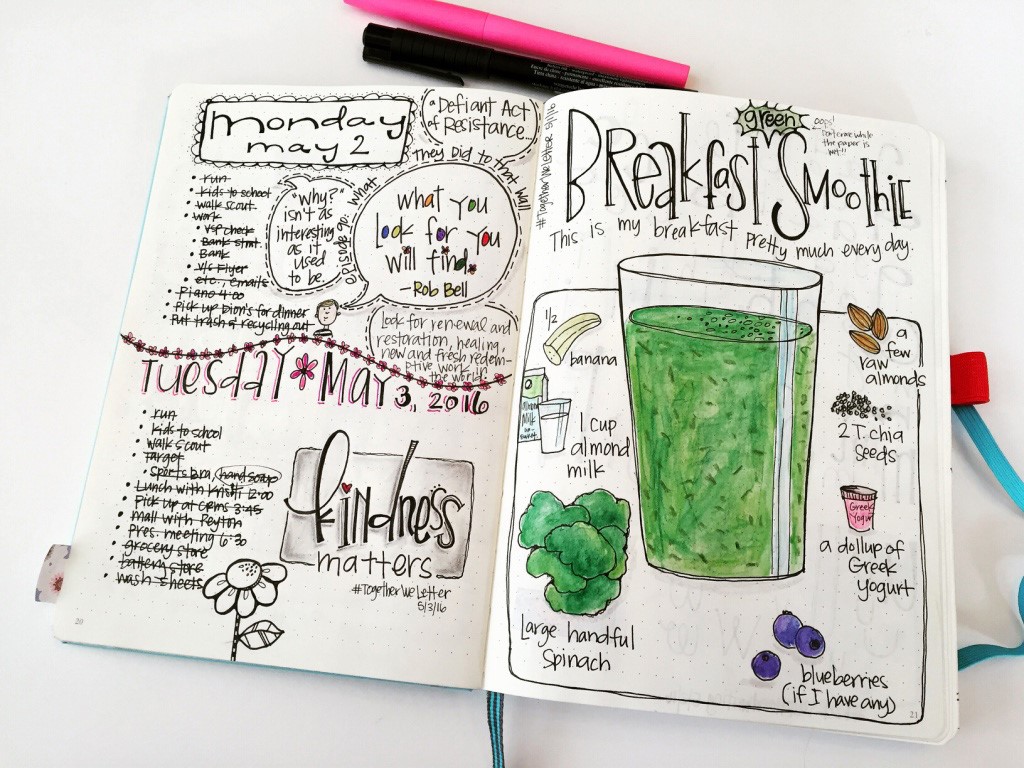
Daily tasks, notable quotes, and illustrated smoothie recipes reflect this bullet journalist’s dynamic days. Image source.
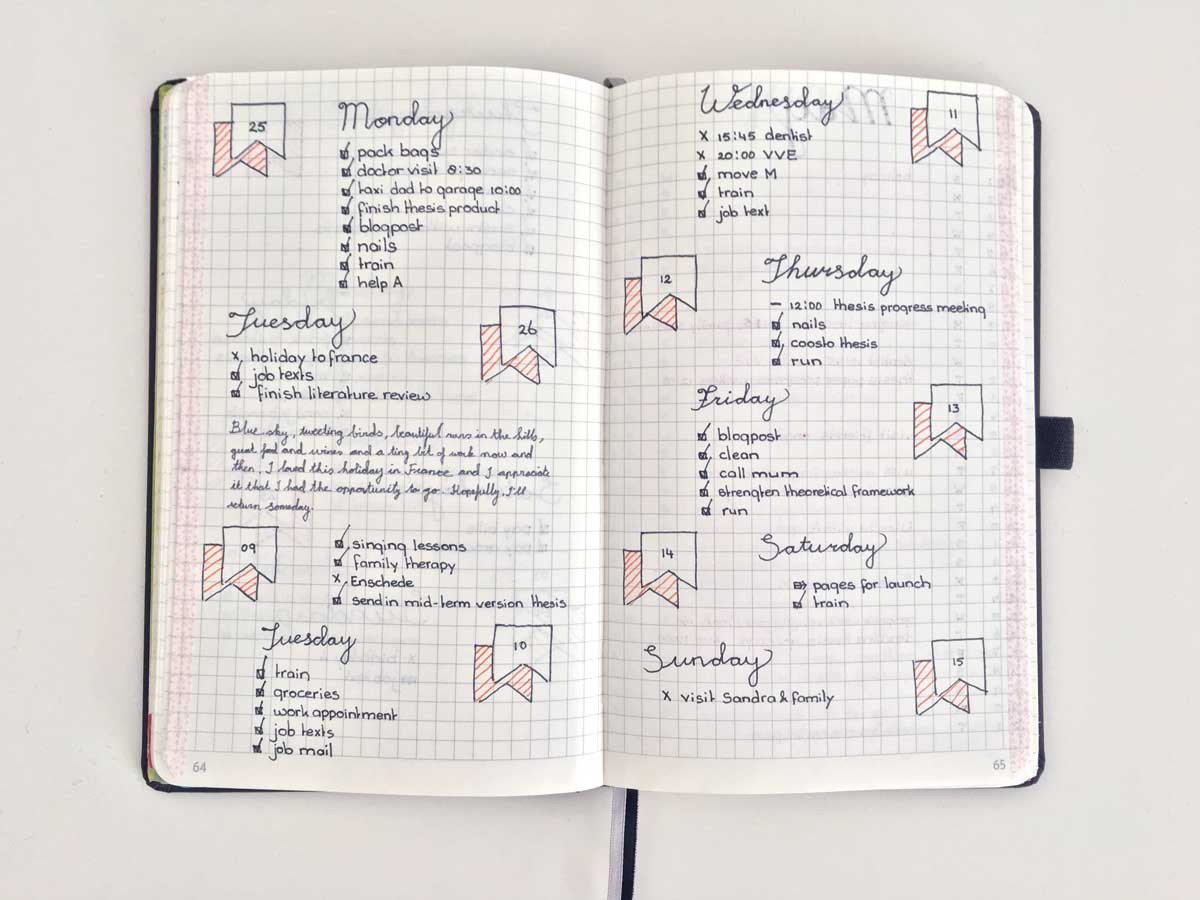
Some prefer clean lines and a minimalist approach to bullet journaling…the good news? Anything goes! Image source.
Maybe you want to remember which pens work best on which surface—make a bullet journal log for it. Maybe you need to keep track of your inventory for the upcoming ComiCon or artist market—make a bullet journal log for it. Maybe you want to collect data so that you can determine when are your busiest and your slowest times of year for custom art commissions—make a bullet journal log to track it. Maybe you want to remember which brand of paint or pen or paper or ink or fabric is your favorite for which kind of project–*say it with me now* make a bullet journal log for it!
However you work best, use that method to organize your life. Who says spreadsheets are the only way to keep track of data? And the best thing about using creative process to take care of your life business? You have a tangible place you can go back and look up items for reference, to compare productivity over the years, identify which months are most creatively productive and which are slower. And the more we know ourselves, the more dynamic our art becomes!
What are your favorite tools for restoring, creating, and maintaining order in your life…with a splash of art? Share with us in the comments! We love to learn new things from our readers. And if you have a skill you’d love to share with others, consider leading a workshop to spread the joy!
 Jenuine Poetess is an artist, visionary, and community organizer. In 2010, she founded In the Words of Womyn (ITWOW), an international, grass-roots, written and spoken-word arts project with chapters throughout Los Angeles, CA; Waco, TX; and Lebanon. Jenuine is the founder of Waco Poets Society and co-founder of the Central Texas Artist Collective. She writes, organizes, and creates rooted in the fierce conviction that holding intentional space, access, and opportunity for all people to foster their creative health is a matter of justice and is a vital asset to the sustainable thriving of communities. She currently lives and poems in Central Texas where she enjoys finding new ways to disrupt the homeostasis of her city. You can contact her at: j[email protected] .
The Act Locally Waco blog publishes posts with a connection to these aspirations for Waco. If you are interested in writing for the Act Locally Waco Blog, please email [email protected] for more information.
(During December we will be reprising some of “2017’s greatest hits” from the Act Locally Waco blog. I couldn’t possibly pick my favorites – so I used the simple (cop out?) approach of pulling up the 10 blog posts that got the most “opens” according to our Google Analytics. It is an intriguing collection that gives at least a little insight into the interests and concerns of Act Locally Waco readers. I hope this “Top 10” idea inspires you to go back and re-read your personal favorites. There have been so many terrific ones… If you would like to see the Top 10 according to Google Analytics, here’s the link: 2017 Greatest Hits. Merry Christmas! — ABT)
By Leslie King
On December 13, I was struck by a letter to the editor from David Trayler that appeared in the Waco Trib. In it he referred to Rev. Kyndall Rothaus of Lake Shore Baptist Church as a “lady pastor.”
In the letter, “Lady” as adjective implies something less acceptable than a real pastor. The implication, intended or not, is that a real representative for God is not a lady or a woman but a man. Such a notion is a theological shortcut that is damaging to our shared life, as well as God’s integrity and freedom.
Shortcuts, whether geographic or mental, benefit us by getting us quickly from point A to point B. That’s the benefit. Shortcuts also mean there is a lot of the proverbial landscape that we will not experience. When we understand God only as man or father, there is a lot about God that we do not see and we do not understand.
God as masculine is set early for many of us in the Christian tradition. Images of Jesus and disciples are pillars in the God-as-male argument.
My own theological shortcut on masculinity and God has been firmly in place since early childhood. My dad, himself a pastor, played his part in this shortcut. He was and is an encourager and my mentor, calling me to challenges and celebrating successes. So you can see, even as I was on track for ministry, my primary understanding of God was male.
The mental and spiritual shortcut was a well-worn path. It was not until the day of my ordination, when my father helped me slip into my robe in front of a dressing mirror that I saw it most clearly. Looking into the mirror, I saw Dad and I saw myself. I saw a pastor and a lady pastor. That was 21 years ago and I am still reconsidering the shortcut entrenched in my brain.
For me, this has been something like taking the long way to reflect on my experiences and to try to understand the experiences of others. The long way still reminds me of Robert Frost’s poem “The Road Less Traveled”. Unlike the poem, going the long way has not been lonely but rather a more densely populated route than the shortcut. I have found others who are navigating around their mental and spiritual shortcuts.
The long way is full of questions. “Does God intend to sort people into winners and losers?” “Are we encouraging right understanding of God when religion issues “loving ultimatums” on what is acceptable and what is not acceptable?” These questioning people are not interested in relativism or an “anything goes” culture. Rather, they seem to be examining their shortcuts. They seem genuinely curious to re-examine the constricting truths told to them about God versus their experience of God.
We are, many of us, navigating around insufferable shortcuts. We go the long way through scripture, tradition and experience realizing that gender has never been the only way we understood ourselves. It is not the only way we understand God.
For my part, I remember the stories of scripture wherein Jesus went the long way around the organized religion of his day. These texts remember his wandering through wilderness, township, home and hearth. “Your faith has made you well,” he spoke to some of the most unlikely candidates on a cultural scale of promise. There is something of them in all of us.
Such encouraging words are needed today. There is a longing to navigate with integrity around the shortcut and live into deeper and broader truths. Some say that the Spirit of Christ still takes the long way round the roughly hewn exclusions within his own church.
 This week’s Act Locally Waco blog post is by Rev. Dr. Leslie Ann King of First Presbyterian Church, Waco.
The Act Locally Waco blog publishes posts with a connection to these aspirations for Waco. If you are interested in writing for the Act Locally Waco Blog, please email [email protected] for more information.
by Jessica Shelton
It has been my experience that most people have at least one thing that really lights them up. Something that, when they participate in it or observe it, creates a feeling of joy in that person. Their emotions run high and they lose track of time. For some it is dance; for others it is art. For me, it is band.
I thoroughly enjoyed participating in band in junior high and high school, and I planned to continue with band in college. During summer orientation my college advisor told me that in order to take my major seriously I should limit extracurricular activities and focus on my studies. Based on that advice (which, by the way, is no longer considered to be “good” advice), I did not join my college’s band, and it is one of my biggest regrets. I played my trumpet a few times a year at my church, but not as part of a band.
Almost twenty years later, as I was preparing my classes for the beginning of the spring 2015 semester at MCC, I received an email from our Music Department inviting faculty and staff to join a new band that was forming that semester. Friday Band, as it was named, would be for MCC employees, students, and community members. I immediately knew I wanted to be part of this group.
I felt nervous as I approached the band hall on the first day of rehearsal. I had no idea what to expect. When I arrived, Sarah Harris, who was Director at that time, made everyone feel welcome. She helped us find our section and talked with us about how much we had played since high school and what part we wanted to try within our section. I saw a few familiar faces of MCC colleagues, but most of the musicians were community members and students. When everyone was in the proper place, we started to play. Even something as basic as that first warm-up scale sparked a bit of that old familiar feeling in me. It was immediately gratifying to play in a large group again.
Each semester, Friday Band meets for 90 minutes (on Fridays, of course) and rehearses between seven and nine pieces for a concert to be held at the end of the semester. The pieces vary widely in difficulty level and style, from pieces written for junior high bands to more traditional classical pieces. It has been very refreshing to have the opportunity to play new music every semester. Both Ms. Harris and our new Director, Jon Conrad, are very patient, and the rehearsal atmosphere is relaxed and fun. If we attempt a piece several times and we are not able to make it work, we move on to something else. By the end of the semester we are able to present our concert pieces proudly.
In the same way that the music varies widely, so too do the backgrounds and playing levels of the band members. There are musicians who had not picked up their instruments in the twenty (or more) years since high school, and there are musicians who played all throughout college and never stopped. There are college students in their late teens and early twenties, people who have retired, and every age in between. One of the best parts of being in Friday Band for me has been connecting with so many people through music. I sit next to people I otherwise never would have met, and we have bonded through playing music together. Each semester has a different combination of people; some familiar faces return and new ones join the group. It has been particularly nice getting to know the students, learning about their career goals, and discussing where they want to transfer. Some of the students play their principal instruments in Friday Band, while others sharpen their skills on a secondary instrument. Their musical abilities are impressive.
I have participated in Friday Band each semester since the beginning, and I will continue to do so as long as it is offered. As a working wife and mother, it is sometimes hard to justify spending time on something that is just for me, but I think it is important to make the time for something that I enjoy so much. I feel more connected to my MCC and Waco communities, and my children seem to enjoy attending the concerts and even listening to me practice. I am even hopeful that one day my husband will brush off the dust from his drumsticks and join the band with me. I am very grateful that this opportunity exists.
The fifth semester of Friday Band will begin on Friday, January 20th. If you are interested in participating, contact Director Jon Conrad at [email protected] or (254) 299-8220. Band members can sign up to take the class as credit, if desired.
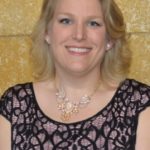 Jessica Shelton is a Licensed Professional Counselor and a Licensed Marriage and Family Therapist. She works at McLennan Community College as an Associate Professor of Mental Health/Social Work. In her free time she enjoys cooking, hiking with her family, and of course playing trumpet in the Friday Band.
The Act Locally Waco blog publishes posts with a connection to these aspirations for Waco. If you are interested in writing for the Act Locally Waco Blog, please email [email protected] for more information.
(During December we will be reprising some of “2017’s greatest hits” from the Act Locally Waco blog. I couldn’t possibly pick my favorites – so I used the simple (cop out?) approach of pulling up the 10 blog posts that got the most “opens” according to our Google Analytics. It is an intriguing collection that gives at least a little insight into the interests and concerns of Act Locally Waco readers. I hope this “Top 10” idea inspires you to go back and re-read your personal favorites. There have been so many terrific ones… If you would like to see the Top 10 according to Google Analytics, here’s the link: 2017 Greatest Hits. Merry Christmas! — ABT)
By Stephanie Korteweg
When I used to think of the word “mentoring,” I used to get this instant mental image of a Big Brothers and Big Sister’s commercial. Almost immediately my next thought was, “I don’t have enough time, and what in the heck would I do if I became a mentor?” We all sometimes have this sort of knee jerk reaction to things that are out of our comfort zone. Think for a moment about a time when you did something that caused you a little fear, whether it was something adventurous like skydiving, or trying something new like a new job or becoming a parent. Sometimes the things that cause us insecurity and a little bit of fear are some of most intrinsically rewarding experiences that we talk about for years.
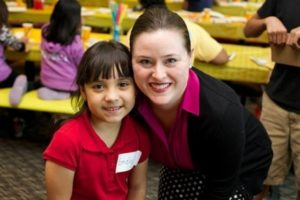 Let me ask you a question… how did you learn the things you know today? What person taught you those things? Who taught you how to change a tire, write a resume, how shake hands. Who was there for you during a difficult time in your life? If you think about it long enough you will probably think of several people who helped you when you needed it. Maybe they gave you advice, or maybe their presence made you feel like you weren’t alone.
I think the biggest barrier to becoming a mentor is the definition of “mentoring” we carry around in our heads. We need to put aside that old rigid framework–you know what I’m talking about. It’s the one that leaves you feeling overwhelmed before you begin. I think it’s time we start looking at what mentoring really is — an intentional investment in a person’s life, particularly a young person’s life.
And, what if I were to tell you that mentoring is one way we can help transform our community?
 I’ve been a part of a mentoring group called the Mentor Coalition for the past five years. As soon as I joined I realized that the mentoring opportunities here are as diverse as our community. We have organizations that require a relatively low time commitment and others with a substantial time commitment. There are mentoring organizations that focus on high school students, others that focus on elementary students. Some are highly structured programs, others are a lot more flexible in their structure. In the Mentor Coalition each organization does their part, working together like the gears in a bike, to see our community changed for the better.
A study from Child Trends called “Mentoring: A Promising Strategy for Youth Development,” showed that “overall, youth participating in mentoring relationships experience positive academic returns, better attendance, an improve chance of continuing on to higher education, and better attitude toward school.”
Another study, “The Consequences of Dropping Out of High School, Joblessness and Jailing for High School Dropouts and the High Costs for Taxpayers,” states “The incidence of institutionalization problems among young high school dropouts was more than 63 times higher than among young four-year college graduates.”
There’s a correlation between the success of the youth of our community and health of our community. I’m not just talking about the old Michael Jackson song here, but the children really are our future. They are the future entrepreneurs, doctors, teachers, social workers, police for our community.
Our American mentality looks for the quick fix. We are in the age of instant gratification, and we have forgotten about the simplicity of consistency, the power of a smile and the impact of an encouragement.
 I was recently speaking with a truancy judge and she told me a story of a family that had been in to see her several times. By the third time she asked to see only the kids in her office. As she sat there with the kids, she pulled an alarm clock from her desk drawer. She gave it to the kids and showed them how to use it. I remember her telling me how inadequate that action felt to her and how she really wanted to do something more. I asked if she’d ever seen the kids back in her court. She paused, thought about it for a minute looked back at me and said, “actually, I haven’t seen them since.”
Don’t discount the small things. Don’t let the fear of the unknown keep you from investing in a kid’s life. Don’t believe the lie that your small investment won’t make an impact. Join more than 800 other individuals in our community who are making an impact by mentoring- go to our website and get involved!
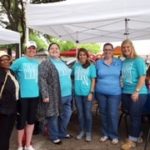 The Mentor Coalition is a group of representatives from mentoring agencies that serve young people in the Greater Waco area. These organizations work with local schools and families to provide necessary academic and social support to our area’s youth. The goal of the Coalition is to double the number of people who are currently mentoring in Waco to a total of 2,000 mentors! Please visit http://www.prosperwaco.org/mentor-coalition/ for more information on how to become a mentor.
The Act Locally Waco blog publishes posts with a connection to these aspirations for Waco. If you are interested in writing for the Act Locally Waco Blog, please email [email protected] for more information.