by Jesse Harden
Nearly four years ago, my family moved from Albuquerque, New Mexico to Waco, Texas, to attend Baylor University. I had never been to Waco, and knew nothing about it. My family’s time in Waco is now complete, and we will be returning to Albuquerque. In this short time, Waco has become more than a space we have occupied, it has become a place that has shaped us.
The concept of place speaks of the physical space we occupy at a given moment as more than the geographic boundaries of our existence, those in which we live, work, play and worship. Conceiving of place goes deeper than mere geography to the intangible ways our environment (its history, beauty and inhabitants) begins to have formative power in our lives. Dale M. Coulter (in an article found HERE) delves into the formative power of place,
“As much as humans seek to carve out the land they occupy, more times than not, it carves them. It turns ordinary humans into Southerners or Midwesterners or New Englanders”
In Short, where we are forms who we are. We are a product of the places we have lived. In the four short years my family has been in this place, we have, in many ways, become Wacoans. This place, its people, geography and culture have captivated us, and we are forever changed.
Two significant aspects of Waco that have forever carved their mark in my family are the prevalence of concern for the common good and the many assets that this community has to leverage toward this concern. First, as I have lived in Waco and have interacted with various members of this community, I have been overwhelmed by the general love, pride and concern each has had for this city. I worked as an intern, both with Communities in Schools and Mission Waco as a part of my studies. Additionally, I pastored at Highland Baptist church for two years. In each of these settings, I met people who love Waco deeply, and are dedicating their lives to see Waco flourish.
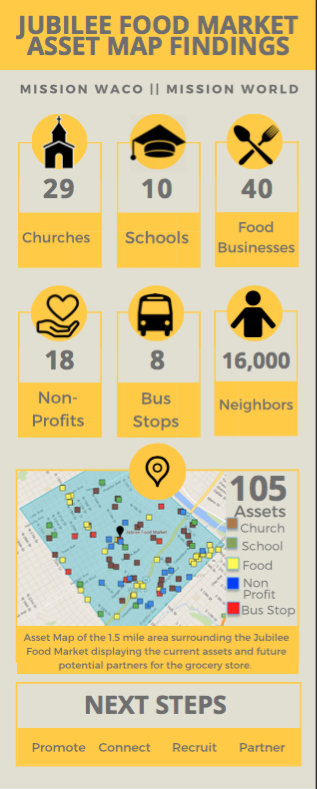 In my work at Mission Waco, I was primarily involved with their work to bring an end to North Waco’s food desert, working with the community to establish Waco’s first non-profit grocery store, the Jubilee Food Market. Among my responsibilities was to promote and process the OASIS Shares that Mission Waco is selling to raise funds for the market. I was privileged to see the name and generosity of each individual, foundation and organization that gave generously to this effort, providing nearly 75% of the needed funds in just a few months. The response of the greater Waco community to the opportunity in North Waco to provide fresh and affordable food to their neighbors was a truly humbling and inspiring experience (Shares are still available, by the way, and can be purchased HERE).
In addition to the generosity and concern of Wacoans for the common good of their city, I have been overwhelmed by the number of assets Waco has available to work toward a truly thriving, fruitful and just city. Waco has so many strengths waiting to be identified, connected and leveraged! As a part of my internship with Mission Waco, I partnered with North Waco residents to complete an asset map of the 3.5 square miles surrounding the Jubilee Food Market. Our team chose just five categories of assets to map, and identified 105 assets! Imagine the potential of these assets being connected together. Imagine the number of assets within Waco as a whole!
Very few people have the opportunity and platform to thank a city for their hospitality and formative role in their lives. I have such an opportunity now. Thank you, Waco! You are more than a space in which people live, you are a place by which people are formed. You have welcomed my family and allowed us to become Wacoans. And, though it grieves us to leave, we will carry our new identity to Albuquerque, inspired by your generosity and passion to see your community prosper.
 Jesse Harden just graduated with his Masters of Divinity and Masters of Social Work from Baylor University. He is a church planter and community development practitioner in Albuquerque, NM.
The Act Locally Waco blog publishes posts with a connection to these aspirations for Waco. If you are interested in writing for the Act Locally Waco Blog, please email [email protected] for more information.
By Roman Novian
It happens all the time. I meet someone new and during the course of the conversation I am asked what high school I attended. I respond, “University High School!” Then, like clockwork, their eyes grow huge. By now I know what the next questions will be. “Were you scared”? “Did y’all have to pass through metal detectors every day”? And on and on. No, I was not scared and no, we did not have metal detectors and actually, I loved every minute of it! I will admit, I was definitely scared my first day as a freshman. Of course being an awkward freshman on the first day of school is nerve-racking for anyone, but the rumors and comments from the public surely didn’t help. As the first day turned into weeks and then months I realized that I was in a great place. I started making great friends and becoming involved in many of the activities that were available through the public school system. I realized that all of the negative comments that I had heard over the years were completely erroneous. I received a top-notch education, extracurricular activities that helped me discover myself, and an unparalleled support system from my educators that went beyond the textbook to help me prepare for the real world.
Today, I am one of the top real estate agents in the country. I can certainly say that my time in the Waco public school system has helped me to be the person that I am.
I recently created the Roman The Realtor scholarship fund for local high school students. I believe it is important to give back to our community and there is no better way than education. Through the Waco public school system I was given an opportunity to succeed and I did.

The “Roman the Realtor” scholarship is open to University High School seniors who have been accepted and plan to attend college. Students should be ranked in the top 11%- 25% of the class and have demonstrated community involvement and volunteerism. Specific application requirements will be announced in early 2017. To learn more about the Roman the Realtor Scholarship, please contact University High School and ask for Mindy Place or Lisa Cain. The Waco ISD Education Foundation manages several scholarship funds for Waco and University High Schools. A committee of Education Foundation members, teachers, counselors and/or administrators reviews applicants and selects recipients. Those interested in contributing to or setting up a scholarship may contact the Education Foundation at 254-755-9517 or [email protected].
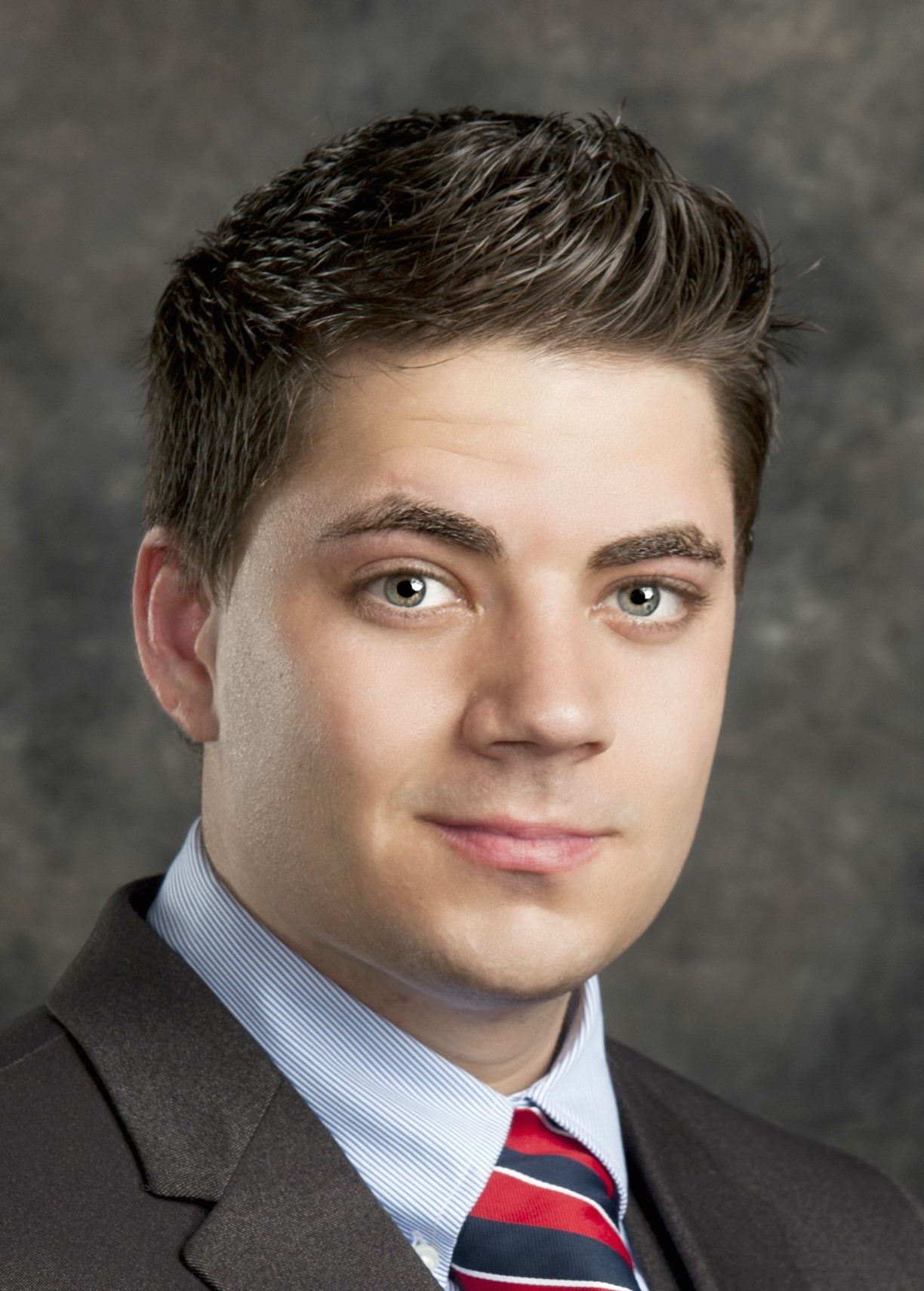 Roman Novian is a top producing real estate agent with Coldwell Banker Jim Stewart Realtors in Waco, Texas. He was born and raised in Waco and attended Waco public schools. His recent accolades include being among the top 1% of real estate agents worldwide for Coldwell Banker, the Coldwell Banker 30 under 30 award, The National Association of Realtors magazine 30 under 30 award, and Waco’s most loved Realtor by Locals Love Us.
The Act Locally Waco blog publishes posts with a connection to these aspirations for Waco. If you are interested in writing for the Act Locally Waco Blog, please email [email protected] for more information.
Dear Friend:
Welcome to Waco!
The boundless summer skies in Central Texas are filled with the savory smoke of family cookouts, the lazy tunes of summer concerts and care-free laughter from parks and summer pools.
Summer is also a time of transition.
As you unpack your bags, I pack mine.
Waco is my home of three years and I will greatly miss it as I leave to serve as the chief fundraiser at a Habitat for Humanity branch in my hometown in Maryland after serving in that role here at Waco Habitat. With some difficulty, as I will explain later, I draft this letter as a means to provide orientation to you and a farewell to our community.
Keep Those Sleeves Rolled Up – Waco Needs your Talents
You have moved, made your first trip to Waco Habitat for Humanity ReStore, found some great paint to redecorate a room or two and you probably made your first trip to a magical grocery store that holds everything your heart, soul and stomach could ever desire in three initials: H.E.B.
You may wonder about your first steps towards getting involved in your new community. Well, you made the right step in reading Act Locally Waco.
Three years ago, I met the founder of Act Locally Waco (ALW), Ashley Bean Thornton, who created the site initially as a “one stop shop” for nonprofits, businesses and individuals to post upcoming events, and job opportunities. ALW is now a critical communication tool in our community.
Ashley and I met at Common Grounds. Three unexpected things happened during the meeting: 1) I noticed and respected Ashley’s incredibly red converse shoes that brilliantly matched her joyful spirit, laugh and intelligence, 2) I placed a random order for a coffee drink called, “Pig Swig”, a decision that forever changed the course of this coffee drinker’s life for the better and 3) Ashley invited me to write about housing issues and how national policy impacts affordable housing here in Waco; a natural fit for someone who works at Habitat for Humanity. I did not know that this invitation would make me the first blogger of what is now a series of talented, well-respected Wacoans who serve as peer-bloggers about diverse issues that range from food, health, fitness, racial issues, education and many topics in-between.
Three years later, it is mighty difficult to find a meaningful way to say goodbye to a community that has meant so much to me between 500-1000, non-rambling (non-sappy) worded blog post.
Sure enough, before I knew it, I realized I was writing around emotions and not truly writing about the true impact our community had on me…it was easier to write about my favorite coffee spots (Common Grounds as mentioned before, Dichotomy is also highly ranked in my heart) and provide a survey of their must-eat menus than to share the heart of the matter. In the spirit of embracing vulnerability (Brené Brown), I rephrased this letter to do just that.
I am a better person because I called Waco home.
I edited this letter several times to unbury the questions: “what about Waco made me feel at home…what about Waco made me want to dig deeper and work harder for our community?”.
The soulful, truth-seeking expedition started above my keyboard and made me feel like a paleontologist at our Waco Mammoth National Park…the “day to day” of three years, commutes on Franklin Ave and I-35, hours of meetings, errands to H.E.B., and highs and lows we all have in life needed to be brushed aside so I could see that truth.
That truth is that Waco’s strong communities of worship and the outstanding service opportunities & associations of our town made the three years a rich, life-giving experience.
Communities of Worship
There are nearly 365 houses of worship in the Greater Waco area based on one recent survey conducted by a local nonprofit. I was able to call Calvary Baptist Church, Acts Church and later Antioch Community Church my spiritual homes during my time here.
Each church was stuffed with timely friendships and messages of encouragement that were sorely needed and allowed for opportunities for me to give back as well. Antioch’s life group network is among the best communities of faith I have been part of and I’m thankful to have the good problem of scheduling more goodbye visits with brothers and sister than there are hours in the day.
You may have the good problem of sorting through which house of worship is a best fit. If you are to be a long-term member or have a membership that reflects mine, know that no matter where you land, you will find a great spiritual home.
Service Opportunities & Associations
For each community of faith I encountered, I found that the mission to put the Gospel into action was highly encouraged and space was provided in service to share about upcoming volunteer or giving opportunities.
Likewise, I’ve had friends who were not part of any community of faith but also cared deeply about Waco and their friendships had an equally powerful influence on my personal growth.
Often times, I would meet diverse people from different professional, ethnic, racial and cultural backgrounds as we discussed positive ways to build our community. We all seemed to share the courage to push the status quo while we also shared mutual respect for each other.
The following nonprofits and civic groups provided space for that personal growth (learn more by clicking on the service opportunity):
- Caritas – Caritas provides the vital service of food and nutrition in addition to other services to our community. Contact them to learn how to volunteer, donate financially or learn about what items are most needed in the food bank ministry.
- Waco Community Development Corporation – Community engagement and affordable housing are some of the focus areas for Waco CDC. Contact them to learn about their homebuyer education courses and learn how to donate to their mission. Their Executive Director, Mike Stone, is going on Mike’s Hike during this summer to raise funds for much needed home repairs in Waco. Call their office to learn how to support this work.
- Citizens for Responsible Lending – A grassroots group focused on the healthy alternatives towards payday lending. Contact Alexis Christensen at Waco Community Development to learn more (see above link).
- CASA (Court Appointed Special Advocates) of McLennan & Hill Counties – CASA stands in the gap for children in the foster care system as CASA staff and volunteers serve as the child’s advocate. Contact them to learn about how to become a CASA volunteer or how to give to their incredible mission.
- Waco Habitat for Humanity – Habitat brings people together to build homes, communities and hope. Habitat builds affordable new homes, repairs existing homes and operates ReStore. Contact the Habitat team to learn how to donate, volunteer or to hear about our latest inventory at ReStore.
- Association of Fundraising Professionals – Professional mentorships, trainings and online resources provided by AFP empowers regional fundraisers to excel through ethical fundraising practices (annual membership in June is discounted $50, contact chapter admin Susan Duecy at [email protected] for more info).
- Prosper Waco – An effort designed to look at education, health and financial security and how our community can move along a collective impact, data-driven model towards each category. Contact them to learn how to join committee work.
- LeadershipPlenty – Leadership training for Wacoans at no cost, LeadershipPlenty is made of facilitators from the community who teach a proven curriculum. Local leaders graduate and apply lessons learned to deepen their existing leadership roles in the community. Contact Catherine Bauer at [email protected] to learn about the application process.
- Nonprofit Networking Hours – Sponsored by the Cooper Foundation, these trainings in management best practices also allow space for news and local events to be shared. Click on the “Nonprofit Networking Hours” link to learn about past and upcoming events.
- Board Trainings – The Waco Foundation annually holds board trainings so that local organizations are well-equipped to lead their mission-work responsibly. Contact Nicole Wynter at n[email protected] to learn more
- City of Waco Council Meetings – Held at the Waco Convention Center on the 1st and 3rd Tuesdays of every month. The hearing of the visitors officers a time where you as a citizen can speak for about 3 minutes about any topic and City staff follow up with you about your concerns. This is a great way to have your voice heard.
- Chambers of Commerce: Hewitt, Waco, Central Texas African American, and Hispanic chambers offer social hours, networking events; Waco’s Young Professionals host professional trainings.
Do Not Wait to Unpack
Living in Waco is not a spectator’s sport.
You can engage the above partnerships or match your skillset to others (by no means is the above list comprehensive of all the partnerships in Waco).
Some common themes run throughout the on-going work of many Waco-based organizations. The above partnerships deal with ongoing issues such as affordable housing, racial disparities in our community and poverty that cannot be addressed alone as it takes your participation, time and resources to make a difference.
I have lived in four states and several different communities and I have never before witnessed any other community like Waco where effective collaboration makes such a positive impact.
We have achieved a great deal together and can still do much more. Further progress greatly relies on open access to the discussion on how to make Waco a place we can all call home.
Using ALW to first learn about said issues and then to later participate in events is a realistic progression towards engagement.
Don’t wait to unpack your skills – jump right on in; Waco will embrace you as you embrace Waco.
What are perceived social or economic challenges are tremendous opportunities for partnership and growth.
No matter how long you may call Waco home, you will be changed for the better and our community will greatly benefit from the gifts you are willing to unpack, share, and develop with your new community.
All the best.
Phil York
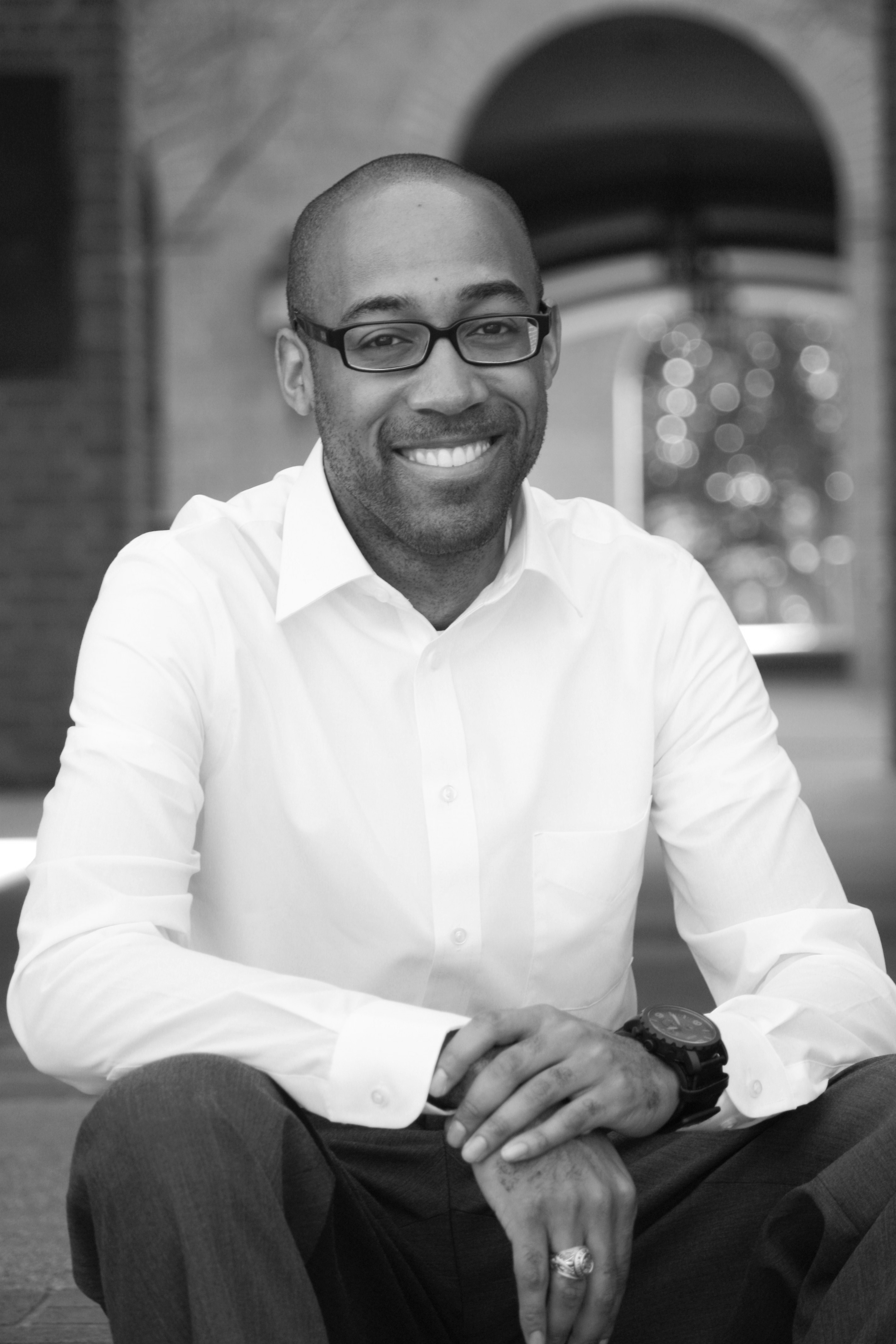 For the last three years Phil York has been working at Waco Habitat for Humanity, most recently as Director of Development. A self-described “policy nerd;” he has also been the Act Locally Waco housing and homelessness policy blogger. Now he is moving back to his home state of Maryland. We’ll miss you, Phil! Thank you for diving into Waco! We are better off for your having been with us for a while!
The Act Locally Waco blog publishes posts with a connection to these aspirations for Waco. If you are interested in writing for the Act Locally Waco Blog, please email [email protected] for more information.
(Note: This post is part of a series called “Entrepreneurs of Waco.” The series is collaboration between the McLennan Small Business Development Center (SBDC), the Professional Writing program at Baylor University, and Act Locally Waco. The McLennan Small Business Development Center offers technical assistance, business mentoring, training, and resources for all stages of small business. For more information, visit their website: www.mccsbdc.com. To see all the posts in this series, click here: Entrepreneurs of Waco. – ABT)
By Allie Drain
Spin Connection is nearly empty by five p.m. Classic rock and modern pop songs play from the speakers, mixing with the soft rustle of plastic – the sound of customers flipping through records.
It’s a comfortable atmosphere. Relaxed. Posters from popular bands and movies, both modern and vintage, plaster the walls behind the displays that line the sides of the store. In the middle are two rows of wooden displays, each row made of eight total bins. These displays show the real treasure of the store: they hold the thousands of vintage records that Spin Connection is known for.
It wasn’t always like this. “When we started, we had a couple of these racks set up,” Stan Wojciechowski explains, pointing his thumb at the bins in the middle of the store. “We were having them built, and so we just had like four racks and about five hundred, eight hundred albums out here.”
“I never thought I would have my own business,” he says. “A few years ago, we did the Austin Record Convention, which is one of the biggest record shows in the United States if not the biggest, and we decided we’d maybe try to have a store here in Waco because vinyl was having a comeback of some sort. Not a huge comeback, but a comeback nonetheless.”
Stan and his wife, Alicia, opened Spin Connection about two and a half years ago. Stan had come to Waco in 2007 for his work with industrial equipment—a job that he still holds on top of running his store. He’d always had his own collection of records though, which he started selling even before opening Spin Connection to help with bills and his children’s tuition.
“I think it’s something that he’s kind of wanted to do for a while and when he did it, his determination, I think, just made it happen,” Stan’s son, Josh, says.
Josh, who helps out at Spin Connection on top of going to school and working, recalls his father’s lifelong hobby of going to flea markets and auctions for music, which often turned into family trips with his parents and older siblings. He didn’t always appreciate it when he was younger until he started learning more about the work behind having a stall or a small business, something he’s become more aware of with his father’s store. “To me, I would say it gives me some inspiration on how to find that something you like doing and turn it into something that you’re proud of,” Josh explains, clearly impressed with his father’s accomplishments.
One of the most challenging parts of owning a record shop is finding the right inventory. With very few exceptions, the records which fill the racks of Spin Connection are all vintage, brought in by either customers looking to sell, or found through an auction of some sort. “I just have to find them, because I want to find them for a good price so my prices are reasonable for the customer,” Stan explains. “Some of the titles we can’t keep. Dark Side of the Moon by Pink Floyd, we can’t keep it. The Wall, also by Floyd. Michael Jackson’s Thriller, it doesn’t stay very long. Those kind of albums, you put it out here, ‘Ahhhh, look!!!’ It’s gone.”
While Spin Connection is never as busy as the chain stores, there is a steady flow of people from all ages and walks of life. There’s a good number of Baylor students who are part of the new record culture, but also plenty of older people. Many of them, Stan notes, come in looking for albums or artists they were fond of in the past, and some come in looking to sell. “You hear them out here laughing and looking like ‘Honey, look at this,’ and they’re laughing. It’s not even a comedy album, it could be anything. They just get a kick out of it.”
Spin Connection’s customers are drawn in mostly by word of mouth, however Stan also mentions the importance of location in starting a business. “You wanna be where there’s a lot of traffic,” he says. For that reason, Stan opened Spin Connection at 3703 Franklin Avenue, right near the intersection with North Valley Mills Drive. Beneath the upbeat music of the store’s soundtrack there’s a steady thrum of passing cars on the street outside. Traffic is a constant on Franklin Avenue, proving the worth of Stan’s words. The location provides Spin Connection with the opportunity to both attract more customers and avoid the heavy fees that helped close some smaller businesses he knew in the downtown area. “Waco is a good place to open a business, but you have to know what you’re doing,” he says. “Do your homework.”
“Having more live music would be good,” Stan says about his future goals. Bringing in bands is one of his favorite parts of the business. “We had a band up here from Austin that was really good and they did an acoustic set. They were doing headbanging music in clubs, but I asked them if they could do acoustic and they said yes,” he recalls. “It was really good.” The live music adds to the unique atmosphere that sets Spin Connection apart from many other music stores.
“He’s involved in all facets of the business,” Josh explains about his father’s work, “and I’ve learned that if you find something that you really like doing, you should really just do it. There are risks involved. My dad didn’t know how exactly it would turn out for him. I guess that’s part of the fun, but his resolve to just open the store and just take that risk … I guess I’ve learned that I should take risks for stuff that I love and try to really focus on those things that I love.”
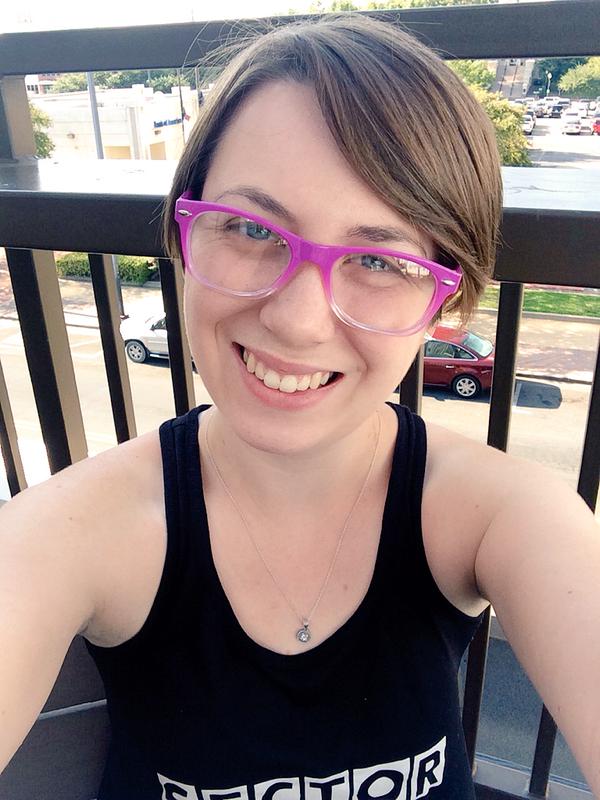 The writer…Allie Drain is a recent graduate of Baylor University, Class of 2016. While at Baylor, she focused her studies on English and Creative Writing while also acting as Co-Editor in Chief of The Phoenix, Baylor’s literary magazine. She loves reading, writing, and sharing stories, and hopes to one day enter the publishing industry.
The Act Locally Waco blog publishes posts with a connection to these aspirations for Waco. If you are interested in writing for the Act Locally Waco Blog, please email [email protected] for more information.
by Rick Allen
It all started with a mule. In 1865, a young Confederate veteran by the name of Albert Parsons sold a mule and some cotton land for the money to attend Waco University. He made it through one year before the allure of Radical Republican politics called him. He began taking political appointments and doing political field work. On one of these trips to a former slave neighborhood, he met a young woman of mixed ethnicities calling herself Lucy Gonzales. They fell in love and attempted to marry. Texas at that time was a state that had legal strictures against “miscegenation”. So…they sold what they had and went to Chicago where they could legally wed.
In Chicago, Albert worked as a printer and eventually had his own newspaper. Lucy, who had learned to read and write, became a labor organizer in garment factories. She also, alongside Albert, led the first May Day parade in Chicago on May 1st 1886 with 80,000 labor union members marching behind. It appeared the days of twelve hour work shifts and children working during school hours were over. Just days later, a riot erupted during a labor rally in the Haymarket Square and several police were killed by a bomb. After a “kangaroo court” of business owners found Albert and four other innocents guilty of the deaths, they were hung.
Lucy wrote pamphlets about this injustice and by 1900 was a leader in the growing movements of socialism and anarchism. She became a hero to the poor and a “radical” to the rich. She encouraged strikes, walkouts and takeovers of factories. She helped start the American Communist Party and the International Workers of the World. By 1940, she was on an FBI watch list and even the NYC Police Commissioner described her as the, “most dangerous woman in America.” She died from a mysterious fire in her apartment in 1942. The police confiscated all her property and it disappeared.
Today, the USA , Saudi Arabia, Thailand, Zimbabwe, Pakistan and a dozen other countries refuse to celebrate Labor Day or Workers Day on May 1st. However, more than 200 countries remember with their own marches the day Lucy and Albert led the big parade.
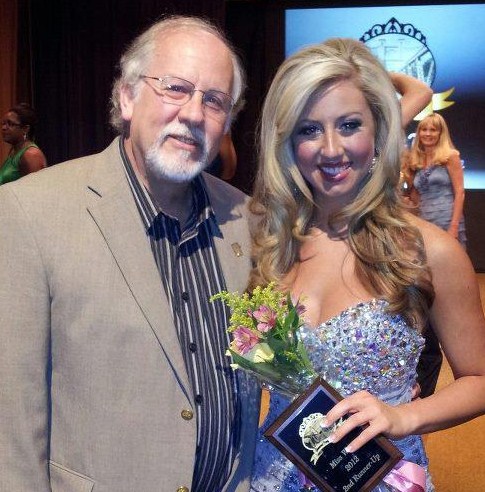 Rick Allen has worn many hats since coming to Waco in 1982. He has been a history and English teacher, social worker, therapist, special educator, school counselor, Dean of Students, Waco City Councilman, landscaper, xeriscaper, pedicab entrepeneur, B&B host, board member, Sunday school teacher, junior college instructor, MHMR curriculum writer, public speaker, blogger and dad.
The Act Locally Waco blog publishes posts with a connection to these aspirations for Waco. If you are interested in writing for the Act Locally Waco Blog, please email [email protected] for more information.
By Glenn Robinson
Did you know the city of Waco has one of the highest teen pregnancy rates, pre-term deliveries, infant mortality rates, and child abuse in the state of Texas? What if there was a way to change these results in a way that benefits not only the mother and child, but also our community and population health overall?
Together with the Waco Foundation, we at Baylor Scott & White Medical Center – Hillcrest have launched a program called Nurse-Family Partnership committed to producing enduring improvements in the health and well-being of low-income, first-time parents and their children. Implemented in January 2016, the program is designed to utilize bachelor-prepared RN’s to deliver into a home environment the information, education, and resource connection for the success of the mother’s pregnancy and the child’s overall health at birth. This evidence-based model has been successfully breaking the generational poverty cycle in counties all over America for the past 38 years, including 33 counties within Texas.
This proven model allows care providers to improve birth and health outcomes for first-time mothers and their babies by educating them in ways that increase attendance to appointments, thereby decreasing the likelihood of early delivery, unforeseen complications and follow-up ER visits.
But our commitment does not stop there – the program continues through the child’s second birthday. As part of the curriculum, in-home assessments are used to identify early childhood development concerns, and promote school readiness. Additionally, our team’s goal is to involve the family unit as a first source of learning, as well as provide nurturing and mentor support to the mother so she may become a more prepared and confident parent.
Hillcrest, in conjunction with community partners, recognizes the need for programs like this to help break the cycle of poverty for at-risk, teenage mothers in our community. Nurse-Family Partnership can help break this generational cycle – empowering confident mothers to become skillful parents who are able to prepare their children for successful futures, growing into healthy, productive citizens.
Interested in learning more about this terrific program? Contact us! Let’s work together for the good of our kids and our community!
Nurse-Family Partnership
Baylor Scott & White Hillcrest Medical Center
120 Hillcrest Medical Boulevard #303
Waco, Texas 76712
254-202-1130
Nfp.sw.org
Nursefamilypartnership.org
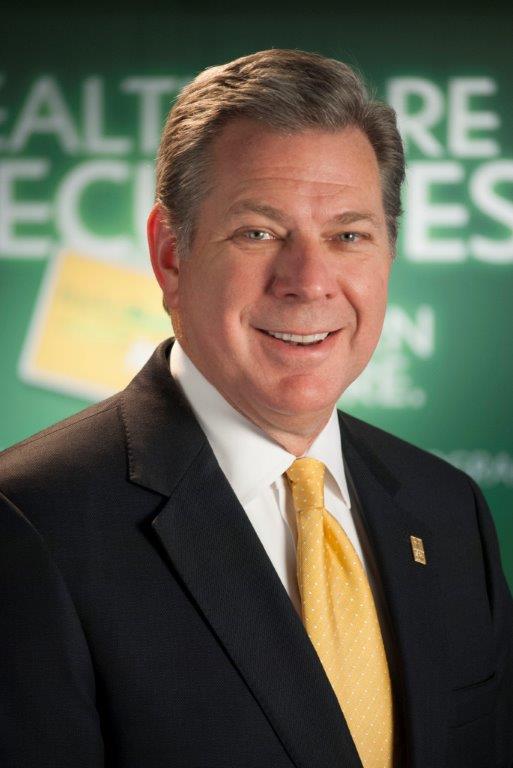 Glenn Robinson has been the President of Baylor Scott & White Medical Center – Hillcrest since September 2007. He previously held several CEO positions at hospitals in Texas, Oregon and South Carolina. A Georgia native and graduate of the University of Alabama, Glenn completed graduate school at Trinity University in San Antonio, Texas. He has more than 30 years experience in hospital and healthcare management, is a Fellow of the American College of Healthcare Executives, has received several professional awards and serves on a number of national and state healthcare policy boards. He also serves as an Adjunct Lecturer for both Baylor University and Trinity University and is involved in several non-profit organizations and community councils. Glenn and his wife, Rhonda, have three children: Josh, Jacob and Sarah Kathryn, and one grandchild: Pierce.
The Act Locally Waco blog publishes posts with a connection to these aspirations for Waco. If you are interested in writing for the Act Locally Waco Blog, please email [email protected] for more information.
by Jenuine Poetess
 In May, Central Texas Artist Collective co-founder, Angie Veracruz challenged Waco artists to engage in a global project called Art Abandonment. The idea for participating was born after a conversation Angie had with a new Waco transplant, artist Christy Town, who first introduced the idea to CTAC. What a thrilling chain of creative events!
Art Abandonment was founded by artist Michael deMeng in 2012. What began as a small project among a circle of friends has since grown into an international movement of creating and giving away art. It’s a movement motivated by beauty, generosity, and the very best of our nature as humans. The idea is simple: create art, leave it for someone to find. The goal is anonymous acts of kindness through art. While the artists are encouraged to sign their work and post art drops on a Facebook group page—with over 28,000 members—the intention is to secretly leave work and quietly intersect every day with bursts of freely gifted art. There are some basic templates of notes that many of us use to let the finder know this is a free gift they may take and enjoy, leave for someone else, or pass along to someone in need.
 After Angie shared with the CTAC community, I set about to create some of my first pieces. The idea of leaving secret art surprises all over Waco is right up my ally. I found it thrilling to work with small canvases—starting at 3” and 4” square—there is something so very freeing about working with a small space. There’s no pressure to fill up so much canvas! I’m still quite amateur in the visual arts department, but abandoning art is not focused on the caliber of art but rather the act of giving away our creations for the joy of others! The items pictured here are some abstract watercolors I did, about 4×4” each. I found that as I began creating work to abandon, I wanted to make more and more! It has become one of my new favorite things to do and I give myself at least one day a month dedicated to making art to abandon. There is a kind of meditative practice that goes with letting go creations and not knowing the outcome of who received it, what they think of it, how they responded, or what they did with it.
There is an option for finders to email their discovery and they are periodically posted on the Facebook group. More often than not, the corresponding stories are poignant accounts of people in a moment of pain, stress, or challenge who encounter the art and receive much needed hope, encouragement, and kindness. It is a wonder to imagine the impact a small creation can have in the life of another person.
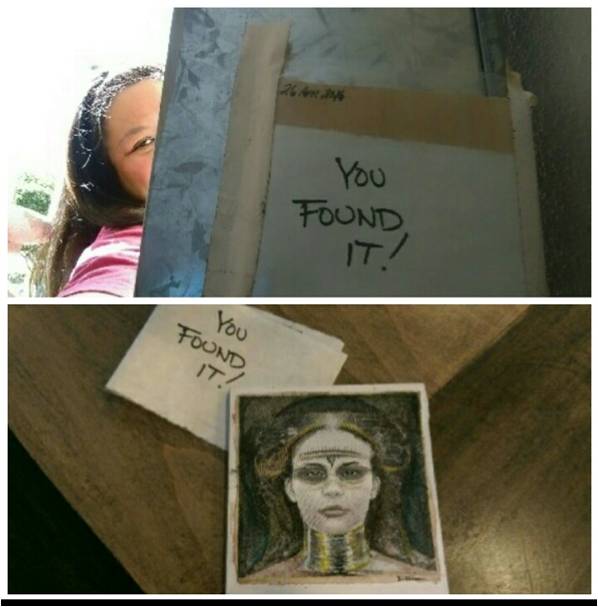 A few weeks after Waco artists took to this project, Angie Veracruz found one such abandoned piece, by photographer and illustrator, Michelangelo Flores. Every artist has their own style of abandoning artwork, just as they do creating it. Flores opted to hide his work and offer clues geocache-style to its whereabouts. Looks like it was a successful route to take! Veracruz opted not to leave any clues as to the location of the work she has abandoned in Waco. I have left clues on my Facebook page and Twitter, but they are pretty broad and would lead to an adventure should anyone undertake to search the city for art!
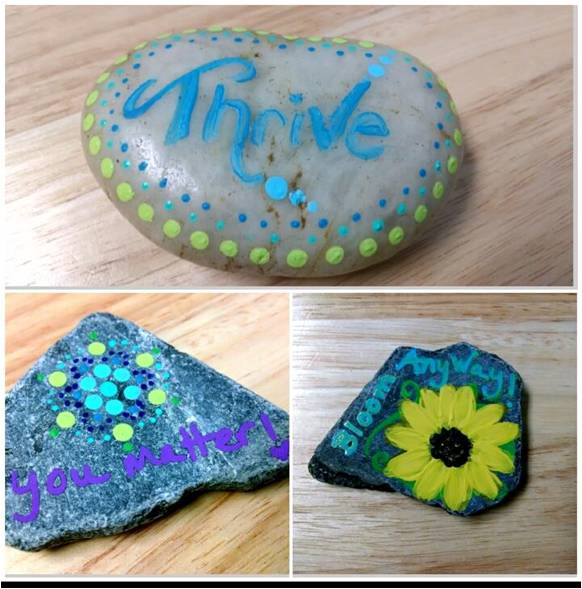 I love the community feel of this project. Anyone can abandon any hand-made item. There are textile and yarn arts abandoned; some artists create stone or leaf designs they leave on beaches and forest paths; other artists create for a cause to raise awareness for a specific issue. The Peyton Heart Project raises awareness for suicide and bullying by abandoning crocheted hearts as love notes for anyone in need of a reminder that who they are in the world matters. Art in every kind of medium has been abandoned—some for the sheer aesthetic, some with a heartfelt message. I recently abandoned some affirmation rocks painted with acrylic paint and as a result, became connected with the Love is Action Movement at Word Rocks. I shared the Art Abandonment project with my colleague, Salley Schmid, a therapist who integrates art process into her work with clients and once a month we have a creative jam session to make pieces to abandon.
As a collective of artists, we hope that Art Abandonment will take root in Waco as more artists create and gift their work to the world. I find a deep satisfaction in the practice and plan to continue. If you wish to learn more or participate, check out the website. If you need a daily dose of what is truly good and kind and noble in the world, join the Facebook group and soak up the wonder! The group page will also give ideas of what people abandon and affirm that anyone can create something to share with others!
Get Involved:
In addition to starting your own Art Abandonment practice, there are a number of other ways you can get involved with arts in Waco this month!
- Creative Waco has compiled an extensive list of summer art camp opportunities for kiddos of all ages. Click here to learn more.
- Thursday June 9th: CTAC will be holding an information meeting Thursday June 9th 5:30pm at GWAMA to discuss their upcoming Ekphrasis Word & Image Collaborative Exhibit and call for submissions! More details about the exhibit and call can be found here.
- Thursdays in June: This Thursday continues the Writer’s Garett FREE creative writing workshop for Veterans—using writing as a means for exploring and expressing personal narratives of hope and healing. More information online here.
- Thursday June 9th: 5:30-8:30pm Art Center of Waco hosts an opening reception for the MCC Visual Arts Student Exhibit. More details here.
- Saturday June 11th: Jenuine Poetess will be facilitating a FREE creative writing workshop: I am/I am not :: writing/righting/riting our stories at the InterWaco & Equality Texas PRIDE day at West Waco Library from 3-5pm in the large conference room. More details online here.
- Saturday June 11th: Waco Poets Society host queer Filipino-American poet, Kai Coggin who will be visiting us from Arkansas to feature at open mic. 7pm at Rufi’s Cocina. FREE and open to all creative expression including rap, poetry, music, spoken-word, freestyle, story-telling, hip-hop and more!
- Thursday June 16th: Singer/Songwriter Braden Guess features at Waco Poets Society open mic at Tea2Go at 7pm. FREE and open to all creative expression including rap, poetry, music, spoken-word, freestyle, story-telling, hip-hop and more!
- Saturday June 18th: The Writer’s Garett in partnership with the Texas Commission on the Arts and the National Endowment of the Arts presents a FREE panel discussion on Writing as a Healing Practice with authors: Ruth Pennebaker, Leila Levinson, Jack Woodville London, and Jenuine Poetess. 1-2:30pm at the West Waco Library more details here.
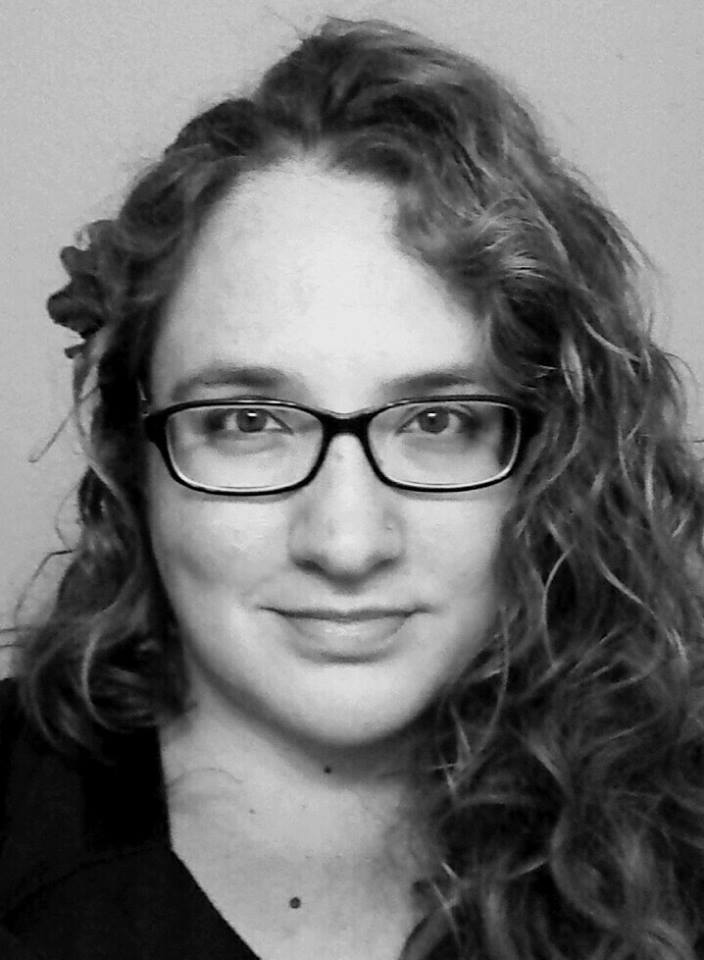 Jenuine Poetess is an artist, visionary, and community organizer. In 2010, she founded In the Words of Womyn (ITWOW), an international, grass-roots, written and spoken-word arts project with chapters throughout Los Angeles, CA; Waco, TX; and Lebanon. Jenuine is the founder of Waco Poets Society and co-founder of the Central Texas Artist Collective. She writes, organizes, and creates rooted in the fierce conviction that holding intentional space, access, and opportunity for all people to foster their creative health is a matter of justice and is a vital asset to the sustainable thriving of communities. She currently lives and poems in Central Texas where she enjoys finding new ways to disrupt the homeostasis of her city. You can contact her at: j[email protected].
The Act Locally Waco blog publishes posts with a connection to these aspirations for Waco. If you are interested in writing for the Act Locally Waco Blog, please email [email protected] for more information.
by Louise Powell, Waco Founder Lions Club Vision Screening Chair
This summer, the Waco Founder Lions Club is pleased to announce our partnership with Allergan Foundation. Prevent Blindness Texas, other Waco area Lions Clubs, and the optometry practice of Dr. Robert Salganik to improve the vision of Central Texans. At the recent groundbreaking of Waco’s Allergan plant expansion, the Allergan Foundation gave the Waco Founder Lions Club a grant to provide 100 no-cost eye exams to Waco area people who don’t have the money or insurance to cover eye exams.
Why 100 exams? The Waco Founder Lions club celebrates its 100th birthday July 2016 (with a huge street party on July 15, 2015 at Lions Park), and Lions International will celebrate its 100th birthday in 2017. Allergan Foundation has chosen to honor the Centennial Anniversary of both the Waco Founder Lions Club and Lions International because, like Allergan, the Lions are dedicated to vision preservation. Since 1925, the Lions’ primary focus has been on vision-related projects. That year—1925–Helen Keller challenged Lions International to become “Knights for the Blind.” Through the years, Lions have recycled donated eye glasses, distributing the refurbished glasses to people all over the world. We have trained service dogs and provided Braille materials for the blind, operated eye banks for corneal transplants, combatted river blindness in Africa and Latin America, and conducted vision screenings in local communities.
Why are no-cost professional eye exams important? Many adults cannot afford eye exams for themselves or their children. Health insurance doesn’t always cover eye exams. Lots of folks don’t have separate vision insurance. And Medicare will not cover routine eye exams for glasses. Lions have discovered these facts as we travel about the community providing vision screenings. When our screenings with our fantastic new Spot Vision Screener reveal a vision problem, we advise clients to make an appointment with an eye care professional, but often they will tell us they can’t afford the exam. Now we can tell our friends that the Lions Club can help them—through the generosity of our partners.
Why is partnership important in preserving the sight of Wacoans? With the help of our partners, we have more people and more money dedicated to vision preservation in Central Texas. For years, optometrist Dr. Robert Salganik of Optical Dispensary has provided discounted eye exams for referrals from Waco Founder Lions Club, but our Waco Founders Lions Club budget was limited to about 50 eye exams a year. With Allergan’s grant, this year we can provide 100 more Wacoans no-cost exams. Another partner, the non-profit organization Prevent Blindness Texas, will continue to cooperate with Lions clubs in vision screenings and provide additional vouchers for no-cost eye exams and glasses for adults who qualify. In addtion, local area Lions Clubs cooperate in providing vision screenings to the community and referring people for eye exams.
What does a Vision Screening by Lions Club look like? You have to see it to believe it! The Waco Founder Lions Club has purchased a high tech vision screening camera that within seconds “takes a picture” which can identify the following serious eye conditions in a child or adult: nearsightedness, farsightedness, astigmatism, and pupil and gaze abnormalities. Results are printed automatically and given to the client; if a problem is detected, a printout (in red) advises “Complete Eye Exam Recommended.” In over 1600 screenings this past year, approximately 20% of the children and adults received a recommendation for an eye examination by an optometrist or ophthalmologist.
Why is this 20% important? Children from the age of 6 months to 5 years of age are often called the “underserved population” because parents do not realize the importance of a complete eye exam in these early years. In fact a child’s first eye exam should be at 9 months (according to the American Optometric Association and American Ophthalmological Association). Babies and young children don’t know they can’t see, so they don’t tell their parents that anything is wrong. Unfortunately, if a vision disorder such as “Lazy Eye” is not detected and corrected early, permanent vision loss can occur. Poor vision can also affect early learning and beginning reading efforts. Schools conduct annual screenings; however, many children unnecessarily suffer from poor vision for several years before they begin school. Vision disorders stand a chance of correction without surgery if detected at an early age.
If you are interested in scheduling a vision screening– which can be arranged for day cares, health fairs, churches, schools, recreation centers, or community festivals/events—call the Lions Club. Vision screening for the citizens of the Waco area is a service project of the Waco Founder Lions Club and other area Lions Clubs.
Contact Numbers: Louise Powell (409) 392-4671 or Waco Founder Lions Club Office (254) 776-5341 –office open Mon-Thurs. 9:00-1:00 –leave a message or e-mail [email protected]
You can find more information about Spot Vision Screening at this website: Spot Vision Videos.
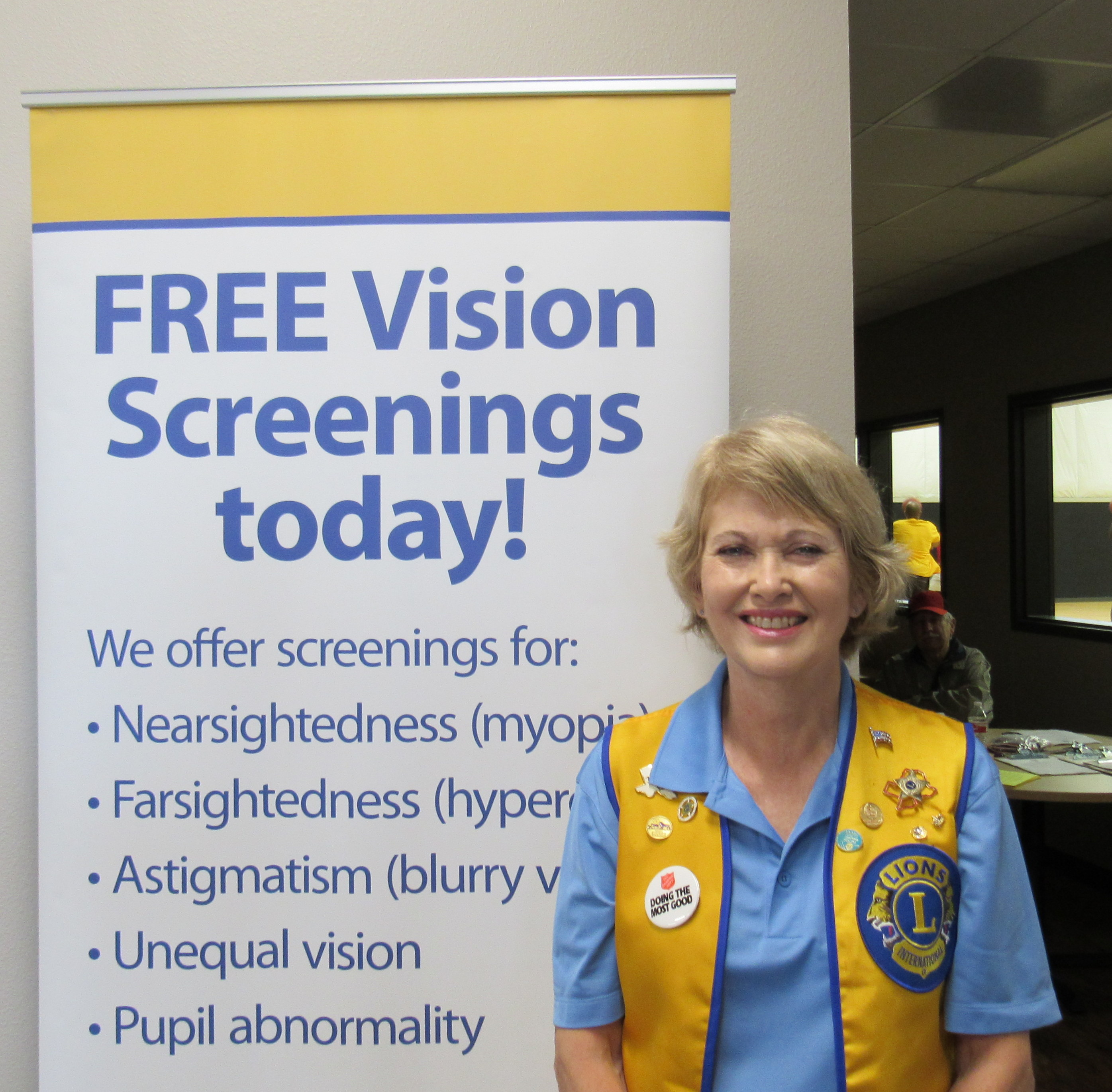 Louise Powell is currently an adjunct English instructor at Baylor and MCC. Previously she was an English teacher and administrator in Waco I.S.D. She is married, the mother of three grown children and grandmother to six (and one on the way). Louise is a past president of Waco Founder Lions Club and currently serves as Vision Screening Chair. Waco Founder Lions Club is the oldest continuously operating Lions Club in the world. We will be 100 years old this July 2016. To learn more about the Waco Founder Lions Club, be our guest any Wednesday at lunch, 12:00 at the Lions Den, 1716 N. 42nd St.
he Act Locally Waco blog publishes posts with a connection to these aspirations for Waco. If you are interested in writing for the Act Locally Waco Blog, please email [email protected] for more information.
(Note: This post is part of a series called “Entrepreneurs of Waco.” The series is collaboration between the McLennan Small Business Development Center (SBDC), the Professional Writing program at Baylor University, and Act Locally Waco. The McLennan Small Business Development Center offers technical assistance, business mentoring, training, and resources for all stages of small business. For more information, visit their website: www.mccsbdc.com. To see all the posts in this series, click here: Entrepreneurs of Waco. – ABT)
by Hailey Nelson
 “Photography is an art form, and everyone has their own unique touch,” says Aaron Jetelina, or AJ, the proprietor of WTX Media. This is the main reason AJ works alone. Photographers have their own fingerprints on the photos, especially when it comes to editing, and the difference can usually be seen in the final product.
For AJ, it all started in high school when his photography teacher left suddenly, and AJ began taking over all of his teacher’s photographing responsibilities. He started out photographing football games and sports events, but that slowly morphed into taking over the rest of the school’s events. Today, AJ’s photography hobby has grown into a well-known business. Beyond finding something you’re good at, he says, “You have to find your niche, because it’s so important to be unique in this business and have focus. There are many new photographers out there, but if you find something interesting, like pet photography or newborn photography, you’re sure to receive more business.”
AJ found his “niche” while taking pictures for a few local dance studios. He realized the typical process that has been used for decades in school and sports photography, does not work with dance photography. When photographing a dance studio one must account for the multiple outfits dancers have, and you need to be able to accommodate a variety of poses. Parents want to see their child’s portraits before making purchasing decisions. AJ developed a new system in order to meet his customer’s needs. Instead of parents pre-paying for pictures without seeing their images, Aaron uses multiple computers as viewing stations. After the dancer finishes his or her photography session, the images are viewable on the computers to help in making purchasing decisions. Along with his professionalism and experience, this innovative way of making sales has enabled AJ to grow his client base to over 20 dance studio across Texas. Last year he photographed over 1000 dancers – which equates to 3000 outfits and 20,000 poses/images – all in the span of 10 weeks.
AJ is now using his knowledge of dance photography to develop a training program to help other photographers across the country learn how to be successful in this very specific photography niche. “I figure I can’t work in more than one state at a time,” he says. With the training program, other photographers can learn to use AJ’s process to expand their businesses.
 AJ’s interest in developing efficient business processes goes back to college where he earned a business degree. Since AJ started his photography business in junior high, he already had quite a bit of knowledge about photography by the time he entered college. He decided that earning a degree in business would be beneficial in continuing his career. AJ’s business degree and his expertise in photography programs have both been integral to his success. For instance, he uses editing programs such as Photoshop and Lightroom to fix minor cosmetic issues such as teeth whitening, and to do major editing such as full background changes, postermaking and more. He spent over seven years mastering these two editing systems, and has been able to use this to his advantage when it comes down to setting himself apart. “Everyone wants the perfect Pinterest shot. They see photos of perfect sunset weddings and immediately assume that’s how it’ll work. When in reality, it takes a massive amount of editing to get those.” This is only part of the reason that photographers can be expensive. It takes two hours to edit every one hour of shooting. So a full eight-hour wedding, can take sixteen hours or more to complete all the basic edits.
Another reason for the cost is that photography is an art. It’s like selling a painting or a movie. It’s something that can never be recreated the same way, and the artist takes pride in his or her work. This is especially evident when the photographer gives away the printing rights to customers. Typically photographers will have a second meeting with their clients where they select the photos they’d like to keep, and they are only allowed to print through the photographer. For his clients, AJ creates a flat rate depending on what they want done; then he provides all of the edited pictures on a flash drive for the customers to use as they please. It’s another innovation, and it has drawn many customers. “The world is relying so much more on technology than it used to, and no one wants the photos printed anymore, they want to put them on Facebook or Instagram,” he says.
AJ’s photographs also appear on Google; he is the only Google photographer between Dallas and Austin. No, he isn’t the guy who rides around in the car. He takes panoramic business images that appear on Google. These help businesses advertise, and they help customers get sense of what a place looks like when they search online. AJ’s experience and his vast array of equipment, including a camera with panoramic capabilities and a swivel tripod that allows the camera to move in a complete circle, helped him land the Google job. AJ owns several cameras and a multitude of different lenses that enable him to capture images from a great distance or up-close and in detail. In other words, he’s prepared because he knows no two photo-shoots are ever the same.
One thing that is the same is Waco, or at least AJ in Waco. He graduated high school here and returned here after college to continue his business. “I grew up here, and the best part is I get to do what I love and capture moments in people’s lives that they can cherish for years to come.”
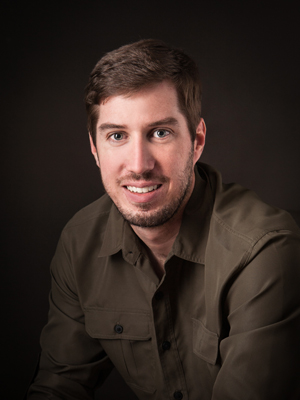 The entrepreneur…Aaron Jetelina started out his career in photography back in 2000 photographing portraits and events. Over the years he has developed the skills and knowledge in working with companies to meet their specific branding and marketing needs. He graduated from Sam Houston State University in 2007 with a bachelors in business administration and management.
 The writer…Hailey Nelson is a secondary education major with a concentration in English. She has moved around to five different states, but Texas is her favorite. She is a semi-pro photographer and loves animals more than anything. Baylor is her second home. She is a member of both Kappa Delta Pi honors society and Alpha Delta Pi sorority.
The Act Locally Waco blog publishes posts with a connection to these aspirations for Waco. If you are interested in writing for the Act Locally Waco Blog, please email [email protected] for more information.
by Joel H. Scott
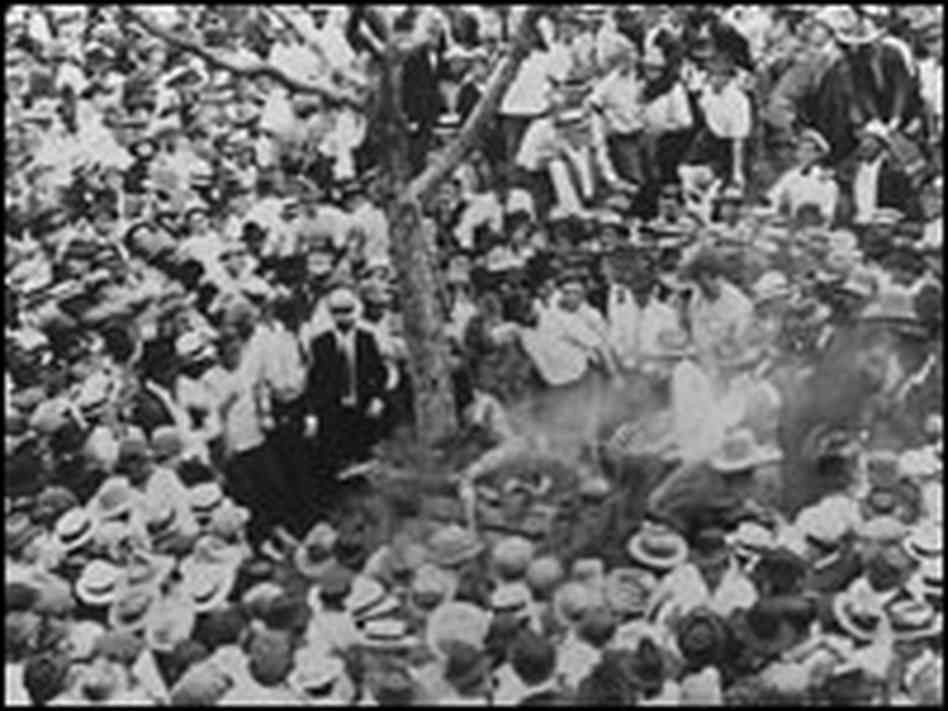 The Jesse Washington memorial service was a confluence of feelings for me. It was sobering, enlightening, liberating, divine… and it made me feel fragile. While I found myself wooed by the rhythmic interplay of words of lament and declarations of faith, (a faith that overcomes the longstanding shadows of hatred and egregious forms of violence), internally, I was struck by my feelings of fragility about my place at this service. I know I represent, both symbolically and historically, a form of unchecked dominance and power to underrepresented populations in this country. I’ve known this for a long time, but it is still uncomfortable for me. Rather than sit with my insecurity, I still prefer to focus on how much “progress” I’ve made in the past 15 years of work toward becoming a more “culturally competent educator.”
So during my intermittent discomfort throughout the service, I found myself thinking things like: “Yes, but this [lynching] happened 100 years ago. So much progress has been made this century…” and other similar self-soothing thoughts in response to my internal dissonance. This kind of thinking is what emerging scholars such as Robin DiAngelo describe as a form of “white fragility.” White fragility prevents empathic listening from occurring in critical discourse regarding equity and inclusion. Well-intentioned discussions addressing the delicate issues of racism, power and privilege are too often met by defensiveness, guilt, or the need to qualify, benchmark, or point to progress—all of which smell suspiciously like shame-avoidance.
This isn’t just occurring individually (as in my case at the memorial service), but institutionally. For example, during the service representatives of Waco were offered times to apologize to the family and community. The corporate declarations of “I’m sorry” turned quickly to descriptions of the new “progressive” Waco. In my opinion, these statements subtly overlooked the gravity of this occasion. And, while Waco may not hold egregious rallies today such as the one in 1916, our community, and our country, continues to trip itself up with “fear-of-the other” behaviors and attitudes that “disembody” people of color. Ta-Nehisi Coates describes this phenomenon poignantly in his recent book, Between the World and Me. Look no further than existing policies and practices that continue to disproportionately impact minority groups: the historic bias of standardized testing, the mass incarceration of African-American men, for-profit detention centers, predatory loan businesses, and the persistent misogyny and institutional racism plaguing many of our “prestigious” universities and organizations. All these things are part of an unfortunate mindset rooted in fear and fragility.
 Look, as a white male of current and historic privilege, I get it. No judgment here if you feel fragile when facing these truths. It’s uncomfortable to sit with these feelings without offering words of hope for humanity or citing current breakthroughs, especially when the event in question happened 100 years ago. But herein lies the tension: In order for personal transformation to stir, Critical Race and White Identity Development theories point to the need for living fully into this tension — without the crutch of self-serving cliché’s and well-intended suggestions. Living into this cognitive, moral, and spiritual tension is work!
- It means empathically listening to friends directly impacted by bias and prejudice.
- It means admitting to ourselves and others that we have biases (a natural human behavior , but one that becomes violent if it goes unchecked).
- It means working toward a deeper understanding of the ways we support prejudice and bias of all kinds through ignorance or silence.
- It means facilitating conversations with our children regarding their friendships and who they may intentionally or unintentionally exclude at school or church.
- It means studying culture, language, and/or music that we may not be naturally drawn to or interested in.
- If you are a Christian, it means wrestling with social gospel realities and inclusion at church.
- It means gently yet firmly redirecting or confronting conversations that are rooted in sweeping generalizations and fear-based perspectives.
People much smarter than I am who study racial reconciliation agree: to develop cultural competencies that can lead a city, a church, or an organization to greater equity, inclusion, and redemption is to live deeply into this tension. As such, I’m grateful for the privilege of attending the memorial service, grateful to be starkly reminded again of my own fragility. Writing this piece for ALW is one of a number of cathartic experiences I have had of late (including responding to my 10 year-old son’s questions about privilege, fear and violence in response to the Waco Horror and service) that are humbling reminders that I still have much to learn and do on the journey toward redemption.
*For a richly uncomfortable account of the Jesse Washington tragedy, I encourage all Wacoans to read The Waco Horror by Jesse Washington at http://theundefeated.com/features/the-waco-horror/
 Joel Scott most recently served on faculty at Boston University. His scholarship is anchored in moral development with an eye toward higher education reform. After four years of commuting and 300,000 flyer miles, his family has decided to remain full-time in Waco. Joel is currently re-rooting, looking forward to backyard barbeques, driveway basketball, and living a more integrative life.
The Act Locally Waco blog publishes posts with a connection to these aspirations for Waco. If you are interested in writing for the Act Locally Waco Blog, please email [email protected] for more information.