Read Locally Waco is a project to promote literacy in Waco. Throughout the semester we will post stories that use sight words our children are learning in Waco ISD. You can print these stories and lists of words to use with your children or with other children in your life. This week’s story uses words from the First Grade Sight Word List. For a printable version of this story and word list, click here: Rosie Likes to Drive Around.
Rosie Likes to Drive Around
Rosie likes to drive around. Robert likes to walk.
For weeks she drove right by him. Then, one day she stopped to talk.
“You are very boring!” Rosie stopped and said that day.
Said Robert to Miss Rosie, “Well, you don’t have to stay.”
“Every day you walk and walk. You go so very slow.
Why don’t you drive a car like me? That’s all I want to know.”
“If you really want to know me, all you have to do is ask.
You never stop to talk to me; you always drive right past.”
So, Rosie stopped her yellow car, and parked it on the street.
She took her sneakers from the trunk, and put them on her feet.
As she and Robert walked along, he showed her many things…
He showed her where he liked to play and pushed her on his swing.
They said “Hello” to Mrs. Jones and patted her dog Chico.
They waved to June and Christopher and their new baby, Rico.
They bought a sno-cone from a truck and each of them ate half.
“Your lips are blue!” “Your lips are blue!” They both said with a laugh.
When they walked back to Rosie’s car, the moon was big and bright.
They had walked and walked and walked and walked till day had turned to night.
Rosie likes to drive around. Robert likes to walk.
Now she never drives right by him. She always stops to talk.
First Grade Sight Words Used in this Story
- Every
- Laugh
- Many
- New
- Night
- Very
- Walk
- Why
- His
- Put
- Him
- By
- Day
- Your
- Them
- Had
- Know
- Ask
 This Act Locally Waco blog post is by Ashley Bean Thornton, she has lived in Waco almost 20 years now. Far longer than she ever lived anywhere else. She likes to walk. If you see her out walking, honk and wave and say “hi!”
The Act Locally Waco blog publishes posts with a connection to these aspirations for Waco. If you are interested in writing for the Act Locally Waco Blog, please email [email protected] for more information.
By Cynthia Cunningham
It has happened again. Precious lives lost. National outcries of blame. Social media arguments. Never did I imagine that this would become our “normal” reality. Living in a world where our children and teachers were not safe in the classrooms.
It is a natural reaction for us to have extreme emotions when these shooting happen. Social media explodes with everyone’s opinion. It gets ugly. Everyone feels that their opinion is right and they stubbornly refuse to see things from another view point.
It’s not enough. I applaud the students that are using their voices following this tragedy to do something. This is what it takes to make a change. We can no longer do the same thing and expect change. We see that it doesn’t work. It’s time for action.
I am reminded of something I would tell my daughter often during her teen years. It’s Julia Roberts’s line in a movie called “Step Mom.” She is telling her step-daughter that she as two choices in life: do the same thing with the same results, or do something. Life is going to happen whether we do something or nothing. Why not do something?
Throughout our nation’s history, it took someone doing something to make a change:
- March 13, 1913, Alice Paul spearheaded the suffrage parade, a gathering in Washington D.C. to call for a constitutional amendment for the right for women to vote.
- December 5, 1955, Martin Luther King Jr lead the Montgomery Bus Boycott and lead the American civil rights movement.
- September 8, 1965, Delano Grape Boycott labor strike, with Cesar Chavez, demanded equal wages to the federal minimum wage.
These major events took someone deciding to do something! Imagine a world where each of us did something. It might not be pretty in the beginning. Think of all the struggles of the above three events. They were not successful overnight. But they did not give up. And as a result a change was made.
Consider what changes are needed that could prevent these tragic events. What could you do to make a change? It sure doesn’t help to just complain on social media. Re-think your actions.
Sounds like this latest tragedy had a lot of missed signs. Missed opportunities for help and to prevent this awful outcome. But we can’t know what we are not taught.
So here is my “Do Something”. I am proud to be a part of OkayToSay.org. This movement was launched by the Meadows Mental Health Policy Institute and their partners to increase awareness that most mental illnesses are treatable and to offer messages of hope and recovery to Texans and their families.
The goal of Okay to Say is to change the conversation and perceptions around mental illness, which ultimately can lead to:
- Growing understanding, advocacy and support for the mentally ill.
- Improving access to community services for diagnosis and treatment.
- Accelerating progress in the quality and delivery of mental health care.
If we make it okay to talk about our mental health, it would be just another health issue that had no embarrassment. Then those living with issues would feel no shame to seek help. With more people bravely acknowledging issues, more services would be needed. This could lead to more united voices asking for change. Our government would recognize that we must have better mental health care. It takes us all talking about it to raise awareness and end the stigma that has caused so many to hide their struggles.
If you want to take it a step further, educate yourself! Most of us have taken a CPR class. We now know how to help someone having a medical crisis. But few of us know what to do when someone is having a mental health crisis. So educate yourself! Take a Mental Health First Aid class.
Some things you learn about in a Mental Health First Aide class:
- Mental Health Problems: Depression, Anxiety Disorders, Psychosis, Substance Use Disorder, Eating Disorders
- First Aid for: Suicidal Thoughts, Self-Injury, Panic Attacks, Traumatic Events, Acute Psychosis, Alcohol Abuse and Aggressive Behavior
We have the Mental Health First Aid classes available in our community! Just reach out if you want to learn more:
See how easy it is to do something? If more people took these trainings, they would know how to help when they see the warning signs. They would not have to look back and have regrets for not recognizing a sign. We can do better!
All it takes is you making taking the step. Just do something! Be active! Start a movement… in whatever you are passionate about.
 Cynthia Cunningham, a Wacoan since age 2, is the Executive Director for NAMI Waco. She lives with her husband of 28 years, Bobby, and two spoiled dogs and one royal cat! Her passion is educating others about mental health. She can be contacted at: www.NAMIWaco.com
The Act Locally Waco blog publishes posts with a connection to these aspirations for Waco. If you are interested in writing for the Act Locally Waco Blog, please email [email protected] for more information.
By Major Anita Caldwell
Homelessness could involve my son, your sister, your father who just didn’t want you to know about their problem and didn’t want to be a burden to you. Homelessness is not caused by The Salvation Army or any other organization; but our goal is to end homelessness by all means possible. The homeless belong to Waco and McLennan County. They belong to all of us. They are the people created by God who walk a broken road. They are the broken souls of our community, our county.
While at our community kitchen, I had the privilege of interviewing five of our homeless citizens of Waco. They represented our veterans, college students, mentally ill and those waiting on disability. Here are their stories.
As a teenager, Ellen had experienced a difficult time and was sent to the Methodist Children’s Home. At age eighteen, she was released and with nowhere to go, she chose to live on the streets of Waco. As I sat with her on the green grass beside the Community Kitchen, I asked her how long she had been on the streets and her reply was ten years. She felt safe in Waco and besides, all her resources were located downtown including the food stamp office, the health center and her lawyer, who was working on her disability case due to a car accident. She said she really didn’t need The Salvation Army but appreciated the clothing we provide her from time to time. She wanted to talk with her grandfather, so I called him, but her grandmother had just had a stroke and he could not invite her to come home.
Bob is a veteran with PTSD. He admits that he can’t keep a job but says that he can hold signs for stores going out of business. He has family in Waco and this always brings him back home. He said that The Salvation Army was the only safe place to stay.
Jake has COPD and was approved for disability two years ago but so far had no received any support. All his resources are located downtown Waco, so he lives in his car and eats one meal a day at The Salvation Army while waiting for payments to begin. He worked all his life as a welder, but his illness no longer permitted him to work. He is angry with life and not open for much conversation.
Peter said that he was a foreign exchange student who left school and had been homeless for four months. All he wanted was a job, a bed, and a shower. He is only nineteen years old and had studied at TSTC. From his experience, there are just too many rules. He recognizes rules are not always easy and they are a choice necessary to reach goals.
Peter’s father had been a veteran but died and his mother is in a nursing home. He had lived with his parents in Waco much of his life, but that home had been sold. His greatest fear was the Illuminati who had set dogs to chase him and bite him. His one goal in life is to create signs that make people smile. I quickly realized that Peter would not be able to work but needed the care of PATH and Mental Health.
When these people cross the path of The Salvation Army, we encourage them to enter a true program for change. We invite PATH from MHMR to meet with those who are mentally ill. We contact our veteran’s liaison to meet with the veterans who need help (and we work together to find them housing when possible. If individuals are suffering from addiction, we offer to take them to a free Salvation Army six-month rehabilitation program. We provide safe shelter, hot meals, a place to shower, and refuge from the streets. Our case managers also provide guidance and work to identify the underlying cause of crisis, finding ways to resolve these issues and implement permanent solutions. Our goal is to help mend the broken road they’re on. Those we serve are created by God; they are His children. The Salvation Army is committed to meeting human need without discrimination and without judgement. We don’t ask their religion, heritage or orientation. Our call is to walk with them from a place of street life to permanent housing, regardless of what that might take in time or patience. Jesus asks that we care for the “least of these” as if it was Himself. This we will continue to do with honor, respect and diligence thanks to a supporting community which recognizes that the faces of our homeless, and how we care for them, reflects the character of our community and the character within ourselves.
 Major Anita Caldwell was born in Olean, NY, to a family of ministers. She attended and graduated from Kentucky Mountain Bible Institute with a BA in Religion. Her MA is in Pastoral Leadership from Olivet Nazarene University. She and her husband, Bradley Caldwell are Majors in The Salvation Army and are Regional Coordinators for this area. They have served as ministers of the gospel in The Salvation Army for 24 years. After serving in three USA appointments, they were transferred as Regional Leaders in Moldova, Romania, Russia and the country of Georgia over a twelve-year period. They received their Waco assignment after serving at International Headquarters in London, UK.
The Act Locally Waco blog publishes posts with a connection to these aspirations for Waco. If you are interested in writing for the Act Locally Waco Blog, please email [email protected] for more information.
*Names changed throughout to protect privacy.
By Christina Helmick
When you think about what it means to make sure students are prepared to enter college successfully, what comes to mind? That they know how to fill out FAFSA and local scholarship opportunities like the MAC grant? That they have been on college tours throughout Texas and the nation? Or, that they have someone helping them figure out their time management skills prior to getting to college? When I think of what it means to make sure students are prepared for the next level, I think of Project Link.
Project Link is a multi-year project funded by the Rapoport Foundation that partners Waco ISD, La Vega ISD, MCC, and TSTC to serve a cohort of more than 1,000 local students and their families in charting a successful post-secondary journey through intense one-on-one college, career, and financial advising. The goal of the program is to ensure that more students have the opportunity to develop personal relationships with professionals who are focused exclusively on the process of supporting them through high school and ensuring a seamless transition to college, where they will receive continued support until completion of their college degree.
In the 2017-2018 Project Link cohort, 1,131 students are being served across all five campuses. Since the program started in the school year 2015-2016, 328 Project Link students have graduated and enrolled in college.
Project Link is staffed by a Project Link Coordinator who manages grant operations on a day-to-day basis and five Project Link Liaisons, three at the high school level and two at the college level. The three high school Liaisons work with Project Link students to prepare them for college in many ways such as:
- helping students with academic planning for college and career readiness
- providing enrichment opportunities
- college and career assessments
- college affordability planning and financial literacy
- college and career application process
The two Liaisons at MCC and TSTC work with Project Link students to help them through:
- one-on-one mentoring and advising
- life coaching
- college transitioning
- transfer requirements
- financial aid and literacy assistance
- scholarship information
- stress management
- student leadership opportunities
“As a Project Link Liaison, I work with many students who don’t think college is a realistic possibility for them. Much of my job is educating students about what college is and how they can benefit from continuing their education after college. In my specific role, I am able to assist students with navigating the college admissions process and financial aid completion and continue supporting them as their personal advisor at TSTC. The most fulfilling moments of my job are when successful students tell me that they would not be in college if not for the hard work of Project Link Liaisons,” Brandon Chappell, a Project Link Liaison, said.
To learn more about Project Link, visit https://prosperwaco.org/work_category/education/ or call 254-741-0081.
 Christina Helmick is the director of communication at Prosper Waco. She is a recent graduate of Baylor University with a BA in Journalism, Public Relations & New Media. Originally she is from Washington, D.C., but has stayed in Waco post-graduation. She is an active mentor at J.H. Hines Elementary School, enjoys spending time with her family and watching Baylor football. Sic ’em Bears!
The Act Locally Waco blog publishes posts with a connection to these aspirations for Waco. If you are interested in writing for the Act Locally Waco Blog, please email [email protected] for more information.
(March 6, 2018 is the Joint Primary Election. Polls are open from 7 AM to 7 PM. For a list of polling sites, click here: McLennan County Election Day Voting Centers. If you are a registered voter in McLennan County, you can vote at any center, regardless of where you live. – ABT)
By Diamante Maya
The United States is a country that prides itself on being a democracy. We see it as so important that we like to help establish democracies in countries around the world. One of the most basic principles of a democracy is that the people vote for who they want to represent them in the government. Despite the importance we place on our value of being a democracy, we as a country have low voter turnout. In the 2016 Presidential election, 40% of the eligible voter population in the U.S. DID NOT show up to vote. And this was actually a higher voter turnout than has been the case in recent history.
I remember graduating high school, turning 18 and being able to vote. I remember how overwhelming it felt because I had never been taught how to vote. I had so many questions about the process. Am I registered? How do I register? What am I voting for? How do I pick who to vote for? It’s been almost two decades since I was 18 and I have yet to be taught how to vote. I’m not aware of any classes or how-to manuals on this. It wasn’t taught in high school and it’s not taught in college. Instead, I have had to teach myself.
When I lived in Los Angeles in my early 20’s, I remember receiving a booklet in the mail. I had not requested it. It just came automatically. I don’t know if the city sent it or not because I was not paying attention to that at the time. It was a non-partisan booklet and it would, for example, list a particular proposition and what those “for” say and what those “against” say. It was up to me to decide what I believed. I remember how much relief I felt receiving this booklet in the mail. Otherwise, I would not have known an election was happening or what it was about.
Then I moved to Waco and in the 8 years I have lived here, I have never automatically received a booklet in the mail to help me out. In fact, many times, I did not even know an election was happening. I had to be proactive to find out. The first year I was here, there was an election. I went online trying to find information and I clicked around trying to figure out what was on the ballot. I couldn’t figure it out and I consider myself quite adept at navigating the internet. I wrote to some friends that were more knowledgeable than I on the topic and they gave me a link to follow to the city website. I remember clicking on the link for a sample ballot and seeing a bunch of letters and numbers. It was not straight forward. I randomly clicked and it pulled up a ballot, but it only told me what was on the ballot. It did not tell me what each person stood for.
As I have talked to people, I have realized that my experience is not the exception. It appears to be the norm. Out of curiosity, I looked it up and discovered California had a 75% voter turn-out compared to Texas’ 43% in the 2016 Presidential Elections. These numbers vary each Presidential election, but stay in a similar range.
Fast forward to February of this year, 2018. I again asked if there was a useful, simple, comprehensive website. This time I asked some people from the League of Women Voters. Finally, finally, I was led to a website that I wished I had discovered many years ago when I turned 18. It’s a non-partisan, comprehensive, easy to navigate website that only requires your address. It gives some basic information on candidates and, for those that provide information; it gives you links to learn more about them. You can access it from your computer or your smart phone.
So, if you are like me and you would like a comprehensive, easy to navigate, website, I highly recommend www.vote411.org. Here are the questions the website answers:
- Am I registered to vote?
- Where can I vote?
- What if I can’t go in person?
- Who and what is on the ballot?
- What does each candidate stand for?
- What are the dates for voting?
- How do I register to vote?
In Texas, we don’t just receive information automatically in the mail about elections, unless it’s a candidate trying to get you to vote for them. It’s an area we could improve; however, until then, each of us has to be proactive. A democracy can’t possibly have representatives for the people if people do not show up to vote for who they want to represent them. Election Day for the primaries is March 6, 2018. Those candidates that get the most votes from each party will run against each other in the November elections. Check out www.vote411.org, exercise your right to participate in selecting who represents you in our government, and spread the word.
 Diamante Maya is social worker by trade and a political activist by hobby. Inspired by the life of Jesus, she is an advocate for the marginalized in society.
(To read this post in English, Click here. )
Por Jaime Carias
Durante la última década, he tenido el honor y el privilegio de trabajar con padres por todo el país que vienen de todos los caminos de la vida. Trabajando con los padres en diferentes escuelas y centros comunitarios ha impactado mi perspectiva sobre la participación familiar. Cada experiencia en mi línea de trabajo ha reforzado mi creencia en la importancia de la participación de los padres durante el viaje educativo K-12 de sus hijos. Entre mas pronto trabajemos con los padres para demostrar el valor que aportan al éxito educativo de sus hijos, mas posibilidad tenemos para mantenerlos comprometidos.
Los padres siempre me preguntan, “Sr. Carias, ¿con quién le gusta trabajar más? ¿Con nuestros hijos, con los maestros, o con nosotros los padres?” A lo que les respondo: “Me gusta trabajar con todos.” Para que nuestros hijos tengan éxito dentro y fuera del salón y persigan una educación universitaria, los tres equipos: los estudiantes, los padres y los maestros necesitan que trabajar en colaboración y no uno contra el otro. La comunicación es clave para establecer la confianza entre los tres equipos. Los padres continúan a preguntarme, “Pero si tuvieras que elegir un grupo con quien trabajar, ¿a quién elegirías?” Cuando me preguntan esa pregunta nuevamente (que ha sucedido varias veces) no puedo evitar pararme y mirar a los padres que me están preguntando. La respuesta es simple: me gusta trabajar con los padres. Creo firmemente que el éxito estudiantil comienza en la casa, y me he comprometido personalmente a trabajar con los padres de todo el país para ayudar a cambiar la narrativa tóxica que a los padres no les importa participar en la educación de sus hijos. Durante muchos años, esta narrativa falsa ha obstaculizado a las comunidades de color, al ser retratadas como comunidades desinteresadas en la educación formal. En cambio, los educadores necesitan que crear oportunidades para que los padres participen. Aun más importante, es que los educadores deben de ayudar a los padres comprender el valor que ser involucrados le inculca al éxito personal, académico y profesional de sus hijos.
En nuestro libro “Buscando Vida, Encontrando Éxito: La Fuerza de la Cultura Latina en la Educación”, destacamos el viaje y los obstáculos que enfrentan los padres cuando hablan sobre el éxito educativo, la matriculación universitaria, y las trayectorias profesionales con los hijos. No es inusual que las familias de bajos ingresos no comprendan la razón por la cual los hijos o hijas se salen de la casa para asistir la universidad. Nuestro libro es una guía práctica para ayudar a los padres a entender cómo convertirse en partidarios proactivos en el camino educativo de sus hijos. La influencia de la familia en la decisión de asistir la universidad es enorme para los estudiantes. Otras veces, los padres no participan y el estudiante se queda solo para tomar estas decisiones tan difíciles. A través de nuestras investigaciones, hemos descubierto que los padres quieren que sus hijos tengan éxito en la escuela. Sin embargo, muy pocos de ellos comprenden el papel que juegan en cumplir esta visión con sus hijos. En mis presentaciones, busco cambiar esta narrativa. Me enfoco en convencer a los padres sobre el valor de desarrollar una mentalidad de crecimiento para crear culturas universitarias en sus hogares. Cambiar la narrativa de una mentalidad fija a una mentalidad de crecimiento permite a los padres comprender el valor del aprendizaje continuo y la participación familiar. Como educadores, tenemos que desarrollar una programación culturalmente competente para los padres de color para que se sientan bienvenidos y puedan participar activamente en el sistema escolar K-12.
 Estoy muy emocionado por mi visita al distrito Waco, donde entregare mi programación para padres y estudiantes. Como estudiante universitario de primera generación que nació y se crió en South Central Los Ángeles por padres de Guatemala, entiendo la lucha y viaje de los estudiantes y los padres que voy a servir esta semana en el distrito Waco. Continuaremos a trabajando juntos para brindar las oportunidades de éxito que los padres buscan para sus hijos. Nuestros hijos necesitan prosperar y no solo sobrevivir en el mundo del siglo 21. Mientras los educadores desarrollan programación para los padres y estudiantes, debemos de acordarnos que todo empieza en la casa. Todos estamos igualmente invertidos en el futuro éxito de nuestra juventud; los educadores y los padres deben de trabajar juntos para alcanzar ese objetivo común. Espero conocer a todos durante mi visita al distrito Waco.
 Jaime Carias nació y fue criado en el Sur Centro de Los Angeles por dos inmigrantes Guatemaltecos. Ha dedicado toda su carrera a ayudar a jóvenes y padres en la búsqueda de mejores oportunidades en la escuela y en la vida. Carias ha aparecido en varios medios de comunicación nacionales y locales por su trabajo en el desarrollo de programas educativos y programas de comunidad que crean acceso a la educación superior y apodera a las comunidades desatendidas en este país.
(Para leer este artículo en español, haz clic aquí.)
By Jaime Carias
Over the past decade, I have had the honor and privilege of working with parents across the country from all walks of life. Working with parents at different schools and community centers has impacted my outlook on family engagement. Every experience in my line of work has reinforced my belief in the importance of parent engagement during their children’s K-12 educational journey. The earlier that we work with parents to demonstrate the value that they bring to the educational success of their children, the better chance we have at keeping them engaged.
Parents always ask me, “Mr. Carias who do you like to work with the most? Our children, their teachers, or us parents?” To which I reply, “I enjoy working with everyone.” In order for our children to succeed in and out of the classroom and pursue a college education, all three teams: students, parents, and teachers need to work collaboratively and not against each other. Communication is key towards establishing trust amongst all three teams. Parents continue to ask me, “but if you had to choose one group to work with who would you choose?” When asked that question again (it has happened multiple times) I can’t help but stop and look at the parents asking me this question. The answer is simple: I enjoy working with parents. I am a firm believer that student success begins at home, and I have made it my personal commitment to work with parents across the country to help change the toxic narrative that parents do not care to be involved. For so many years this false narrative has hindered underrepresented communities and students of color by being portrayed as disinterested in education. Instead, educators need to create opportunities for parents to become involved. Most importantly, educators must help parents understand the value that being involved brings to their children’s personal, academic, and professional success.
In our book “Buscando Vida, Encontrando Exito: La Fuerza de La Cultura Latina en la Educacion” (Accomplishing Success: Supporting Our Children with The Power of Culture) we highlight the journey and obstacles parents encounter when discussing educational success, educational goals, college enrollment, and career paths with their children. It’s not unusual for low-income families to fail to understand why their sons or daughters might want to go away for college. Our book is a practical guide meant to help parents understand how to become proactive advocates in their children’s educational journey. The influence of family on a student’s college-going decision is huge. Other times, parents are not involved at all and the student is left on their own to make very difficult decisions. Through our research, we have discovered that parents want their children to succeed in school, yet very few of them fully comprehend the role that they play in helping their children fulfill that vision. In my presentations, I seek to change this narrative. I focus on having parents understand the value of developing growth mindsets to create college-going cultures in their homes. Changing the narrative from a fixed-mindset to a growth-mindset allows parents to understand the value of continuous learning and family engagement. As educators, we have to develop culturally competent programming for parents of color so that they can feel welcome and can actively participate in the K-12 school system.
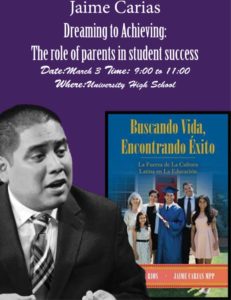 I am very excited to visit Waco ISD for student and parent programming. As a first-generation college student who was born and raised in South Central Los Angeles by Guatemalan parents, I understand the struggle and journey of the students and parents I will be serving this week in WISD. Collectively we will continue to work together to provide the opportunities parents seek for their children. Our children need to thrive and not just survive in the world of the 21st century. We need to remember that it all starts at home, as we move forward and develop student and parent programming. We are all equally invested in the future success of our youth; educators and parents need to collectively work together towards that common goal. I look forward to meeting everyone in the WISD.
Jaime Carias was born and raised in the low-income community of South Central Los Angeles to Guatemalan immigrant parents and has dedicated his entire career to helping young people and parents seek better opportunities in school and in life. Carias has been featured on several national and local media outlets for his work developing educational and community-engaging programs aimed at creating access to higher education and empowering underserved communities across the country like his.
by Steve Orr
When people ask me why I, a man, am a member of the League of Women Voters, I find it helps to recount my voting journey.
I’ve been voting for almost half a century. I find that realization sobering. To think that this country allowed a mere 18-year old to attempt to shape it. And I did do that —attempt to shape this country— and I did so every chance I got. I haven’t always succeeded, but I have always made my best effort to do so.
Sometimes I voted for winners. Sometimes, my vote went to the eventual loser in the race. And sometimes, when I voted for the winner, I was later unhappy with the conduct of that elected official. Regardless, I still voted. I still made my attempt at shaping my country. In those instances when the eventual outcome was disappointing, I vowed to do better the next time … knowing full well that I would vote the next time.
In addition to people, I also voted into existence school and road bonds, resolutions expanding or restricting how people could act, and, from time to time, non-binding resolutions that, for good or ill, never produced any activity at all. Yes, I have done all of that in my near half century.
But I didn’t do it alone.
And I didn’t do it without guidance. I have been referencing the League of Women Voters Election Guide for most of my voting life.
From the very beginning, it has been a companion on which I depended … for a clear description of the candidates, the issues, and the pending legislation. In the flurry of political advertising, flyers, mailbox stuffers, and phone calls, I welcomed the calm, objective descriptions I found within the pages of those guides. They were unique in that they contained just the information I needed to make an informed decision … and nothing more. No candidate was ever favored or pilloried. All I found was the facts … and in plain language.
And so, having a long appreciation of that particular aspect, when our local LWV chapter was reenergizing and reaching out for new members, I was intrigued to consider active membership. Yes, I was a bit surprised to be invited to do so. I had always assumed only women were members; and so, though admiring from afar, I had never thought I could be a member.
Today, I am a dues-paying member. I attend our chapter meetings. I am active on the Voter Education Task Force. I participated in our recent Candidate Forum as a Table Moderator. I have found LWV to be exactly the right place for me, politically. I can be active in the political arena with a group of people, gender considerations aside, who always leave the divisive side of politics outside the door.
To me, that sounds like an organization for everyone.
I’ve been voting for almost half a century. LWV has been advocating for voters for almost an entire century. That’s a perfect team-up for me.
Stephen Orr has been active in the Waco community since he and his wife, Pattie, moved here in 2007. Past community service has included building wheelchair ramps at area homes, assembling recycle bins for distribution at sporting events, and serving on the Waco Convention and Visitor Bureau Advisory Board. He is a graduate (with Class 5) of the LeadershipPlenty Institute-Waco. Currently, he is an active member of the Board of Directors of The Cove, serves on the Waco-McLennan County Library Advisory Commission, serves on the Membership Council of the Baylor Club, and is a member of the DaySpring Baptist Church. The Orrs love cheering on the Lady Bears basketball team and enjoying time with their daughter, son-in-law, and grandkids. And, of course, both are active in the Waco Chapter of the League of Women Voters.
For more information about the Waco Chapter of the League of Women Voters, link to their Facebook page (League of Women Voters of Waco), working group, or join the email list by sending an email to [email protected]. Connect with them on Twitter or Instagram.
By Glenn Robinson
Each year, thousands of Texas patients must rely on charity care to receive the medical services they need. Hospital charity care means no payment is expected for the services the hospital provides, which means that patients who qualify for such care typically receive no hospital bill and are not subject to collection efforts.
While Texas may lag far behind other states when it comes to number of residents who have health insurance coverage, it was the first state to establish a required level of community benefit for non-profit hospitals in exchange for state tax exemption.
This community benefit requirement means that Texas not-for-profit hospitals must spend four percent of expenses on charity care, and a total of five percent overall on charitable activities.
While exact criteria to receive hospital charity care may vary, generally patients who receive care at a non-profit hospital may apply for complete or discounted charity care if they are either financially indigent – meaning they are uninsured or underinsured with an income at or below 200 percent of the federal poverty level; or are medically indigent – meaning their medical or hospital bills exceed a certain percentage of their annual income after payment by insurers, leaving them unable to pay the remaining bill.
A hospital’s total uncompensated care is the sum of its charity care provided and uncollectable patient debt. Since 2000, U.S. hospitals have provided more than $538 billion in uncompensated care.
Funding for Medicaid and the Children’s Health Insurance Program recently have been the topic of a lot of hot political talk in Congress, so let’s take a closer look at these two government-administered health insurance programs.
Medicaid covers about one in five Americans. It reaches many low-income children, adults, seniors, and people with disabilities.
In Texas, children, the disabled, and seniors represent 90 percent of those covered by Medicaid. The remaining 10 percent are working-age adults – three-quarters of whom are employed, but do not earn enough to afford health insurance or do not work for an employer offering insurance.
Medicaid is the nation’s major source of long-term care financing, which is particularly important in supporting seniors and helping relieve the care burden that often falls on families. It also provides benefits for people with disabilities who are unable to find or afford other coverage.
The Children’s Health Insurance Program, or CHIP, is low-cost health coverage for children of families who earn too much money to qualify for Medicaid.
Medicaid, together with CHIP, has resulted in improved access to care for children and helped bring the uninsured rate for children to record lows. Children with Medicaid or CHIP have greater access to care than uninsured children and comparable access to children with employer-sponsored insurance.
But enrollment in Medicaid and CHIP have positive impacts on children and families beyond improving access to health care services. These programs may provide financial protection for families who have very little otherwise.
When we talk about a changing approach to healthcare in this country, many people’s minds immediately go to what is going on in Washington regarding healthcare policy – or perhaps some of the latest and greatest treatment technologies.
These are indeed important, impactful facets of the changing healthcare landscape, but perhaps even more impactful is the shifting mindset of many hospitals and healthcare organizations who are now focusing on overall community wellbeing.
Central to these efforts are innovative and effective community partnerships. Through community partnerships, hospitals and health systems seek out new and nontraditional partners to improve both health and overall quality of life in the communities they serve – regardless of the ethnic, racial, socioeconomic or physical circumstances that make up a community.
These non-traditional partners for hospitals may include police and fire departments, food banks and grocery stores, community recreation centers, churches, and local non-profits addressing issues such as housing and education.
The esteemed Robert Wood Johnson Foundation believes hospital-community partnerships are indispensable when it comes to building what it calls a “Culture of Health.” While often viewed as non-traditional, these partnerships make good sense because good health is dependent on far more than the medical care available to a community. A safe environment and dependable access to healthy foods are essential to the cause, as are a range of other factors.
These partnerships have the potential to reshape communities and change lives. And in the end, isn’t changing lives for the better what great healthcare is all about?
This report, and other episodes, are available at KWBU.org.
 Glenn Robinson is the President of Baylor Scott & White Medical Center – Hillcrest. He has over 30 years experience in hospital and health care management, and currently serves on several Boards associated with the Texas Hospital Association and the American Hospital Association. In addition, Glenn is Past-Chair and an active member of the Greater Waco Chamber of Commerce, and serves on the Prosper Waco Board.
The Act Locally Waco blog publishes posts with a connection to these aspirations for Waco. If you are interested in writing for the Act Locally Waco Blog, please email [email protected] for more information.
(In this post Rudy Solano shares thoughts and memories about the neighborhood where he grew up, known to those who lived there as “La Calle Dos.” If you would like to learn more about La Calle Dos, you may enjoy this link from the Waco History Project: Calle Dos. – ALW)
By Rudy Solano
Some years ago, one of the early astronauts was interviewed about his experiences in space. I am paraphrasing, but the interviewer asked him: “What did you feel when you went up in space and saw what no other person had ever seen—planet Earth from that perspective?” “What was going through your mind?” His answer, so simple but so meaningful, has stayed with me all these years. The astronaut thought about the question for a moment and then replied, “I couldn’t get over the feeling that our planet Earth looked so small. “ “That in the vast universe this tiny little speck was our home and we all lived here!” Implicit was the notion that we all must learn to get along with each other.
From time to time I have visited the small corner of the world that we affectionately called “La Calle Dos”—we moved away in 1950. Invariably, I am overcome by similar feelings. I ask myself: Did we really live here in this tiny little space? Could this be the same place where all those homes used to be? Where are all the people lived? Trying to orient myself, I look for something familiar. I should be standing where Don Marcial’s grocery store was, I tell myself. Instead, I am confronted by an immense building complex covering an area where several neighborhoods would have been. The large marquee by the road tells me this is now a middle school named Indian Springs.
In a way, “La Calle Dos” is a misnomer. Although the phrase literally means “Two Street,” or “Second Street,” in Spanish, the name came to represent an amorphous area that around the 1900’s became an enclave for primarily –but not exclusively–immigrants of Mexican descent. The red-light district of Mollie Adams notoriety gradually gave way to families of modest means who were seeking to provide for their families as best they could. In the case of my maternal grandfather, who was born in Aguascalientes, Jesus Maria, Mexico, all his children (with the exception of an infant daughter who stayed with her grandmother in Mexico) were born in the United States. During the years that we lived there, a preponderance of the residents were Mexican, Latin, Latino, Hispanos, Hispanics, Chicanos—take your pick—and several Negro, Black or African-American families. We were also blessed with at least one American Indian family and an Anglo-American, who– as far as I know– was single. Mr. Cooper, as we referred to him, was an entrepreneur—a one-man Lipsitz*, buying scrap metal, rags, bottles or any article of value.
La Calle Dos, was by financial measures, a place of modest circumstances. By a curious coincidence, as I write this I am reading a book titled Being Rapoport, Capitalist with a Conscience. Mr. Rapoport, a Waco icon who founded the Audrey and Bernard Rapoport Foundation, traces his roots to a very humble beginning. His father, an immigrant from Russia, was a street peddler on the streets of San Antonio, Texas. This man of great renown, who was known to have conversations with people in the White House, to be a personal friend of ambassadors and powerful people in politics and business, never lost that precious virtue so rare and so highly prized: humility.
Referring to the ethnic makeup of our old neighborhood, I have always believed that this experience, limited as it was– with African-Americans in particular– served me well in later years in the Community Relations Division of the Waco Police Department.
Reminiscing about the years I spent in La Calle Dos as a youth, I am aware that some might wonder why this ordinary-seeming place could be considered special at all. It is a fair question. Assuming agreement on two basic points, I would gladly attempt an answer by sharing my thoughts. The two presuppositions would be: One, that we are all the same, different and unique. Two, that Will Rogers had a valid point when he stated, “We are all ignorant; only about different topics.”
Few people outside of our family and a small circle of friends have ever heard of Martin C. Solano. I am aware of two separate monuments that bear his name. At Rosemound Cemetery a small granite tombstone quietly announces to the visitor:
Here rest the remains of
Juanita Colmenero Solano
Died Oct 17, 1930
at the age of forty
Rest in Peace
A remembrance from her son
Martin Solano
At St. Francis of the Brazos Church are fourteen large wall sized murals that mark the Catholic “Stations of the Cross.” The seventh mural, which was donated to the church by my grandfather, has a small plaque on the bottom that reads: “In memory of Martin Solano.”
By most l accounts Martin Solano was a caring person who loved life. At the height of the Great Depression he told his sister, my Aunt Jessie, “Don’t you worry none, I’m going to take care of you.”
He was a boxer. He was in the Civilian Conservation Corps with another Wacoan, Nieves Rodriguez. Joe Nieves Rodriguez, who later became a Waco police officer, graduated from the FBI Academy and retired with the rank of Assistant Chief of Police, related to me that Uncle Martin had helped him out of a tough spot while in the CCC. It seems that Captain Joe was boxing with another person and getting the worst end of it. Thanks to my Uncle Martin giving him some timely tips about his opponent, he said, he was able to come out on top.
Like countless others, Uncle Martin was called to serve his country after the consequential bombing of a faraway place called Pearl Harbor. The only time I remember seeing my uncle alive was when he knelt on the bare wooden floor at 538 North Second Street to receive his father’s blessing. My mother recalled that, on the eve of his departure, her brother was saying goodbye to his friends, playing the guitar and singing a popular song of the day, “El Soldado Razo,” a plaintive song about a young man going to war who is ready to die for his country, but laments leaving his mother behind.
Uncle Martin entered the service on July 4, 1942, and remained on active duty until he was mortally wounded by an enemy hand grenade in an Italian campaign. He succumbed to his injuries in a California veterans’ hospital. On April 30, 1945, PFC Martin Colmenero Solano of Co. F, 349th Infantry gave up the spirit. Another native son had been sacrificed as fodder for a cruel and senseless war that shook the global village to its foundation. By an ironic twist of fate, on that same date, 5,280 miles away, a man named Adolph Hitler inside a Berlin bunker died as well. This is part of what gives La Calle Dos relevance. At Oakwood Cemetery in Waco, Texas, a monument marks the gravesite of a Texas son who died too soon and came from a place called La Calle Dos. Our family and a few friends mourn his loss yet.
I see the river–El Rio Los Brazos de Dios—Spanish for “the arms of God.” It’s still there, I think to myself, somewhat amused at my unspoken reaction. Looking westward, I spy another familiar sight, the Spanish mission, San Francisco de Assisi. I don’t remember it being so close! St Francis is on Third and Jefferson Street. There is Jefferson Street. So, if I follow it till it meets up with the Brazos River…Yes! There it is! I cannot believe my eyes. La Pila! The artesian water fountain we called La Pila (Spanish for “basin”) is still there! It’s been covered over, but part of it is still visible. I don’t remember that pecan tree growing almost on top of it. Riverside Drive, now called University-Parks, is virtually at the outer rim of the fountain, encroaching into what was once a large lawn area. The lawn around the water fountain, always green and well-maintained, extended farther out to First Street. Through the years, I am almost sure, the Brazos River (now renamed Lake Brazos) has eroded the bank, forcing the road to be constructed closer to the fountain.
Standing at the Pila site, several Waco historical landmarks are within view. A few hundred yards away is the suspension bridge designed by the same person who designed the famed Brooklyn Bridge, the bridge that was a crossing for the Chisholm Trail cattle drives of the storied wild West. Literally a few feet away from the bridge is located a freshwater spring in the aptly named Indian Springs Park. This was a source of fresh water for the Huaco Indians (from which the name “Waco” derives). Finally, the viewer can see the building which was the tallest structure West of the Mississippi River when it was built. We called this building “la veintidos.” Why? Probably because the Alico building is twenty-two stories high and veintidos means 22 in Spanish.
 Rudy Solano is retired from the City of Waco. During his career at the City of Waco his role included Community Relations Specialist for the Police Department a position he treasured. He and his wife Adela are Waco natives where they raised their four children. He is a proud husband, father, and grandpa!
*The Lipsitz Scrap Metal Company is a well-known, highly successful Waco business known for its philanthropy and many civic endeavors.