By Christopher Qualls
I work at Indian Spring Middle School in Waco ISD. Though I share that with pride, I am not oblivious to the feelings it conjures up in others. Our school has been in the news for a myriad of less-than-positive reasons over time. Recent history is no exception.
There are several vicious cycles present in our communities’ schools, and I have not the time nor energy to discuss each of those in depth through this platform. However, the most nefarious problem I believe that our students face is the public perception.
While shopping at a local business this weekend, I learned that an employee there had retired from Midway ISD. Interested to find that unique bond shared between wartime trench-friends, I proudly shared my occupation.
“Oh. I bet that’s tough. Those kids have a rougher, street element”
Wait. What.
What does that mean?
Our students at Indian Spring are exceptional.
There is little difference in the students of Indian Spring, Tennyson, Caesar Chavez, G.W. Carver or even Midway Middle.
The problem is not the people; it is the perception of the people.
Our students at Indian Spring are victims of others’ perception. From the time they were in elementary school, the assumption has been that these students are somehow lesser than. There are those in the community that mistakenly underestimate the limitless potential of youth. They assume that these children will grow into underperforming middle school students, high school students, and eventually some sort of scourge on society.
This perception seeps through to the students, and it becomes a self-fulfilling prophecy.
By expecting less of the students at Indian Spring, we are setting them up for failure.
These are good children who have been given up on and underestimated.
If we are going to change the educational climate of Waco ISD, we must first start with the perception we have of the students. That means we must start with ourselves. We must realize that the perceptions we have of our students will either enable or limit their future. More than any skills, we teach young people how to believe in themselves—or not. We wield a dangerous power through our perception. We must use it wisely.
 Christopher Qualls is a Licensed Master Social Worker serving Waco Independent School District as the Afterschool and Summer Enrichment Programs Manager and actively consulting various non-profits on all aspects of programming. He has near 10 years of experience in agencies all over the world, but has spent the past three years living and serving in Waco.
The Act Locally Waco blog publishes posts with a connection to these aspirations for Waco. If you are interested in writing for the Act Locally Waco Blog, please email [email protected] for more information.
By Emily Carolin
For the 2017-2018 school year, Baylor launched an exciting set of transdisciplinary courses aimed toward the promotion of human flourishing and the development of innovative approaches to some of the world’s most complex challenges. Under the umbrella of the Social Innovation Collaborative (SIC), Baylor currently has teams of students and faculty collaborating on a wide range of important projects. One of these projects includes the pioneering Water, River, and Community course taught by a wide range of professors from Museum Studies, Economics, Environmental Science, English, Education, and Religion. I was fortunate enough to be one of three Museum Studies graduate students in this course, along with nine other undergraduate students from various disciplines. This unique mix of both professors and students allowed us to delve into a topic from our own backyard.
Water, River, and Community is a problem-based, community-embedded transdisciplinary learning experience that involves students in an exploration of the wicked problem of water. The problems associated with water are difficult to define, without clear solution, socially complex, void of one group who expresses sole responsibility for the problems, and involve many interdependencies. As stated by Ban Ki-moon, former United Nations Secretary General, “Water is the classic common property resource. No one really owns the problem. Therefore, no one really owns the solution.” As a class, we undertook the problem of water and in some cases, worked to find a solution, through lectures, field trips, and assignments.
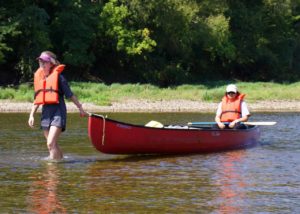 At the start of the semester, we took a canoe trip down the Brazos River in conjunction with reading John Graves Goodbye to a River. While we contentedly paddled down the river, we looked to discover our own natural connection with the river while understanding Graves’ personal love for the Brazos River. We saw turtles, various bird and fish, snakes, and encountered one too many spiderwebs strung across low-hanging branches. We caught and identified tiny fish native and non-native to the Brazos River, while discussing the impact of the Whitney Dam on the aquatic life. We explored the heart of the Brazos River Valley first-hand with wet clothes and slightly sunburnt skin.
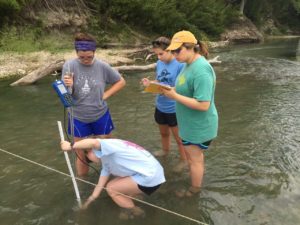
One of my personal favorite assignments and activities of the semester included the development of a survey using Contingent Valuation Method (CVM). This economics-based method allowed us to inquire as to our fellow students’ willingness to pay regarding cleaning up and beautifying Waco Creek on Baylor’s campus. Many students complain of the trash in the creek and recognize it as a major eyesore on Baylor’s campus. We developed questions that probed students as to their recycling habits, opinions on landscaping on Baylor campus, and if they choose to recreationally use the areas around Waco Creek. We proposed a one-time $25 increase to student fee and a subsequent $5 increase to install a bandalong trash collection device that would skim the top of the water for trash and adding planters and seating to other areas of Waco Creek. A high majority of students said they would be willing to increase their student fees to clean up Waco Creek for the betterment of the Waco community. In the future, we hope to expand upon this survey to propose a solution to keep Waco Creek clean. Waco Creek is not just important to the Baylor campus but to all Waco residents; and this is only one example of how our class continually connected the health of a community to the health of a river. We depend on a river just as much as the river depends on us.
 A final assignment brought local fourth-grade students from Bell’s Hills Elementary School to the Mayborn Museum to learn about their local waterways. My group developed an activity, Can You Undo Pollution? It simulated pollution in a river or creek. We took a metal tub of water and filled it with dirt and trash. Students upon walking up the activity were initially disgusted by the tubs, which was just the reaction we were hoping for! By seeing the damage that littering or polluting local waterways can cause, students can better understand how the actions they take affect the world around them. With strainers and tongs, we asked the students to attempt to remove the dirt and trash from the water. While the trash was removed, much of the dirt continued to swirl in the water showing students that pollution is often irreversible. Students then suggested ways that we could act to stop pollution from happening, including: stop littering, recycle, and throw trash away appropriately. We hope that came away from this activity with a better understanding of how their actions affect the health of a river, which in turn will affect their own health in the future.
While this is only a small glimpse of activities we undertook in the Water, River, and Community, Overall, the course taught me to be more cognizant of my actions and to better appreciate the natural world where we live, while also providing me with a strong background to discuss water policy, ethics, and law. I hope this blog has helped you learn some of the effects that a person can have on a river!
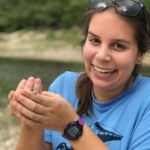 Emily Carolin is a Yankee living the grad school life in the South. She can often be found: devouring books and baked goods, wearing clogs, and wandering in museums. Emily is a graduate student at Baylor University and works at the Mayborn Museum Complex.
The Act Locally Waco blog publishes posts with a connection to these aspirations for Waco. If you are interested in writing for the Act Locally Waco Blog, please email [email protected] for more information.
By Christina Helmick
Like any year, 2017 had its highs and lows. As we enter the holiday season, we choose to focus on the positive developments in Waco and look forward with excitement to the new year. You only have to drive around downtown to be reminded of how much Waco has grown in the last year—new development, new restaurants and businesses, new energy in the heart of our city. The mission of the Prosper Waco initiative is to harness that energy and growth to create an environment in which all members of our Waco community can measurably improve their education, health and financial security.
2017
What are some initiative projects that happened in 2017? The Waco Employer Resource Network (WERN) began its initial work of connecting employees of partner businesses to the support of local social service agencies to make sure that they get the help they need to keep their job when they run into financial and other challenges. The McLennan County Community Health Worker initiative has trained a dozen community members to serve as community health workers throughout the city. The Waco ISD high school internship program doubled in size as more employers provided opportunities for students to work, learn, and earn this summer. The Landlord Liaison Project connects people looking for housing to a housing navigator, case management, and potential landlords.
McLennan Community College began offering its Work Readiness Certificate, built with local employers, to help job seekers be prepared to get and keep a job in Waco. MHMR, in partnership with numerous local school districts, is offering mental health services to more than 100 students on school campuses. The McLennan County Reintegration Program has supported dozens of individuals as they leave the county jail and work to become productive community members. And 325 McLennan County households saved a total of more than $110,000 on their electricity bills through the first ever Waco Power Switch program.
For information on these efforts, download the 2016-2017 Prosper Waco initiative report.
2018
What’s coming next? At the 2017 Prosper Waco Summit, initiative partners revealed exciting projects that will continue our community’s important work in 2018. Waco Foundation has spearheaded the creation of a community plan to reduce teen pregnancy in McLennan County. This plan will take coordinated efforts from schools, healthcare providers, churches, families, and others. Only two percent of teen mothers earn a college degree, and the children of teen mothers are more likely to be raised in poverty. Providing the community education and support to our youth to reduce the number of children having children will improve long-term education, health and financial security outcomes in our county.
Family Health Center began a variety of new programs in its effort to become a Community-Centered Health Home, including offering guided fitness activities at its new Wellness Center; partnering with Greater Waco Legal Services to give patients access to the legal support they need to address issues that harm their health; and urban gardening and fresh produce for patients and neighbors. The Start Up Waco initiative will connect community members with resources and support to create new businesses. Connecting with other entrepreneurs and with experts at Baylor, MCC, and our chambers of commerce will allow young and old Wacoans to become their own boss. And a downtown co-working space will be a place to make the magic happen. Click here to watch this month’s Prosper Waco television show on the City’s Cable Channel to learn more about these three efforts.
As 2017 comes to an end, it is important to take a step back and look at what our community has accomplished by working together to improve education, health and financial security outcomes in the Waco community.
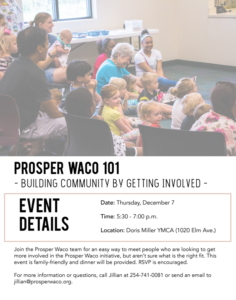 The work continues into 2018! If you want to get involved in the Prosper Waco initiative, there will be a Prosper Waco 101 session on Thursday, December 7 at the Doris Miller YMCA starting at 5:30 p.m. This fun and informative session will cover the history of the Prosper Waco initiative, some current projects, and ways to get involved. This is a child-friendly event and dinner will be provided. Please RSVP as space is limited!

If you are unable to attend the Prosper Waco 101 event, but still want to be involved, please email Jillian Jones ([email protected]) or call 254-741-0081.
From the entire Prosper Waco team, happy holidays and we look forward to the great work our community will do in 2018!
 Christina Helmick is the director of communication at Prosper Waco. She is a recent graduate of Baylor University with a BA in Journalism, Public Relations & New Media. Originally she is from Washington, D.C., but has stayed in Waco post-graduation. She is an active mentor at J.H. Hines Elementary School, enjoys spending time with her family and watching Baylor football. Sic ’em Bears!
The Act Locally Waco blog publishes posts with a connection to these aspirations for Waco. If you are interested in writing for the Act Locally Waco Blog, please email [email protected] for more information.
by Ashley Bean Thornton
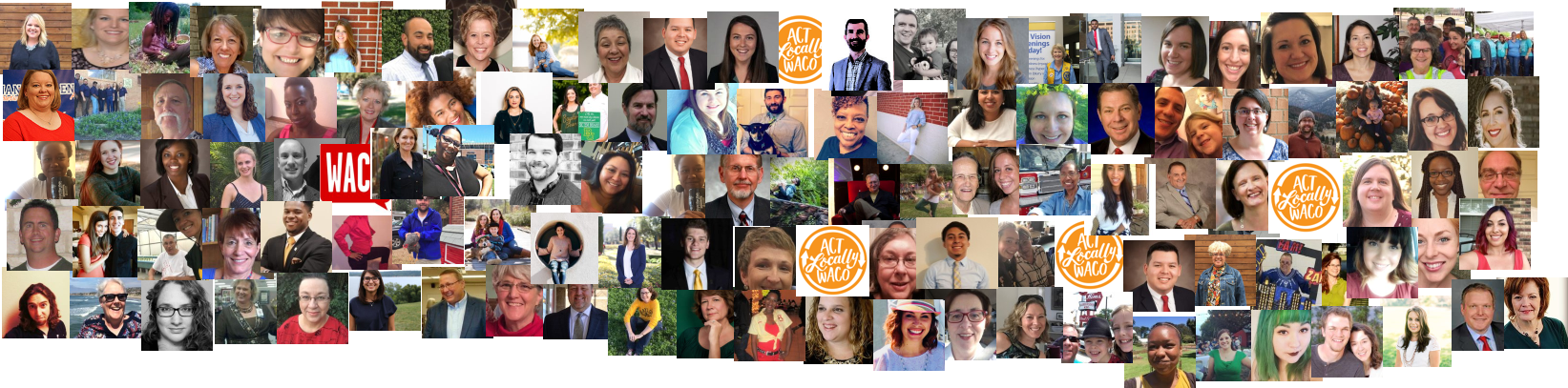
One of my favorite things to do in the world is edit the Act Locally Waco blog. This year the Act Locally Waco blog published 152 posts written by 111 different Wacoans. Topics ran the gamut from prejudice to planting a garden, from frisbee golf to financial planning, from gratitude to graduating from high school – with everything you can imagine in between. The connecting thread is that they all have something to do with these aspirations for Waco that are the driving force behind Act Locally Waco.
December is a wonderful, but hectic, month for most of us so I thought it might be nice to give my beautiful bloggers a month to focus on family, friends and the joys of the holidays rather than on meeting our blog deadlines. So, for the month of December we will have one or two new posts, but mainly we will be reprising “2017’s greatest hits.”
I couldn’t possibly pick my favorites – so I used the simple (cop out?) approach of pulling up the 10 blog posts that got the most “opens” according to our Google Analytics. It is an intriguing collection that gives at least a little insight into the interests and concerns of Act Locally Waco readers. Interestingly, there were a handful of posts from previous years that were still getting as many opens as the newer posts, so included some of those in the list along with the top 10 from this year.
I hope these lists inspire you to go back and re-read your personal favorites. There have been so many terrific ones… but of course they couldn’t all be in the list of the 10 most opened. I would love for you to reply in the comments or on the Facebook page with a note about some of your favorites.
We will be reposting these in the next few weeks between now and the new year — but I know some of you are “list” people who would like to see them all at once. So, I offer the list below, with thanks to everyone who has written for the blog this year, with pride in what we have created together, and with no small amount of wonder at the beautiful complexity that makes up our beloved community! Enjoy!
Think of it as a Christmas present from your community to you, and invitation for you to write in 2018! – ABT
The 10 blog posts written in 2017 that got the most opens this year:
- A letter to my DACAmented friends in Waco by Eloisa Haynes (1,022 opens)
- What does teen dating violence look like? by Berkeley Anderson (807)
- Prejudice then and now…by Ashley Bean Thornton (766)
- Fighting a Monster of our Own Creation by Andre’ Watkins (743)
- God, Gender and Shortcuts by Leslie King (641)
- Four Things I Wish I Had Known in High School by Kassidy Munden (640)
- What the research tells us about how to help your kids do well at school by Jon M. Engelhardt (475)
- Communities of Waco: King’s Landing by Rebecca Melton Mercer (446)
- Changing The Community, One Mentor At A Time by Stephanie Korteweg (432)
- Stop the Bleeding by Mike Stone (385)
A few posts from previous years that got quite a few opens in 2017…
- Where are Waco’s public pools? by Rachel Lynne Wilkerson, 2016 (745)
- Why should we care about housing and homelessness? by Phil York, 2013 (699)
- My Story of Homelessness, Hope, and a Mustard Seed by Destiny Fernandez, 2016 (555)
- What about people who “Just don’t want to work…” by Ashley Bean Thornton, 2015 (523)
- Entrepreneurs of Waco: Black Oak Art by Shannon Lesko, 2016 (495)
 This Act Locally Waco blog post is by Ashley Bean Thornton, she has lived in Waco almost 20 years now. Far longer than she ever lived anywhere else. She likes to walk. If you see her out walking, honk and wave and say “hi!”
The Act Locally Waco blog publishes posts with a connection to these aspirations for Waco. If you are interested in writing for the Act Locally Waco Blog, please email [email protected] for more information.
By Kimberly Trippodo
Thanksgiving 2017 is in the books… even though the “official” day is past, this is still the season of giving and thankfulness.
As a social worker, I consider Thanksgiving a mental wellness holiday, in which mindfulness, gratitude, and positive cognition are prioritized. I work in Special Education; and I am a parent to thoughtful, explorative, kind young man with Autism. Two years ago, around Thanksgiving, I set out on a quest to do a better job of teaching the concept of gratitude to the children with whom I work. My own child was overstimulated by gift giving, which made gratitude during the exchange of gifts even trickier to teach. In turning to the research, obviously and without question, teaching children gratitude is something which requires the adults to demonstrate consistency, lifestyle change, and even a heart shift.
Gratitude Must Be Modeled
A clear theme in the literature emerged and moved me. The key facet to teaching gratitude turned up time and time again as modeling gratitude (Hammer, 2012 & Kupferschmid, 2015). It’s simple but convicting. Maybe my gratitude is not where it should be, which sets a tone for the children around me. I made an effort to count my blessings…yes, out loud. My husband and I thanked each other for the smallest things, to the point of possible ridiculousness. Something happened to my heart: a joy, a lightness, and humor (which I sometimes forget to have) emerged.
Gratitude is an active skill. To be able to look at challenges and say, “Yet I find a reason to have joy and to be thankful,” takes practice, as well as the ability to tolerate distress and develop solutions to overcome. Think about any maneuver learned in an athletic setting. The easiest way to learn a skill is to watch it done by someone more skilled than you and practice it until it becomes a habit.
Gratitude can be even more easily taught when rituals are made of the modeling. Rituals allow extra practice and folding into routine for our children with intellectual or developmental delays. Community service, volunteering, and charitable giving are great rituals to teach gratitude for what one has and the joy of helping others in need. Sharing what one has can diminish materialism (Hammer, 2012).
Many families in my life have dinner table activities such as “Name a high and a low,” which create ritualized discussion of gratitude nightly. The wonderful thing about this approach is it allows for authentic connection and communication to happen in general. Families who engage in this practice are not saying, “we only accept you if you sugarcoat your life.” Families instead allow children to come as their real selves–happy, sad, the range of emotion, and let it be known that their family can handle that conversation. Still, we teach children that even in the challenging times, we can find a reason to be grateful.
Gratitude Happens in Safe Environments
According to research, the other piece to teaching gratitude to children is to give them secure relationships in which to be vulnerable, in which to fail, in which to figure out who they are. All those pieces of knowing themselves, figuring out adaptability, and having healthy relationships with others reduce anxiety and create comfort and safety, so a child can have the space necessary to reflect on gratitude. The more present-minded, mindful, and unhurried we allow our children to be, the more room there is for gratitude to become a part of their thoughts and lives.
Any of us can think about times in life we felt ostracized or rejected. The precariousness of unstable relationships can make failure much scarier. Now, add the helplessness of child’s inability to care for themselves and the need for survival. Abuse, neglect, or trauma make gratitude much more difficult, for very understandable reasons.
The hopeful thing we know from the literature (Ludy Dobson and Perry, 2010 and DuFrense, 2012) is it just takes one stable adult, showing empathy to a child, to build their sense of safety and coping skills in the world. I work in schools, and while many children have secure relationships and loving families, not all of them do. We can all choose to be an adult who shows up in a consistent and warm manner, not allowing a child’s behavior to change the warmth with which we approach them, any of us can be that one secure relationship.
We have a huge responsibility to our kids. Inspiring gratitude takes more than saying, “be thankful,” to our children. It takes adults devoted to living in a state of gratitude. It is our job to model gratitude and foster safe relationships for the children in our lives. With practice, children can understand and even make a habit of this skill.
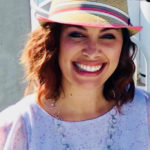 Kimberly Trippodo is a Social Worker for Waco ISD. In her spare time, she enjoys writing, anything from fiction, to poetry, to policy analyses, to blog posts. Her other modes of creative expression are culinary concoctions, her violin, and community events. She incorporates art as an expressive outlet in her work with students. She loves all the social and cultural growth happening in Waco, and most weekends, she is out and about in Waco, enjoying the city with her husband and son. You may reach her at [email protected].
The Act Locally Waco blog publishes posts with a connection to these asirations for Waco. If you are interested in writing for the Act Locally Waco Blog, please email [email protected]pirations for Waco. If you are interested in writing for the Act Locally Waco Blog, please email [email protected] for more information.
References:
Baumgartner, Audra. 2013. “Teaching Kids Gratitude and Empathy Year-Long.” Pediatric Safety. https://www.pediatricsafety.net/2013/11/teaching-gratitude-empathy/
DuFrense, Susan. 2016. “Safe Adults & Creating Compassionate Schools Parts 1-4” Living in Dialogue. http://www.livingindialogue.com/
Hammer, Connie. 2012. “Growing Gratitude in Children With or Without Autism.” Parent Coaching for Autism. http://parentcoachingforautism.com/growing-gratitude-in-children-with-or-without-autism/
Kupferschmid, Sarah. 2015. “Gratitude, Autism, and ABA.” Behavioral Science in the 21st Century. http://www.bsci21.org/gratitude-autism-and-aba/
Ludy-Dobson, Christine and Perry, Bruce. 2010. “The Role of Healthy Relational Interactions in Buffering the Impact of Childhood Trauma.” Working with Children to Heal Interpersonal Trauma: The Power of Play. https://childtrauma.org/wp-content/uploads/2014/12/The_Role_of_Healthy_Relational_Interactions_Perry.pdf
(Tami Nutall Jefferson, a married mother and grandmother, is going back to school and she has invited us all along to enjoy the ride. For more posts in this series, click here: Tami’s Big Do Over. – ABT )
by Tami Nutall Jefferson
Lessons Learned
The Fall 2017 semester is wrapping up, and the lessons have been many.
For instance, my landscape architecture course was confirmation of how much I dislike history. Yet, I learned that much of today’s architecture, city and town planning, societal philosophies, gentrification, classism, religion and so much more actually originated thousands to hundreds of years ago in the Europe and Asia. I realized the Bible is true, when it says that “…there is [absolutely] nothing new under the sun.” The point is, whether in college or not, learning expands your view and objectivity of the world and helps put all of its issues into perspective – a perspective which is often skewed by inaccurate media, gossip, myths, legends, and lack of a knowledge of history and other cultures.
As for myself, I learned that, while the university application process can be intense, that same level of intensity is not built within every student. I assumed that every student, would have the same fervor, over-achieving spirit, and GPA that I have. I realized during the course of my first group project, that is so not the case. Everyone cannot perform academically well, nor do they want to when they have other classes and social activities to prioritize. I learned, through the help of my Leadership Plenty cohorts, that I really have to meet people where they are and not weigh them (or myself) down with my super high expectations.
I also learned that people need stuff to do – all day, everyday. I only took two classes because I wanted to ease into this TAMU academic life and not overload myself. What actually happened was that I underwhelmed myself. I had way to too much time on my hands; time that I filled with volunteering, business, and Monk (the TV show). My courses, I ended up procrastinating on because I knew I could do it in the final 2 hours before deadline. So, next semester is jam-packed with courses and work. The extra pressure actually leads to greater productivity.
Greatest lesson of all – for someone who’s car drives only a maximum of 15 minutes from home, in any direction – is that I (and my car) can actually make the 82-mile drive to Bryan-College Station with a smile. I practiced several times this year. I’m in training for the 2018-19 school year, when I’ll have to make that drive weekly.
A Journey Between Sisters
My next – and last – “old lady student” interview this semester, is my very own sister. The back story is that I’ve always been thought of as the career student in the family, while we were just glad that she finished high school. She never voiced her dreams or goals; she just existed in her own happy world. She’s definitely the Type C to my Type A personality. Early in her 20’s, she got a necessity-job as a nursing home nurse’s aid. We were proud of her for just doing something. But out of all of us, she’s been the most stable one over the last 2 decades with her job and family. But this summer, she shocked me, when she enrolled for her first semester at college. You would think I already know the answers to these questions, but I’m learning them just as you are. So, it is my pleasure to hear her journey. Let the interview begin.
Something About Erica
TNJ > Hello Sister. You haven’t been to school since high school in 2001. What made you think of going back to school at 34 years old and what made you actually decide to do it?
EW > I have been thinking about going to school for the last 3-4 years, but I’ve always found a reason not to go – made up a gazillion excuses. But what made me actually decide to go was just looking at my kids and realizing I want more for them and I’m tired of living paycheck to paycheck. I have a job, but jobs usually do not get you very far. I needed a career.
TNJ > What are you studying and how will it change your and your family’s life.?
EW > I’m studying Nursing. My end goal is to be a Director of Nursing, still in the long-term care industry. Nursing will change my life by allowing me to be more able to adequately provide for my family.
TNJ > What does it feel like being a first-time college student at 34?
EW > Going back to school after being out for some years is a bit challenging. Trying to balance all the schedules that I have in life such as work, school, and kids plus trying to study and do homework is a bit harder for me then it would be for some of my classmates who do not have half of those responsibilities. I’m trying my best to embrace being a first-time student though.
TNJ > What have you learned so far after your very first semester?
EW > What I’ve learned so far this school year is that I need to manage my time more wisely. Procrastination is not my friend. I need to go ahead and start on assignments, if possible, as soon as I get them so I won’t be cramming hard the night before.
TNJ > What advice would you give to another person thinking they’re too old to go to college or they’re not the “academic type”?
EW > My advice to anyone is go ahead and go to school. Age doesn’t matter. These years are going to pass anyways so you might as well be in school trying to improve your economic situation. You cannot focus on what could happen 2 years from now or how you will pay for college. You just have to do it. It will all work itself out.
Thank you Erica. Good luck on your journey. And happy holidays Waco.
 Erica Williams is a student at Lone Star Community College in Houston, and is earning her Associate of Science degree for Nursing. Erica currently manages the medical records department at a long-term nursing facility, in addition to a household of 3 beautiful children and 1 husband.
 Tami Nutall Jefferson is an older, non-traditional student with a professional real estate background. Tami begins her first academic year at Texas A&M University pursuing a Bachelor’s Degree in Urban Planning and Real Estate Development while commuting between Waco and College Station. Her hope is that Waco becomes the most attractive, modern, vibrant, and prosperous version of itself as an inclusive city and her mission is to help make that happen as a real estate developer and entrepreneur. Tami volunteers her time and voice to several downtown Waco placemaking and economic development causes and organizations. To engage and share your non-traditional student experiences with Tami, contact her at [email protected] or connect with her on Facebook https://www.facebook.com/tami.nutall.94
By Glenn Robinson
Health care is among the most heavily regulated industries in America – virtually every aspect of the health care system is subject to government oversight.
There are regulatory mechanisms to supervise the doctors and professionals who render care; the institutions in which care is provided, such as hospitals and clinics; the medications and medical devices that are the tools of care; and the insurance coverage that finances it all. These regulations are developed and implemented by all levels of government — federal, state and local — as well as private organizations.
Everyone in health care agrees that regulations and standards are necessary to ensure compliance and to provide safe health care to every patient. Policy debates, for the most part, typically focus not on whether oversight should exist, but rather on how it should be structured. Impartial, external oversight is considered necessary to protect the public interest – even by those who are especially suspicious of government bureaucracy.
American health care has flourished over the past 100 years. Rather than hindering its progress, the complex system of government regulation actually may have served to support and nurture it.
Consider, for example, the public confidence engendered in the competence of physicians through licensure requirements and in the safety and effectiveness of prescription drugs through the Food and Drug Administration’s approval process.
Another form of regulation is known as HIPAA. At some point while filling out a bevy of forms at the doctor’s office, you may have run across this term.
The Health Insurance Portability and Accountability Act, or HIPAA, was passed by Congress in 1996 and was intended to improve health care efficiency by standardizing electronic data exchange and protect the privacy of patient records.
Since 2010, as part of national health care reform, there has been increased urgency in transitioning to digital versions of patients’ paper charts called electronic health records, or EHRs.
EHRs can contain a patient’s medical history, diagnoses, medications, treatment plans, immunization dates, test results and more. But they’re not just a replacement for paper charts.
Part of what makes EHRs so powerful is that they also allow doctors and other care providers to access evidence-based tools that can be used to make decisions about a patient’s care in real time.
Another key advantage of EHRs is convenience. Health information can be created and securely managed digitally by authorized providers and shared with other providers at other locations.
This helps cut down on the number of forms patients must fill out and can eliminate the need for duplicate testing, as well as promote legible, complete medical documentation for streamlined coding and billing.
With all this information available to be shared with the touch of a button, precautions must be taken to ensure the privacy of the patient. As EHRs continue to evolve, so must our regulation of them.
The HIPAA law’s privacy standards strive to give patients rights over their health information, and set boundaries on who can receive a patient’s personal health information. Those who must follow the law include healthcare providers such as hospitals, doctors and nurses, pharmacies, insurance companies, and government programs such as Medicare and Medicaid.
The law limits the use of patient information by health care providers to specific purposes. Patient information can only be shared if it is necessary to coordinate treatment, pay providers for patient care, protect public health, assist police in criminal investigations, or assist family, relatives or friends responsible for care or paying medical bills – unless the patient objects.
HIPAA also requires healthcare providers to inform patients how they may use and share their health information, and grants certain rights to patients regarding their health information, such as receiving copies of their health records upon request and being informed if their health information is being used or shared.
If you are ever concerned that your personal health information is being improperly used or shared, you have the right to file a complaint either with the federal government or your healthcare provider.
So while regulation may be seen merely as red tape in some industries; in health care, it provides a critical public protection.
This report, and other episodes, are available at KWBU.org.
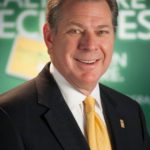 Glenn Robinson is the President of Baylor Scott & White Medical Center – Hillcrest. He has over 30 years of experience in hospital and health care management, and currently serves on several Boards associated with the Texas Hospital Association and the American Hospital Association. In addition, Glenn is Past-Chair and an active member of the Greater Waco Chamber of Commerce, and serves on the Prosper Waco Board.
By Hannah Rigg
A neighborhood school. Each morning children are dropped off at the front entrance of Brook Avenue Elementary School and personally greeted by Brook Avenue staff as they make their way to their classrooms. Each afternoon, those same families are congregated outside of the school waiting to walk home with their children. This is what a neighborhood school looks like.
Brook Avenue is in the second year under the leadership of Principal Sarah Pedrotti and Assistant Principal Jessica Torres. They are faced with the challenge of leading Brook Avenue out of the Improvement Required status as set by Texas Education Agency (TEA). You may have read recently that Brook Avenue is one of the five Waco ISD campuses that is at risk of closure at the end of the 2017-2018 school year. Although the threat of closure is one reality, excellence is the reality that Brook Avenue is living into. To ensure excellence, it will take the full dedication of this Waco community.
In the three full months that I have been working at Brook Avenue, I have experienced a transformed campus. Students are provided with opportunities to improve their reading skills through CIS groups, Kids Hope USA mentors, and literacy groups with staff. Students receive a book on their birthday.
When students miss class, they miss instruction time with their teacher and classroom engagement. We need our students in the classroom actively engaging in the work they are completing to ensure increased test scores. At Brook Avenue, attendance is rewarded at each six-week period in order to encourage students to come to school consistently.
Communication between the school and community has increased, and so has the level of involvement.
Brook Avenue is redefining itself as a neighborhood school where families and community members are invited onto campus. The first Tuesday of each month you will find a group of parents gathered in the lunchroom for Coffee and Conversations. The November meeting was filled with determination as parents refuse to allow Brook Avenue to fall below standards for another consecutive year. Every parent in attendance signed up to volunteer to read with students or to support teachers by completing preparation activities.
As Brook Avenue continues to work towards success, they are creatively supported by their new staff provided by the Texas Title I Priority Schools (TTIPS) Grant, Columbus Avenue Baptist Church (Kids Hope USA Mentors), Communities in Schools (CIS), Klaras Center for Families, and the BEAR (Be Emotionally Aware and Responsive) Project. Each agency has responded zealously to the call for improvement this school year.
The TTIPS grant has allowed Brook Avenue to become a campus of innovation. Initiated by parents and funded by the TTIPS Grant, an outdoor classroom will be created in the back of the school allowing teachers to uniquely engage their students during lessons. And, a Maker’s Space allows students to utilize creativity as they bring their learning to life. The TTIPS grant made it possible to purchase one iPad for each student to promote technological learning. It also heled support non-traditional seating options for classrooms so that the classroom can be arranged to better suit the learning styles of the children. The grant has also enabled additional learning trips for all students. These trips give students an opportunity to make connections between their classroom learning and hands on real-world experience. As a campus, we are honored that the state has recognized Brook Avenue as a priority for receiving this funding and it is essential that our community recognize Brook Avenue as a priority as well.
Look for the hashtag #BrAveLearns on Twitter, Instagram, and Facebook throughout the year as we watch Brook Avenue achieve success. Our students are learning, our teachers are engaging, and our community is behind us. The next time you see Brook Avenue Elementary School in the news, look for their accomplishments.
 Hannah Rigg is a student in the Diana R. Garland School of Social Work and serves as a social work intern on campus at Brook Avenue and West Avenue Elementary Schools through the BEAR Project. She has been living in Waco for two years and loves exploring this city.
By Major Anita Caldwell
In 1890, William Booth, the founder of The Salvation Army, wrote Darkest England and the Way Out. He envisioned a world where the poor and needy were provided a way out of their poverty. He was convinced that a cab horse was treated with a better standard of living than the poor of London. He opened a work bureau to help people find work. Next, he purchased a farm where men could be trained in various forms of work so they could get employment and gain self-respect. A match factory was operated by The Salvation Army to provide work as well. He laid a foundation for impact assistance.
Serving McLennan County since 1891, The Salvation Army is dedicated to serving the community and being good stewards of donor dollars. Widely recognized for our homeless shelters and community soup kitchen, our services extend far beyond essential needs. While meeting emergency needs is critical, our goal is to identify the underlying causes of crisis and tailor our services to break the cycle of poverty for this and future generations as we guide individuals toward long-term financial stability and independence.
We join Prosper Waco and United Way of Waco – McLennan County in addressing education, financial security, and health along with our providing essential services to those who walk through our doors.
We educate others daily in the following areas:
- Youth – Character building classes, music education, and church youth group activities provide opportunities to continually educate youth with life-long skills to empower them into adulthood and break the cycle of poverty and crisis.
- Homeless – One-on-one case management, life skills classes and employment referrals are provided to homeless families and single individuals to identify and address any educational gaps preventing their success.
- Veterans – Life skills and budgeting classes are offered through one-on-one case management.
- Seniors/Disabled – Our William and Catherine Booth Apartment Complexes provide an affordable housing option for low-income seniors and disabled adults. The Salvation Army also affords education in life skills, health and nutrition, and assistance with home health care benefits to the residents. We connect residents to vocational training, money management, budgeting, lease education and other programs to prevent issues of poverty.
- Inmate Reintegration – Life-skills and job skills are key aspects of our Fresh Start program provided to newly released inmates to guide them toward successful re-integration into the community.
- Red Kettle Employment Program – This program generates on-the-job training for shelter residents.
- Anti-Trafficking Prevention Education – The Salvation Army Officer is an UnBound Professional Trainer and leads prevention training with parents specifically at local churches and community groups.
We work towards financial security in the following ways:
- Homeless Families – Budgeting skills and financial planning are shared with homeless families, singles, elderly, and youth.
- Veterans – Rental assistance and utility assistance are provided to prevent homelessness.
- Christmas Assistance – Budgeting review is provided to Toys for Tots applicants.
- Empowerment Angel Tree Program – A budgeting seminar and follow-up consultation are given to each participant.
- Homelessness Prevention – Helps stabilize families via budget review and financial support.
- Rapid Rehousing – We engage ongoing support/budget counseling until a family is stabilized.
- Red Kettle Employment Program – Assists shelter residents with finances for next steps.
- Seniors/Disabled Booth Apartments – Residents receive benefits/entitlement assistance, case management, crisis intervention, and assistance with tax preparation.
- Fresh Start – Inmate reintegration services include budget education, job search and savings program.
We support those who come to us with their health needs by:
- Women – Health education to homeless women, seniors, other program participants.
- Youth – A range of programs are taught, such as first aid.
- Veterans – Meals and shelter are free for veterans while they gain support through the VA hospital.
- Adult Rehabilitation – For those ready to overcome drug/alcohol addiction, transportation is provided to one of five Salvation Army free addiction treatment centers in Texas.
- Community Hunger – The Community Kitchen provides hot, nutritious meals daily to those facing hunger.
- Warming/Cooling Centers – The Salvation Army Community Kitchen and Family Store serve as community warming or cooling centers during extreme weather, providing respite and replenishment.
- Senior/Disabled – Booth Apartment Complex programs assure adequate nutrition, mental health services, isolation assistance and substance abuse referral as needed.
- Homeless – Referrals to mental and physical health assistance as needed.
- Fresh Start – Inmates receive nutritious meals, counseling, drug/alcohol training and medical assistance.
- Spiritual – The Salvation Army church meets for worship each Sunday at 11 am. All are welcome.
Finally, we support this community with those emergency essential needs:
- Food Pantry – Emergency food to families in need.
- Clothing and Household Vouchers – The Salvation Army voucher program allows those living in poverty and those newly re-housed, including families and veterans, to receive critical supplies free of charge through our Family Store. Furnishings are provided to any victims of fire who have a Red Cross referral.
- Transportation vouchers – Bus tickets.
- Meals – Served daily at The Salvation Army Community Kitchen and during disaster response from the mobile kitchen.
- Emergency Shelters – Short-term crisis housing for men, women and families with children.
- Emergency Disaster Services – Including on-scene disaster assistance, post-event care and crisis intervention through case management.
While some people might think we simply provide “three hots and a cot”, we engage in upending the root causes of need while providing emergency services to those who come through our doors. Please call our office to volunteer in any of these areas as we seek to truly make a deep and lasting difference in McLennan County.
 Major Anita Caldwell was born in Olean, NY, to a family of ministers. She attended and graduated from Kentucky Mountain Bible Institute with a BA in Religion. Her MA is in Pastoral Leadership from Olivet Nazarene University. She and her husband, Bradley Caldwell are Majors in The Salvation Army and are Regional Coordinators for this area. They have served as ministers of the gospel in The Salvation Army for 24 years. After serving in three USA appointments, they were transferred as Regional Leaders in Moldova, Romania, Russia and the country of Georgia over a twelve-year period. They received their Waco assignment after serving at International Headquarters in London, UK.
The Act Locally Waco blog publishes posts with a connection to these aspirations for Waco. If you are interested in writing for the Act Locally Waco Blog, please email [email protected] for more information.
(The Heart of Texas P-20 Council includes representatives from K-12 education, higher education and employers. They meet regularly to help coordinate efforts to launch our young people into productive lives as workers and citizens. This post is one in a monthly series of posts intended to share information about the work of this important group in our community. For more posts in this series, click here: P-20 education. – ALW)
By Christine Holecek
All across Texas, students are finding their voices, setting goals, and taking steps towards securing their own successful futures. Through these efforts, they become an integral part of a growing movement known as Generation TX. These students are what’s next for our state. They have the power to become the most successful generation ever.
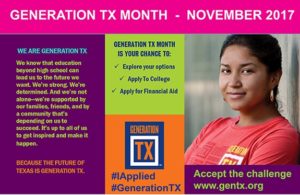 What is Generation TX Month? Generation TX Month combines college admissions and financial aid application efforts into one. Generation TX Month events are designed to take place when schools and community organizations typically host college fairs, financial aid drives, and other college and career-related events. The Generation TX Month provides the perfect opportunity to build on these initiatives around college and career readiness, pull them together to make a broader impact, and expand their reach.
Generation TX Month focuses on getting students, especially those in middle school and high school, thinking about their future with a range of actions and next steps that they can take toward college and career readiness, including:
Prepare (Middle & High School Students)
- Career Exploration
- Finding a Mentor
- Creating a Brag Sheet
- College Visits
- PSAT, SAT, ACT
Apply (High School Seniors)
- College Applications
- Financial Aid Applications
- College Scholarships
Download your planning guide today
The Heart of Texas P-20 Council believes that achieving college and career readiness allows students to reach their fullest potential. By accepting the GenTX challenge the council is acknowledging the focus on the future of our workforce and encouraging them to focus on their goals for college and career. GenTX also provides a college planning and financial aid guide to help parents and students make decisions about the future.
Download College Planning & Financial Aid Guide
Student Tools
- ApplyTexas – If you are applying to a public two-year or four-year institution in Texas, you will need to complete the ApplyTexas application. This application is available at www.ApplyTexas.org. Once completed, you can use this one application to apply to many schools across Texas.
- Applying for Financial Aid – The FAFSA is the primary form you will need to apply for most financial aid
- College Major – What College Major is best for you? Find out at MyMajors After taking this assessment, you will be recommended the top majors, colleges and careers based on your academic achievements, interests and personality.
Generation Texas Month supports the regional efforts and goals of the 60x30TX Texas Challenge to Reach Higher, an initiative to increase college applications, FAFSA completions, and college readiness across Texas.
 This Act Locally Waco blog post was written by Christine Holecek. Christine is an Education Specialist at Education Service Center Region 12 in Waco. She has worked in the area of Adult Education and Career & Technical Education for the past 25 years. She earned an AAS degree from MCC, a BAAS and Master’s Degree from the University of North Texas and is currently enrolled in the Doctoral Program in Educational Leadership and Policy Studies at Tarleton State University.
The Act Locally Waco blog publishes posts with a connection to these aspirations for Waco. If you are interested in writing for the Act Locally Waco Blog, please email [email protected] for more information.